Spared

To be spared is to be pared, part of you left but part removed. To be spared means to pare, to reduce what happened to its essence and to find your own essence despite what happened. Injured but not killed. Damaged but not broken. Burned but not torched. You are what is left over, what you can afford to be, what you still have to give others. In Old English, spare means not enough. Were you not enough to be worth destroying or not enough after being destroyed? In Latin, pare means prepare. Do you feel prepared now that you’ve been skinned?

The Architecture of Mental Illness

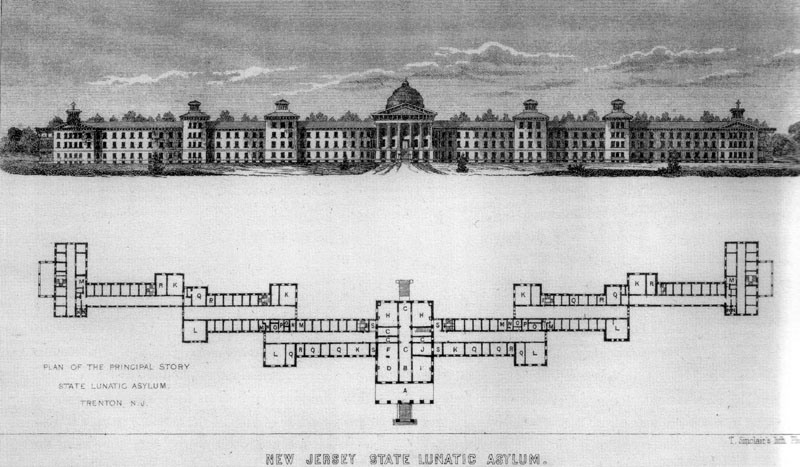
Mental illness has an architecture. That’s part of the story of asylums and treatment in this country. Central State Griffin Memorial, the hospital in my hometown, wasn’t laid out like this, but it had that same grand feel juxtaposed against the lives of those who inhabited the buildings.

Throughout its history, which spans more than a century, Central State’s story has been one of hope, ignorance, dehumanization, and harm: the same story from the asylum era to era of deinstitutionalization to today. I can barely tell any of it but have to before that history is lost. My mother worked there as a nurse and was treated there as a patient. Her relationship with Central State spanned more than three decades. That architecture was in her body, her bones part of the structure of those buildings and that land. Now, we need to make sure these places don’t come back with a new story: one of coercion, exploitation, profit, and greed.

Source: PBS Utah video about The Kirkbride Asylum, which was the template for many other asylums across the country.

Bloatano

I lost my phone for a while today and had the exact same feeling of being untethered that I experienced when my mother died. Unfortunately, this played out in front of my therapist, so he no longer has some image of me as a moderately reasonable or quasi pulled-together person.

I wrote a poem. It’s not about my phone, but I do have a poem about my phone because I love it. I mean her. I mean Aluminium. That’s her name. She and I have bonded over the fact that we both contain lithium. She has a little case with a cover on it that’s kind of like the leather pocketbooks my mother’s cigarette company used to give its customers for free. I love her. I also love my mother, who died on December 20, 2004. Oh, that’s what’s happening. That anniversary’s coming up in two days, hence all the big emotions directed at Aluminium.

This Calibri T-shirt is getting tighter as the night wears on. It feels like a corset and not in a good way. Bloatano has entered the building. I mean my body. I mean I’m bloated, but Bloatano sounds better, like the monster that GI distress is. The internet says I’m the first person ever to use the word Bloatano, so that’s kind of a big deal, which means I’m kind of a big deal. Bloatano also affects my ego from time to time, clearly.

I blocked three people today. It was super. My image of the medieval badge gave me the courage I needed in the precise moment I needed it. I can’t wait to hold all those little phalluses in my hand when the actual badge arrives. If phalluses really ward off evil, I’ll have ample protection.

Mistuning

We seem to have lost the ability to comprehend, to reason, to infer, to extrapolate, to synthesize, and to contextualize just about anything other than maybe song lyrics, and even then it’s iffy.

By comprehending, I don’t just mean understanding. I mean interpreting things like tone, which is essential for grasping meaning(s). We’ve lost that, too.

We’re taking personally that which is not personal and not taking personally that which personally affects us. Instead, we deflect, defend, deny, derail, dismiss, disparage, detonate. I’m tired of that pattern. We’re giving birth to mistuned responses in the driverless car that passes for communication.

We’re reading and listening too fast or not at all, at once too little and too much, leaning into things like AI to do our work for us, even when we aren’t using it actively and may not be aware of how it’s shaping our communications and changing our brains (and in turn our minds).

We’re tired and angry and sloppy in our reading, writing, and responses. I don’t mean some we that’s far away or out there or that doesn’t include poets. I mean all of us. The past 24 hours on Facebook have been unbearable for me. I’ve tried to talk about two issues that are significant. It’s clear from many of the responses I received that Facebook isn’t the place to say anything that matters.

So why am I there? Why are any of us there? Maybe it’s time to not be there, at least not in any significant way, whatever significant means these days. I’m afraid it doesn’t mean much.

Bad D(a)NA

I took a genetic test last year. It said my overall health score is in the 74th percentile. I was like, That sounds about right. Well, I looked at my score again today and saw that it can be broken out into DNA and lifestyle. My lifestyle score is in the 99th percentile. My genes? Only the 49th percentile. Half of the genes they look at promote health. The other half strongly promote illness, disease, and disorder. And I do have a number of health issues, rare diseases, syndromes, and one big, fat disorder. So it’s not off.

So far, the company has identified 149 potential risks based on my DNA. I recognize a bunch of them because they aren’t just risks. They’re acute and chronic issues I have, like heart arrhythmia, thyroid inflammation, dyslexia, and mania. It even picked up on my sugar cravings, tendency to worry, droopy eyelids, rosacea, TMJ, and obsessive-compulsive tendencies.

And that 149? It’s not even factoring in things like postural orthostatic tachycardia syndrome, common variable immunodeficiency, and follicular thyroid cancer, all of which I’ve had or currently have.

I can add labs to my report to bring my overall score up. (Aside from my TSH lately, my labs are awesome, mostly because they miss a lot of things.) But I can’t get over that DNA percentile. How am I a viable organism? How am I here? Am I dreaming this life? Are a groin hernia and leaky gut really in my future? Do I have a future?

In the words of my fellow Gen X elders: What gives?

Pill Fight

Because Thanksgiving somehow marks the start of the new year for me, I spent part of the day doing what people do as they move from the old year to the new one: creating a schedule for the thirty-three vitamins and supplements and five medications I take.

Half of what I take interacts with one or more of the other things I take, so putting this schedule together feels like getting a poetry manuscript in the right order. It’s also like doing calculus, which I vaguely remember. Math was always fun and games for me until the answer invariably came out wrong and I had to start all over.

I have diagrams with things that are crossed out, things I’ve moved multiple times, pictures I’ve drawn of pills fighting with each other, little swords in their little pill hands. My floor, covered in sticky notes, has been transformed into a pink-paper sea of faded, flattened blossoms, each a failed attempt to meet every substance’s needs without compromising any other substance’s needs or my needs, which is the whole point of this undertaking. I have to be careful about how and when and why I introduce new substances to the watery admixture that is me.

I have a bunch of tabs about chemical interactions open on my computer. I have a brand-new Trello board full of notes. I’m very close to writing a raggedy-edged poem ranting about pills and people in the style of Charles Bukowski.

The Trello board has a white-stucco background depicting stairs leading to a colonnade whose immersive columns rise all around me, or so it seems, like bleached bones. I chose the photo for all my boards related to my health. It makes me feel safe somehow, like I’m inside my own body, which is at once dead and also impenetrably strong. It’s almost like one of the liminal spaces in my dreams, but I never futz with pills in my dreams or boluses I empty under my tongue or sticky fluid made from other people’s plasma that I absorb under the skin through needles I jab into my upper arms. I’m too busy running in my dreams or flying or falling. Unless I’m in the grotto. I could stay in the grotto forever, and I will if we get to choose where we go next, once the pills stop working and the cathedral of the body collapses and someone burns me like a banned book, like a bra, or maybe like a flag.

Coerced Treatment

Matthew Yglesias today, on the heels of the July 24 executive order and its implementation in states like Utah: … there is a non-trivial population of chronically homeless people who suffer from addiction and other illnesses who probably should be coerced into treatment.

This is my red line, and it’s one of the areas in which I’m most in alignment with Mad In America: Coercive treatment isn’t treatment. It’s often abuse that takes myriad forms, and that abuse can happen even in something as short as a three-day hold. I know because it’s happened to me, but I’m not using inductive reasoning here. There’s data from studies and accounts from those with lived experience with mental-health issues that backs up my claims about forced treatment being harmful.

There’s also what I saw as a child in the psychiatric hospital where my mother worked as a nurse. And there’s my mother and the treatments that were forced on her and nearly killed her.

I’m not saying Matthew Yglesias is a terrible journalist or human being. I’m saying he doesn’t know what he’s saying. This is privilege at work, the privilege of not knowing and not having to know about these kinds of issues and experiences, which results in his slipping an incredibly dangerous statement into a longer piece about whether prisons have replaced mental hospitals. I’m not talking about the piece as a whole. I’m talking about that statement because it matters. He can’t even commit to it, as evidenced by that probably. Probably should. Probably should be. Probably should be coerced.

Yglesias probably. Probably should. Probably should be coerced away from privilege. Oh, wait. We would never coerce anyone in that way or in any way unless we don’t see them as fully human and therefore entitled to the same human rights as everyone else, would we? Link in comments.

Assertions

I came across a thread today from ten years ago. It’s about the poet who sexually assaulted me. I’d never seen the thread before or the assertions it contains. I want to be very clear about something: I never retracted or changed my story. The essay that was slated to run in VIDA did not run because another poet divulged the name of the poet who sexually assaulted me to one of the publication’s editors, and that compromised me as well as VIDA. The piece did not name or otherwise identify the poet in question, which was a requirement for the essays in that series.

I have since published that essay and made it publicly available. It took me ten years to do so after what happened. I’ll link to it in the comments.

The thread I saw sickens me even now, a decade later. I don’t have words to describe how atrocious it is. It reminds me why I left poetry in the first place. It wasn’t just because of the sexual assault. It was because of how poets, in particular women poets, responded to the situation.

The poetry community terrifies and horrifies me.

Apathy

Last year, I was talking to someone who told me one of their co-workers sexually assaulted their friend. I asked how she could keep working with that individual.

He didn’t do it to me, she replied.

I think about that interaction all the time, what it encapsulates, what it enables. Monsters are only monstrous when we remain silent, when we go along, when we allow them to continue doing what they’re doing.

It’s the apaths who will destroy this country more than the monsters themselves. Too many of us are apaths. Some of it stems from conditioning, from learned helplessness, and from systems that tell us to remain silent (like those in place here in Utah). I think those folks can change.

Some of it’s from emotional indifference and a lack of concern for others’ suffering. I’m not sure those folks can change. They tend to fall in line with whatever’s happening around them, which is why it’s important for those who lead to be ethical and compassionate.

In that same conversation last year, I explained why I was speaking up about an issue that was important to me. The woman suggested I not say anything at all.

Of course she did.

I didn’t listen. Of course I didn’t.

Whole in Your Wholeness

Sometimes, you travel somewhere and leave something behind: the body of your pain, which is taken into so many mouths and carried into the air and consumed and changed and spread until it becomes one with earth, water, air, and fire. Until it transmogrifies, and you think finally, finally, because you’re ready to let it go. You wanted to let it go a long time ago but now you can, so you do, and your doing becomes something done, something you did, have done, as if the past in all its verb forms exists independent of the present, as if you exist now and only now. And right now, you do. That’s exactly what you do. You are here, sometimes, whole and aware of your wholeness. Say hello to who you are.