Here’s what could get you lobotomized at the age of 12 in 1960 here in the United States: not reacting to love or punishment, objecting to going to bed but sleeping well, daydreaming and not discussing the content of the daydreams, and turning the lights on in a room when it’s sunny outside.
These are the “symptoms” that led to Howard Dully being institutionalized from the age of four and undergoing a trans-orbital lobotomy in which an orbitoclast was inserted into his brain through each of his eye sockets.
Please don’t make jokes about lobotomies or about mental-health issues and treatments in general. And please realize that we’re headed backwards in this country where mental healthcare is concerned. Lobotomies may not be in our future, but barbaric treatments and human-rights abuses are. I pray I won’t live long enough to see them or to be on the receiving end of them.
For me, the pronoun they works on many levels. One complaint about using they in the singular is that it’s grammatically incorrect. But is it? The mind is plural and decentralized. We may be one, but “I” may not even be a thing other than an understanding between us, a kind of “you there, me here” shorthand, a fiction that appears to simplify living. They is a better pronoun for me than he or she any day. It does more than help me escape the waist trainer of gender essentialism. It helps me remember that my mind is not one and never was and never will be.
Just as I was falling asleep again after the recurring nightmare about the house with thirty basements that are actually a portal to hell, the fire alarms went off in our house, making it, too, a portal to hell, an existential one that can only be reached by way of six interconnected wireless fire alarms blaring and yelling FI-YUR FI-YUR FI-YUR all at once.
This is the third time this has happened in less than a year with these fancy alarms the life partner installed, the ones that should last ten years with no issues. Maybe time’s moving faster than I think. Maybe years are decades and decades are eternities. Maybe I’ve been here forever and so have you.
The alarms are terrifying our dog, wrecking our sleep, and allowing my body to rehearse going into flight mode, which isn’t what it needs to be doing. My intestines got so upset, I think they consumed themselves and left a ball of iron in their place. I guess I’ll have to learn to live on air and remember to avoid MRI machines.
I’d rather die in a house fire than ever hear another fire alarm go off. I said what I said.
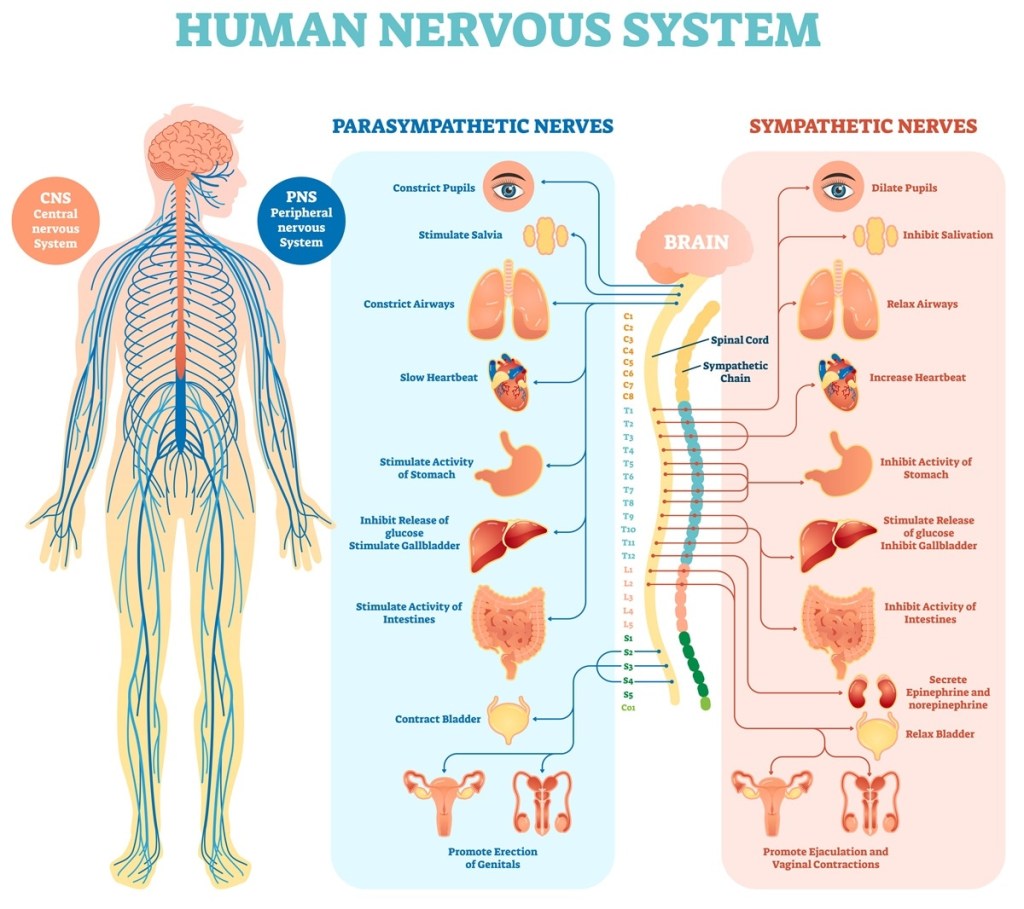
Neuro- is a combining form that means nerve, nerves, and nervous system. It does not mean brain, though the nervous system includes the brain. So when I talk about neurodiversity, I am not reducing folks and their experiences, identities, or labels to their brains, and I am not situated inside any kind of bioessentialism or biomedical framework. We are biological organisms. Everything that happens to us is biological. Our biological experiences are largely informed by our nervous systems. Our nervous systems are—both acutely and chronically, and both idiopathically and collectively—affected by everything around us, including our experiences, our abuses and traumas, the ways in which we are marginalized and oppressed, and more. Saying something is neuro-, including using terms like neurodiverse within the framework of neurodiversity, is not saying this, that, or the other thing starts and ends in the body. It is not the equivalent of denying or discounting the larger systems, functional and otherwise, in which we as biological beings exist or the forces those systems exert on our lives.
Image: A graphic depicting the human nervous system, including the parasympathetic nerves and the sympathetic nerves. The functions of the former include constricting pupils, stimulating saliva, constricting airways, slowing heart rate, stimulating stomach activity, inhibiting the release of glucose, stimulating the gallbladder, stimulating the intestines, contracting the bladder, and promoting the erection of genitals. The functions of the latter include dilating pupils, inhibiting salivation, relaxing airways, increasing heart rate, inhibiting stomach activity, stimulating the release of glucose, inhibiting the gallbladder, secreting epinephrine and norepinephrine, relaxing the bladder, and promoting ejaculation and vaginal contractions.
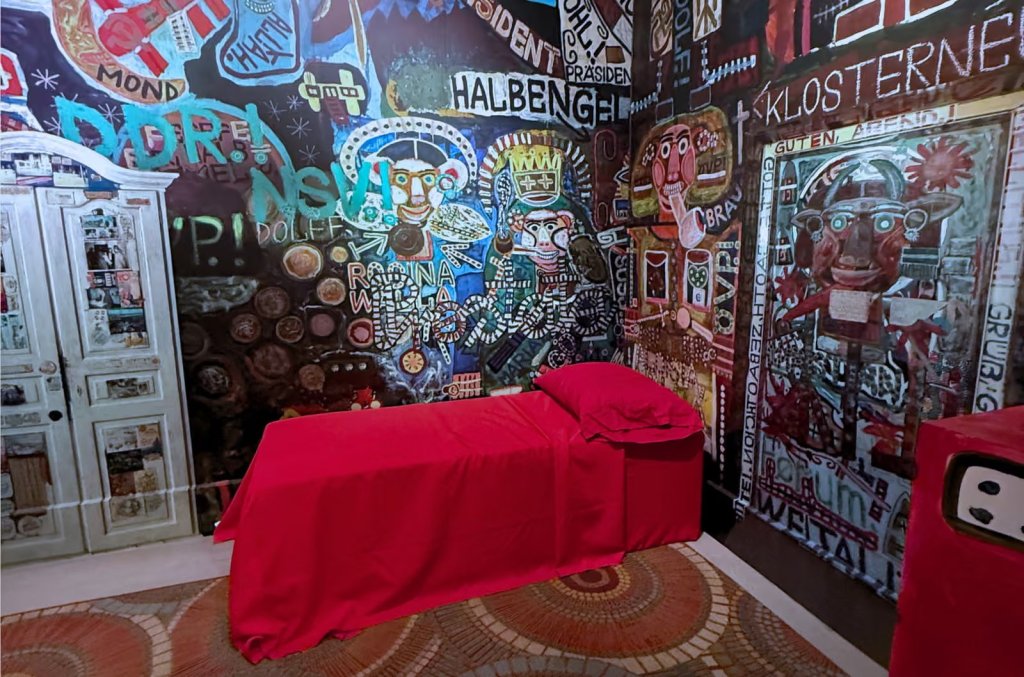
In September 1994, [David] Bowie and Brian Eno—who had reunited to develop new music—accepted an invitation from the Austrian artist André Heller to visit the Maria Gugging psychiatric clinic. The site’s Haus der Künstler, established in 1981 as a communal home and studio, is known internationally as a centre for Art Brut—or Outsider Art—produced by residents, many living with schizophrenia and other psychiatric disorders.
The acclaimed Austrian photographer Christine de Grancy documented the visit, capturing Bowie engaging with these so-called outsider artists—a term often criticised for framing artists through illness or marginality rather than authorship. For the first time, these intimate portraits will be shown in Australia, when A Day with David opens at Joondalup festival in Western Australia in March, in collaboration with Santa Monica Art Museum.
And, of note: Gugging itself carries a darker weight. Founded in the 19th century, the clinic was later absorbed into the Nazi’s Aktion T4 program, which targeted those with mental and physical disabilities, and resulted in the mass murder of an estimated 250,000 people. At Gugging alone, hundreds of patients were murdered or sent to extermination facilities.
To be spared is to be pared, part of you left but part removed. To be spared means to pare, to reduce what happened to its essence and to find your own essence despite what happened. Injured but not killed. Damaged but not broken. Burned but not torched. You are what is left over, what you can afford to be, what you still have to give others. In Old English, spare means not enough. Were you not enough to be worth destroying or not enough after being destroyed? In Latin, pare means prepare. Do you feel prepared now that you’ve been skinned?
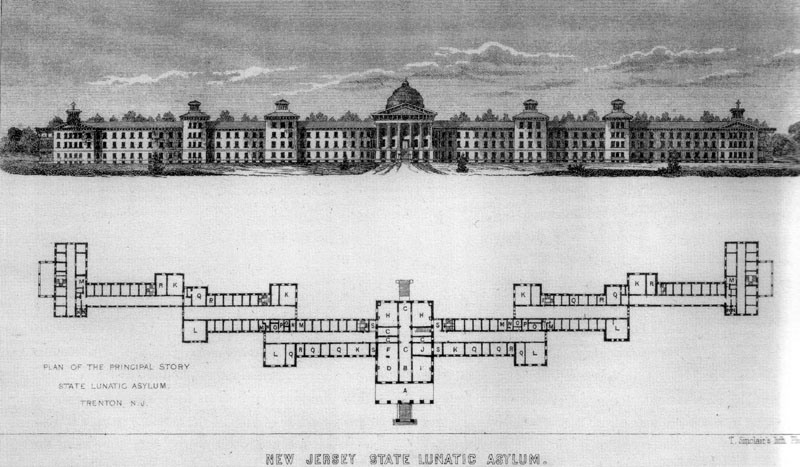
Mental illness has an architecture. That’s part of the story of asylums and treatment in this country. Central State Griffin Memorial, the hospital in my hometown, wasn’t laid out like this, but it had that same grand feel juxtaposed against the lives of those who inhabited the buildings.
Throughout its history, which spans more than a century, Central State’s story has been one of hope, ignorance, dehumanization, and harm: the same story from the asylum era to era of deinstitutionalization to today. I can barely tell any of it but have to before that history is lost. My mother worked there as a nurse and was treated there as a patient. Her relationship with Central State spanned more than three decades. That architecture was in her body, her bones part of the structure of those buildings and that land. Now, we need to make sure these places don’t come back with a new story: one of coercion, exploitation, profit, and greed.
—
Source: PBS Utah video about The Kirkbride Asylum, which was the template for many other asylums across the country.
I lost my phone for a while today and had the exact same feeling of being untethered that I experienced when my mother died. Unfortunately, this played out in front of my therapist, so he no longer has some image of me as a moderately reasonable or quasi pulled-together person.
I wrote a poem. It’s not about my phone, but I do have a poem about my phone because I love it. I mean her. I mean Aluminium. That’s her name. She and I have bonded over the fact that we both contain lithium. She has a little case with a cover on it that’s kind of like the leather pocketbooks my mother’s cigarette company used to give its customers for free. I love her. I also love my mother, who died on December 20, 2004. Oh, that’s what’s happening. That anniversary’s coming up in two days, hence all the big emotions directed at Aluminium.
This Calibri T-shirt is getting tighter as the night wears on. It feels like a corset and not in a good way. Bloatano has entered the building. I mean my body. I mean I’m bloated, but Bloatano sounds better, like the monster that GI distress is. The internet says I’m the first person ever to use the word Bloatano, so that’s kind of a big deal, which means I’m kind of a big deal. Bloatano also affects my ego from time to time, clearly.
I blocked three people today. It was super. My image of the medieval badge gave me the courage I needed in the precise moment I needed it. I can’t wait to hold all those little phalluses in my hand when the actual badge arrives. If phalluses really ward off evil, I’ll have ample protection.
We seem to have lost the ability to comprehend, to reason, to infer, to extrapolate, to synthesize, and to contextualize just about anything other than maybe song lyrics, and even then it’s iffy.
By comprehending, I don’t just mean understanding. I mean interpreting things like tone, which is essential for grasping meaning(s). We’ve lost that, too.
We’re taking personally that which is not personal and not taking personally that which personally affects us. Instead, we deflect, defend, deny, derail, dismiss, disparage, detonate. I’m tired of that pattern. We’re giving birth to mistuned responses in the driverless car that passes for communication.
We’re reading and listening too fast or not at all, at once too little and too much, leaning into things like AI to do our work for us, even when we aren’t using it actively and may not be aware of how it’s shaping our communications and changing our brains (and in turn our minds).
We’re tired and angry and sloppy in our reading, writing, and responses. I don’t mean some we that’s far away or out there or that doesn’t include poets. I mean all of us. The past 24 hours on Facebook have been unbearable for me. I’ve tried to talk about two issues that are significant. It’s clear from many of the responses I received that Facebook isn’t the place to say anything that matters.
So why am I there? Why are any of us there? Maybe it’s time to not be there, at least not in any significant way, whatever significant means these days. I’m afraid it doesn’t mean much.
I took a genetic test last year. It said my overall health score is in the 74th percentile. I was like, That sounds about right. Well, I looked at my score again today and saw that it can be broken out into DNA and lifestyle. My lifestyle score is in the 99th percentile. My genes? Only the 49th percentile. Half of the genes they look at promote health. The other half strongly promote illness, disease, and disorder. And I do have a number of health issues, rare diseases, syndromes, and one big, fat disorder. So it’s not off.
So far, the company has identified 149 potential risks based on my DNA. I recognize a bunch of them because they aren’t just risks. They’re acute and chronic issues I have, like heart arrhythmia, thyroid inflammation, dyslexia, and mania. It even picked up on my sugar cravings, tendency to worry, droopy eyelids, rosacea, TMJ, and obsessive-compulsive tendencies.
And that 149? It’s not even factoring in things like postural orthostatic tachycardia syndrome, common variable immunodeficiency, and follicular thyroid cancer, all of which I’ve had or currently have.
I can add labs to my report to bring my overall score up. (Aside from my TSH lately, my labs are awesome, mostly because they miss a lot of things.) But I can’t get over that DNA percentile. How am I a viable organism? How am I here? Am I dreaming this life? Are a groin hernia and leaky gut really in my future? Do I have a future?
In the words of my fellow Gen X elders: What gives?
 Dana Henry Martin