Institutions

Because Knott’s early life took place in various institutions, and because their confines would have seemed insurmountable, it shouldn’t be surprising that he viewed the poetry world with suspicion and contempt. After all, institutions were his only experience of organizing the chaotic world, and those institutions did not treat him well. — Sandra Simonds

I’ve been thinking about Bill Knott again. I feel this. I really do. Institutions have not treated me well, either, whether familial, social, political, religious, educational, or governmental. Read Simonds’s essay on Bill Knott on the Poetry Foundation’s website.

Flint

My father and his friends destroyed my childhood innocence. The poet who sexually assaulted me destroyed the innocence I reclaimed in adulthood. He did it in part by making me talk about how my father and his friends violated me while he violated me. I know you don’t want to hear about that. I know nobody wants to hear about that.

Maybe you want to write your poems. That’s what I want, too. Maybe you want to see your work in the world because you believe it could help others—and you for that matter. That’s what I want, too. Maybe you want to belong to something and feel proud of what you belong to. That’s what I want, too.

If there’s a difference between us, my guess is that you’ve been heard, believed. Or that what happened to you isn’t what’s been happening your whole life. Or that you found poets who are safe, kind, welcoming. Or that you conjured some kind of flint to restart the fire of your life.

One Life

Years ago, Tyrone Williams wrote that the poet who harmed me (and others) suffered two “deaths”—a social death and a cultural death. If Williams were still alive, I’d tell him what I suffered: one life I can’t even stop living, one life that feels like an emotional and physical battle every day, one life where I’ve lost trust in everyone, one life that just won’t end.

Utah State Mental Health Hospital

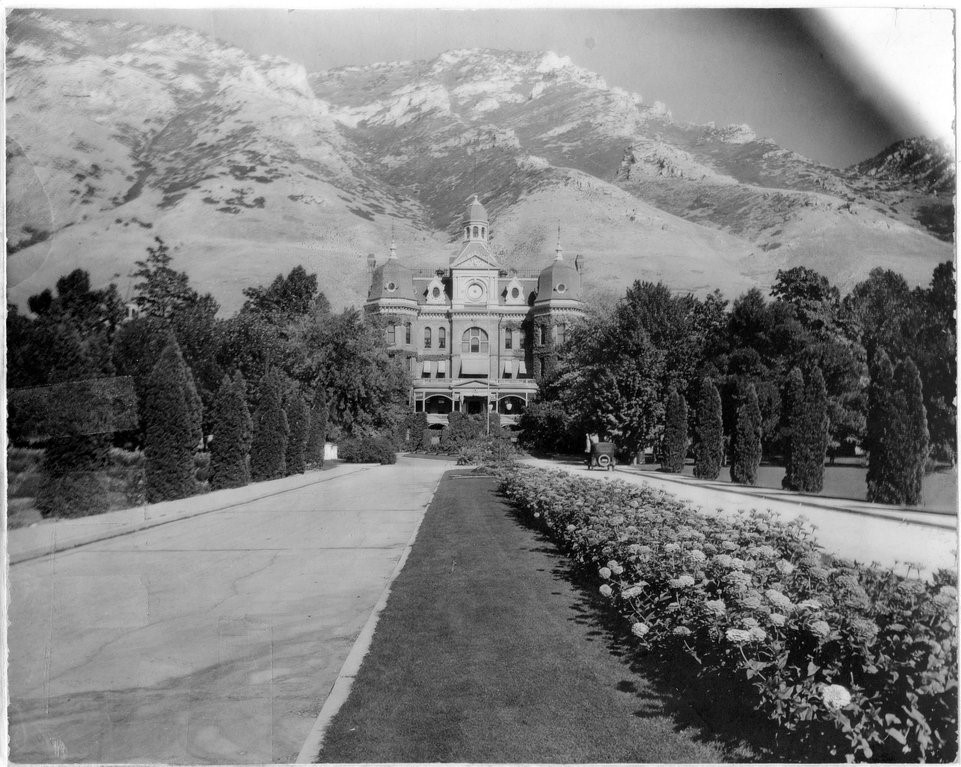
Here are some of the reasons a person could be committed to the state psychiatric hospital in Utah around the turn of the century: having epilepsy, financial embarrassment, disappointment, softening of the brain, death of a child, poverty, jealousy, unreciprocated love, studying prize fighting, ovarian trouble, reading novels, solar heat exposure, overwork, litigation, sedentary life, hypnotism, having girl trouble, being sheep herder, and smoking cigarettes.

Image: Utah State Mental Hospital in about 1920. From Utah Department of Health and Human Services.

Whateverality

I just called my partner my husband, and he was like I’m your partner not your husband, and I was like you’ve never taken issue with the word husband before, and he was like I am now and besides, he said, if I bring my husband into this, there’s going to be trouble, and I was like, you have a husband, and he was like, me as a husband not a husband I have, and I was like can we pretend like you have a husband and if so what’s he look like and is he into asexualish married nonbinary folks who sometimes lean into bambisexuality, and suddenly my partner was gone and I was sitting alone in the living room on the champagne-colored velvet sofa just as the sun was starting to rise and warm the creek and the horses and the laccolith, and I thought maybe I need a new word for my sexua-whateverthefuck this is.

Utah Mega-Shelter Update

This is major news: Utah’s House Majority Leader has filed a bill that would block plans for a homeless shelter campus in Salt Lake City’s Northpointe neighborhood, angry over what he suggested were broken promises to protect the Great Salt Lake.

On Monday, House Majority Leader Casey Snider, R-Paradise, filed House Bill 253. It would prohibit any permanent shelter over 300 people and shut down any efforts to develop land for what critics have blasted as a “mega-shelter.”

ICE OKC

In Oklahoma, the federal government is attempting to convert a 415,981-square-foot warehouse thirty minutes from the home where I grew up into a 1,500-bed ICE detention center. City attorneys and city officials say they can’t stop it because these detention centers are explicitly exempted from local zoning regulations.

That’s been the case for a long time, with precedents that date back to 1941. What’s changed is the number of people being sent to these centers. That number jumped during Trump’s first term in office and is jumping again during his current term.

What’s also changed are the conditions within these centers and the number of human-rights violations and worse occurring within them, including the homicide of Geraldo Lunas Campos, who was in ICE custody in Montana. According to a witness, five guards held him down. One put an arm around his neck and squeezed until he was unconscious and died.

Detainees held a demonstration inside an ICE facility in Dilley, Texas, two days ago to bring attention to the inhumane conditions within the facility and to demand their freedom. Among those heard shouting during the demonstration? Children.

Five-year-old Liam Ramos, detained in Minnesota last week, is one of the children being detained at the Dilley facility. He’s there with his father.

Howard Dully

Here’s what could get you lobotomized at the age of 12 in 1960 here in the United States: not reacting to love or punishment, objecting to going to bed but sleeping well, daydreaming and not discussing the content of the daydreams, and turning the lights on in a room when it’s sunny outside.

These are the “symptoms” that led to Howard Dully being institutionalized from the age of four and undergoing a trans-orbital lobotomy in which an orbitoclast was inserted into his brain through each of his eye sockets.

Please don’t make jokes about lobotomies or about mental-health issues and treatments in general. And please realize that we’re headed backwards in this country where mental healthcare is concerned. Lobotomies may not be in our future, but barbaric treatments and human-rights abuses are. I pray I won’t live long enough to see them or to be on the receiving end of them.

I Am Them

For me, the pronoun they works on many levels. One complaint about using they in the singular is that it’s grammatically incorrect. But is it? The mind is plural and decentralized. We may be one, but “I” may not even be a thing other than an understanding between us, a kind of “you there, me here” shorthand, a fiction that appears to simplify living. They is a better pronoun for me than he or she any day. It does more than help me escape the waist trainer of gender essentialism. It helps me remember that my mind is not one and never was and never will be.

FI-YUR

Just as I was falling asleep again after the recurring nightmare about the house with thirty basements that are actually a portal to hell, the fire alarms went off in our house, making it, too, a portal to hell, an existential one that can only be reached by way of six interconnected wireless fire alarms blaring and yelling FI-YUR FI-YUR FI-YUR all at once.

This is the third time this has happened in less than a year with these fancy alarms the life partner installed, the ones that should last ten years with no issues. Maybe time’s moving faster than I think. Maybe years are decades and decades are eternities. Maybe I’ve been here forever and so have you.

The alarms are terrifying our dog, wrecking our sleep, and allowing my body to rehearse going into flight mode, which isn’t what it needs to be doing. My intestines got so upset, I think they consumed themselves and left a ball of iron in their place. I guess I’ll have to learn to live on air and remember to avoid MRI machines.

I’d rather die in a house fire than ever hear another fire alarm go off. I said what I said.