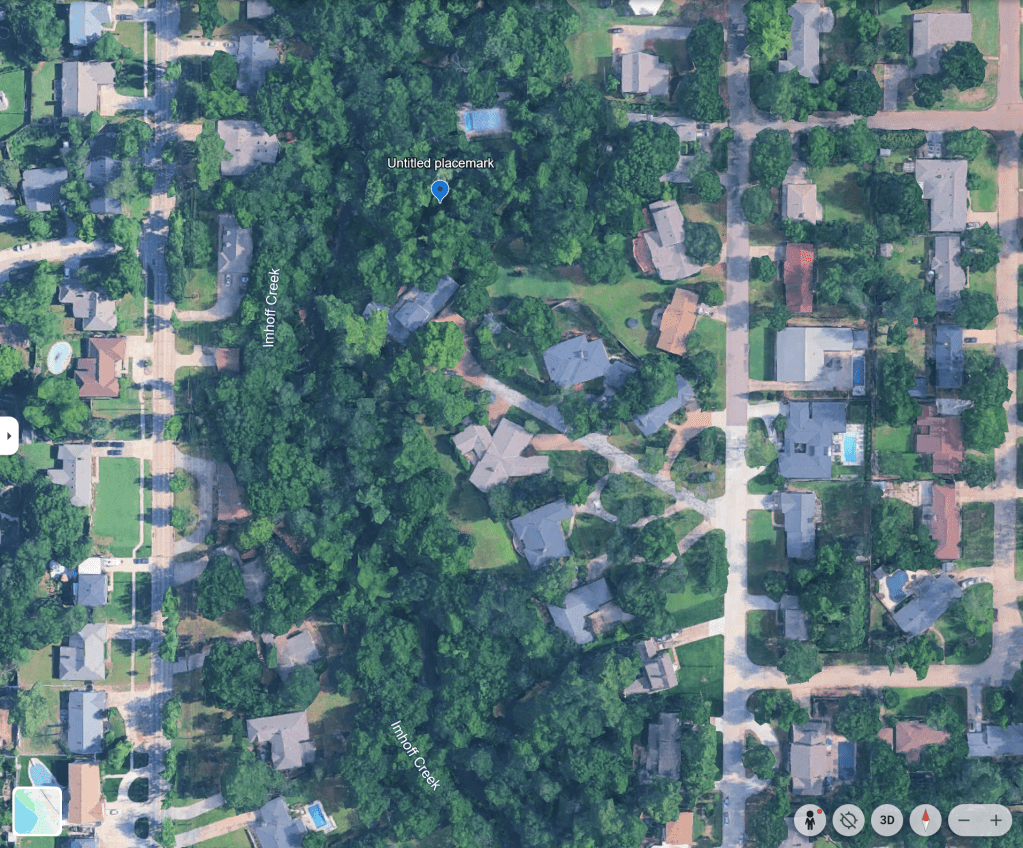
I guess what I want to say about land is that it continues even after we’ve left it, even after what’s happened there—including in some cases what’s happened to us there—has happened. I learned this in Oklahoma when I was visiting my hometown last August. I went to Imhoff Creek behind my house, where I was raped by a classmate when I was in ninth grade. Before the rape, I loved the creek. After it, I avoided the creek. It held energies and memories I didn’t want to face. I wanted to pretend what had happened hadn’t happened.
I didn’t even know yet that what happened had a name. I just knew the shame and embarrassment I felt and how it hung like fog over my earlier experiences playing in that creek as a child, often with my best friend. What was once a place of safety and retreat from each of our violent homes had, overnight, become just another place of violence and the rape just another instance of violence I felt I had to hide because I thought it was my fault or that other classmates would mock me if they found out or that they’d call me a slut, and I wouldn’t have the language, composure, or strength to respond.
When I saw Imhoff Creek last year, the same spot where the rape occurred, it was beautiful, as beautiful as Oklahoma gets. Lush. Green. Wild with birds. It’s not that the land forgot what happened. It’s that the land continued. It marked time in growth and change when I couldn’t because my hippocampus failed to function under threat. It showed me how much time had passed and how much had changed since that night in 1986.
The creek’s loam and clay subsoils shifted and gave themselves to the water and grew new plants and trees like post oaks and black willows that attract birds. Dare I say the land healed, and that returning to it helped me see it as it is now, not as it was then, which helped me heal, a little, in that moment. There’s wonder in that. There’s awe. That soil beneath us, it’s not just something we ignore and abuse and desecrate. It’s also something that goes on and teaches us that we can go on. The land can move from desecrated to sacred because it’s always sacred, even when we attempt to desecrate it, each other, and other living beings.
In the case of Imhoff Creek, locals are helping to restore and protect the creek’s riparian corridors and emergent wetlands from erosion and environmental changes. Folks are trying to protect the creek and all the life it supports. We just have to give land a chance, and see it, and it will show us what a miracle it is and always has been. We have to give ourselves that same chance by following the land’s lead. It is not what it was at its worst or when people, individually and collectively, were at their worst. And neither are we. We are as beautiful and resilient as our lands. If the land wants us to know anything, I believe it’s that.
Image: A Google Earth image with a placemark indicating where I was raped. My childhood home is also shown in the image.

