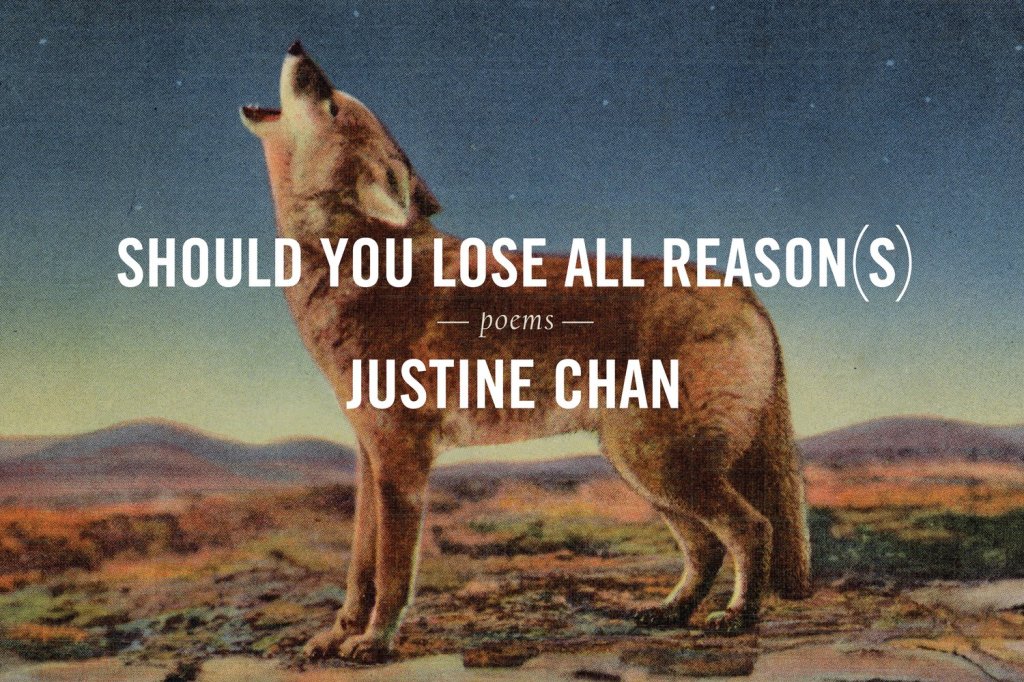
Justine Chan’s ‘Should You Lose All Reason’

Should You Lose All Reason(s), by Justine Chan

I’m reading Justine Chan’s poetry collection, Should You Lose All Reason(s). It’s based on her experience of a Southern Paiute myth she told over and over when she was working as a park ranger in Zion National Park, which is just a few minutes from our Utah home. I found the collection in the Springdale, Utah, library the day Jon and I drove out that way.

Chan lives in Washington state, where we lived for about a decade. Somehow, that makes her work resonate even more deeply for me. I’ve always felt a connection between Eastern Washington and Southern Utah. Where the land is concerned, I mean. The wildlands and the wildlife and how human consciousness is informed by both in ways they might not be elsewhere.

These poems are enveloping. They’re somehow a deep dive that feels like wading slowly into a welcoming body of water. Some parts remind me of Woman and Nature by Susan Griffin. Others remind me of a pillow book, namely the poems Rebecca Lindenberg has written in that spirit.

These poems speak to place, to identity, to what it means to live in a larger, natural world—or to live away from nature. Of who we are and how we become and how we continue. The speaker, I mean. The speaker, but also all of us. Also me, as a reader. (And maybe you if you choose to read this collection.)

Chan writes this place, Southern Utah, in ways that are image- and sound-driven without sacrificing authenticity, vulnerability, or accuracy:

You will get used to never seeing the full red sun as it rises or sets. You will see peregrine falcons and turkey vultures circling overheard, but never the condors.

None of the pictures you take will be quite right. Not in focus. Or the light’s not right. Or there is just too much.

You will bask. You will burn.

The bark of the spruce on the rim will always smell sweet and fresh in between its flaky scales.

The people will forget there was ever blanket poisoning of the public lands. That there are bounties for pairs of hacked off ears. That less, to rescind, must mean more.

Most of Chan’s lines are impressively long, like someone trying to stretch their arms as wide as the mouth of a canyon. The book is actually much wider than it is long to accommodate those lines. (It’s designed to look like an oversized postcard.) Her approach is somewhat experimental: at times bivocal, at times hugging the right margin or drifting cloudlike down the page, at times interspersed with dates and facts, and frequently breaking into song. (She quotes lyrics from sixteen songs throughout the book.)

I hope folks take the time to read this collection. Because. Just because.

Because the air is so hot, full of rasping. The land so full of landmarks and stories you can’t even begin to know.

Because you feel some part of you was / is / will always be secret.

Because the crickets are madness, a roar that fades to silence / if you forget / to listen.

Poems as Places

During the Southern Utah Book Festival, poets Paisley Rekdal, Danielle Dubrasky, and Simmons Buntin led the workshop “Real Locations, Imagined Selves,” whose focus was on defining a sense of place through words and documenting a place through poetry.

The conversation was much more far-reaching than expected. Poetry of place tends to focus on physical places, as in Richard Hugo’s Triggering Town or Wendell Berry’s poetry, which is closely tied to the specific farms he’s played in and worked on over the course of his life. Both Hugo and Berry’s approaches to place seem to be consistent with James Galvin’s notion of what a poet of place is, which is someone who situates himself in place in order to lose himself in it.

Rekdal discussed something similar to Galvin’s concept in the workshop, but she also talked about many other layers of writing about place—ones that augment and challenge the notion of place itself. She used the term palimpsest to describe places and our experiences of them, noting that places are layered in terms of their geographies, histories, uses, cultures, and more. Other layers include the ways in which places inform us psychologically, mentally, and politically.

The question implicit in this discussion is this: How can we begin to examine the layers of a place in order to more deeply know it, each other, and ourselves?

Partway through the workshop, an attendee said his body feels like a place, one that’s being politicized and treated like a territory. This was a powerful moment. The idea of the body as a place, one that can not only be inhabited by the self but also invaded, in a sense, by others, is disconcerting. When that type of invasion occurs in a physical space (someone’s community, their school, their place of worship, and so forth), body and space intersect, making both feel less safe. Here, we see layers of place building up and around the human body within the social, political, and physical elements of a place.

Rekdal says much of how place is defined is through bodies, and much of how bodies are being called into or excluded from a place is racial. She then discussed how the Chinese in the West could become white or reject becoming white depending on whether they wanted to be part of the United States. The idea she touched on is that, like places, race isn’t static. Bodies aren’t static. They’re all processes that are in flux and that meld into or layer over one another—and that sometimes collide with each other.

(I want to add that bodies are also excluded from places because of discrimination based on ethnicity, gender, sexuality, disability, age, national origin, and sex.)

Place is not just where you inhabit. It inhabits you, too, Rekdal said as the conversation began reaching toward the ineffable. I sometimes think about places as hauntings, she added.

She notes that we can be drawn to places we’ve never been before, perhaps because something inside us may be encoded to seek out a place and call it home. Or perhaps we seek out a place and immediately feel the atrocities and suffering that occurred there, such as at the Topaz Internment Camp Museum in Delta, Utah, where Rekdal gives tours as the director of the American West Center.

Whatever the reason, humans seem to have the capacity to carry a sense of place within us that’s larger than life and longer than the human lifecycle.

             Nothing natural but made
             in the beauty of this place. To create a home,
             we imported trees and water, we slashed
             and burned to excavate a state where nothing
             lived, nothing ruled us, and yet in all this nothing
             we were subject to the rules nothingness demande

Those lines are from Rekdal’s poem “Soil,” which appears in West: A Translation. She says places create relationships and help us develop empathy for each other. The forging of community from hardship is evident in the lines above and is part of the universal human experience.

The takeaway is that places can’t be places in any human way of understanding and experiencing them without our presence in them: the communities we build, the bonds we create within and because of place, and the ways in which we come to know place.

Wendell Berry says we’re losing our connection with place because our use of our places is greatly reduced from what it was in the past. Of course, he means literal places and a very specific type of past use of those places.

Perhaps Berry’s not imagining place as broadly as possible. As Buntin pointed out at the end of the workshop, imagination itself is a place. Imagine that. If what we imagine is a place, then the products of those imaginings, such as poems, are places. We really can create worlds out of words.

I wonder what you all think about where we are with regard to our relationships with places in any or all senses of the term? Is our understanding of places—like places themselves—a multidimensional process rather than a half-static relationship in which only human understanding changes, not the very idea of what constitutes a place?

Asked another way, are we as deeply connected with place as ever, even if we haven’t quite identified all our places as places: interior, exterior, past, present, analog, digital, elemental, philosophical, built, imagined, and so forth?