The laccolith shoulders this inelegant sky, nothing to write home about, as if this weren’t home now but that other place, the one I’m from, a town that’s rotting building by building, foundation by foundation, the fences, the red brick, the sweetgums and their dejected seeds. But mostly the psychiatric hospital, which the state left to vandals years ago.
Where I live now is less town than scrub, less scrub than sand, less sand than canyon. Plenty of room for a word to get lost, to go out on the air and never reach a listener but also never boomerang back to the speaker who stands, silent, beyond language, at least for a spell, isolated from everyone, including themselves.
That’s when the laccolith comes in handy, a kind of giant anchor for thought, for yearning. Headless under dark clouds, the color of night before night falls. A heavy future, a heavy past, a sense of always about it that makes humans seem like baubles, a bracelet of seals surrounding a whale in a faraway watery world before one slips into its mouth unnoticed.
What rises here rises in the distance, with its monzenite and spruce, big-eared bats and fir, bitter cherry, dollarjoint cactus, pygmy rabbits, sandweed, spleenwort. We’ve never been liberated from names or naming. In my ignorant past, I didn’t learn what to call things or what to call myself. Cardinal was red bird. Finch was sparrow. Father was father. I was daughter.
I read that if you think enough about a relative, your genes flip on and off to become more like theirs. Ten minutes a day for thirty days is all it takes. In case that’s true, who should I think of? I’ll take my chances with my mother, the way the white-tailed antelope ground squirrels take their chances with the feral cat when the neighbor’s trees are heavy with apricots in late summer. At least her genes helped me survive him.
Pistachios escaped cultivation in nearby mining towns and made their way up into the mountains. Birds, the first landscape architects, move them around the foothills, where they grow like bonsai. Humans spread from place to place, trying to find and lose ourselves. We look for footholds. We lock in. Even if we only grow a little, it’s something. A small life is better than none at all.
Horses and cows come and go here, the way they do where I’m from. My mother came and went, into and out of the hospital as a nurse and sometimes as a patient. Those buildings feel like her body rotting, returning to earth with no dignity. Her broken windows. The word PSYCHO spray-painted on her side. Her interior waterlogged and full of God knows what in the one-time hospital chapel that hasn’t shivered with song in decades.
Inger Christensen says there is war all the time. There is war. There is war. War in the cells. War in the genes. War in the heart. War in the mind. War in the family. War in the mother. War in the father. But there is also deerweed and spikemoss, manzanita and mat muhly. There is histone modification and methylation, expression and heritability. There is asbestos and lead, observation hatches and safety glass.
There is what happened and what passes for what happened, in memory, in polite company, in our palm lines, in our bloodlines. There is war all the time, even under new paint and old dirt.
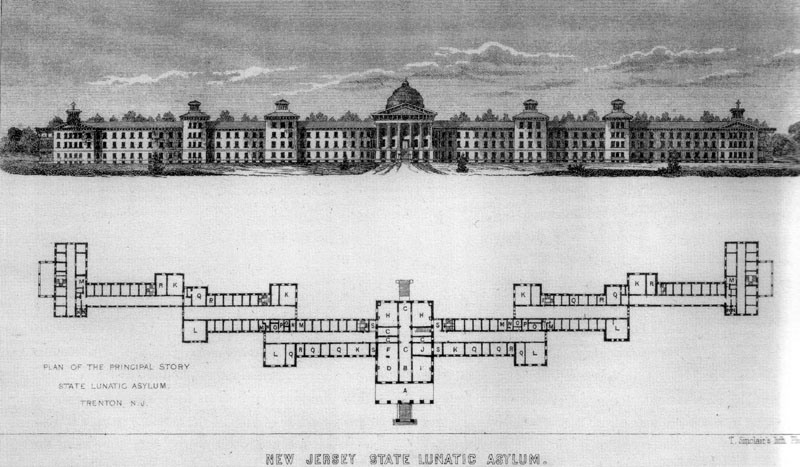
Mental illness has an architecture. That’s part of the story of asylums and treatment in this country. Central State Griffin Memorial, the hospital in my hometown, wasn’t laid out like this, but it had that same grand feel juxtaposed against the lives of those who inhabited the buildings.
Throughout its history, which spans more than a century, Central State’s story has been one of hope, ignorance, dehumanization, and harm: the same story from the asylum era to era of deinstitutionalization to today. I can barely tell any of it but have to before that history is lost. My mother worked there as a nurse and was treated there as a patient. Her relationship with Central State spanned more than three decades. That architecture was in her body, her bones part of the structure of those buildings and that land. Now, we need to make sure these places don’t come back with a new story: one of coercion, exploitation, profit, and greed.
—
Source: PBS Utah video about The Kirkbride Asylum, which was the template for many other asylums across the country.
I lost my phone for a while today and had the exact same feeling of being untethered that I experienced when my mother died. Unfortunately, this played out in front of my therapist, so he no longer has some image of me as a moderately reasonable or quasi pulled-together person.
I wrote a poem. It’s not about my phone, but I do have a poem about my phone because I love it. I mean her. I mean Aluminium. That’s her name. She and I have bonded over the fact that we both contain lithium. She has a little case with a cover on it that’s kind of like the leather pocketbooks my mother’s cigarette company used to give its customers for free. I love her. I also love my mother, who died on December 20, 2004. Oh, that’s what’s happening. That anniversary’s coming up in two days, hence all the big emotions directed at Aluminium.
This Calibri T-shirt is getting tighter as the night wears on. It feels like a corset and not in a good way. Bloatano has entered the building. I mean my body. I mean I’m bloated, but Bloatano sounds better, like the monster that GI distress is. The internet says I’m the first person ever to use the word Bloatano, so that’s kind of a big deal, which means I’m kind of a big deal. Bloatano also affects my ego from time to time, clearly.
I blocked three people today. It was super. My image of the medieval badge gave me the courage I needed in the precise moment I needed it. I can’t wait to hold all those little phalluses in my hand when the actual badge arrives. If phalluses really ward off evil, I’ll have ample protection.
My mother and I closely fit the archetypes of Demeter and Persephone, which is why I write about both in my poetry. I’m more like Hecate now that I’m older, or at least I’m getting there. My mother began the process of becoming Hecate as well. But first, she had to protect me the way Demeter eventually did by saving me from what she was partially responsible for.
That happened in 1985 when she risked everything to keep one of my father’s friends away from me. I remember that day. She saw his golden-bronze El Camero pull into the drive and told me to run and hide in my bedroom closet, quick. So drunk she could barely stand, she screamed at him to leave, every word she uttered a plosive, a bomb in his face. “SHE’S. NOT. HERE. R—.”
Anything could have happened. He was larger than her, stronger than her, and hellbent on getting access to me. She had no help from anyone in the family or the community. It came down to the two of them. She blocked his path to me by standing between the kitchen peninsula and the dining room table, interposing herself bodily, or at least that’s how I imagined it. I could only hear them from where I was hiding.
Her ferocity was derived from her own trauma, which prepared her for this moment. Trauma is often generational and repeating. It may not be optimal to live with trauma on a daily basis, but when you’re mother sees a moment for what it is and responds accordingly, her embodied trauma can provide the means for freeing you and your body from further trauma.
After that day, the path was cleared for my mother to become Hecate. She didn’t quite get there for complicated reasons, but I saw enough of Hecate in her to know the route. She stacked the cairns for me. Now, the journey is mine to make.
My mother and I are the original triple goddess, as are many traumatized women in traumatized families and traumatized communities in this traumatized world.
Wildness is one of those words that looks like it’s missing a letter. I want another d or n. Something. Maybe a second i or one of those slashes right through the middle that allows the word to be at once one thing and two things. Wild|ness. That still doesn’t look right.
I had a thing to say about poetry, a quip or an aphorism that I came up with while I was making the bed. Then I saw my husband’s blood on a white pillowcase and lost my train of thought. He cut himself working on the house and didn’t think he needed a bandage. He needed a bandage. Because he had no bandage, the pillow became his bandage.
There’s something about the blood-red of blood on the bright white of white that makes the non-brain parts of my body react. To what, I don’t know. I saw a beaten woman bleed all over her white eyelet skirt at substitute teacher training last year in St. George, Utah. But this goes back further than that.
There are also, of course, the white floral handkerchiefs women used to carry that had crimson berries sewn onto them to disguise the blood they were coughing up because they had TB. But that’s not it, either.
It’s something from my childhood, something I saw or experienced. Blood drowning white cloth. White cloth destroyed by blood. Frantically trying to get bloodstains out of white fabric.
My mother knew how to do that. She removed nearly all traces of what happened to her, what she survived. She had a wildness that couldn’t be beaten or shaken or ripped out of her. I mean another word there, not ripped—a word I can’t say here on Facebook. Remove the i and one p. Add an a. Yeah, that word. By my uncle and later by my father.
Wildness is one of those words that looks like it’s missing a letter.
Trauma is one of those words that looks like it’s packed with bodies.
Mother is one of those words that looks like it can be anything at all. Moth. Ether. Mote. Other. Tome. Moot. Mere. Mete. Hoe. Tooth. Hoot. Root. Home.
Robin, by John James Audubon. Image used in accordance with U.S. public domain laws.
This time of year, American robins move in large flocks. They adorn bare trees all over our area. Last weekend, they came to our backyard in waves. Their washed-out orange underparts made it look like our sweetgum trees were covered in apricots. Stone fruit. Flesh clinging to a hard center clinging to a branch. I haven’t seen any robins for two days, but I know if I drove out to the nearest wetlands or even cruised across town, I’d see them clutching the trees, their legs like thick stems.
Last week, I learned how to tell the difference between the male and female robin. Each time half a dozen or more gathered at our birdbath, I practiced my identification skills. “Male, male, male, female, male.” Now that I know what I’m looking at, the distinction is obvious. Her coloration is so much softer, especially her head, which is greige as opposed to charcoal or sable. Still, more than four decades of my life passed before I could see anything other than a generic robin—the Platonic ideal of the bird, perhaps. I was not seeing them, only some loosely held idea of them that came to feel like seeing.
Robin. It’s a soft word, like a wool sweater on a cold night. A comfortable word for a bird who brought me comfort as a child. The muted browns. The rich oranges. These birds carried fall’s earthy color palette on their bodies along with the promise of all that fall is after the terrible brutality of a hot, dry summer—one in which emotions routinely got out of hand as oppressive days ground into stifling nights. Nothing mixed well with the heat: not exertion, not rest, not that last glass of vodka, not my parents’ dealings with one another or with me.
My mother loved robins and would shrill “Robin! Robin!” whenever she saw one at the birdbath. Not all birds received such a ceremonious reception. The robin was on my mother’s bird-celebrity shortlist, along with the northern cardinal and, in the number one spot, the scissor-tailed flycatcher, who was our state bird. I’m not sure how any birds made their way to that birdbath, let alone the ones my mother loved most. My father had bulldozed the backyard and veneered the soil with concrete. Like frosting, he skimmed the concrete with a mixture of pebbles and epoxy. He left two trees standing—a magnolia and a sweetgum. The latter died, most likely from the abuse of having its surface roots constricted. My mother put a birdbath where the sweetgum had been. Like its surroundings, the bath was made of concrete. She placed rust-colored lava rocks on the circle of exposed earth that had surrounded the tree. The birdbath rose from the rocks like a whimsical headstone. Bird sightings were few and far between, but now and again a desperate winged creature would traverse the concrete jungle for a few sips of water and a bath on a feverous day.
That was my introduction to birds. Ultimately, they were baubles to my mother, as I was her bauble. She never moved beyond her initial excitement about seeing birds to actually watching them. Like everything, they were accessories. Bird. Child. Earrings. A pair of strappy sandals into which she wedged her tumid feet. Each played the same role and had the same status. Birds were something to chirpily declare having seen—“I saw a cardinal today!”—as if, as an extension of herself, the birds made her more valuable than she was on her own. They weren’t something to care for, to learn about, to appreciate, to protect. They certainly weren’t something to be with or to go out of one’s way for. My mother never went into the woods or fields or grasslands looking for birds, leaving her own world in order to get a glimpse of theirs. With the exception of my father, everything that came and went in her life did so on her terms. She was a planet. Everything else was a celestial object pulled for a time into her orbit. So I grew up with vague impressions of a few birds, namely my mother’s favorites.
What my father contributed to my understanding of birds amounted to coddling purple martins while attempting to starve European starlings. The martins got a fancy hotel in the sky, as blinding in the sun as the crest of a wave on a bright day. Below, he set a trap for the starlings: a wire cage that allowed them to enter but not exit. The device was not unlike the hanging cages used in Europe during the medieval period. I ended the torture the day after my father caught his first starling. I couldn’t bear witness to that barbaric form of execution and not do something. I found an older child in the neighborhood who was able to reach the trap and convinced her to open it. I knew I’d pay later. I didn’t care. The bird flew off, and that meant everything to me. My father stopped putting the purple martin house up after that. Its green and white facade languished in the back corner of our property until he died, and for two decades thereafter. My mother hated it but couldn’t bring herself to remove it. Unlike the starling he tried to starve, my father died quickly. Heart attack. Two words like stones that I didn’t know until I knew them and he was gone, a bird set free from a trap.
We had two juvenile robins in our yard this summer. That was before I was serious about watching birds. These were just two of the animals we inherited when we purchased our house in June. They were adorable in the way baby birds always seem to be. They don’t know quite what to make of the world or their place in it. I can’t imagine experiencing and processing so much so quickly. Every day for them is life and death, not that they think about it in those terms. But something in them knows already, if “knows” is the right word, to be on alert. If they used language, verbs like “fly,” “dart,” and “take cover” would be central to their vocabulary. They would be governed by a lexicon of imperatives.
It’s hard to look at birds and not think about the trauma I’ve experienced and the ways it’s shaped me. My working vocabulary is not unlike the one I’ve imposed on them. I, too, dart and take cover when I sense danger, even when no danger is present. Perhaps this is why I feel so protective of birds, why I whisper prayers for them under my breath or plead with them to hang in there. “Please make it through the day,” I would say to the juvenile robins. “Just try.” Then I would look for them the next day and, seeing them, smile.
My relationship with the young robins was quieter and more intimate than the one I have with the flocks who’ve visited the yard recently. Those adults have come by the dozens for the sole purpose of drinking water then moving on. With each wave, a handful of starlings also arrived. They seemed to be shadowing the robins, perhaps to take advantage of their ability to find resources. Between the robins and the starlings, the whole yard was mobbed. It looked like a pointillist painting, each bird a dab of black or brown ink. My partner was intimidated by the crowd. I’m not sure the smaller birds appreciated it, either.
Birds are complicated. They aren’t the simplistic trinkets my mother took them for. What I know about them is changing with each day, each encounter. I’ve learned that they don’t sound the same from place to place. The dark-eyed juncos use calls in the country that they don’t use in my backyard. They don’t act the same, either. Within a species, some birds are bolder than others. Some appear to be teachers while others are more apt to watch and learn. Some take the opportunity to feed while others are sleeping. Some experiment while others go by the books. Complexity exists at the group level as well. Case in point: The sparrows are fighting right next to me at the window feeder. Hierarchy is being established and defended. One’s place in the hierarchy can mean the difference between surviving the winter and succumbing to its cruelties. As I watched the flocks of robins who swarmed my yard, I realized there were more social dynamics among them than I would ever understand. My knowledge of them is akin to looking into a room through a cracked door. I see some of the details, but I have no idea what the room really looks like.
My relationship with birds is growing more complicated. I thought I’d signed up for learning their names and how to identify them. But now I’m involved. I’m moving away from my mother’s “Robin! Robin!” approach and into something else. “Bird” is coming to mean something richer, stranger and more mysterious than it ever did when I was a child staring at a cement birdbath girdled by a cement lawn, a single bird writhing in the shallow water—though now that I think about it, the birds I watched as a child were just as rich, strange and mysterious as any. Fancy that.
I used to think to be not alone meant / never having to walk through the high wheat / or struggle in the water.
— Allison Seay
I am standing in the high wheat. Field with Sheafs, by August Haake (1911–1914), oil on cardboard. Image used in accordance with U.S. public domain laws.
When I was a teenager, my mother’s best friend came over one night after a long absence from the weekly happy hour my mother hosted. When she arrived, the friend was serious, even somber. She stayed just long enough to tell my mother and their mutual friends that she wasn’t coming back to the group because she had quit drinking.
Couldn’t you just come and not drink, someone asked, flummoxed by the surprise announcement.
No, she said. And I can’t be around any of you again, not while you’re still drinking.
She explained that being around people who drank would jeopardize her recovery. She couldn’t be in that physical or psychological space anymore. My mother didn’t understand, or maybe she understood but didn’t accept her friend’s decision. This was, after all, the woman who had been there through everything with my mom. They’d known each other for more than thirty years. This woman even picked out something for my mother to wear to my father’s funeral. I remember her bringing a selection of outfits home for my mother to try on.
Nothing black, my mother had insisted. I hate it when widows wear black at funerals.
Her friend complied. She fanned out half a dozen wool and satin pieces in beryl blue, emerald green, and ruby red—the rich colors of a painted landscape. My mother sat slumped on the edge of her bed, barely present.
Get up and try these on, her friend coaxed.
Her concern for my mother was evident. It was one of those defining moments in a friendship. Through death, they had become even closer—friends for life, or at least that’s what everyone thought at the time.
After her announcement, my mother’s friend rose and walked purposefully through our paneled den, the one with the mirrored wet bar my father built before his death. She reached the thick cedar door and let herself out.
Empty Space
There are many differences between the alcohol recovery model and the mental health recovery movement. Still, situating myself within the recovery movement feels similar to leaving everyone and everything I’ve known, the way my mother’s best friend had to all those years ago. For one thing, there isn’t a recovery-oriented support group in my area. I don’t feel comfortable at local support groups that follow the disease model, suppress or dismiss research that challenges that model, treat the DSM as authoritative, teach people that medications are the best and often only option for managing their assigned illness, accept funding from pharmaceutical companies, and act as mouthpieces for those companies.
I’ve tried to take part in those groups—to create a space for myself and my view there—and I’ve been met with everything from dismissiveness to outright disdain. For me, they are not places where healing can occur. Rather, they are culdesacs that lead to feeling, and learning to be, what Lewis Mehl-Madrona describes as “forever ill.” In Coyote Wisdom, he writes:
On the down side [sic], support groups for particular illnesses sometimes encourage stories that keep people sick and support them in seeing themselves as ill. People who absorb these stories can come to define themselves as forever ill. A healing story needs to challenge their membership in the community of sufferers.
In my experience, label-specific support groups don’t tell healing stories or encourage peers to create those types of stories for themselves. Instead, I’ve heard group leaders refer to their own mental health labels as “awful,” “terrible” and “horrible.” I’ve seen peers internalize that language and mindset. This does an incredible disservice to the community and is, in my opinion, contemptible. I won’t set foot in those groups anymore because of the culture of self-loathing they cultivate.
Recently, I ran into someone from a group I used to attend. Though it was wonderful to see him, I wasn’t sure how to pick up where we left off more than a year ago. My DSM diagnosis has changed since I attended that group, but that information isn’t important because the DSM isn’t an accurate or helpful classification system. Whatever label I do or don’t have is just that: a label. My thyroid disease has also been addressed, but explaining how that affects my well-being is taxing for even the most attentive listener. So a silence opened in the conversation, like a crevasse in brittle ice. I stood on one side, he on the other. I care about him. I also care about myself and need to do what’s best for me, which includes walking purposefully on my own path, the one that leads to healing. Now I understand how space forms between people, like it did between my mother and her best friend.
Hello, Out There?
There are like-minded people in my area, and I’ve had a difficult time connecting with them. Often, when I reach out, I don’t get a response. I know survivors experience frustration, exhaustion, burnout, and a host of other issues related to trying to have their voices heard while also caring for themselves. Nobody in the recovery movement owes me anything, and I don’t want to take time or energy away from their important work. At the same time, it’s hard to go it alone when I know there are others in town who feel the same way as me. I like to imagine us coming together in friendship and shared purpose. (That’s my internal idealist talking. I’m trying to find my internal realist, but so far she’s eluded capture.)
I’ve had difficulty with recovery-oriented online support groups as well. Members seem to spend an inordinate amount of time fighting with one another, suppressing individual voices, and creating caustic environments in other ways. It’s exhausting to take part in those groups. I often come out feeling worse than when I went in. Online groups also tend to share a great deal of misinformation about mental health, most of which goes unchecked. There are perspectives and opinions, certainly, and those should be respected. But sharing inaccurate information doesn’t help anyone.
Whether in person or online, it probably doesn’t help that, in addition to being an idealist, I’m sensitive, introverted, and have a low threshold for interpersonal strife—either experienced or witnessed. Still, I’m here. I want to speak, write, and act in accordance with what I value, which is a model that promotes well-being over ill-being, individual approaches over generalized protocols, and healing over harm.
I’m over here in the high wheat, in the water. I will stay here even if nobody joins me.
Aside: Reaching Across the Crevasse
One way the mental health recovery movement differs from the alcohol recovery model is that there’s really no room for leaving anyone behind. That silence I felt when talking with my friend recently? I decided to try to connect with him to the best of my ability. He’s my people. Everyone with lived experience is my people, and I am their people. I can’t forget that. While I do need to distance myself from the disease model and the “therapeutic” frameworks that fall out of it, I don’t need to distance myself from anyone who’s open to where I am coming from, even if they remain on the other side of the crevasse.
In part, I told my friend that I am looking at well-being as opposed to ill-being these days, and at a mental health model that supports everyone (regardless of DSM label or lack thereof) having the tools and supports to live meaningful lives. I added that I believe we can all heal from trauma, adversity, and distress—which comes in many forms and touches most of our lives in one way or another. Finally, I said that I don’t think the medical system (physical or mental) goes far enough in not just treating illness and ill-being but in showing us ways that we can thrive and experience well-being.
I guess that’s my new elevator pitch, though it’s a little long. I’ll work on it.
I want to talk about touch, how it’s the only sense I fully trust. When I doubt my ears, my eyes, or both, I find the world with my fingers, skin and lips.
I can almost see and hear her, lilting through the kitchen in her white nylon underwear.
I work puzzles by going over the edges of one piece with my forefinger and thumb as I hunt for the matching piece on the table. My eyes pick out the inverse of what my fingers feel, as if my hands and eyes together are what someone else’s eyes are without assistance from a secondary sense.
I have routinely felt my way over a new lover’s body with my face, chest and tongue. It was nearly always a sensual experience. But it was also a sensual experience—a way of learning, through touch, if this was a person I wanted in my life. I’ve even used my eyelashes to find out what my ears and eyes could not tell me about a partner.
For more than a decade, I felt my way through music. I started by opening the faux velvet-lined case of my new flute and running my fingers over its perfect, machine-made nickel keys. It took me days to bring the mouthpiece to my lower lip. Taking the instrument in with my fingertips was all I wanted or needed during those first encounters.
I am convinced, now, that I could have kept playing the flute if the notes had not been named after letters of the alphabet. I believe this connection caused my visual dyslexia to leak into my fingers, tangling them up like the piece of driftwood my father proudly displayed in our front flowerbed. I would play the note I had come to know as “E,” and my fingers would try to play the note I had come to know as “F,” most likely because capital E and capital F look very similar.
I made it a long way with music despite my dyslexia, most likely because touch was involved. When I relaxed my mind enough, to the extent that I felt I was no longer in my body, the notes became what they were: whole and pure sounds that represented, but could not be extracted from, the universe—sounds unadulterated by our arbitrary assignation to them of letters or our perverted desire to pull them apart the way a curious child might want to pull the wings off a living dragonfly.
I loved music enough to take it as far as I could. And now I know why, in the end, I had to set it aside. There was nothing more I could do. No matter how much I practiced or how hard I tried, I was never going to have perfect, or even relative, pitch—and I was never going to get my fingers right 100 percent of the time.
(When creating music, you only have one chance to position your fingers and mouth. If you miss that synchronicity, you sound the wrong note—or a disastrously shrill noise that lies between notes and is not unlike the wheeze I imagine being emitted by a bird shot in the throat. Composing with words is much more forgiving because you can backtrack and change mistakes or, when speaking, you can pause—and it’s OK because there’s no tempo or conductor or orchestra mercilessly driving you forward.)
There was also the matter of listening, of hearing. I was unable to separate chords into individual tones, a requirement of my ear training classes. I was also unable to hear any tonal progressions, save for the perfect fourth and minor second, the former popularized by “Here Comes the Bride,” the latter by the theme song for “Jaws.” Even with this imprinting, there were days when the perfect fourth and minor second were beyond me. I couldn’t hear them in my head, let alone give them voice.
While I feel a renewed sense of mourning with regard to my loss of music, knowing it was my dyslexia that held me back, I also feel more indebted to music than ever. I am certain that when I set music aside and gravitated to writing and literature, I recruited the musical pathways in my brain to handle all the reading, writing, speaking, and other visual and auditory processing my new interests demanded. I believe my ability to hear the rhythm and tonality of texts is an outgrowth of my language pathways taking up residence in my musical pathways. Sure, it’s a little awkward, kind of like steering a ship along a set of railroad tracks, but it’s working for me. Somehow, it’s been working for decades, without my even knowing that my ship was, in fact, on a set of railroad tracks, and that those tracks were not submerged in water.
In some ways, my heart wants to break where music is concerned. Look what it did for me. Look what it gave me, asking nothing in return. All so that, one day, I would be able to speak. And write. And keep speaking and writing. And to keep singing my tone-deaf song, my ugly little song that feels more precious than ever to me, the imperfect song that connects me back to my mother as if she and I are two diminished seventh chords standing side by side on a treble clef.
And there she is. I can almost see and hear her, lilting through the kitchen in her white nylon underwear from Anthony’s department store, humming “The Girl from Ipanema”:
Tall and tan and young and lovely, / The girl from Ipanema goes walking, And when she passes / I smile, but she doesn’t see, / She just doesn’t see, No she doesn’t see
And I see my mother now. And I sing for my mother now. And I write for her now. And now her voice is my voice. And now I know her mind—one that always put the cereal in the refrigerator, that couldn’t balance the checkbook, that never wrote anything by hand, that loved to talk but not to read.
And I have her mind. And I am not sorry. And if I could reach out and touch her, I would. I would hold her hand and tell her it’s OK that she gave me this wiring, and I would sing her a lullaby and urge her to rest, just rest, and to please not worry about me anymore.
I remember when 1 million seemed unfathomable—the number of zeros strung along after the 1, as well as what they signified, impossible for me to envision.
I remember people telling me things were supposed to be awkward during what they called my awkward years. I’m not so sure I ever grew out of my awkward years, although I am no longer gangly and my teeth managed to grow in straight.
I used to run away from everything by climbing up a tree or running along an overgrown path to one of many hiding places. It’s not so easy these days to run away.
As soon as I think I’m good at something, someone comes along and reminds me I am not, then tells me the reminding is for my own good.
They tell me I know what I want to say when I write, but that I don’t know how to say it. They tell me my writing is uneven, slightly wrecked. Of course that’s the case, since my writing reflects my life. How could it be any more together than I am? And what’s better: writing that is even and predictable, or writing with a pulse—albeit sometimes weak and irregular—writing that moves under its own control and in ways you, and I, could never anticipate?
For a time after my mother’s death I forgot how little I like people. I thought it was her I disliked and that her death had freed me from that feeling. Turns out it had not.
I went to the grocery store yesterday to have a cheese sandwich. I looked around as I ate it. I had no idea what anyone was doing or why they were doing it. Not one person in that store made any sense to me.
We are all wasting our lives in so many and varied ways.
Writing is just another way to waste time, but at least it allows me to keep a record of how I’ve wasted it. I will always know that yesterday I had a cheese sandwich and took a nap. I will always know the sadness I feel right now, even if one day I manage to move through and beyond it to something else—something that at this moment feels unfathomable and that I can’t yet see clearly.
Because during the poetry class I was just in, a moth flitted across the room. Scratch that. Shot across the room with a speed and straight-line purpose seldom seen in moths, even those under round-the-clock observation. The moth went right into my left eye. The instructor was trying to keep things on task as I, an impacted vessel, held my hand to my face and listed a bit in the direction of my injury.
I believe all the voices in my head are my mother. My father has not once spoken to me since his death.
Nothing dramatic, not like the time a gnat flew into my right eye at full force over at Yellowstone when all I wanted was to relaxedly take in a little scenery. I was convinced the gnat had grown a stinger for the sole purpose of injecting me on the cornea. It had not in fact stung me, but came as close to the sensation of stinging as anything without a stinger could, so to this day I maintain that it stung. I screamed, jumped about and generally carried on.
Let’s face it. I make people uncomfortable. Even when I’m not screaming, jumping about and generally carrying on. Add to this winged creatures coming at my eyes, and (I can only envision) the feeling of uncomfortable-ness I cause in others would be increased, though by what positive exponent remains to be documented. If you are interested in that degree of specificity, further experiments and data analyses will be necessary, and I’m not really down with all that, being, as I happen to be, so uncomfortable both with: 1. making people any more uncomfortable than I usually do, and 2. having things with wings deliberately sent into my eye. I am a human, after all. And these are only moths and such. I am not earth, and they are not bombs. Let’s not forget these vital distinctions.
I want also to touch on this: Things without wings going into my eye I am not fond of either. Grit, pencil shavings, salt, etc. have all made their way in at one time or another. I can only imagine what’s accumulated behind my retinae. Some things might not dissolve and instead be siphoned up through my optic nerve. Especially et cetera. I bet et cetera has a long half-life. Can you imagine how long the list would be if we detailed everything et cetera houses? Set end to end, et cetera ‘s contents would entirely wrap each and every one of our bodies, like a good bandaging job for an everywhere injury. Imagine how et cetera weighs, what we’ve made it take on, you and I. It must surely feel like a moth is always in etc’s eye. Then, to add insult to injury, we abbreviate it. How etc. aches to be longer. For recognition of all we’ve made it become. Et cetera is a moth with its wings pulled off, a thing whose shadowy undertow has been erased.
But I risk losing my point if I start talking about anything other than today and this moth. So let’s stick with the moth for now. Actually, I feel I have exhausted the subject. I wouldn’t want to write past my ending. I could go into how I had to excuse myself from the class and make my way to the restroom, how the instructor did not acknowledge what was up with my eye and the whole leaning-slightly business, or how perhaps he did acknowledge it because I do seem to recall a disembodied voice saying “I saw that” after I finally worked up the courage to say, “A moth just flew into my eye. I am hurt.”
However, I couldn’t tell you with certainty if the person who replied was the instructor, a male student, or some voice of recognition in my head. The last notion really isn’t that absurd, except that studies show almost all imagined voices are female, not male. Something about the cadence and lilt women lend to the words they/we speak. (Sorry for the slip. I sometimes forget I am a woman when I speak of women. I wonder if “a moth” ever forgets it is “moth” and what it thinks it is instead, or if it ever feels it is nothing. If I were a moth, which I am not, I believe I would lapse into thinking I was all wing. Single wing like a small fan in nothing’s hand.)
But back to voices. I believe all the voices in my head are my mother. My father has not once spoken to me since his death. I do not love him less for it.
I almost forgot to mention how I could mention why I didn’t go back to the class. It wasn’t my hurt eye, although my eye hurt. It was fear. Or poetry. In that room, there was no air for poetry, not for me. My way of writing it. I should mention this was all playing out inside me, again no fault of the class or instructor. In fact nobody saw my discomfort, the air being pushed out of my lungs one breath at a time, less air coming back with each inhalation, a kind of measured dirge toward suffocation.
The moth knew this was happening, something close to panic but not quite panic. It doesn’t surprise me the moth would recognize panic in the making, given the tizzy of a short moth-life. Poetry was unsafe for me in that moment, and the moth knew it. Hence the speed. The direction. Self-sacrificing it went into me, my light, the window of my lighthouse, to protect me. It’s the only logical explanation.
A woman just slipped into the seat across from me in the computer lab where I’ve set up camp to write this. I told her my story. She listened. She said to take a spoon, fill it with water, and lower my eye into it. She, too, is a moth. Another kind of savior.
I could keep going and going, like a winged thing fighting its way to its destination: final, temporary or insulary. But I think I will stop with the sentence, “So let’s stick with the moth for now.” That seems a proper ending. But I will add this: My only regret is not having been considerate enough to make sure the moth was OK before running out of the room. We should treat those who save us with more kindness.


 Dana Henry Martin