The Order

I want to talk about the concentration camp being built in Utah, where I live, that will warehouse people who are unhoused and force treatment on them for real or perceived mental-health issues and substance-use issues. I want to compare it to the Topaz concentration camp that was built here in 1942 and operated until 1945 under Executive Order 9066, whose name I know because I have to know it. To survive. To advocate. To resist. To not repeat the past even as we repeat the past because others don’t know the name Executive Order 9066 or what it did, what it made our country and its people: ugly, cruel, inhumane. Those who don’t (or don’t want to) know about EO 9066 also may not know that another EO made this new concentration camp in Utah possible, the one written July 24, 2025, whose official title I won’t mention because it doesn’t describe what the order does, what it enables. It would be better if it just had a number, not a misleading title. It would be better if it didn’t exist at all.

But I can’t talk about the concentration camp because my language isn’t welcome, especially among those who also have lived experience with mental-health issues. Those I most want to communicate with will attack me for using the diversity model to give context to what I’m conveying. Those of us with lived experience with mental health have different experiences and use varied frameworks for communicating our experiences. We are and should be polyvocal. Yet there’s a growing push for monovocality—for one way of speaking, for one way of perceiving and communicating human experiences. So I’m not talking, not the way I want to be or to the audience I want to talk to. At least I have this loose take on the haibun.

              The age of pastures
              is over. Detention is
              involuntary.

                            Your right to exist
                            on your own terms ends now.
                            You belong on outskirts.

              Get used to the word
              stern. Your life is a concrete
              slab if you’re lucky.

                            Say no and go to jail.
                            What is this if not jail
                            by another name?

              Like a rose. You think
              you’re like a rose when really
              you’re a line item

                            in a multi-million
                            dollar budget. You’re our
                            ticket, our future.

              Containing you is
              business. Here’s a pill.
              We’re sorry it’s come to this.

                            Swallow. Concentrate
                            means gather. We gather you
                            today for Holy

              Capital, for the bottom
              line. You’ve lost your right
              to leave, so don’t try.

One (Sanist) Country for All

I emailed the organizer of the poetry event I was at and sent a letter to the faculty member whose comments concerned me. I don’t expect anyone to support me or even understand my concerns, but here’s the letter.

I’m deeply troubled by your comments yesterday about Ezra Pound at the [writing conference]. Many accounts support the fact that he had a psychotic disorder. Whether you believe that or not, your venom toward him and your characterizations about what a terrible person he was were emblematic of sanism. Your comment about the authorities not being able to put him in prison or kill him were incredibly painful given that they came on the heels of Fox news anchor Brian Kilmeade’s comments two weeks ago about those who are unhoused or who have mental-health issues needing to be killed, not to mention the July 24, 2025, Executive Order that trammels the rights of those who are unhoused, have mental-health issues, and have substance-use issues.

I stood up and took a risk by sharing my own mental-health issues with everyone at the conference in the context of helping those in my community overcome stigma about mental-health diagnostic labels and lived experience only to see you reinforce stigma and nearly seethe over someone who had a psychotic disorder. You undermined everything I tried to do, and you made that space unsafe for me and for those like me who are just trying to survive, which is especially hard to do here in Utah if you live with a mental-health label.

Your flippant comment about Pound being placed in an asylum (because he couldn’t be put in prison or killed) denies the reality of those institutions and the myriad harms they did to people in this country and all over the world. My mother worked in an asylum-turned-psychiatric hospital as a nurse. She was also subjected to great harm in similar hospitals as someone who lived with bipolar.

Those places are not a joke, should not be talked about lightly, and were the setting of, and justification for, countless human-rights abuses. This is the crux of my work as a poet and essayist: uncovering and documenting abuses that those with mental-health issues have experienced and continue to experience.

I was ashamed of myself yesterday, of my existence, as you spoke. Then I realized what I’m actually ashamed of is you: your attitude, your words, and your carelessness. Nothing you shared is why I paid the expenses associated with [the conference], why my husband took time off work to accompany me there, or what I hoped to learn during the event. If you hate Pound that much, you should have chosen a poem that wasn’t by him. Then the entire rant could have been avoided.

I’m nobody to someone like you, but I’m writing this to you anyway because I’m somebody to me, and I’m somebody to those I fight with and for. I will not stop speaking back to bigotry and hate, even when I encounter it in the unlikeliest of places.

I should mention the fact that, thanks to the July 24 Executive Order and its erosion of decades of protections for those it targets, it is now legal to hold anyone who’s affected by the order, including those with mental-health issues, in prison indefinitely. That’s yet another reason the faculty member’s comments are poorly timed and extremely insensitive.

In response to a comment on Facebook about this note, which was initially shared there: One of my concerns about Pound is that scholars who are not experts in psychiatry have tried to make the case that Pound either didn’t have a psychiatric issue or was feigning one. We aren’t in a position to make that determination, both because we aren’t there to assess him and because we don’t have the background that would allow us to do so.

The literature I’ve read that makes the case that Pound did not have psychosis doesn’t hold up and betrays more about the person doing the long-distance, time-traveling assessment than it does about what it’s like to have lived experience with mental-health issues or to have had them during a time when diagnoses, understandings, and treatments were rapidly changing.

Pound was in the asylum right before my mother had her own experiences both as a psychiatric nurse and as a psychiatric patient. There’s actual overlap there in terms of the dates. My mother’s diagnosis changed many times, as did her treatments, as did the degree to which she was affected by her psychosis.

Pound is challenging, difficult, and complicated. We can’t complicate him more by injecting one or more layers of sanism on top of his story. This was a class about concision in the poetic line. We weren’t there to study Pound or fascism or history or mental health. We weren’t. And to bring that into the conversation in a way that lacked skill and an understanding of what’s happening today in the United States to those who have mental-health issues, with a proposed resurgence of asylums and all, is alarming, heartbreaking, and soul-crushing, at least for me.

Just a couple of months ago, I saw a prominent poet get a whole group of poets riled up here on Facebook about another poet who was clearly experiencing psychosis. The pile-on was awful and included sanist labels, attitudes, and outright attacks. We need less of that kind of thing in the world and in the world of poetry, not more. I feel the way Pound was discussed two days ago promotes more of that kind of thing in the here and now, not less.

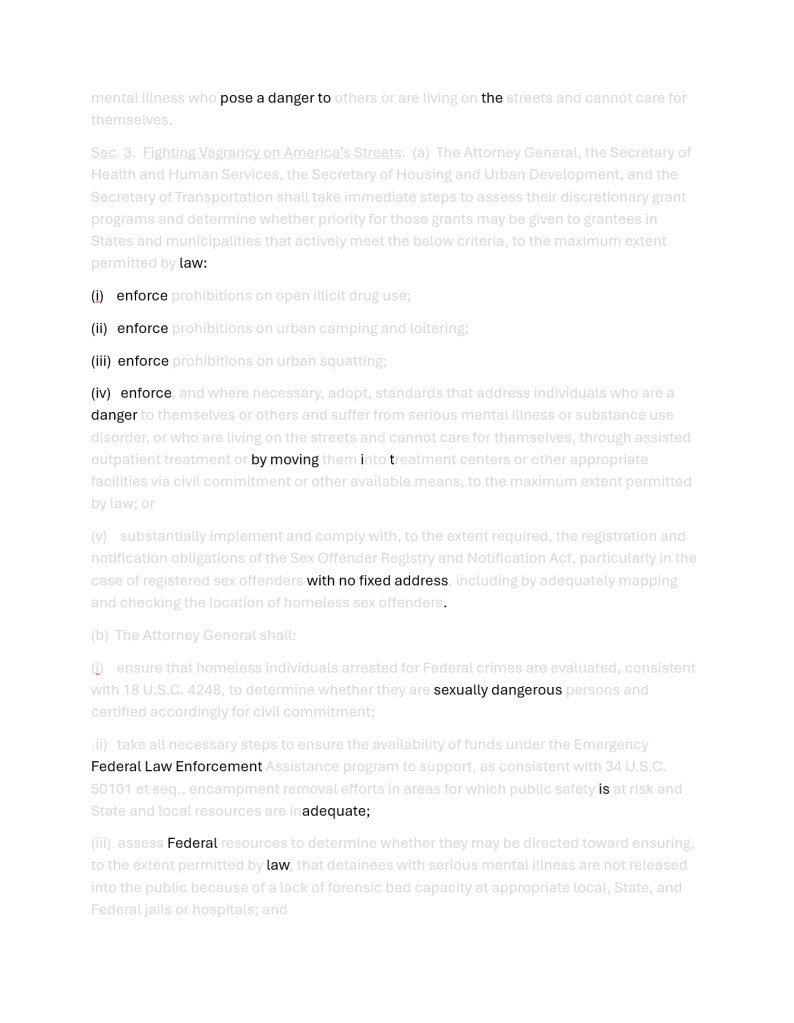
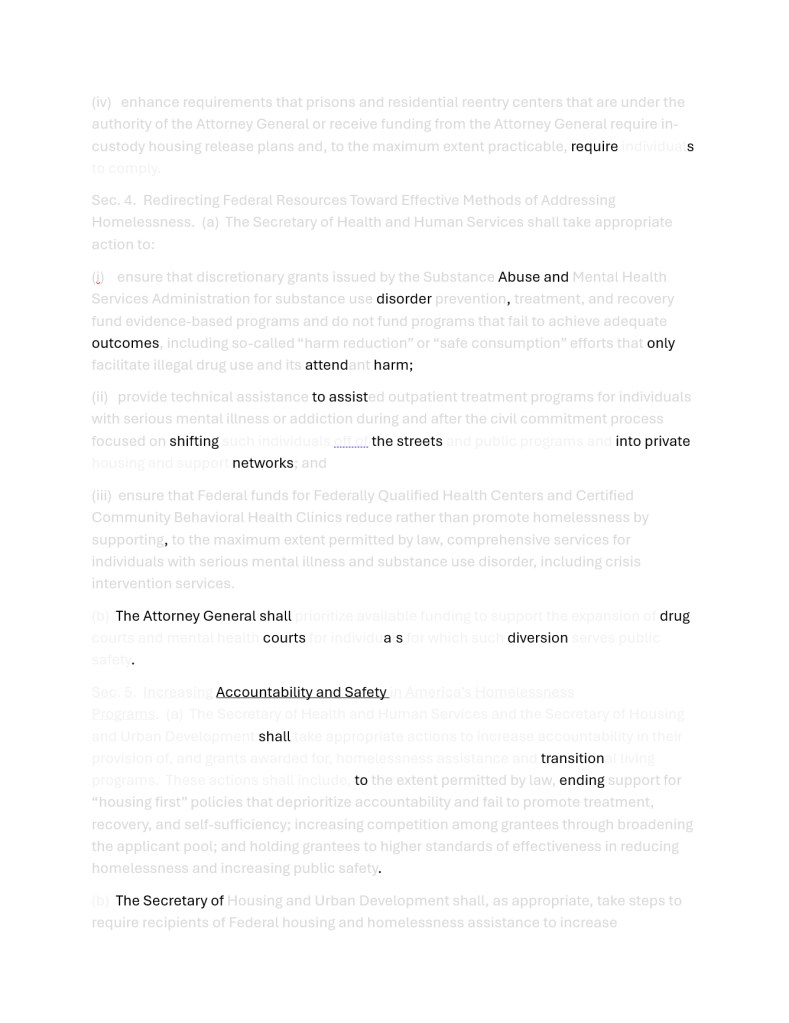
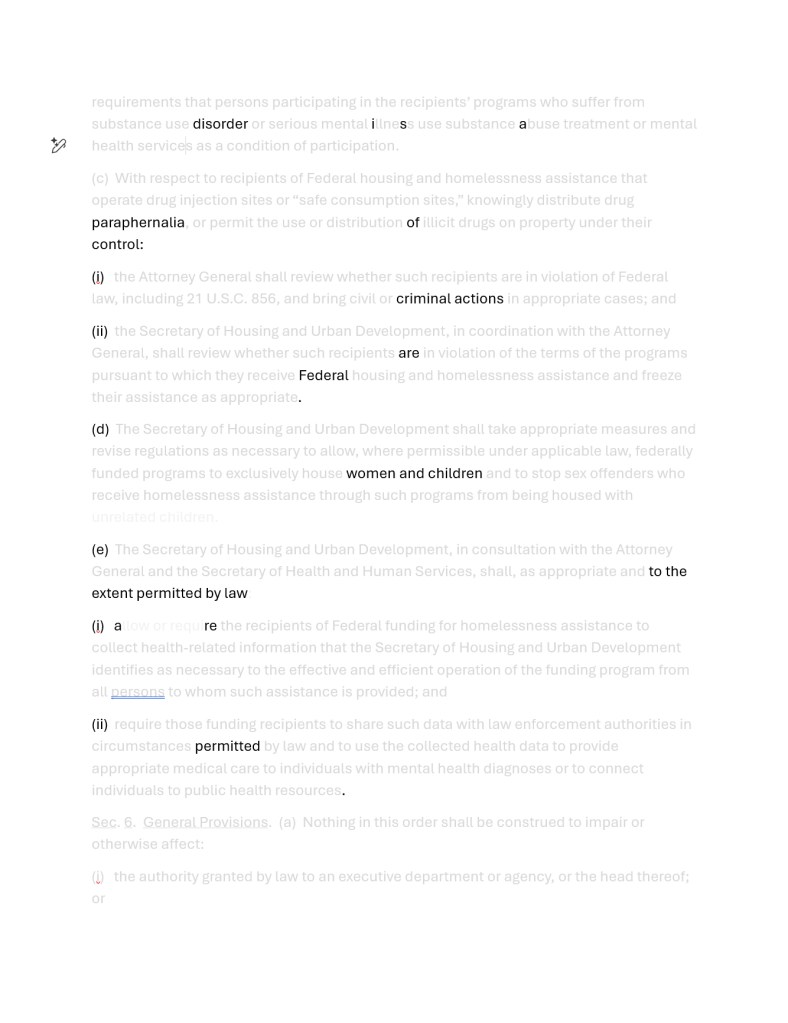
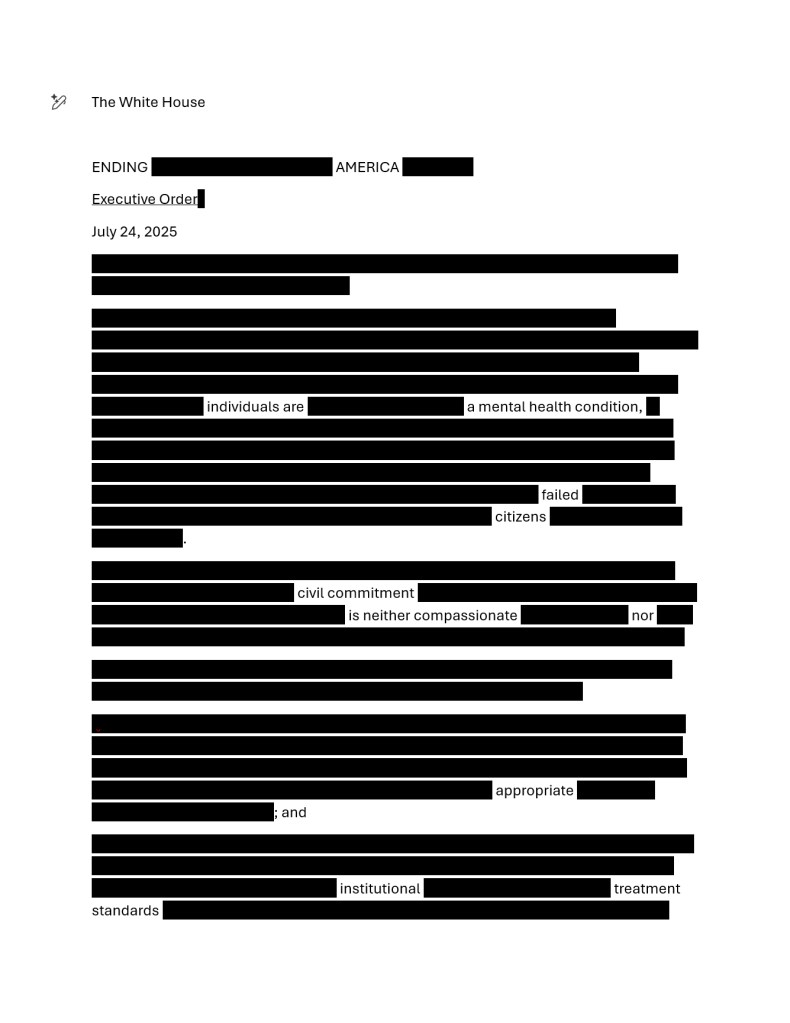
July 24 Executive Order Erasure 2

Given that Fox News host Brian Kilmeade just called for people who are unhoused or have mental-health diagnostic labels to be killed by way of involuntary lethal injection, I’m sharing two erasure poems that use the July 24 executive order as their source text. Nobody, including poets, seems to be aware of the existence of this horrific executive order. This is the second erasure.


July 24 Executive Order Erasure 1

Given that Fox News host Brian Kilmeade just called for people who are unhoused or have mental-health diagnostic labels to be killed by way of involuntary lethal injection, I’m sharing two erasure poems that use the July 24 executive order as their source text. Nobody, including poets, seems to be aware of the existence of this horrific executive order. This is the second erasure.