Holy Nodding Donkeys!

I know it’s April Fools’ Day, but this is no joke. My full-length manuscript Crude has been accepted for publication. It took most of the morning to write that last sentence because it doesn’t seem real. I’m actually just sitting here now thinking of what to write next.

I feel funny in a good way like when you have a colonoscopy and they give you Propofol so you wake up loving everyone and wanting to call them on the phone to say I love you and you love your gastroenterologist so you tell him so and you love the nurses and techs so you tell them so and you run around in the waiting area in your paper gown with your butt hanging out telling everyone you can how much you love them because you love them you really do you really love them.

I’ll share more details when I can. At that time, I’ll do a more formal announcement that doesn’t read like this one.

Water Cracking Air

Happy Trans Day of (Indi)Visibility.

I just saw an ad that read: Turn Your Expertise into Jerome. I was like, Who is Jerome? It actually said Income, but I’m dyslexic and the font was swashy.

The yellow-throated warbler is the happiest of all warblers, and I will fight anyone who says otherwise.

I put a bird in a box
so it wouldn’t be hurt
by the wind

I put myself in the wind
so I wouldn’t be hurt
by the box

Inspired by an Oklahoman who put a native sparrow in a box on a windy day because she thought the wind would harm the bird.

I dreamed Bill Knott’s mind had been transferred to millions of pieces of paper. They were lying all around me in a vast room, each one folded like an origami prayer boat meant for a memorial ceremony, but there was no water anywhere on Earth for them to float in.

(ツ)_/¯ I guarantee my reasons for not liking our former sheriff are very different from our local alt-right extremists’ reasons for not liking the former sheriff. ¯\_(ツ)

This public speaker was being interviewed, and he kept saying co-creation, but I heard it as procreation. Imagine my confusion when he said he wanted to co-create with his partner, his co-workers, his friends, his family, and his children.

I’m doing the floss this morning along with a little song I wrote called “Our Shitty Fucking Sheriff Resigned” because our county’s shitty fucking sheriff resigned suddenly and without explanation. I had several frustrating interactions with him when I was dealing with complex PTSD and bipolar issues in 2023. He was unhelpful, clueless, patronizing, and demeaning.

Our shitty fucking sheriff resigned. Our shitty fucking sheriff resigned. Sing it with me now.

Oh, and he resigned on International Bipolar Day. Even better. What a gift. How thoughtful of him. And all I got him in return was this victory dance.

Someone from my weaving group is getting rid of four styrofoam heads, so Styrofoam Heads keeps showing up in my inbox. It’s weird. I love it.

Our little town has gathered to watch a rattlesnake climb the wall of a neighbor’s house. It feels like very olden-times entertainment. The life partner is down there with everybody. I am here with myself confronting the snake that is automated AI results embedded in the Yahoo search that’s somehow made itself my preferred search engine.

Evening, a sun-drenched power line is a whip of water cracking the air.

I just misread breaking news as heartbreaking news, and that should be what all breaking news is called these days.

I’m rage-eating gummy bears is how I am.

I’m threatening my nasal cavity with a neti pot is how I am.

Based on my last couple of Facebook posts, people appear to like poetry thirty-five percent more than they like bacon.

I just misread a beacon of hope as a bacon of hope is how I am.

I ate bread in the shower is how I am.

These days, getting to the end of a roll of toilet paper is exciting. I’m like, achievement unlocked. I literally say that.

I had to buy bigger underwear is how I am.

As an Oklahoman, I want to apologize for Markwayne Mullin.

I am dyslexia strong.

Book title, free for the taking: Plastination.

It could deal with the literal plastination of the body or the figurative turning of a country into something as caustic and inorganic as plastic.

I just misread donor organ as donor orgasm is how I am.

Oklahoma is like one of those relationships you just keep finding yourself in again.

If I didn’t have a spine, I would feel like I was one with everything. It’s this skeleton that makes me feel like a soul clinging to bone, something separate from, not part of, something that will one day break.

You know that feeling when you suddenly have to poop right after you take a shower? That’s how Monday feels.

Alex LaMorie

Poems may be forgotten, but they shouldn’t start out as forgettable.

My history is a burning history in a burning world.

If you don’t care about Oklahoma after reading my work about Oklahoma, then I haven’t done my job as a poet, as an Oklahoman, or as a storyteller.

It’s so windy here in Toquerville that I feel like I’m in Béla Tarr’s The Turin Horse. Wind like this makes me cry. It is whatever my mind is, as Gertrude Stein observes. I am as my land and air is, as my cracking and straining house is, as raw as I felt the moment this wind hit my back in a dream and stripped the veneer of reason from me in one clean and somehow profound motion. I sit in the dark shaking, my heart beating like a wild nestling’s.

Something good happened and I can’t talk about it so I’m just eating a bunch of gummy bears is how I am.

Whenever I have something I want to tell the life partner, he’s like, Is it about gender or poetry or trauma, and it almost always is about one or more of those things.

Systemic issues don’t have individual solutions and can’t be offloaded to individuals who must then bear the burden for the systemic issues. We can’t self-love our way out of abusive, harmful systems or the attitudes they encourage and reward.

Some folks drive like they have donor organs in their cars.

What are these words, even?

Me looking at my own writing.

I worked on the new manuscript more today. Loved it. Hated it. Loved it. Hated it. Loved it. Hated it. Loved it. Hated it. ¯\_(ツ)_/¯

What do you do when you have two manuscripts with presses for their contests and open reading periods? You finish a third one and send it out, too. That’s what you do.

Every time someone attacks me, I just eat dark, leafy greens and grow stronger.

I’m placing a bowl heaped with disco balls in the light and leaning over them, my face cracked across a thousand mirrors, is how I am.

My neighbor is killing weeds with a blowtorch connected to a propane tank.

Flirting with the life partner by showing him my new spreadsheet is how I am.

I smell like barf for some reason is how I am.

I got immunoglobulins all over myself today doing my immunoglobulin infusion is how I am.

I fell into an agave twice after thinking Don’t lose your balance and fall into that agave is how I am.

Scattering Light

My manuscript Crude was shortlisted for the Lightscatter Press Book Award, judged this year by Heid E. Erdrich.

I’m from Oklahoma. Crude is set largely in that state. The work deals with issues related to trauma, healing, and the formation (and destruction) of identity through places and what happens in them. The word crude functions in several ways in the manuscript. It captures what is raw and coarse and also speaks to the oil industry, which informed so many people’s lives in Oklahoma through the 1980s, including my family’s.

Things like the Dust Bowl, the Great Depression, and the oil boom (and subsequent bust) may seem like forever ago and like they have nothing to do with your story. But Crude is where we were and where still are, all of us. We are all hurting in one way or another in this crude country and this crude world. We are all healing in this crude world, too. Or trying to.

We’ve survived, my kin and me, the unthinkable, the unimaginable, the unsurvivable. Surviving the impossible is possible. That’s my story. It’s that I’m still here and so are you.

Lightscatter Press is a micropress here in Utah whose publisher, Utah Poet Laureate Lisa Bickmore, and board of directors all live, write, and work in the state. It’s one of those dream presses for me because of the people involved and what the press embodies. I’ve said before that I don’t aspire to be on the biggest press. I want to be on a press that cultivates a sense of community and connection, a sense of people and place.

I’m touched by this. It’s good to know my work matters in some way to some people. After all, I’m not writing about what I’ve experienced for fun. It’s not an exercise. It’s a decision to enter into a way of being and to remain there for as long as it takes, which I hope is as long as I live.

The winner of the award is Sagirah Shahid, whose book SPIRIT: An African American Muslim Lyric, will be published in Spring 2027.

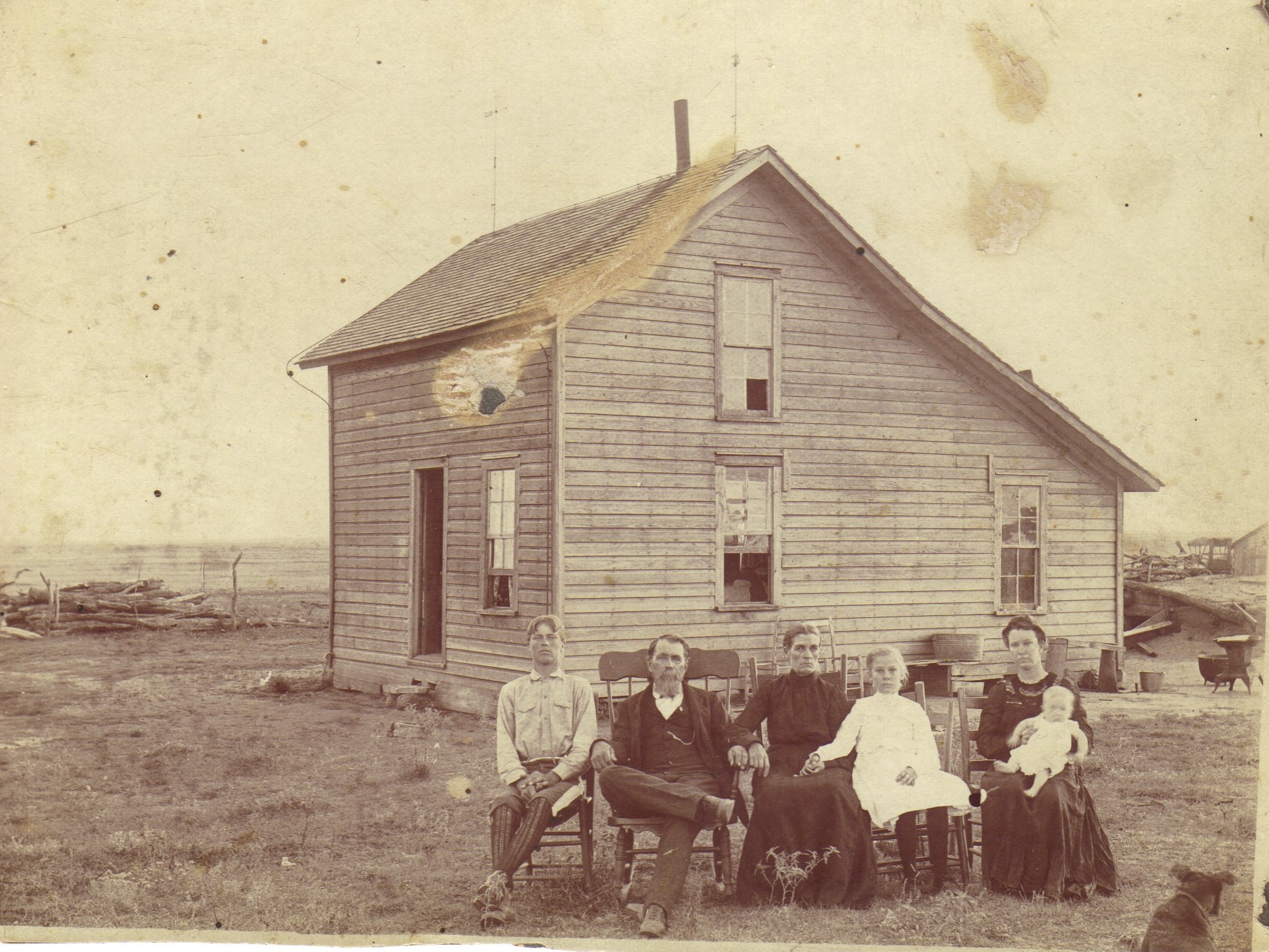
Image: My mother’s grandparents, father, aunts, cousin (who was passed off as an aunt if the rumor is true), and dog in front of one of their early homes in Oklahoma. This family photo and many more are woven into the fabric of Crude.

Viscosity

I wake with a wad of hair in my mouth, thinking about perception: its power in defining how we feel about situations and about people; its power in defining how we are perceived by people and how we come across in situations.

I slept hard. I dreamed hard. In one dream, a group of friends and I were asked to pass up and over a large mountain by way of an asphalt path. On the other side was knowledge. The scene was like an apocalyptic version of The Wizard of Oz. Instead of boulders, trees and greenery, we were surrounded by dark, featureless land, save for the mountain we were on. Instead of a yellow brick road, we walked on a path made from the sticky black material found in crude petroleum.

I have a relative who is a petroleum engineer. When I was a child, he gave me two glass bottles filled with oil. One represented the good oil. It was light, almost golden. The other represented the bad oil. It was dark, like blackstrap molasses. He explained what you could do with each type of oil, what they were good for. As he took a drag off his Marlboro, he explained how we wouldn’t have anything without oil, not even roads. Not even Vaseline. It’s in everything, he told me.

It was then that I perceived oil was a miracle, our miracle. We depended on it; society depended on it.

What this relative doesn’t know is how I would hold those bottles after he was gone, tip the liquid this way and that, judging the viscosity of each by how sluggish their movement was. One moved more like my father, darting quickly at any stimulation or in the face of any problem. The other moved more like my mother, who was slow to respond, slow to rise, slow to move across the room, often without pants on. She was also slow to dress.

How could I not marvel at something this relative gave me—these beautiful representations of the world we lived in and walked on and smeared on our chapped faces and the bottoms of babies. These beautiful representations of what, quite literally, allowed us all to move through the world, to float over it. To hover, to speed, to glide, to ride. Our family could not have had our days at the lake without oil. My mother could not have elongated her body on the speedboat for my father’s snapshots if we hadn’t had the gas to ride into the lake’s middle, where water and surrounding land could frame her.

Nothing on that lake was bad. It is the only place my family was a family. That boat was the only place where I had no fear, and saw no suffering. Until we caught a fish. Then the boat was all suffering. I saw something close to love on that boat, torn free from abuse, addiction and pain. In this way, my family depended on oil. We would not have existed as any kind of recognizable unit without it—both the oil needed to get us to the lake by way of car and the oil needed to suspend us above it by boat.

The bottles were marked with the name of my relative’s company, as well as drilling information. They were objects that stood as placeholders for who this relative was in the world, what he did. But they weren’t just that. For me, they represented love. He loved me enough to think of me, and to bring these bottles that represented him home to me. I could look at the bottles and remember who he was, and where he was, in the world. That he was out there, somewhere much safer than my home, and that he loved me, and that the roads I rode on were a way of being connected to him. Someday I, too, would be out there in the world, safe, perhaps loving someone who was trapped somewhere unsafe.

I started reading the labels of products I used, hoping to find “petrolatum” listed, just as he’d taught me to do. Every time I found that word, I would smile, having found another point of connection to him and his love.

The other day, I was with my partner at a poetry reading. The reading took place in an art gallery. There was a human art installation as part of the current show. I felt happy and safe in the space, and I was enjoying being out with my partner. Then I realized one of the women in the art installation—who was dressed in a costume and wearing a wig—is a poet with whom there is a history, and a deep dislike.

I was no longer in the same space. My heart began to race, I felt nauseated. I was ashamed to be there, didn’t want to be there anymore. The rest of the night was extremely uncomfortable. But what had changed? It’s not like this woman walked into the room, and I could argue that her appearance had palpably changed the room’s “vibe.” She had been there all along.

All that changed was my perception. Nothing else. This proved to me the power of perception and what it can do to our minds and bodies. If I could be happy in that space not knowing the woman was also there, I have the potential to be happy even when my perception shifts. But potential is only potential until it is realized.

Perceptions can change markedly over a lifetime, even if the actualities behind them do no shifting. The question is, what do we do with our shifting perceptions? How do we handle them? The relative who works in petroleum must have some reaction to a world whose relationship to oil is increasingly being called into question and in which more and more oil alternatives are being developed, even here in the oil-hungry United States, whose move to alternative fuels and technologies is as slow as a highly viscous crude oil.

As my relative moves along more and more paths over the globe looking for oil, does he still seethe when people make comments about its dangers and destructions, both to human life and the planet? Does he still rail against those who say we are running out of oil, defiantly stating that we will never run out?

My perceptions have changed during my own lifetime. I no longer believe a family is a family because of how it functions on a boat on a lake on the border between Texas and Oklahoma, aptly called Lake Texoma. What we are as a family depends on how we relate to one another every day—and includes what happens when nobody else is there to bear witness or keep our behaviors in check.

In the dream last night, the one where my friends and I were instructed to walk up over the mountain on our way to finding knowledge, I veered from the group and our issued instructions. I walked down and down to the base of the mountain. Around the back, it was open. The way it had been opened up, the mountain resembled a woman’s stomach and thighs. The opening resembled her partially gutted pelvis. It/she glowed red inside, as if the cavity was filled with blood.

I realized the red color was the glow of a giant fire. All around the base of the mountain were piles of trash and environmental waste. Some men were feeding refuse into the fire while other men stoked the flames. I asked one of them where the trash had come from. He gave no answer but instead told me that this was the real seat of knowledge, not the destination the path above the mountain led to, where the group and I were being steered.

Here is where you can learn everything about us, he said. Right here. He continued shoveling waste into the giant burning pelvis.

Suddenly someone appeared and yanked me back up to the path. When I rejoined the group, I tried to explain what I’d seen. They didn’t believe me. It’s just a mountain, they said. What are you talking about, they asked.

But my perception had been changed, and there was no changing it back. Wherever we were going, it had nothing to do with knowledge. We needed to go down, down.

my relative saw The Wizard of Oz, it was on a black-and-white TV. But something magical happened, he says. At the point where the movie turns from black and white to color, it did so on the television. For years, he insisted the movie turned to color, despite the fact that it was technically impossible for that to have happened.

Perception is everything. Perception is everything.

There are on average 2,600 oil spills per year. On average, 726 million gallons of oil are spilled annually. As of July 19, 2010, between 90 million and 170 million gallons of crude oil have been released into the Gulf as a result of the 2010 BP oil spill. But those are just numbers. I should say something about water, what it means to the body. I should say something about the body, how it yields to oil, succumbs.

First published at Poets for Living Waters.