The Architecture of Mental Illness

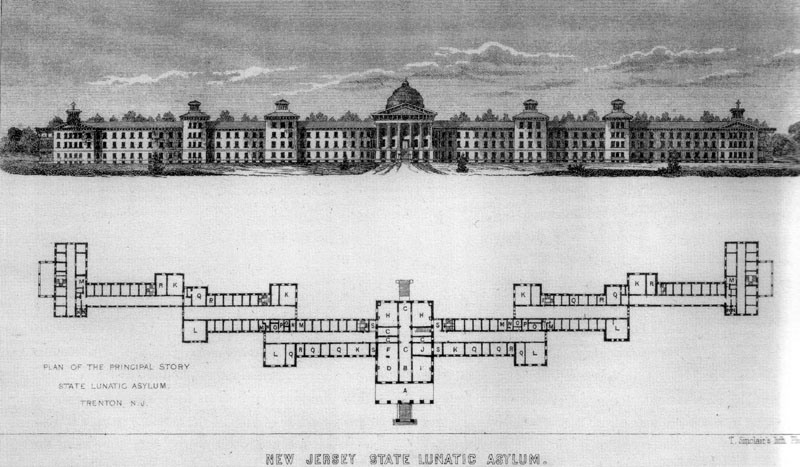
Mental illness has an architecture. That’s part of the story of asylums and treatment in this country. Central State Griffin Memorial, the hospital in my hometown, wasn’t laid out like this, but it had that same grand feel juxtaposed against the lives of those who inhabited the buildings.

Throughout its history, which spans more than a century, Central State’s story has been one of hope, ignorance, dehumanization, and harm: the same story from the asylum era to era of deinstitutionalization to today. I can barely tell any of it but have to before that history is lost. My mother worked there as a nurse and was treated there as a patient. Her relationship with Central State spanned more than three decades. That architecture was in her body, her bones part of the structure of those buildings and that land. Now, we need to make sure these places don’t come back with a new story: one of coercion, exploitation, profit, and greed.

Source: PBS Utah video about The Kirkbride Asylum, which was the template for many other asylums across the country.

Hope Hall

Now, Hope Hall is an empty and quiet place, one where footsteps echo down tunneling hallways. Bob McDonald, who once stayed in an open barrack on the campus, said “the noise level was huge” when patients were “warehoused” in the mental health ward, back in the 1980s and before. Their cries reverberated throughout the building, he said, and patients pounded on their doors. Some had only an eyeball-sized peephole to the outside world.

And more important, perhaps—the patients had little or no treatment for their illnesses. They were the castaways from generations that didn’t understand them. They were locked up and kept out of sight.

From a story about Central State Hospital / Griffin Memorial Hospital, where my mother worked for thirty-five years. We need to seriously evaluate where mental-health care is headed under the July 24 executive order. It’s headed back, not forward. Back to the days of warehousing human beings like sacks of grain. Story link in comments.

‘Socially Dead’ Others

Disability researcher Shuko Tamao on using photos of patients in an attempt to bring about reform in postwar asylums in the United States:

Devoid of any opportunity to communicate their personal experiences, these asylum residents became illustrations on popular magazines and on the front pages of newspapers, serving as vehicles for eliciting the pity of readers. Because the reformers elicited pity for their cause while simultaneously inciting a morbid fascination in their readership, these photographs had the effect of giving their subjects the status of socially dead other, whether that meant a mad other or a racial other.

I don’t know that I agree with the conclusions this researcher draws, but she makes important points. I think the way we receive and perceive visual information is contextual and socially constructed, so it’s fluid and can change over time. The point about not allowing patients to tell their own stories is important, as is the way these patients were used to sell magazines and newspapers, which is another form of dehumanization and objectification. Still, I see value in these images, and I feel each person’s humanity when I look at them. But their use and reception in 2025 is different from the way they were initially used and received in the 1940s.

This article includes a photo taken in the back ward at Central State Hospital in Norman, Oklahoma, where my mother began working a few years later.

From “Picturing the Institution of Social Death: Visual Rhetorics of Potwar Asylum Expose Photography,” published in Journal of the Medical Humanities, September 30, 2021. Link in comments.

Pinfeathers

There are some things you can’t show, things you can’t share once you’ve seen them, so you turn them into a poem, and you can barely do that. Because they happened in the state you’re from. Because they happened in the state mental hospital where your mother worked. Because they happened while everyone looked away. Because we were not much better here in the United States than the Nazis were where those sent to mental hospitals were concerned.

Because in a day room in Taft, Oklahoma, we let a little boy sit wet with his own excrement or urine or blood or all three, a strip of white cloth cinching his arms to his neck. Because he’s not the only boy or the only man in the photo. Because this is what we did to human beings in the 1940s but also now or again or now and again with a new face, a new flavor, a new reason, from a new hatred, a new greed, a new form of consciouslessness.

What did I leave out? That the boy was Black. Everyone in the photo was Black. This was at the State Hospital for the Negro Insane. That’s what they called it. Are you sick yet? Do you want to turn away? You already have, from all of us, as the cages are built in Florida, as we find new reasons to cage. Will PETA come to the rescue? People are animals, too, and being treated worse than animals.

People who cage people are animals in a different sense of the word. They should start an organization called People for the Obliteration of People. POP for short. It has a ring to it. It’s weaponized.

Here, drink from this metal cup. Here, sit on this wooden bench. Here, look through this barred window for the rest of your life. Here, here. Here, here.

The photos I’m looking at include one of the back ward at the hospital where my mother worked in Norman, Oklahoma. These are not easy images to see, but this history matters. What’s been happening to people like me has been happening to people like me for a long time. This country could learn a lot from this history as its pinfeathers break our democracy’s skin.

The Oklahoma History Most Oklahomans Never Learned

On the desegregation of American psychiatric institutions and structural racism in American psychiatry. Link in comments.

Oklahoma,1964: Taft State Hospital was an all-Black facility, with an all-Black staff, located in an all-Black town. In 1940, its 738 patients were cared for by three psychiatrists (including the superintendent), three nurses, and an unknown number of direct care staff, who apparently all lived in one room. In 1949, Oklahoma consolidated the state hospital with the Institute for Colored Blind, Deaf, and Orphans and the Training School for Negro Girls, creating one large facility for Blacks with all manner of clinical needs. Oklahoma desegregated its public facilities in 1964. Rather than admit white patients to its state hospital for Black patients, as most of the other states would do, Oklahoma transferred the Black patients to its two other (all white) state hospitals. Taft was closed in 1970 and converted into a correctional facility, thus confounding in the public’s mind people with mental illness and criminals. (Some state hospitals have converted some of their units into correctional facilities, leading some people to think that psychiatric patients are being held behind multi-layered, barbed wire, razor-topped fences.)