Get in Line, Brian Kilmeade

Days of Bruising in the Sunflower State. Kansas City, Kansas, June 19, 2015.

You want me dead, Brian Kilmeade? Trust me, there’s a psych tech in Kansas who couldn’t agree with you more. This photo was taken three days after leaving KU Medical Center in 2015 with bruises all over my body after being beaten by a psychiatric nurse who also put me in a face-down hold, despite that position being illegal in most states and despite my having asthma. He threatened to hurt me even more if I ever “tried anything.”

What I had “tried” was getting my inhaler because I couldn’t breathe. The staff refused to give it to me, saying it was expired by one day, and they didn’t have orders for another one. I’d just been diagnosed with common variable immunodeficiency by the lead immunologist at KU Medical Center, but the staff in the psychiatric unit said I was making my diagnosis up. I also had thyrotoxicosis at the time, but nobody at KU Medical Center did the simple test necessary to reveal that was the case, even though it’s in their algorithm to test the TSH level of anyone who presents with symptoms similar to mania. The psychiatric unit’s former director implemented that policy.

Photos of these bruises are also on file at Shawnee Mission Medical Center, where social workers from KU Medical Center and a local organization for women took me to document what had happened to me. Of course I never did anything about what happened. Lawyers weren’t interested in my case. The state human rights organization wanted me to tell my story over and over again, which was retraumatizing. And my records from KU Medical Center were not accurate. This incident, for example, didn’t make it into the record. Nor did the EKG they had to do while I was blacked out, which I’m only aware of because I woke with a node still stuck to me. Nor did my being undressed, washed enough to be wet all over, and dressed again, but without my underwear.

The staff withholding my medication didn’t make the record. Nor did the staff throwing food on the floor for me to eat. Nor did two male techs standing in the doorway laughing at me. Nor did a female nurse dogging me in the hall outside my room while saying “I didn’t do anything to you,” as if this absolved her from everything that was done. Nor did the staff hanging up the phone on me while I was trying to call my immunoglobulin company, which I’d been instructed to do to set up my infusion deliveries after I left the unit,* or important organizations like the one that was trying to advocate for me, or my friends, or my family members. Nor did their crushing me in the doorway to the room where the phone was located while trying to remove me from that room. Nor did their playing violent movies in which women were being beaten. There are more nors, I’m sure. But you get the idea.

* Having these infusion deliveries set up was a condition of leaving the unit. The staff repeatedly refused to let me use the phone or hung up mid-call in an attempt to keep me from being discharged.

Updated Immunotypical Privilege List

In 2014, I wrote a piece titled “44 Signs of Immunotypical Privilege” shortly after my diagnosis with common variable immunodeficiency. It’s a compilation of my experiences and those articulated by others living with various forms of primary immunodeficiency. The Irish Primary Immunodeficiencies Association published it on their site and had plans to make it into a brochure, though I’m not sure the brochure ever materialized.

My piece was inspired by Peggy McIntosh’s famous essay, “White Privilege: Unpacking the Invisible Knapsack,” written in 1998. I later updated my piece when “COVID” and “monkeypox” became household names. It’s now titled “46 Signs of Immunotypical Privilege.”

I plan to write a new piece titled “44 Signs of Neurotypical Privilege in the Poetry Community.” It won’t make people feel comfortable. That’s not the point. The point is that it needs to be written, and it matters, and I can’t see how to not do so after what amounts to an executive extermination order against those with mental-health issues. Ask Brian Kilmeade. He sees that order for exactly what it hopes to be and understands exactly what it allows those who hate us through and through to say, including my fellow Utahns.

46 SIGNS OF IMMUNOTYPICAL PRIVILEGE

Every day, as an immunotypical person—

  1. I can go out when COVID is circulating without being in a high-risk category that makes me much more likely to be hospitalized, die, or develop long COVID.

  2. I can go out during flu season without worrying too much about how serious contracting the flu could be.

  3. I can see the exponential rise in monkeypox cases and not worry that I might be especially vulnerable to the disease.

  4. I know my immune system will respond to flu and COVID vaccines. I might even skip vaccination altogether without serious health consequences. Attenuated, live vaccines such as the one for monkeypox are safe for me because my immune system works properly.

  5. I can read about measles resurgences without feeling alarmed. After all, the measles vaccine isn’t contraindicated for me, and I know my body has mounted an immune response to the disease.

  6. I can touch door handles and other surfaces in public without much concern.

  7. If I get a slight cough, I don’t have to worry about it turning into bronchitis or pneumonia.

  8. My health status never goes from relatively normal to life-threatening in a matter of hours.

  9. When I take antibiotics, they work quickly, and I only need one round.

  10. I haven’t been on antibiotics dozens or even hundreds of times over the course of my life.

  11. I’ve never been on prophylactic antibiotic therapy. I don’t even know what that is.

  12. I don’t have to routinely take medicines such as prednisone that weaken my bones and put me at greater risk for osteopenia and osteoporosis.

  13. I don’t have to wonder what comorbidity might be lurking just around the corner and if it will be a noninfectious condition, a malignancy, or an autoimmune disorder.

  14. I’ve never heard the phrase “immune dysregulation” and don’t have to concern myself with what that might mean.

  15. For me, boosting immunity means popping more vitamin C or Airborne. I have no idea what immunoglobulin is or why it’s essential to the human immune system.

  16. When I attempt to eat out, I don’t have to think too much about how long items are left on buffet tables or how well food is washed and prepped by food handlers.

  17. When I’m out in public, I don’t have to worry when people cough into their hands or without covering their mouths.

  18. I can be sure that, when I go to classes, movies or restaurants, I’ll find a place to sit in which I’m free from issues that exacerbate my breathing problems, such as perfumes, fragrances, and cigarette smoke.

  19. I know I won’t have to pass on social activities because they would put my health at risk.

  20. I know family gatherings won’t pose a threat to my health, even if young, potentially unvaccinated, children are present.

  21. If someone I love is in the hospital, I don’t have to think about when I can visit, how long I can stay, or other health considerations. I can fully focus on that person and their health needs.

  22. I can attend school, have a full-time job, raise a family, and engage in recreational activities without also having to manage the many conditions that would affect me if my immune system didn’t function properly.

  23. I can leave meetings, classes, and conversations and not feel excluded, fearful, attacked, isolated, outnumbered, unheard, held at a distance, stereotyped, or feared because of my immune system.

  24. If I pick up a magazine or watch television, I’ll see images that represent me and my experience of my health.

  25. I never have to speak on behalf of all those who are immunotypical. My thoughts about my immune system can be my own with no need for political alliance relative to my immune function.

  26. My actual and potential contributions to society will not be challenged because of my immune system.

  27. I can go for months without thinking about or being spoken to about my immunotypicality.
  28. I’m not identified by my immunotypicality.

  29. I won’t lose friends who can’t relate to what I’m going through, who think I’m exaggerating about my symptoms, or who just can’t deal with having a friend with my health status.

  30. I know I won’t be discriminated against by employers who neither understand my condition nor have the desire to provide a reasonable accommodation, despite the legal requirement that they do so.

  31. I don’t have to be afraid that, when I talk with others about my health, they will suggest unsolicited supplements, dietary approaches or exercise programs.

  32. I won’t be told by friends, family, and even uninformed members of the medical community that my condition is really just a psychological problem such as anxiety or depression.

  33. I know nobody looks at me and makes assumptions about why I appear to be ill (or well), or why I am too thin (or too heavy), or why I am not fit (or manage to stay fit despite my illness), or why I do (or do not) eat what I do (or do not) eat.

  34. I don’t have to explain why I have a lingering cough, why I might sometimes need to wear a mask in public, or why situations and settings that are safe for others may not be safe for me.

  35. Because I have never had to wear a mask in public, I have never been asked to leave a public place because the manager or owner of the establishment believes I am putting others at risk, when in fact the mask is to protect me from the pathogens others carry.

  36. I don’t have primary immunodeficiency, so I never encounter people who make the assumption that, despite the condition being genetic, I somehow brought it on myself through my diet or lifestyle.

  37. People aren’t embarrassed to be seen with me because of my health status.

  38. When I talk about my health, I can be certain that friends, family, co-workers, and others won’t become uncomfortable and change the subject.

  39. My partner doesn’t suffer from undue stress and hardship because they’re my primary or only caretaker.

  40. Nobody tells me I should feel lucky to have primary immunodeficiency because it means I don’t have to work or accomplish anything during my lifetime.

  41. My doctors have seen a lot of patients who are immunotypical. This means I’m not put in the position of having to educate them about my immunotypicality, since they’re already familiar with it.

  42. When I present in a health crisis at the emergency room, I’m given prompt medical treatment, not told I’m merely having a panic attack.

  43. I’ve never had the experience of being misdiagnosed over and over again throughout my life.

  44. I don’t have old misdiagnoses in my medical record that can’t be removed without a great deal of time and effort on my part.

  45. I don’t have to deal with the financial burden of expensive, ongoing medical care and therapy.

  46. I don’t have to face insurance companies that must review coverage for my life-saving therapy before that treatment is approved; that sometimes make patients go off their therapy for months in order for those patients to prove they still have the condition; and that sometimes deny therapy because they don’t feel the patient is ill enough to warrant it, despite documentation to the contrary in the patient’s file.

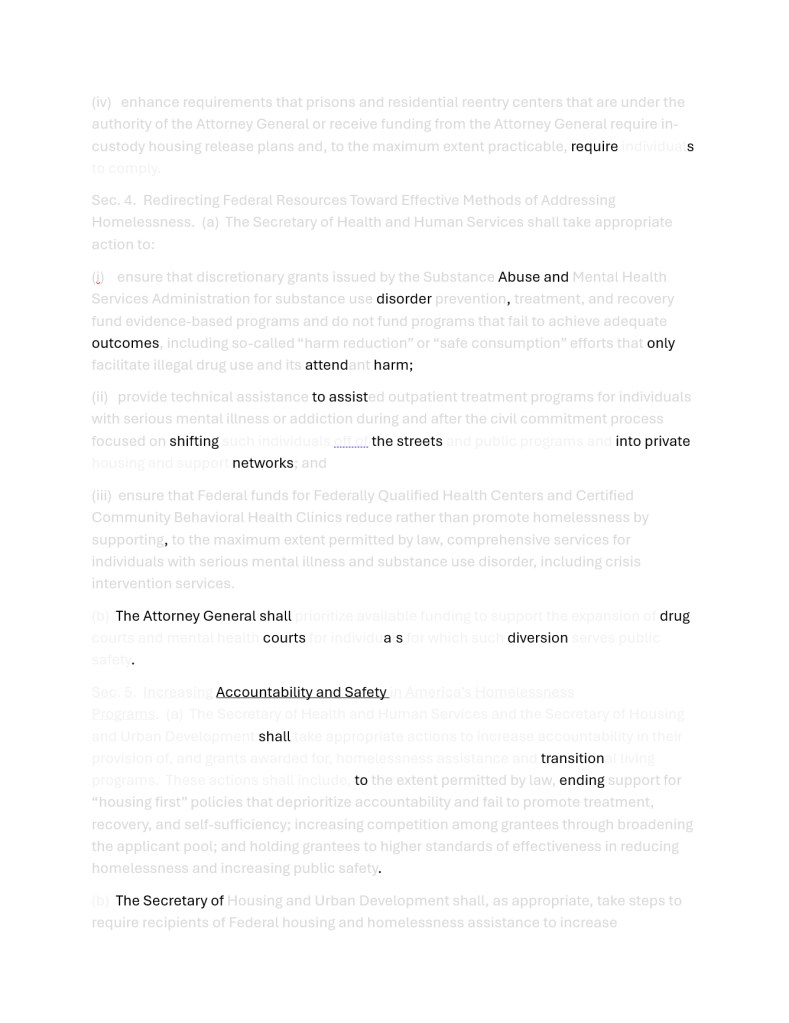
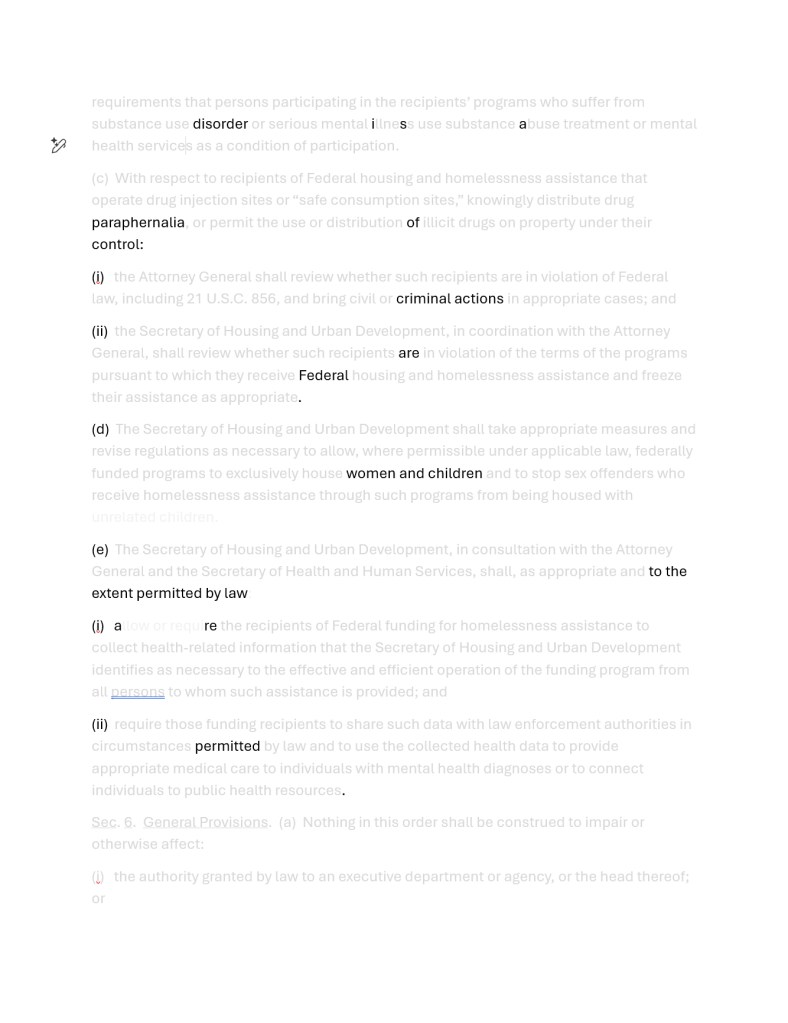
July 24 Executive Order Erasure 2

Given that Fox News host Brian Kilmeade just called for people who are unhoused or have mental-health diagnostic labels to be killed by way of involuntary lethal injection, I’m sharing two erasure poems that use the July 24 executive order as their source text. Nobody, including poets, seems to be aware of the existence of this horrific executive order. This is the second erasure.


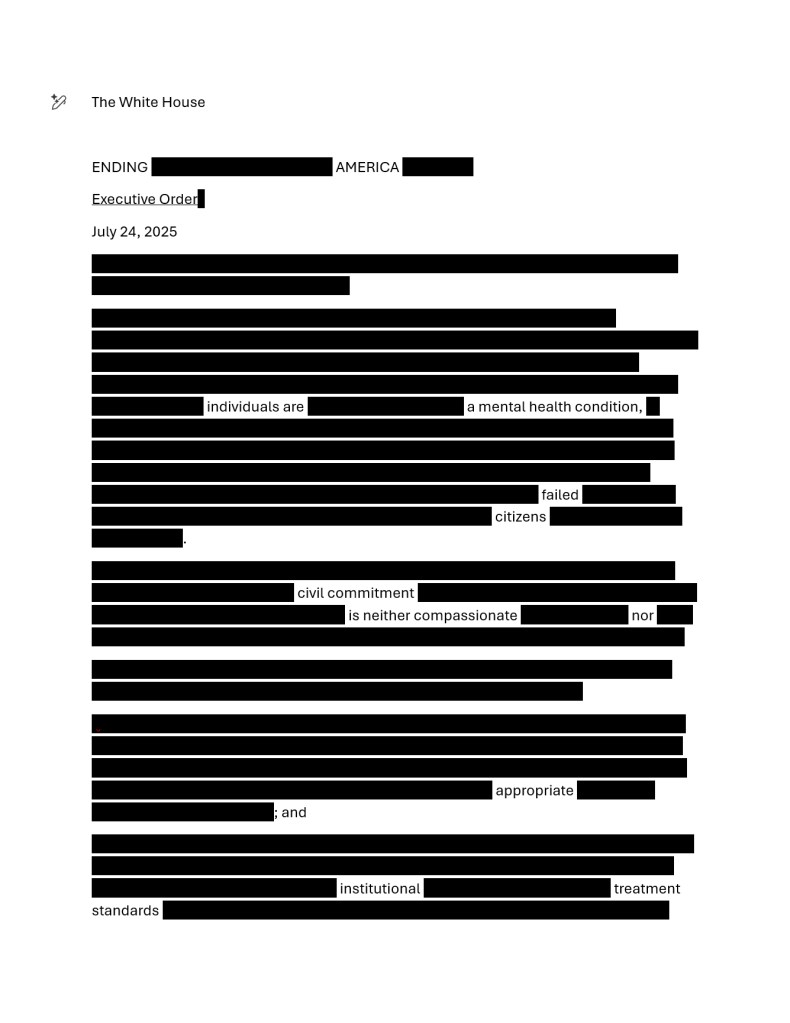
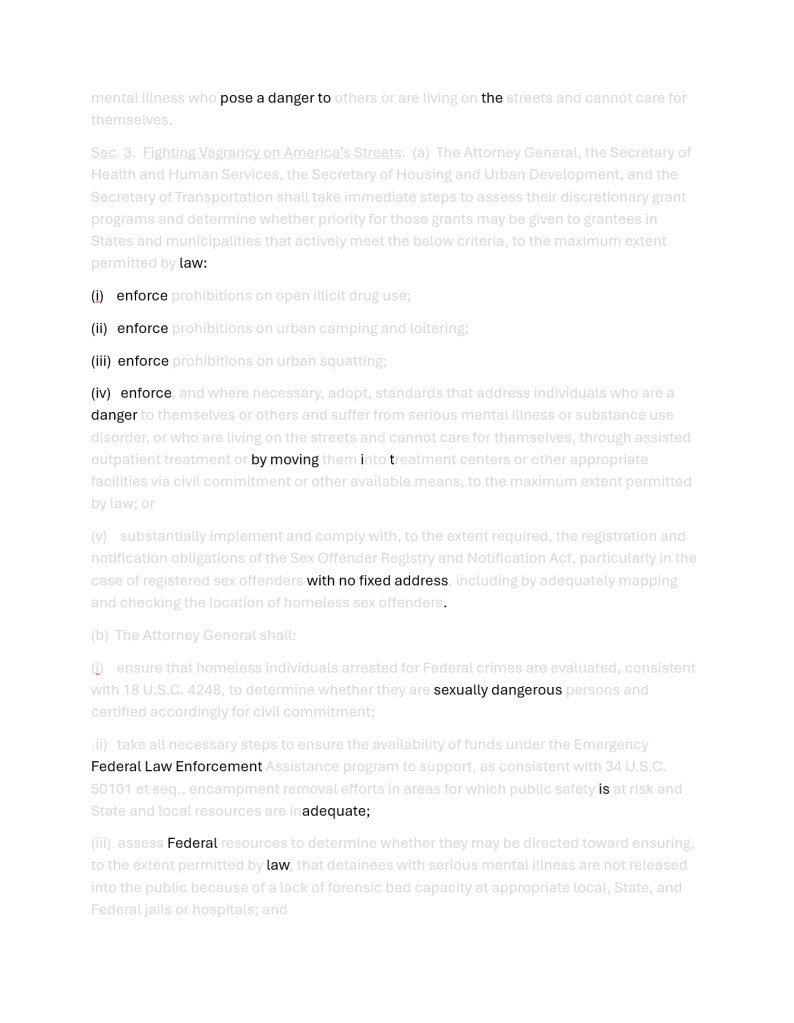
July 24 Executive Order Erasure 1

Given that Fox News host Brian Kilmeade just called for people who are unhoused or have mental-health diagnostic labels to be killed by way of involuntary lethal injection, I’m sharing two erasure poems that use the July 24 executive order as their source text. Nobody, including poets, seems to be aware of the existence of this horrific executive order. This is the second erasure.