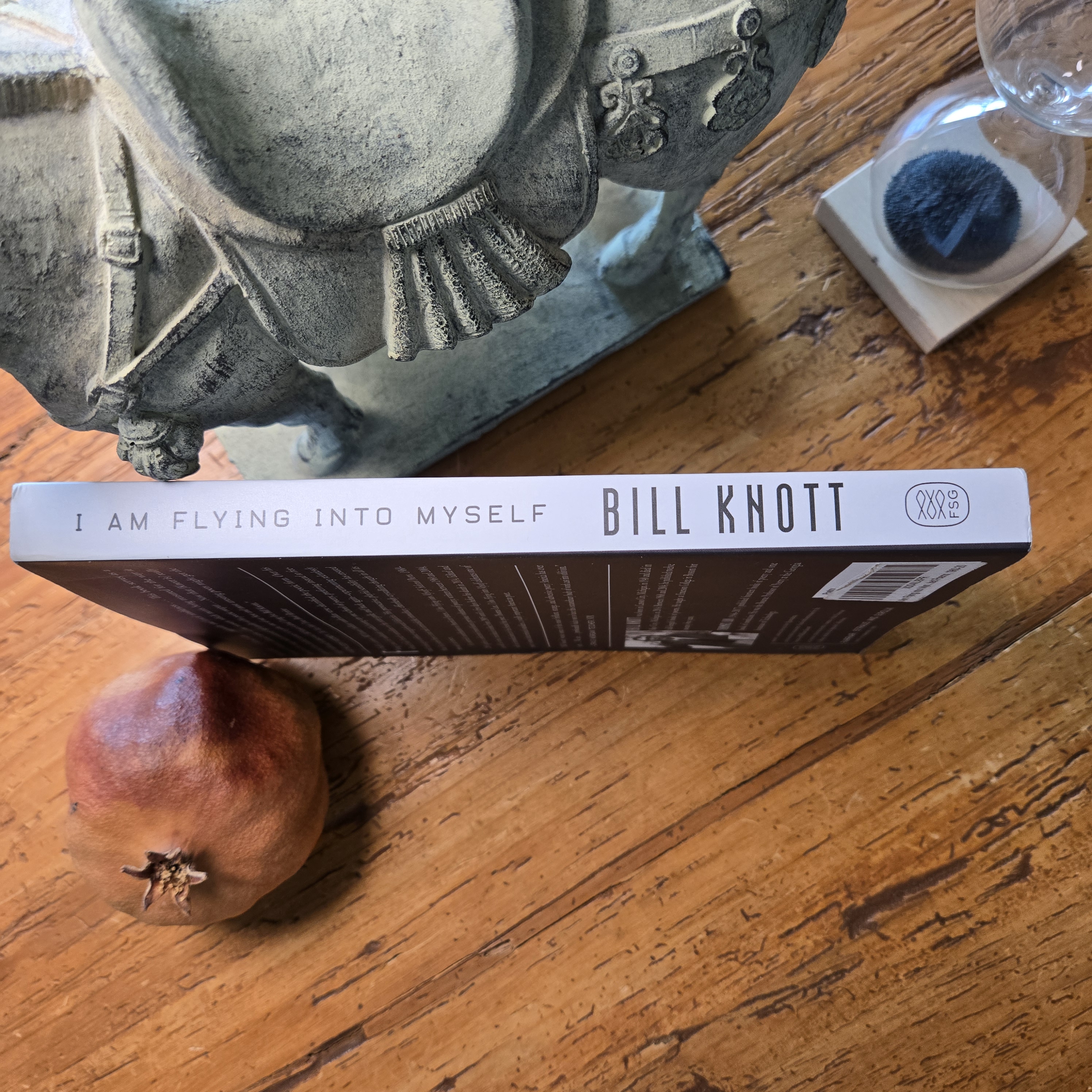
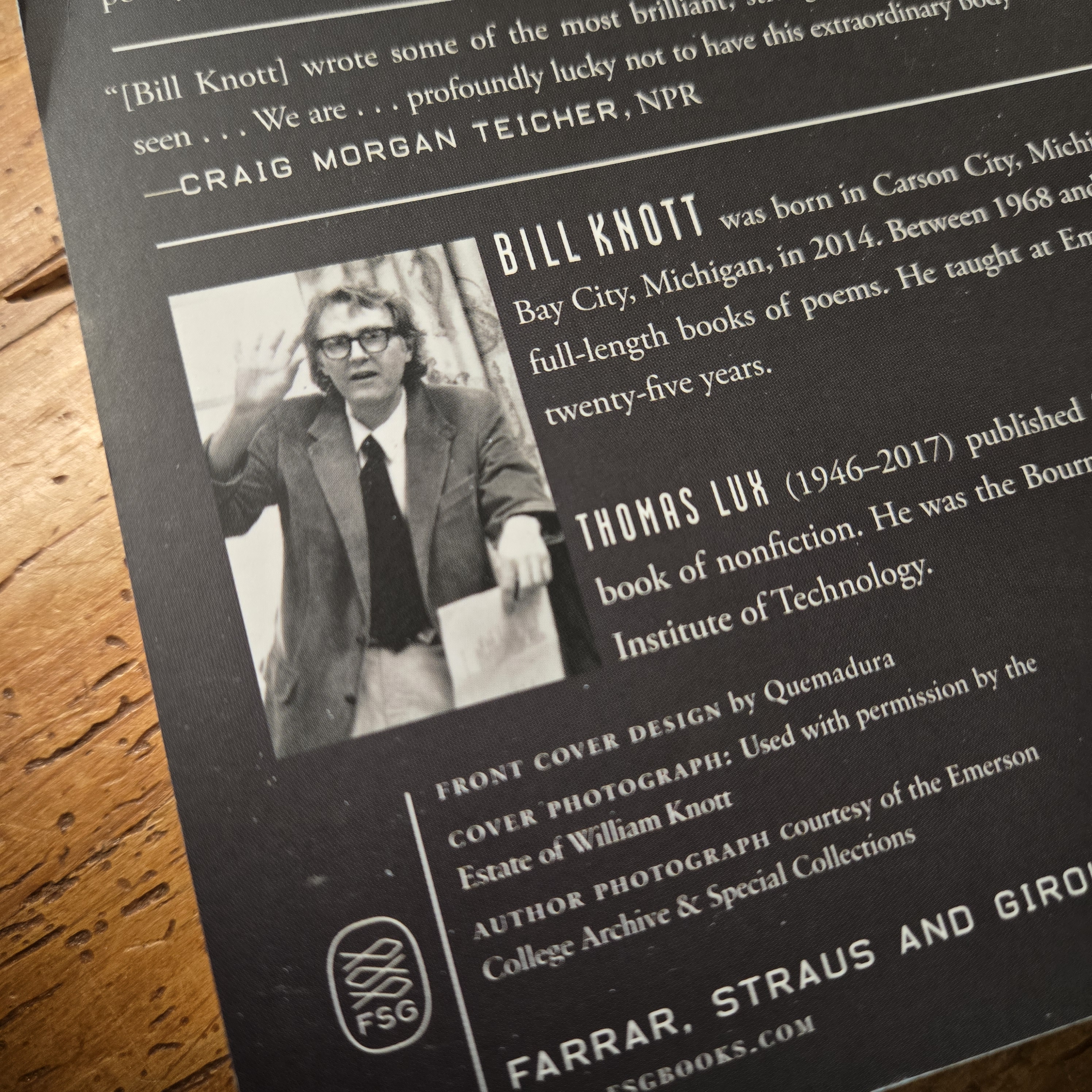
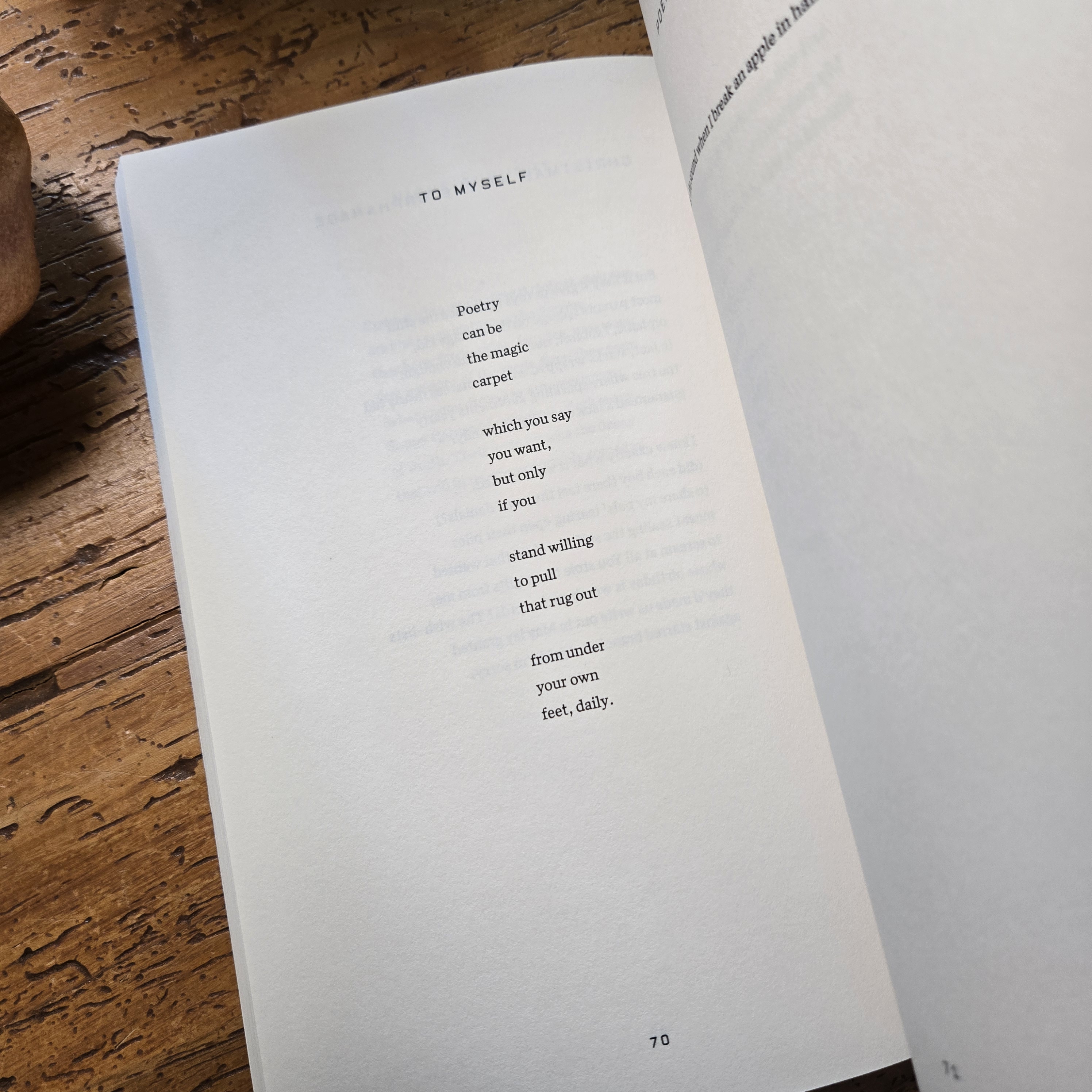
Images: 1. I Am Flying into Myself: Selected Poems 1960-2014 standing perpendicular to my desk with a dried pomegranate, a horse sculpture, and an hourglass. 2. The author image on the back cover of the collection. 3. A page from the collection.
Images: 1. I Am Flying into Myself: Selected Poems 1960-2014 standing perpendicular to my desk with a dried pomegranate, a horse sculpture, and an hourglass. 2. The author image on the back cover of the collection. 3. A page from the collection.
What my last post is leading me to is the understanding that I matter, meaning my voice matters, my perspective matters, my experiences matter, and my identity matters. That’s true for everyone, and it’s also true for me. Reading Andrea Gibson all day yesterday led me here, to a place where I can say That’s true for everyone, and it’s also true for me. In my case, those are easy words to say but hard ones to believe.
What’s also true is that I have a new intersection to consider, one that will guide me as I continue to share my poetry. I want to find publishers who like my work and also want to support my being in poetry. I want my voice, perspective, experiences, and identity to matter to those publishers, not just the work that stems from those things. This is especially important as I try to find homes for my manuscripts.
Right now, I feel that level of support from several publishers, including Chiron Review, Meat for Tea (both the review and the press), Moon in the Rye Press, The Nomad, ONE ART, and Thimble Literary Magazine. Each feels like it’s saying why I write what I write matters, not just what I write. Given what I’ve come through in poetry and in life, that’s important to me.
I don’t want to publish with folks who dislike me or just tolerate me. Once they know a little bit about who I am, I want them to feel like it’s important to include me in poetry, on and off the page.
Hi, I’m Dana. You may wonder how I got myself into this situation. Not really. That’s just a silly introduction. Speaking of which, consider this my introduction post.
For starters, I’m trans, specifically nonbinary, also known as enby. I’m queer, specifically ¯\_(ツ)_/¯. That’s been shifting over the course of my life, but I’ve mostly landed on asexual with hints of bambisexuality.
I’m female-bodied and am treated like a female—at least in terms of what we’ve collectively decided female-bodied and female mean—including the very not good ways those perceived to be female are treated. In college, I largely wore tuxedos I found at thrift stores, and I had short, blond, young Mary Stuart Masterson hair. That’s the only period in which I was routinely mistaken for a boy, a little English schoolboy to be precise.
What you don’t know is that I’m in drag all the time, and I like it. The man in me likes it a lot but would also like a beard and a man bun and to be totally ripped, which is how I came to marry the man I wanted to be, who eventually lost his hair, so no man bun, but who has a beard that makes him a total snacc and who also has nice guns. I mean whatever those arm muscles are, of course. We are gun-free people. Biceps. I think that’s what I mean.
I live with complex trauma. I’ve experienced abuse and violence on too many occasions for me to count, in part because I have dyscalculia, as you’ll learn below.
I live with bipolar. I’ve known the world through the lens of psychosis, though only for a tiny fraction of my days, thus far, on Earth. That lens has taught me a great deal about terror and its origins but also about love and its origins. Extreme states are extreme but not without meaning. We are meaning-making creatures, after all. We do what we can with what we’re given.
I was given words, which is a tremendous thing. I took them, actually. They weren’t given to me. You’re about to learn about my dyslexia. What that means is language was a fight, and I fought for it. That’s why I won’t give it up again, not even when poets and writers and the systems they inhabit behave badly.
I have learning disabilities, including dyslexia and dyscalculia. (I told you I was about to talk about them.) My spatial reasoning skills are top-notch. I’ve been tested. But my body in space is another matter entirely. I knock about is what I do. I’m dizzy a lot. I fall, literally. I get up.
I just read dizzy as fizzy because of my dyslexia. That’s funny. The idea of being fizzy is a hoot.
When I was younger, I could do calculus but cannot count well at all ever, which is how I once ended up in trouble with the IRS because of how I subtracted something I should have added. They were very prickly about it. I’m not an institutionalist, but I didn’t like being treated like I was trying to rip off an institution, either. My father was a crook. I’m sensitive about being accused of similar behavior.
I’m neurodivergent in other ways and not about to give up that label because some folks in the communities I inhabit don’t like it. I’ve started using a Hannah Gadsby voice as I type this, just to illustrate one of the many ways in which my neurodiversity makes itself known, even if only to me. This introduction is a lot funnier in that voice. I like the idea of Gadsby being here with me right now. It’s been a hard night. Let’s get Andrea Gibson in here, too. There. Do you feel that? They’re the keto bread to my plant-based, thinly sliced protein, but not in a Bambi way, just in a support-system sandwich way. Nom nom nom.
Most of my name is not what I was born with. My other names are my dead names. My legal name serves me better, represents me better. I may not be able to vote because I changed my name and not because I got married to the man I wanted to be. He’s a good life partner after more than three decades of trying. I’m a good life partner, too. I’m serious. I’m not even sure I want to be him anymore. These days, I’m busy being, and becoming, me.
I forgot to tell you about all my medical issues, including rare diseases that pedal wave inside me like various and sundry nudibranches. Just imagine them like that, not like what some of them actually are, which is life-threatening.
Oh, and I’m a flutist, essayist, poet, birder, and weaver who loves the world and all living beings, which is why I’m so damn vocal about everything. I’m bound to frustrate you, confuse you, or piss you off at some point if you don’t beat me to the punch. Some of those frictions will be superficial. Others may cause deeper wounds.
That’s it. Me in a nutshell. My story or my personal brand or whatever. This is the poet you’re supporting if you support me. I think I’m worth supporting, so give it a go.
I just read one of the most sanist, ableist things I’ve ever seen on Facebook. I am awake and alone and it’s the middle of the night and why do I even try is all I can think. Why do I try when it makes no difference? When folks like me are detested, seen as less than human, when everyone piles on as soon as one person gives the green light to do so?
I don’t know what to say. I am crying and shaking. The person, a writer with whom I share almost 250 mutual friends, is upset because his friend is experiencing psychosis. Folks should read his post and his comments and the comments others have made. Then they should set their own biases aside and imagine someone talking about them that way.
I left my own response in the comments, which I’m sharing below. Fuck sanism. Fuck it. We deserve better, especially from our fellow writers. This writer is wrong. He’s doing immeasurable primary and secondary harm.
—
I’m an advocate for those with mental-health issues and have lived experience myself. I know you’re upset, but I encourage you to find your own center here and situate yourself within a framework of understanding and compassion.
I don’t always love NAMI, but they have support lines for loved ones who are dealing with situations like the one your friend, and by extension you, are going through. You can call them day or night. I encourage you to do so before you do secondary harm to others, like me, who are reading your words and feeling your disgust and hatred for folks like us.
If you wouldn’t say it about a cancer patient, don’t say it about someone experiencing psychosis. It’s dehumanizing and may take someone’s last hope and remaining dignity away. Your words are doing that for me right now. I’ve survived a lot. I’m in tears. You’re saying the part out loud that everyone thinks about us no matter who we are, what we do, what we accomplish, or how much we try to educate others through art and advocacy.
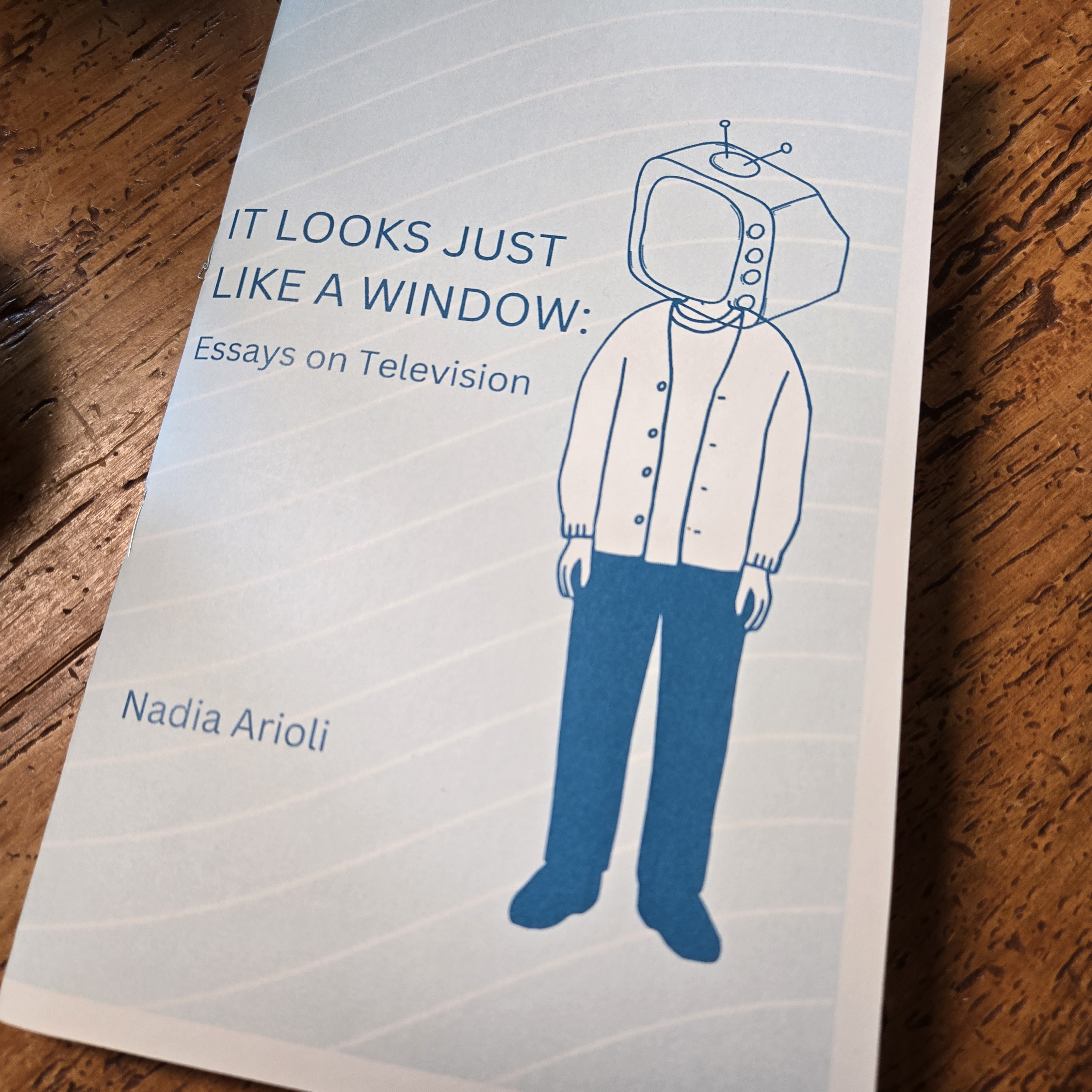
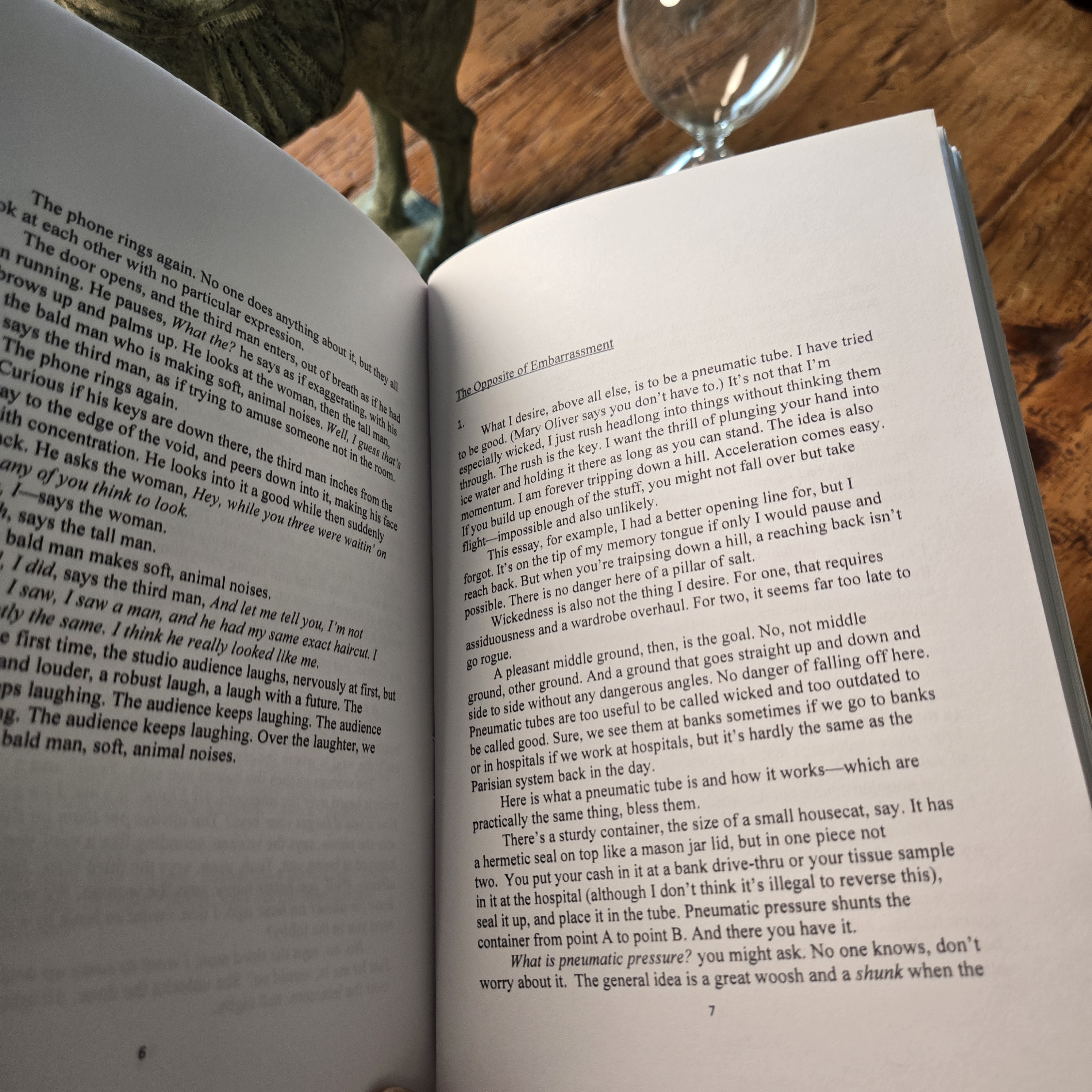
Sometimes, you think wanting to be the cylindrical carrier in a pneumatic tube system—maybe like the ones at Security National Bank or Anthony’s in your hometown—makes you strange and unrelatable. But then one day, you’re reading an essay whose author says what they desire, above all else, is to be a pneumatic tube. And you think, wow. And you think, yeah. And you think, suddenly, this is a world I may actually belong in.
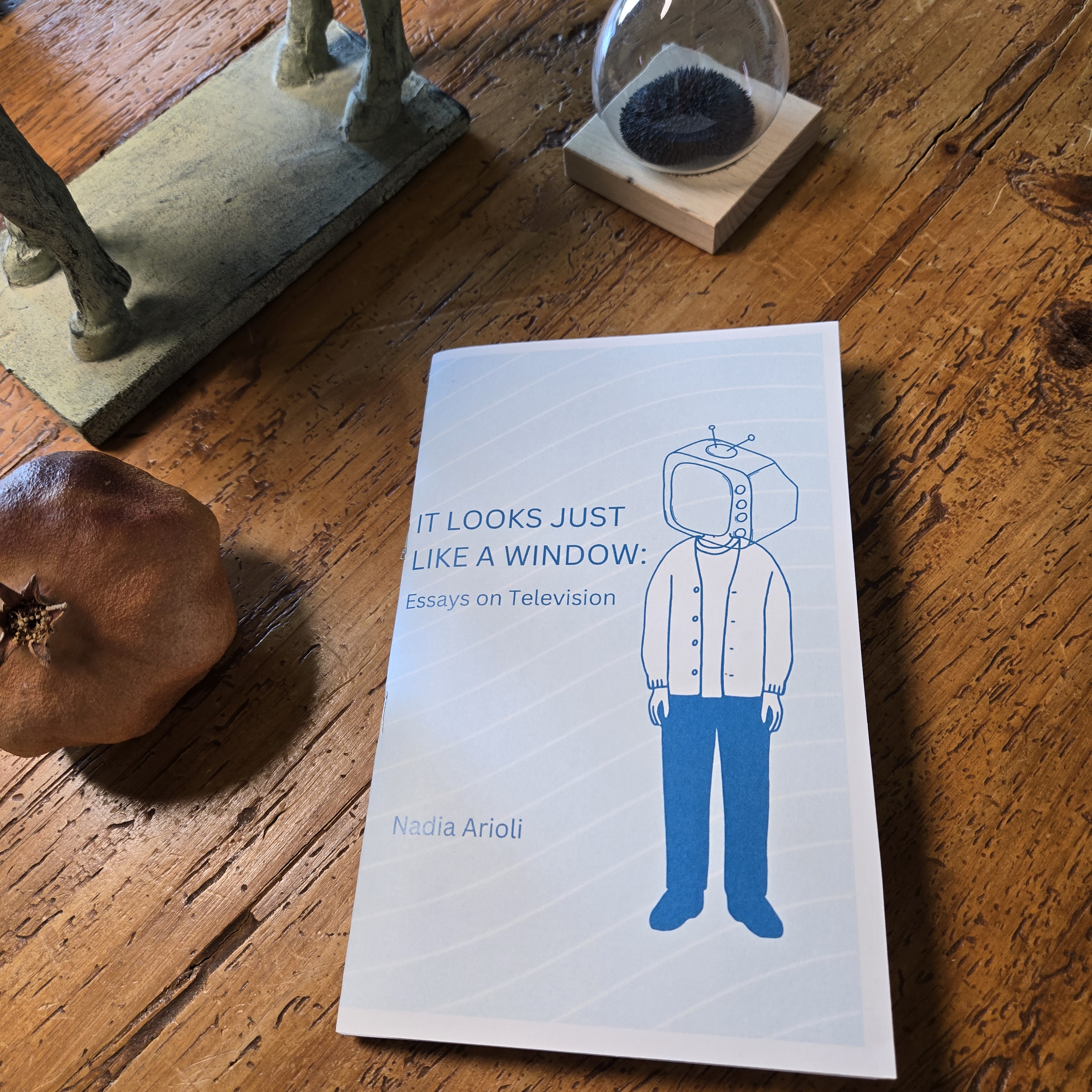
The author of that essay is Nadia Arioli. The collection it appears in is It Just Looks Like a Window: Essays on Television, from Kristy Bowen’s Dancing Girl Press. It’s really good, really really good.
It would be good even without the pneumatic tube, but it’s even better with it because now you know someone has thought about being a pneumatic tube the way you’ve thought about being a cylindrical carrier in such a tube, and you feel a little less stupidly alone and also grateful to spend time in these essays which, to borrow a word from Arioli, are “liminous” (not to be confused with luminous): each piece a pass-through place, each paragraph a doorway full of light.
—
Images: 1. The front cover of It Just Looks Like a Window: Essays on Television. 2. Interior pages from the chapbook. 3. The chapbook with a dried pomegranate, a horse sculpture, and an hourglass. 4. The dried pomegranate.
The life partner sneaked off and got some pizza yesterday from this place when he was supposed to be going to the gym. It was some kind of partner alone time with pizza thing that I wasn’t allowed to participate in. I guess he felt guilty, so he brought me some pizza, which was small and cold and covered in onions and not at all keto, and I ate it because of course I did.
Within hours, I was dizzy and felt super weird, so I ate a whole thing of chocolate hummus right before bed because I thought it might help, which as it turns out is ten servings, not five like I thought, but whatever, and then I went to sleep and had disturbung dreams that I did in a disturbing way, which only happens when I’m stressed. I was flying around on my back refusing gravity, sort of superhero-like, but my foe was just some Costco employee who didn’t like neck tattoos with queer messaging.
I woke up and then started back in on the dream before I felt like I was even asleep again. I do not like it when that happens. I woke up again and checked my fitness watch only to see that it wasn’t pairing with my phone. I tried to pair it because I am governed by these technologies, and the phone decided to pair with my walking pad, which started beeping and flashing its lights unsettlingly like a digital presence being birthed into something that approximates being.
All of this of course woke my dog up, who then needed to potty outside, and so here I am, bloated, dizzy, and suddenly playing with my Magic 8 Ball at 2 a.m. and not liking what it’s telling me about poetry while simultaneously watching the news and not liking what it’s telling me about the world.
In the dream, I could fly horizontally really fast in the lavender Converse high tops I had in the 90s, but when I got to the woman from Costco, I would stop suddenly and hover midair, my feet inches from the woman’s face, and I would be mad that something was keeping me from crashing into her feet first. Now, I have to sit with that part of me, a dream part but still a part, and I also have to sit with the fear that my dog has cognitive decline because the walking pad may have woken her up tonight, but she’s been waking up in the middle of the night like this a lot lately. Right now, she’s pawing at me and wanting to play. I love her so much, more than those lavender high tops, and more than flying in dreams without the violent impulse behind the flying, and more than my smart tech that’s got me doing its bidding in the middle of the night, and maybe even more than the moon and the bats and the creek and the laccolith put together.
I mean, I love my dog and don’t know why she’s never in my dreams. It’s always some stand-in, like my childhood dog or a dog I don’t know who’s supposed to be her but isn’t. I want to be able to visit her in dreams every single night so we’re always together now and for the rest of my life.
I shouldn’t have had that pizza. Or that chocolate hummus. I am puffy and emotional, beyond the degree to which I am typically these things. It is dark. Even the walking pad has gone back to sleep. Something appears to be on fire on the news. The Magic 8 Ball says Outlook Not So Good. That should be on all the faces of its floaty thing these days. Outlook Not So Good. Outlook Not So Good. Outlook Not So Good. That floaty thing is an icosahedron, so I should technically say Outlook Not So Good twenty times, but I’ll spare you. Five times is already four times too many.
P.S. I also sat in the pizza somehow. A little of it. Messed up my workout jeans. But I took my shirt off, drank some milk, and listened to Kid Rock, which made everything OK.
Because Knott’s early life took place in various institutions, and because their confines would have seemed insurmountable, it shouldn’t be surprising that he viewed the poetry world with suspicion and contempt. After all, institutions were his only experience of organizing the chaotic world, and those institutions did not treat him well. — Sandra Simonds
I’ve been thinking about Bill Knott again. I feel this. I really do. Institutions have not treated me well, either, whether familial, social, political, religious, educational, or governmental. Read Simonds’s essay on Bill Knott on the Poetry Foundation’s website.
My father and his friends destroyed my childhood innocence. The poet who sexually assaulted me destroyed the innocence I reclaimed in adulthood. He did it in part by making me talk about how my father and his friends violated me while he violated me. I know you don’t want to hear about that. I know nobody wants to hear about that.
Maybe you want to write your poems. That’s what I want, too. Maybe you want to see your work in the world because you believe it could help others—and you for that matter. That’s what I want, too. Maybe you want to belong to something and feel proud of what you belong to. That’s what I want, too.
If there’s a difference between us, my guess is that you’ve been heard, believed. Or that what happened to you isn’t what’s been happening your whole life. Or that you found poets who are safe, kind, welcoming. Or that you conjured some kind of flint to restart the fire of your life.
Years ago, Tyrone Williams wrote that the poet who harmed me (and others) suffered two “deaths”—a social death and a cultural death. If Williams were still alive, I’d tell him what I suffered: one life I can’t even stop living, one life that feels like an emotional and physical battle every day, one life where I’ve lost trust in everyone, one life that just won’t end.
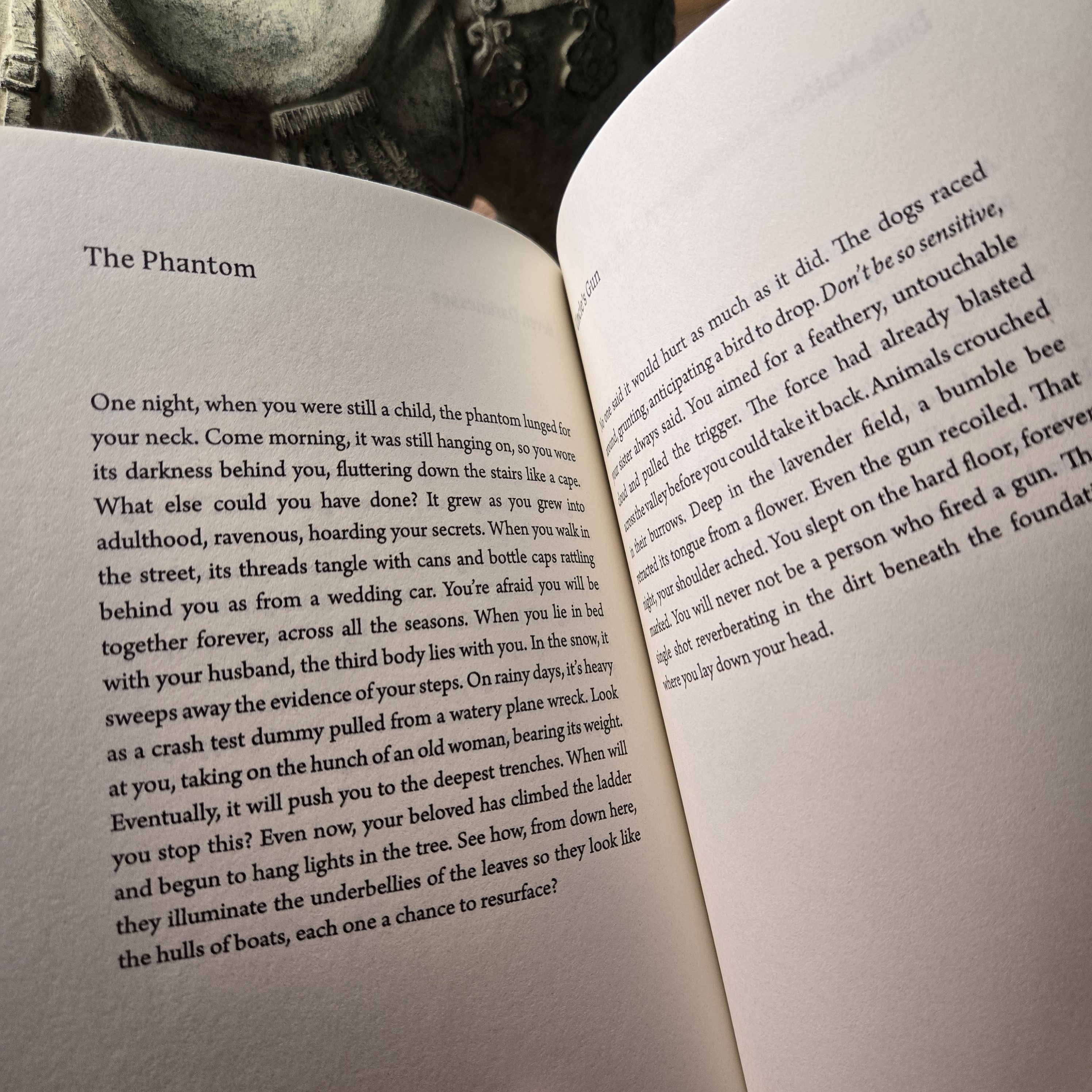
These poems have a feel for me, a texture. Take the opening lines of “MRA Machine”:
Strapped inside this bright rocket, you are a spirit ready to be launched toward the light.
Do you feel that? In the pacing, in the sound? There’s fear, but there’s also something soothing about the language because of its music.
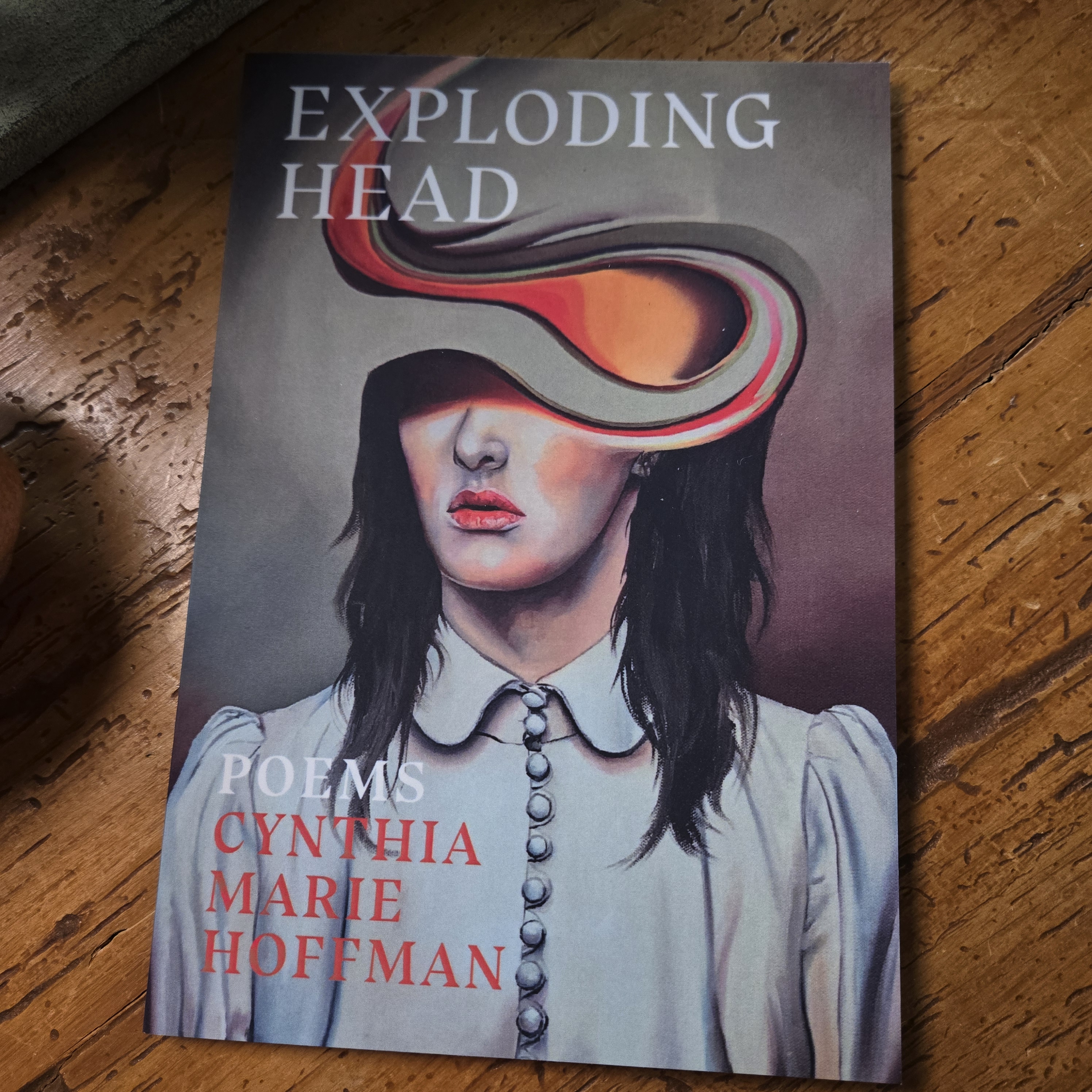
In Exploding Head, Hoffman’s prose poems feel like the warp of the subject matter coming together with the weft of the language she uses—language that, in her words, both opens up and clamps down hard. Reading the work is, for me, like running my hand across the face of newly woven fabric, nubbins and knots and all. I’m talking about poems that drape, that shoosh or scritch, that become something sensual, that conceal and reveal. I’m talking about a poet who can make a poem into a garment woven from different types of yarn that readers can step into and then back out again, both ourselves and not ourselves—the you in the poem an internal conversation in second person but also us if we allow ourselves that moment of extension into and beyond, which I willingly and gladly do. What is poetry if not a way to experience the world through a consciousness and creative expression that is not our own?
These poems sley the reed, thread the heddles, and follow the fell line as they take shape on the page as blocks of memory, experience, imagination, and disquiet.
—
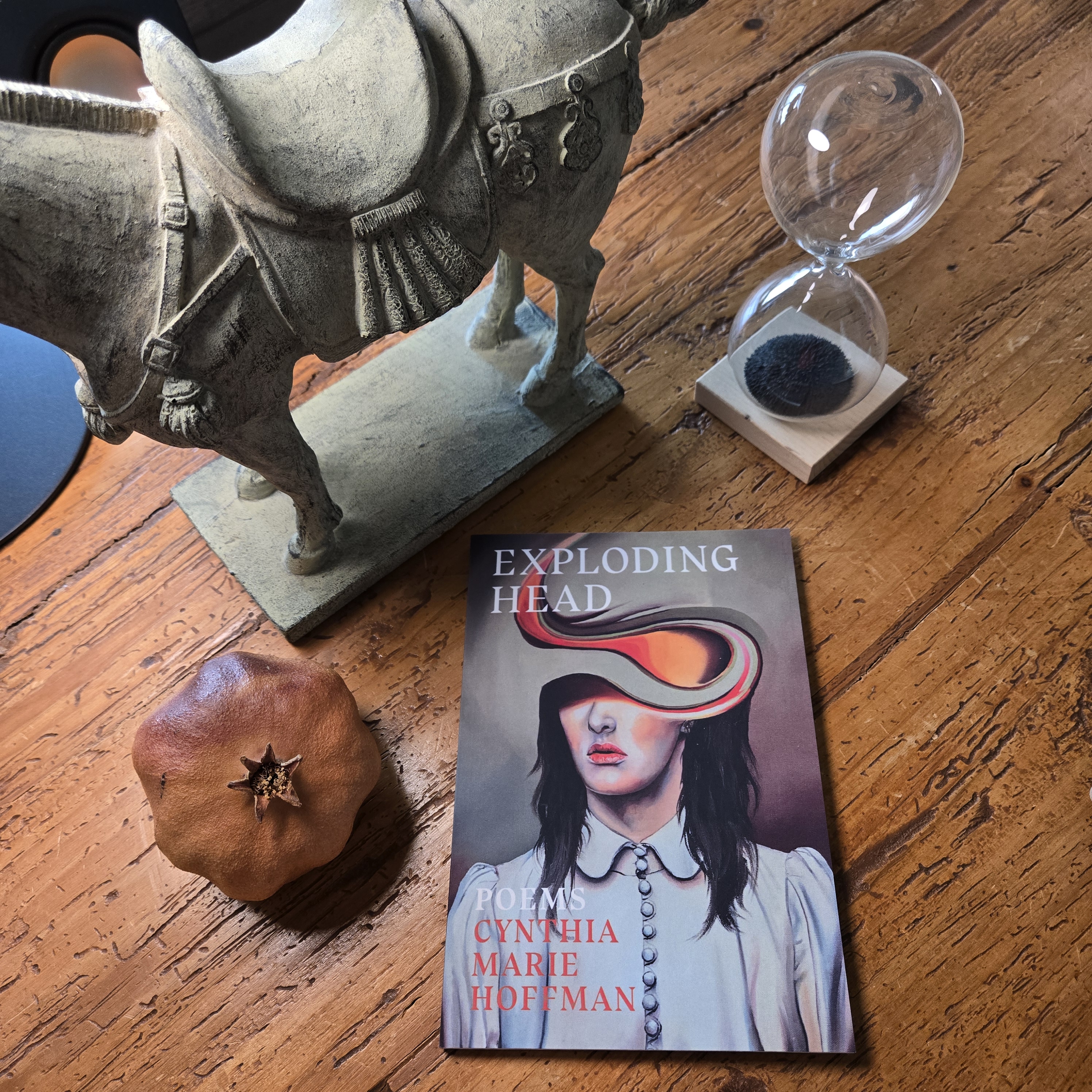
Images: 1. The front cover of Exploding Head, by Cynthia Marie Hoffman. 2. Two interior pages from the collection. 3. Another image of the front cover of the collection, along with a dried pomegranate, a horse sculpture, and an hourglass.
 Dana Henry Martin