Spring in Salt Lake City

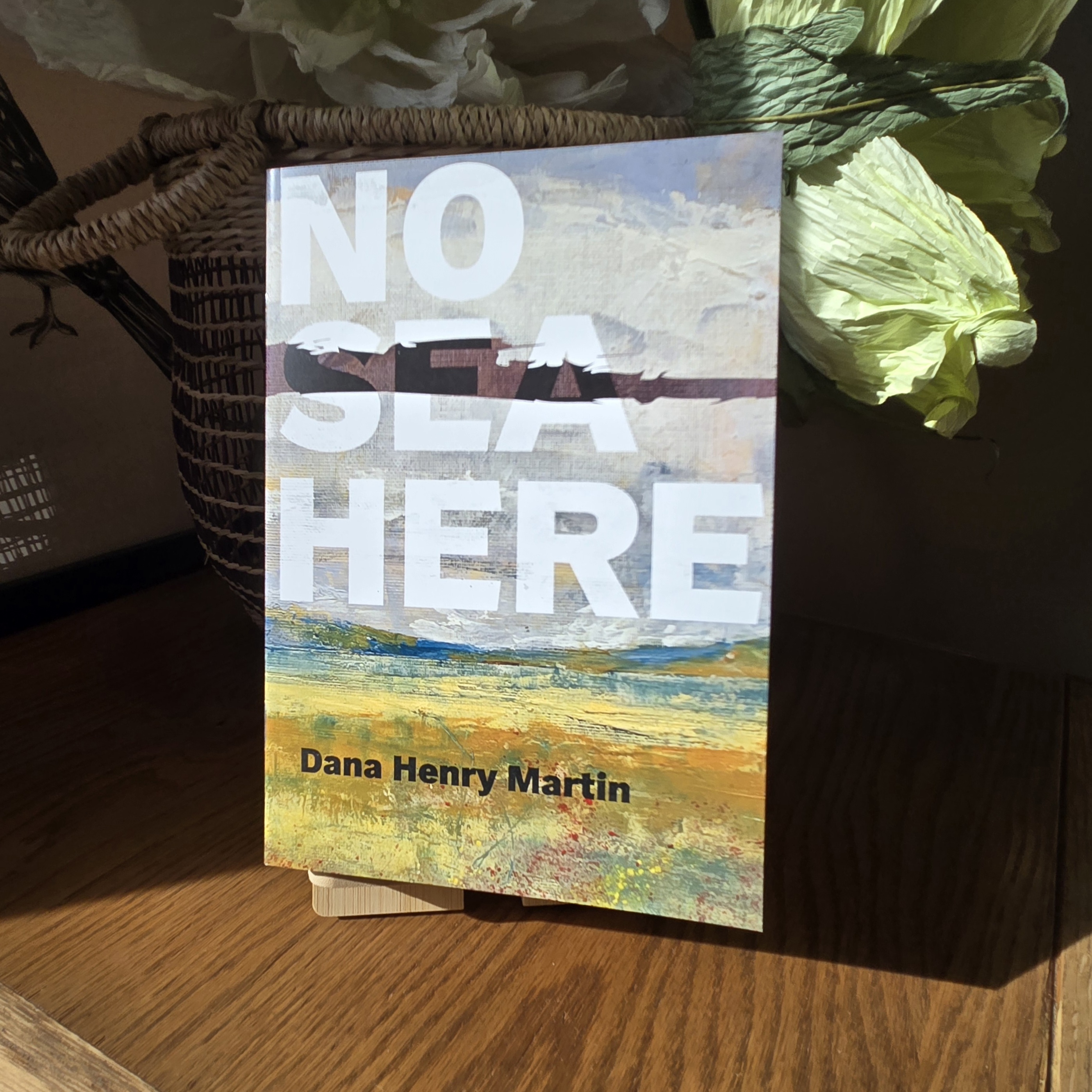
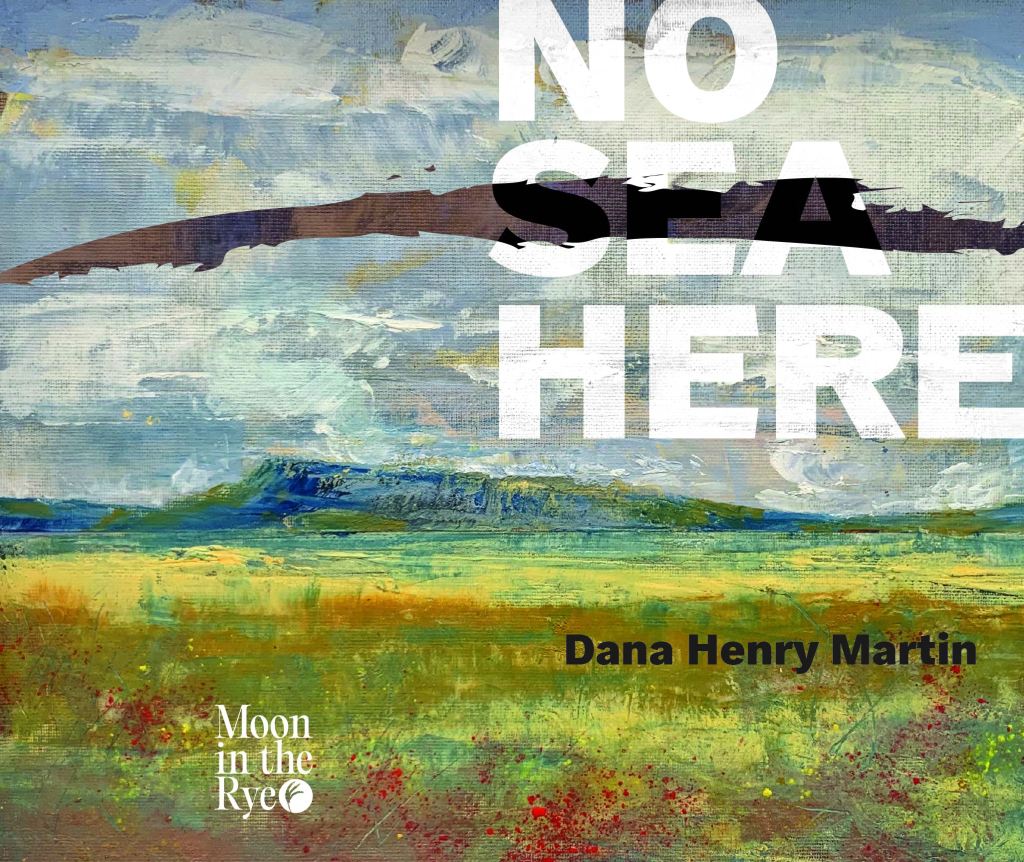
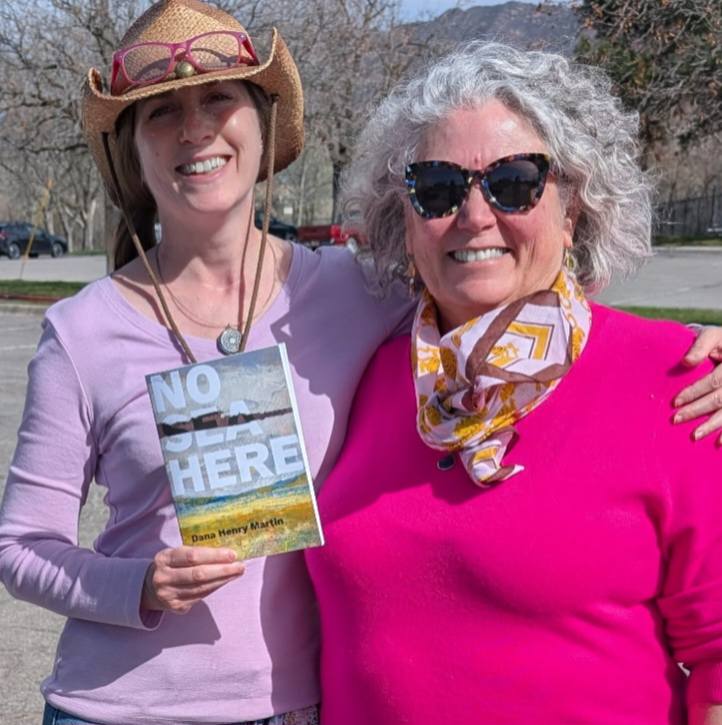
Spring in Salt Lake City and my collection No Sea Here from Moon in the Rye Press in hand.

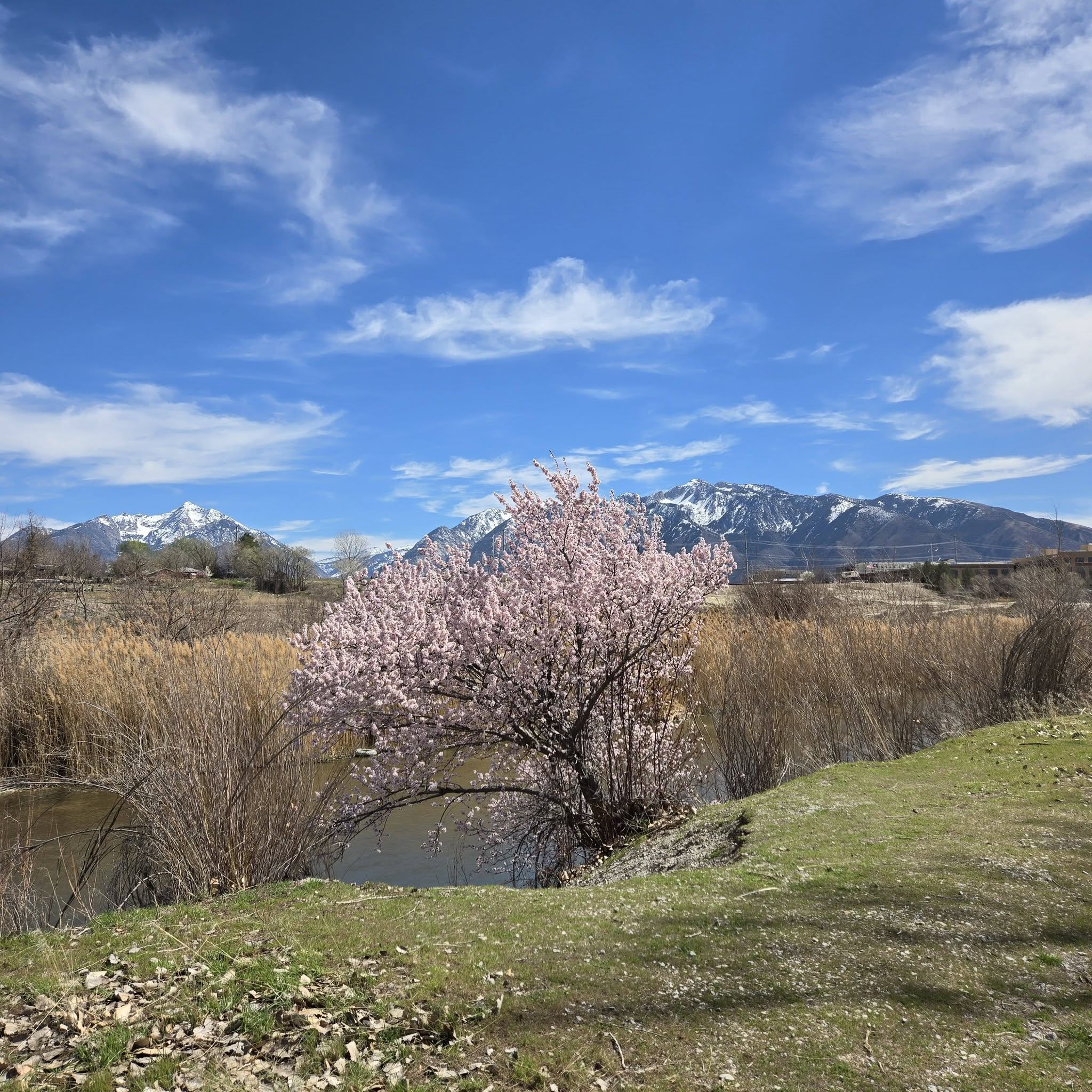
Images: 1. Lisa Bickmore giving me my copies of No Sea Here in Salt Lake City. 2. Along the Jordan River Trail near South Jordan, Utah. 3. Another view along the Jordan River Trail. 4. The life partner, Lexi, and me at Gardner Village in Midvale, Utah.

Like Him

Like father, like daughter is the most terrifying thing anyone could say to me. I was raised as a daughter. I was raised as his. Whenever someone catches me doing something he would do, or when I see those similarities myself, I feel like the floor of my life is dropping out from beneath me and I have to hope I’ll keep spinning until there’s a floor to stand on again. I used to say my biggest fear wasn’t death, it was living with my father for eternity. Even worse would be living as him for eternity. Even a second is too long to move through the world the way he did.

For Kelly

My friend never lost her way with nature. Months before her death, Stellar’s jays landed on her arms when she was still well enough to stand in her backyard. I wouldn’t have believed it, but I saw the photos her husband took. I don’t mean those AI fabrications everyone’s sharing. I mean real arms and real birds and real sky and real ground. This is what grounded her. When she learned that a study showed bees play, she called me to say, Of course they do. By that time, she wasn’t going outside anymore. She was closer to death and to the dead than she was to the living. I’m not sure what that made me. I landed on her arms. I ate from her hands. I tried not to fly away, ever, but I was still alive and so I had to.


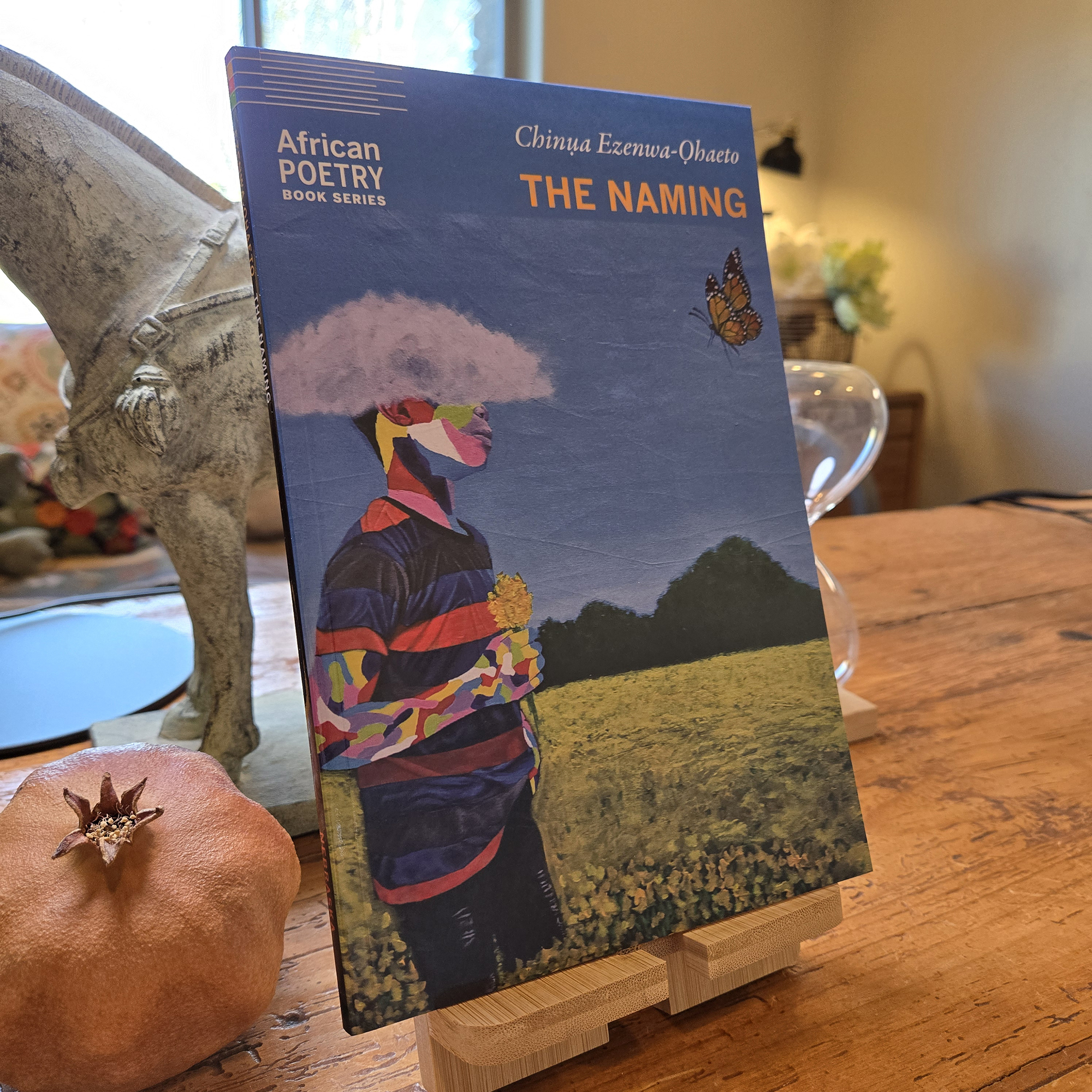
The Naming, Chinụa Ezenwa-Ọhaeto

The Naming is a reconciliation: with the personal, the familial, the ancestral, the spiritual, the terrestrial, the institutional, and the political. It is a world that is being created over and over again because of and through the past, one in which the speaker finds himself in time and place but also outside time and place with the help of his father’s fathers.

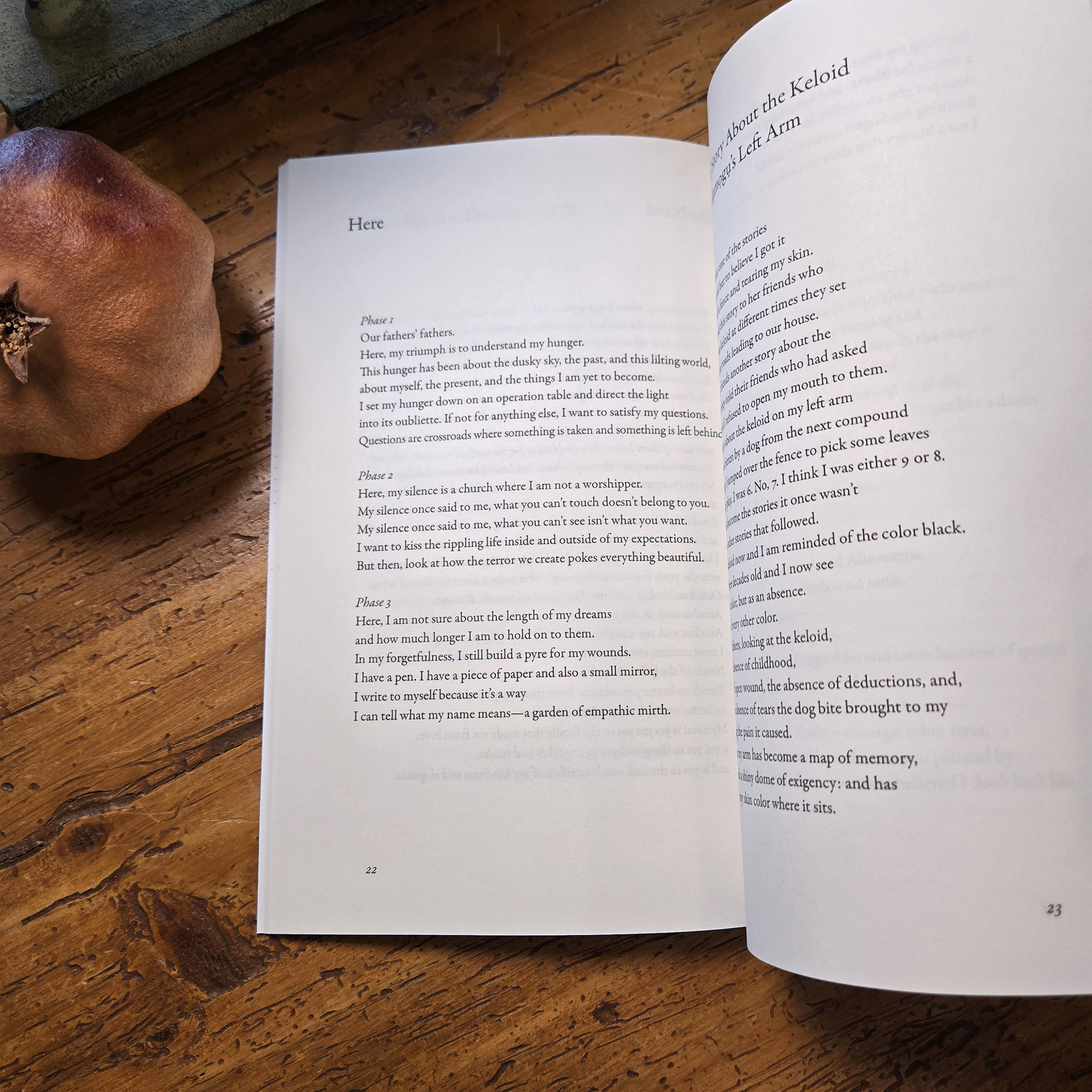
I feel deep history and deep love in this work. It’s the kind of collection that makes me think, I’ve been doing it all wrong, and by that I mean living—in the here and now, without calling my ancestors in close, my mother and my mother’s mothers. The Naming points at history to find out where it hurts the most, but it also points at us to show us how we can begin to heal.

Images: 1. The collection on a stand with a pomegranate, a horse sculpture, and an hourglass. 2. Interior pages from the collection alongside the pomegranate.

By Dirt, by Blood, by Oil

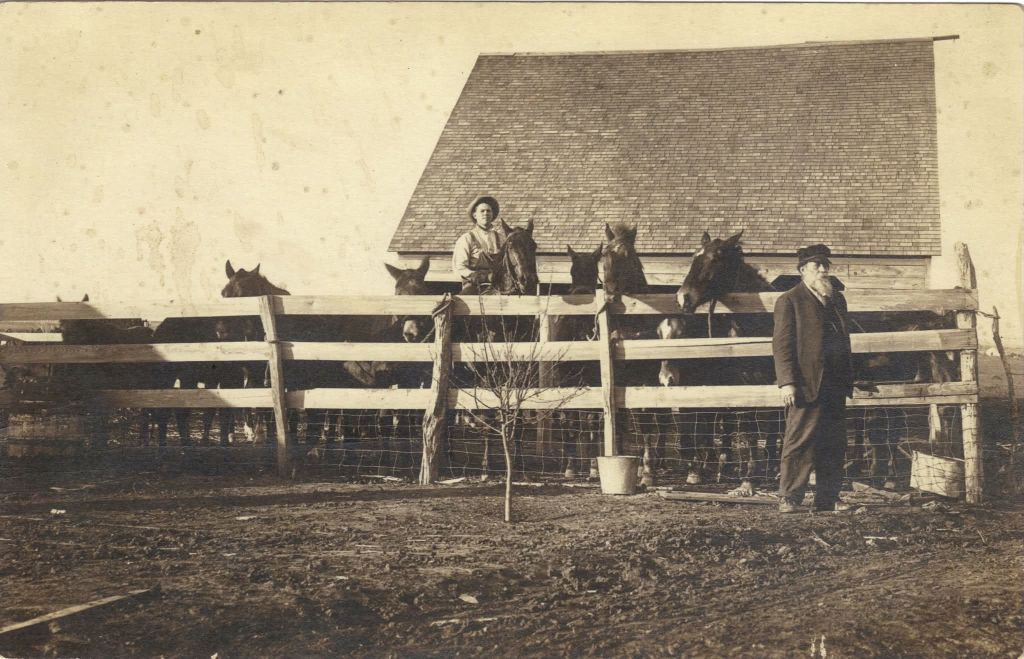
I could have called my family by its dirt. I could have called it by its blood. But it’s oil I settled on, the oil that extracted something from us as a family and as Oklahomans even as we came for it this way and that.

How oil turned to paper money then burned. How it burned us in the process.

I could have called my family by its horses. I could have called us by our broken land, our busted hope, our anger, our crimes, our laughter, our deaths, our abuses, our bruises, our fires—I mean real ones we set, places we took a match to when they stopped being to our liking. That includes our own bodies.

But it was always oil, my family, even before it knew it was oil.

Image: My great-grandfather and my grandfather on my mother’s side along with their horses. Either Altus or Headrick, Oklahoma, date unknown, probably 1920s.

Wind

It’s so windy here in Toquerville that I feel like I’m in Béla Tarr’s The Turin Horse. Wind like this makes me cry. It is whatever my mind is, as Gertrude Stein observes. I am as my land and air is, as my cracking and straining house is, as raw as I felt the moment this wind hit my back in a dream and stripped the veneer of reason from me in one clean and somehow profound motion. I sit in the dark shaking, my heart beating like a wild nestling’s.

Seedbox

Poems that occur outside are becoming less popular, especially poems in, about, and from wild places.

We increasingly live in boxes and in boxes inside boxes.

We write poems about the boxes we live in, where the poems themselves are boxes that are capable of holding nothing or everything.

Birds seem to be OK still in poems, usually written about superficially or inaccurately.

Trees, same deal.

Some trees just appeared in a poem I’m reading as I write this post. They have no names but filter light. Dappled is the word the poet uses. Dappled holds nothing where trees are concerned. Dappled is not even in the box of the poem.

A Facebook post is a box inside a larger antisocial box parading as a ballroom floor where nobody knows the box step.

My office is a box inside the box of my home that looks out on a desert punctuated by more and more boxes every year. Some of those boxes move. Others never do.

I think ghosts are boxes but can’t prove it. I know some ghosts break down over time in monsoon rains. Be careful with that cardboard you’re handling. It may be your grandmother as a box.

The trees in this poem I’m reading are talking. They’re asking questions. They’re interrogating orchids. Of all the flowers worthy of investigation, orchids don’t even make my list. I want a word with the seedbox flower, aka the rattlebox. I want to know about its cubic capsules and rigid sides, why it decided to go out into the wild and be a box when it could have been anything. Explain that, seedbox. Answer for yourself.

I don’t know. I just don’t know. Maybe we should stick with boxes, not birds and trees and flowers.

At this very second, a box is lumbering down my dead-end street in the form of a trash truck to pick up recyclable boxes from a bin that’s just a fancy box.

There’s no end to boxes once you start paying attention to boxes.

There are probably more boxes on Earth than trees or birds or orchids or even poems.

The next time someone asks how I am, I’m going to say I’m boxes is how I am. It won’t make sense, but it still will be true.

Well, would you look at this? Turns out we’re full of cuboid epithelial cells, so I am boxes and I do make sense as boxes.

But our lungs are trees and our scapulae are wings. There’s no removing these wild things. We have within us what is beyond us even as we try to erase ourselves from anything that doesn’t box us in.

This essay initially appeared on Facebook.
Scattering Light

My manuscript Crude was shortlisted for the Lightscatter Press Book Award, judged this year by Heid E. Erdrich.

I’m from Oklahoma. Crude is set largely in that state. The work deals with issues related to trauma, healing, and the formation (and destruction) of identity through places and what happens in them. The word crude functions in several ways in the manuscript. It captures what is raw and coarse and also speaks to the oil industry, which informed so many people’s lives in Oklahoma through the 1980s, including my family’s.

Things like the Dust Bowl, the Great Depression, and the oil boom (and subsequent bust) may seem like forever ago and like they have nothing to do with your story. But Crude is where we were and where still are, all of us. We are all hurting in one way or another in this crude country and this crude world. We are all healing in this crude world, too. Or trying to.

We’ve survived, my kin and me, the unthinkable, the unimaginable, the unsurvivable. Surviving the impossible is possible. That’s my story. It’s that I’m still here and so are you.

Lightscatter Press is a micropress here in Utah whose publisher, Utah Poet Laureate Lisa Bickmore, and board of directors all live, write, and work in the state. It’s one of those dream presses for me because of the people involved and what the press embodies. I’ve said before that I don’t aspire to be on the biggest press. I want to be on a press that cultivates a sense of community and connection, a sense of people and place.

I’m touched by this. It’s good to know my work matters in some way to some people. After all, I’m not writing about what I’ve experienced for fun. It’s not an exercise. It’s a decision to enter into a way of being and to remain there for as long as it takes, which I hope is as long as I live.

The winner of the award is Sagirah Shahid, whose book SPIRIT: An African American Muslim Lyric, will be published in Spring 2027.

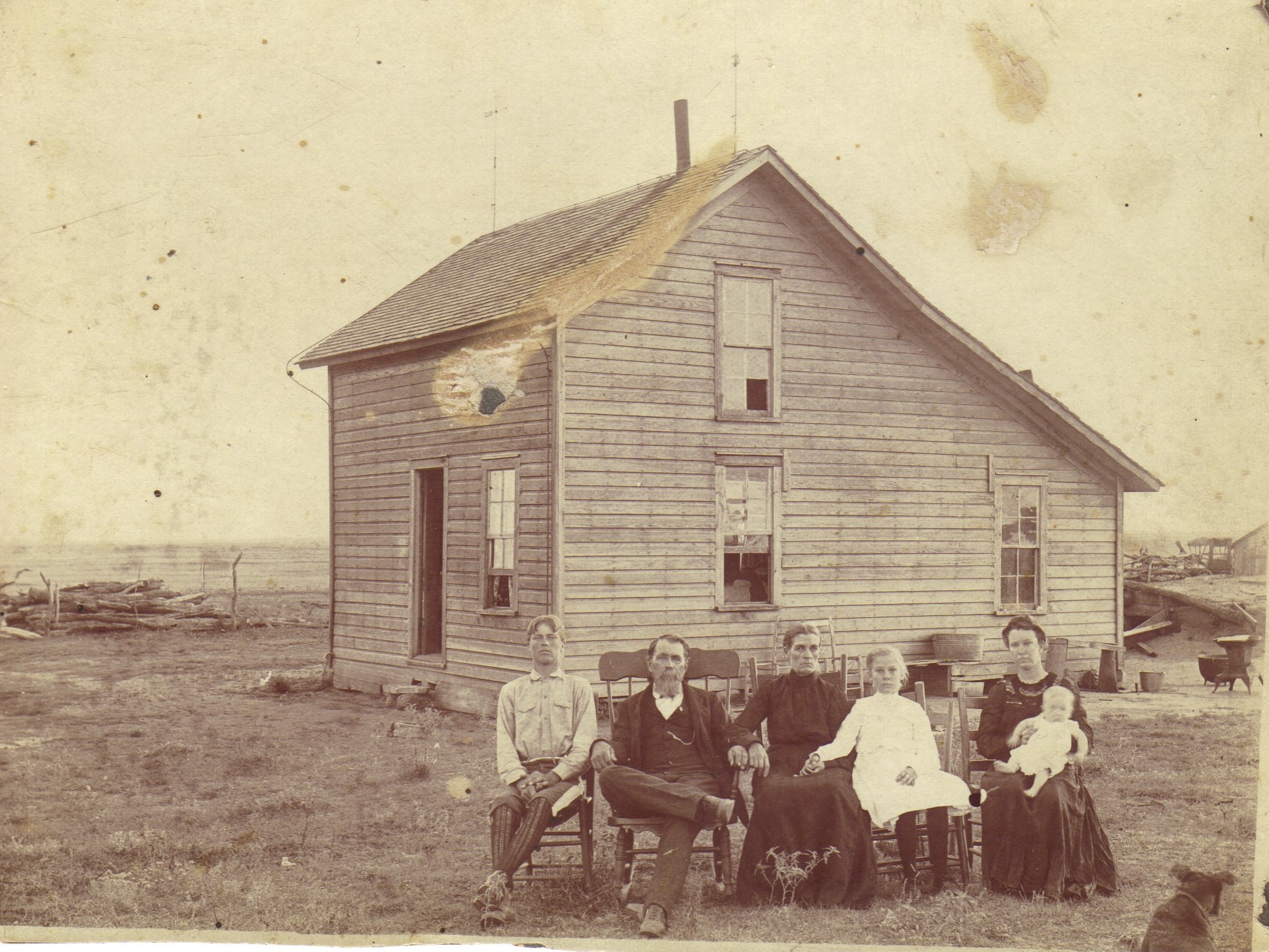
Image: My mother’s grandparents, father, aunts, cousin (who was passed off as an aunt if the rumor is true), and dog in front of one of their early homes in Oklahoma. This family photo and many more are woven into the fabric of Crude.

Propel Disability Book Series

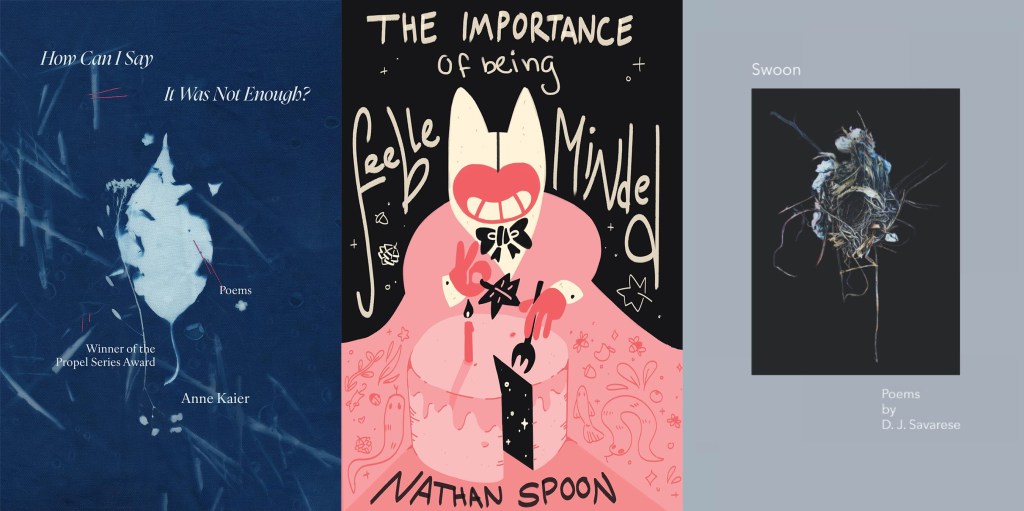
I’m thrilled to announce that I’m joining the advisory board for the Propel Disability Book Series at Nine Mile Books. Propel focuses on disabled poetry, noting that disability is often overlooked in publishing, even by presses that prioritize other forms of diversity. All Propel books are written, edited, and produced by disabled poets.

Steve Kuusisto invited me to be part of Propel in this role. I can’t capture in words how much this opportunity means to me. The work is essential and dovetails with my personal experience and advocacy around severe health- and mental-health issues, neurodiversity, and trauma.

This role also gives me a sense of belonging, which is something I don’t typically feel. Belonging is also essential and allows us to do our best work in the world with a sense of meaning and purpose. I mean it when I say I’m honored to serve something bigger than me and something that matters to me in poetry—all while being accepted for who I am and the perspective my experiences have given me.

I feel like a clipping that’s starting to grow roots, the magic of that.

Image: The covers of three collections from the Propel Disability Book Series. Left to right: Anne Kaier’s How Can I Say It Was Enough?, Nathan Spoon’s The Importance of Being Feeble-Minded, and D.J. Savarese’s Swoon.