Earth Dream

We’re heading back to Tucson in the morning. We’re just watching the day’s eyes close slowly here in Southern Utah. We’ll leave when the world wakes tomorrow.

Does Earth dream, too? Of course it doesn’t, but I hope it does. I want Earth to have a lucid dream about its own beauty and wake startled into itself the way we feel when we realize we’re more beautiful than we think we are.

Who’s that whistling down the street? A whistle is a bell and a bell is an angel.

Angel of the sandstone. Angel of the desert. Angel of this dry land we curse and pray to and live in and die for.

Angel of sage. Angel of globemallow. Angel of creosote. Of saltbrush and buckwheat and prickly pear and rabbitbrush.

Angel of the bell, of the child’s whistling mouth, of who the child is, where he came from, and where he’s going.

Cloud angel in the sky tatted like a mourner’s black lace.

Laccoloith angel who I’ve seen burn red as fire.

Farm angel with its sweet cows and shy horses.

Illumination angel steadying a light above a herd of cloned white bulls who shine like stars.

Goodnight, Toquerville. Sweet dreams. See you tomorrow, Tucson.

Desert Slopes

I’m here to share. I’m here to learn. I’m here for joy, surprise, and to feel awe shoot through me like sudden light. Every one of you is a purveyor of awe. Here, now. Then, again. Always.

When light enters a certain way, it feels holy. Our eyes are wired for light. Our hearts. Our minds. We are vitreous chambers with the wisdom to let light through unimpeded, unquestioned. So flower can be flower. So sky can be sky. So love can have a body with pores and wrinkles and folds. A body that, in the right light, becomes light. Nothing but light.

I’m waiting for you in spring. Make your way to me through winter.

As you sit on winter’s hard ground, remember that you may be someone’s spring.

And just like that, a poem brings me back to the world.

Poems are not office memos.

January 18: Fell asleep to a dog barking. Woke to wind howling. Inside it, the dog continues to bark, but all the desert slopes repeat now is wind and more wind.

I want to wallpaper my writing room with scenes from Days of Heaven and then write like that movie. That’s what my manuscript Crude is supposed to be. It’s supposed to sound like the narrator from Days of Heaven and look like everything in Days of Heaven.

Leonard Peltier. Fuck yes.

Curve-billed thrashers woke me up this morning. The sun stared me down through our patio door. Saguaros threw up their arms, exuberant as always. Coffee tastes better here. Reading poems is better here. My keyboard sounds better on my Mesquite writing desk than it does on my IKEA desk in Utah. Music is more immersive here. Love gets bigger and bigger here. You can’t even find its edges or measure its volume or figure out its overall shape because it has no shape. Love is in everyone and everything, more evidently here than in other places I’ve lived. (Kansas City may be the exception.) I love Tucson because Tucson is love as incarnate as I’ve ever experienced it. Imagine the fruit of the prickly pear cactus as my watery heart laid bare between spines. That’s me on Tucson, baby. Good morning from the Sonoran desert.

Last night, I dreamed I was produce. I was in a cardboard box with a head of leafy green lettuce and an unwaxed cucumber. We all came from the organic farm and were part of a CSA delivery. I don’t know what, exactly, I was. Maybe a red bell pepper. I was trying to work that out in the dream when I turned into the cardboard box the produce was in. Before I could fully experience being a box, I was cut apart, folded flat, and loaded onto a barge for “recycling.” Me and all the other recyclable materials—nut-milk jugs, tin cans, egg cartons, and all kinds of plastics—jiggled and jingled our way to a nameless atoll that was packed with other recyclables. We were all just trash, really, part of some scheme to offload us with minimal effort where nobody would find us. I spent my final days there being broken down by salt and water until I didn’t know what I was anymore, or who, if ever I was a who at all. Parts of me stayed on the island. Parts of me floated farther and farther into the ocean, above the dead coral, where I met bits of other recyclables that were indistinguishable from me, if I could even call myself a me.

I know less about existence than twin fawns who died inside their mother days before she would have given birth to them.

I was listening to the Twin Peaks soundtrack when I learned David Lynch died. I met and interviewed him for a feature story for UWTV and ResearchChannel. He was at the University of Washington for a talk about Transcendental Meditation. He also talked about living in a sea of creativity and dissolving the suffocating rubber clown suit of negativity in order to have freedom. “The pain and suffering should be in the art, not the artist,” he said in the talk. That stuck with me. We sometimes get that backward. To the stars, David.

House sparrows aren’t sparrows. They’re weaver finches. (And that is how poets tell you the news.)

After all everybody is as their coffee maker is. Everybody is as the maker is quiet or loud. Everybody is as there is maker or no maker. That is what makes a people, makes their kind of brew, their kind of viscosity, their bitterness and their aftertaste, and their pouring and their sipping and their drinking. — Gertrude Carafe

Yesterday, I saw an ad for a ceramic Baby Jesus being sold on Etsy, but the swaddled body looks like a vulva, and Baby Jesus’s head looks like an oversized clitoris. I can show you the photos if you don’t believe me. Good morning.

There’s a poem in my throat. I don’t want it there. I don’t even want it there.

Love is coming at me from every direction. That’s how I know we’re all dying.

My husband is up. He sounds like rain.

There was a time in my life when the answer to everything was poetry. It’s still that time.

I hydrated, styled my hair, put on lotion, lifted weights, sat by my light box, color-coordinated my outfit with my jewelry, reading glasses, and handkerchief, and put on some sick tunes. Now I’m going back into my poetry database, where I will stay all day hyperfocusing on the task at hand: consistently formatting every poem, adding appropriate metadata, and moving every post from classic mode in WordPress to the blocks format.

See you on the other side. If I don’t make it out, bury me in poems. Good ones.

I organized my poetry database all day long. I got pretty obsessive about it, and now I can’t shake the buzzing feeling inside me that is screaming, “Organize more things, STAT!” My hands are vibrating. My feet are vibrating. I’m covered in fake butter because I ate popcorn while I worked. My pen is buttery. My keyboard is buttery. I haven’t brushed my teeth for hours. I didn’t bathe. I didn’t style my hair. I didn’t exercise. I just sat here typing and formatting and labeling and blah blah blah blahblahblah. There are more than one thousand poems in the database, and that’s not counting collaborative work I’ve written with various poets over the years. It’s so many poems. It’s too many poems. I think I might be pretty obsessive about writing poems, not just organizing them.

I’m embarrassed about how much fun I used to have in poems.

It’s hard, but not impossible, to see a man as a hook.

New Order’s “Leave Me Alone” makes me feel a certain way about my childhood, like I’m back in it. Not only that, but that I love it, that past, exactly as it was because every transcendent feeling I had was only possible because of the dirt I lived in, because of my Oklahoma crude family, because of the everything of everything. My body hummed. It sang. It insisted. My terror had nothing on my joy. How I trilled at being alive, my roots growing down, my crown hitting the sky.

On a thousand islands in the sea / I see a thousand people just like me / A hundred unions in the snow / I watch and walking, falling in a row / We live always underground / It’s gonna be so quiet in here tonight — New Order

No tree, it is said, can grow to heaven unless its roots reach down to hell. — Carl Jung

New Year’s Goal: Write poems that make readers blister.

I just learned that white-tailed deer chase Canada geese. My friend Kelly would have loved knowing that.

I just got a nice rejection from a literary journal. The editor wrote, I’m grateful to have read your work, especially “Persephone.” The last stanza is perfect. God. Damn.

I feel like Mike Birbiglia is in my digestive tract right now throwing himself around on an improvised stage he’s set up on my pyloric antrum.

Last night, I dreamed octopuses who could no longer live in our polluted oceans. They devised a scheme that involved attending open houses, sneaking off to the bathroom, running a bath, throwing in some salt and rocks and stuff, and taking up residence for as long as possible. If they did this toward the end of the open house, chances were the home would sit vacant for at least a few days if not longer, especially in a bad housing market. They’d have it made. And it wasn’t that hard to drain the tub and hide during an unexpected showing. I happened upon a pair of octopuses at an open house. They were mating. The male’s hectocotylus was rammed way up in the female’s siphon. Startled, I shouted, “Get an aquarium!” But I knew what they needed was an ocean, a clean ocean.

It’s interesting how love expands when we’re scared but contracts when we’re angry, which is also just being scared.

Coming off the sudden stress of the past few days, I’m in a space that’s part relief, part surge of emotion. This means I may tell every single one of you that I love you—and mean it.

Some poems are like passivation layers on exposed aluminum. They protect the poet from vulnerabilities beneath the surface, maybe reader, too.

I’ve been watching a looped video of a hydra every day for months and thinking about hydras’ many arms reaching, feeling, without thought, without the conjoined burdens of meaning and purpose—planted, going nowhere, wanting for nowhere. Hydras are completely embodied. They don’t have brains. We have brains attached to hydra bodies that make us yearn, strive, interpret what our bodies are doing, usually incorrectly.

Some poems feel like de-icer.

Jon and I were driving into town this morning and going over our lists of things to do if the other one dies. Things like cremate body, inform relatives, get death certificate, alert life insurance, and so forth. For the scenario where I die before him, Jon suddenly blurted out—wait for it—call Oliva Munn. I’ll allow it. I might even make him an Olivia Munn playlist in case he needs it. Just music I think she’d like.

Some poems feel like licking an old sofa.

The light is moving. Slowly, slowly, the light.

Writing is breath. As breath, writing is life.

Did you know tin cries when it’s bent? That’s because its crystals are twinned, meaning two crystals grow into each other and share points along its lattice structure. When bent, the crystals rub against one another, creating a pressure wave we hear as a cry or a squeak. The phenomenon is known as deformating twinning but is commonly called the tin cry.

There’s a poem in there somewhere, but I can’t find it, at least not today. Maybe you can. I know the poem’s title: “The Tin Cry.”

Slowly, the sky turns violet, its true color. Suddenly, the laccolith turns coral, as if to say: “You had your night, sky. The day is mine. Give it here.” A common raven flies between the two, a glossy witness, all ink and no page. Both the sky and the mountain turn gray.

I feel kind of bad about my perfect-poet post yesterday, my future-husband post, like I’m betraying E.R. Fightmaster.

I hear the stars hidden in the blanket-swaddled sky. I hear them beating.

In my dream last night, I’d just finished a poetry manuscript. It was an exquisite thing heavy with history, like a body that’s lived several lives. I bound it with ribbon, placed it in the passenger seat of a new Cadillac, and pushed the car off one of the cliffs here in canyon country. Someone tried to stop me. What are you doing, they asked, laying a hand on my left arm. You wouldn’t understand even if I explained it to you, I answered before giving the car one final shove.

Just enough light these days to give thanks to darkness.

I picked out my next husband. I showed photos of him to my current husband. He’s a poet who looks like a cross between my husband, Prince Harry, and someone who’d nail a guy’s hand to a table if the situation warranted doing so. In other words, he’s perfect. My next husband might be a wife, though, or I might just marry myself. I have a friend from high school who did that. She had a ceremony and everything. She’s very happy together.

Note: I would only go with another husband or wife if Jon’s been dead for at least ten years. Maybe twenty.

It’s super quiet now in the ER. I’m weirded out.

I can’t believe I got all gussied up for this CT scan.

A wallpaper-installation company whose slogan is We’ll help you get it up.

Last bird seen in 2024: rock wren.

First bird seen in 2025: Anna’s hummingbird.

Proof of Something

The dead have a way of killing the living, as do the living. That’s what I woke up thinking at 3:30 a.m. when my rodeo neighbors flew their helicopter over my house and the walls vibrated and the bed vibrated and I vibrated.

I’ve been dead and alive for months now, maybe years. Maybe since I learned about the sex trafficking in the communities my father moved in and moved me around in.

Maybe since I learned that [REDACTED]. They’re rotting aspens, my family, carved with graffiti and missing bark, their leaves falling dead to the ground. All dead. All hollowed long ago but still demanding their remaining branches reach the sky somehow. For what? A sun that heals? A sun like a dead god who will help them forget how they’ve lived, if you can call it living. What do you call all that fluttering in the air above rot?

Definitely since my brother-in-law began dying from early-onset colorectal cancer last fall. Definitely since then.

Then there’s the call of the living who are dying or think they’re dying, the living I love, the call I will answer whenever it comes, even if it comes in the dead of night like a helicopter tangling the desert sage as it passes over. Or in the form of my husband. Or in my neighbor in Tucson, whose eyelashes are gone from chemo, and more, and more.

I’m tired. I’m sad. I’m scared. In Tucson and elsewhere, Indigenous people are being detained and told they aren’t citizens. And that’s just one atrocity that’s been happening over the past week. You can read about it in the news. I’m not the news and don’t want to be the news. I’m barely a person right now and am certainly in no shape to be reporting on anything.

Last week, I got the results of an extensive genetic test back. I’m not viable. That’s the bottom line. Yet here I am. I’m in the 99th percentile of fucked or fucked up on just about everything that matters. But genes aren’t everything. We know that. Whatever keeps me going isn’t my genetics. I’m in the 99th percentile for atherosclerosis, so yesterday I had the interventional cardiologist review the CCTA he ordered for me in 2022 when I was having heart issues. The test wasn’t done to determine how much soft or hard plaque I have in my arteries, but the cardiologist was able to pull it up and interpret the results. Jon and I stood in the exam room as he scrolled through the images from the test as if my interior was one of those flip books children make. Nothing. No plaque anywhere. My first thought was great. My second thought was why not me, why him. Him being my husband.

Risk doesn’t mean you have disease, the cardiologist says.

It’s good to know risk, but what we want to know is if you actually have disease or are on your way to having disease.

In this case, I’m high risk, no disease. Jon’s low risk, disease. Fuck risk factors. I mean, I don’t mean that. I don’t know what I mean. Just fuck maybe.

I had a dream two nights ago that took the form of a prose poem. Trump had dismantled the EPA and shut down all environmental cleanup sites, telling builders contamination won’t matter once the sites are developed.

It’ll be buried, Trump said. The waste will be buried. Just bury it. What’s buried can’t hurt anyone, almost as if he was talking about his own father, as if dead family can no longer do harm. I’m here to tell you they can. Look at my father in his grave, nothing now but bones caving in, obeying gravity like a falling apple only rotten all the way to the seed.

In the dream, I thought of Midvale, Utah, and the outrage locals felt in the 1990s when more than ten million cubic tons of toxic slag by the Jordan River were haphazardly covered in plastic with no lining underneath, vented, and later turned into commercial and residential developments. Folks in Utah wanted the EPA to do more, not less. They fought hard for more to be done but lost that battle. What would they fight for today? Less? Little? Nothing? Probably nothing. Just cover it up. Abolish the EPA. Who needs them. Who needs water and soil and air and viability for living beings.

In real life, not in the dream, we lived on that slagged land when we first moved to Utah, just down the street from Overstock, which was owned by the now-infamous Patrick Byrne, whose round concrete building with a peace sign on the roof was also on that land. Byrne got a deal on it, and he liked a deal. Jon worked for Overstock and for Byrne. This was right as he, Byrne, was transitioning from being a three-time cancer-surviving neuroatypical genius to whatever he is now. Maria Butina. Voting machines. Deep state. Trump as savior. Bars of gold and hunks of cheese stashed in Utah caves so he could feed and pay his employees in the event of an apocalypse. All of that. We’ve seen a man move from brilliance to chaos. We know what that looks like. We recognize it in others. I recognize the potential in myself. I certainly have the genes for it.

I’m afraid of myself. I feel like I’m full of slag, like my teeth and mind will loosen and fall out any day now. I don’t know how the Trump thing was a prose poem in my dream, but I know my mind was telling me to write. For me, writing is the way through, the only way through. Through to where, I don’t know. That’s the thing. What are we. Where do we start and where do we end. What is starting and ending, even? Some way to explain why we taper into fingers as slender as unlit candles that continually graze what is not us, or so we believe.

Almost as soon as the helicopter made the house rumble, it was quiet again. The house, I mean. Also the helicopter, which had landed on the neighbors’ helipad. But I was still quivering, my organs like china on a glass shelf in a display case nobody can open or illuminate other than a doctor who uses a mouse to drive through me one image at a time showing me how perfect I am, how goddamned perfect I am, despite everything. Proof of viability. Proof of life, at least for now. Proof of something.

You are also something. I can tell you that much. It’s all the news I can muster.

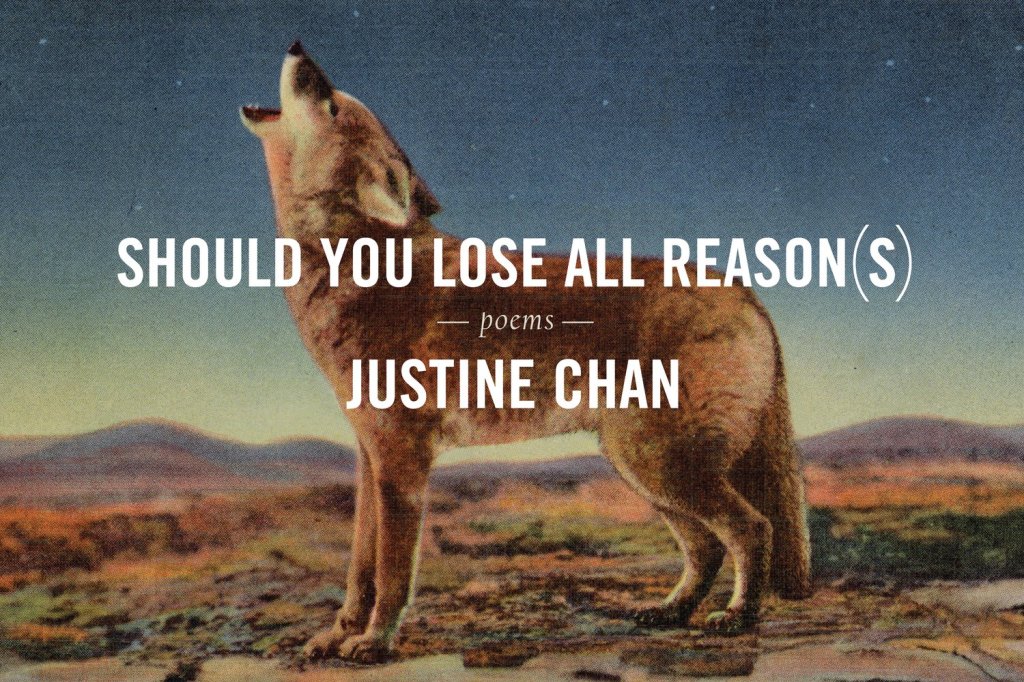
Should You Lose All Reason(s), Justine Chan

I’m reading Justine Chan’s poetry collection, Should You Lose All Reason(s). It’s based on her experience of a Southern Paiute myth she told over and over when she was working as a park ranger in Zion National Park, which is just a few minutes from our Utah home. I found the collection in the Springdale, Utah, library the day Jon and I drove out that way.

Chan lives in Washington state, where we lived for about a decade. Somehow, that makes her work resonate even more deeply for me. I’ve always felt a connection between Eastern Washington and Southern Utah. Where the land is concerned, I mean. The wildlands and the wildlife and how human consciousness is informed by both in ways they might not be elsewhere.

These poems are enveloping. They’re somehow a deep dive that feels like wading slowly into a welcoming body of water. Some parts remind me of Woman and Nature by Susan Griffin. Others remind me of a pillow book, namely the poems Rebecca Lindenberg has written in that spirit.

These poems speak to place, to identity, to what it means to live in a larger, natural world — or to live away from nature. Of who we are and how we become and how we continue. The speaker, I mean. The speaker, but also all of us. Also me, as a reader. (And maybe you if you choose to read this collection.)

Chan writes this place, Southern Utah, in ways that are image- and sound-driven without sacrificing authenticity, vulnerability, or accuracy:

You will get used to never seeing the full red sun as it rises or sets. You will see peregrine falcons and turkey vultures circling overheard, but never the condors.

None of the pictures you take will be quite right. Not in focus. Or the light’s not right. Or there is just too much.

You will bask. You will burn.

The bark of the spruce on the rim will always smell sweet and fresh in between its flaky scales.

The people will forget there was ever blanket poisoning of the public lands. That there are bounties for pairs of hacked off ears. That less, to rescind, must mean more.

Most of Chan’s lines are impressively long, like someone trying to stretch their arms as wide as the mouth of a canyon. The book is actually much wider than it is long to accommodate those lines. (It’s designed to look like an oversized postcard.) Her approach is somewhat experimental: at times bivocal, at times hugging the right margin or drifting cloudlike down the page, at times interspersed with dates and facts, and frequently breaking into song. (She quotes lyrics from sixteen songs throughout the book.)

I hope folks take the time to read this collection. Because. Just because.

Because the air is so hot, full of rasping. The land so full of landmarks and stories you can’t even begin to know.

Because you feel some part of you was / is / will always be secret.

Because the crickets are madness, a roar that fades to silence / if you forget / to listen.

Winter Hiking

They don’t know it, but the birds are competing to be the last bird I see in 2024.


Poems aren’t looking for advice or solutions. They don’t want to be told to see a therapist. They don’t give a rat’s ass about shaping up or shutting up or being shut down. Don’t treat poems like people, not even like the poets who wrote them, about whom you know little to nothing. The poems aren’t telling you all about the poet, not exactly (if at all). Poems are telling you about the poem. That’s what poems care about. Being poems.

My body’s resisting action, resisting thought. It’s off in the worlds Justine Chan creates, and that’s where it wants to stay. There are things she does in her poetry that make me think about how my poems operate, how they mean, how they exist. But I don’t want to move into the writing now, not yet. I want to listen to music and remain painlessly, effortlessly pried open.

Today has a stagnant-water vibe that I don’t particularly mind.

Oh, Jimmy Carter.

How do you not see that everything is everything?

At least my vomiting and diarrhea are being polite and taking turns.

I die and live, marking my days divined and madmade. This stoma of life strickens me. I am mummified.

(Trying my hand at some of the techniques Catullus uses in “Odi et Amo.”)

Love woke me today thinking about love. The cow love bought who gets to spend the rest of her life in the pasture. The tunnel love carved under a house that serves as a way out. The milk in the breast and bread in the mouth. An arm held close but not too tight. Branches tinseled with sudden ice. The stunned finch taken back by unbroken sky. Two old horses eating fresh hay. The dead in their humble pioneer graves. The broken fever. The cast spell. Dead words alive on the page. The prayer in the breath. The breath in the asking. The love of pleading, of desperation. Love of body, of cell. Love inside passing time, within lapsed memory. Those fettered by love who love even when they don’t want to love. Those shackled by fear who hear love mooing low in the distance.

It really hurts to write about dead people and dead birds and dead lands.

It’s gonna be a long night.

My job right now is to hold my dog while she dreams.

I dreamed I was dead but didn’t know it because my husband used petrification to preserve me perfectly. I looked like I was still alive. I couldn’t see or hear or smell or taste or feel, but I thought I could. I experienced the world as if I was still part of it, not realizing my husband was carrying me everywhere: from the bed to the sofa, from the sofa to my desk, from the desk to the car for long drives in the wildlands.

The angel’s in the details, too.

This poem says you belong.

I dreamed words were written on my back, but I couldn’t read them because I didn’t have a mirror.

Awake again. I feel like a helium-filled balloon that drifted from the party, got snagged in a tree, deflated, was eaten by a bird, and is now killing the bird slowly by blocking its intestines. Or maybe I feel like the bird. Or the tree. I definitely do not feel like the air or the rising helium or the child wailing about the lost balloon or the parent trying to distract the child with hand puppets. Maybe I feel like the hand puppets who know it’s all fun and games until they get wadded up in a drawer for another year and eventually stop coming out at all because the kid’s into 3D modeling and AI and sustainable farming, her days of being entertained by balloons and hand puppets long behind her.

I woke up early. I feel like warm Dr Pepper.

May we all be free from suffering and the causes of suffering.

I just got ageismed by a cashier at Lin’s Fresh Market in Hurricane, Utah. And they didn’t even have the one thing I wanted that nobody else carries, which is the only reason I didn’t go to Davis Food and Drug in La Verkin where everyone is super nice and never ageisms me.

I will get your attention, and when I have your attention, I will speak.

The world is bad enough that my poems make sense in it now.

Dr Pepper was once served as a warm drink with lemon. It was called Hot Dr Pepper. Hot Dr Pepper sounds like something that would pair nicely with winter hiking.Dr Pepper was once served as a warm drink with lemon. It was called Hot Dr Pepper. Hot Dr Pepper sounds like something that would pair nicely with winter hiking.

Other dreams last night, each an extension of the psyche dream: 1. A metallic spiderlike creature with telescopic presentation pointers for legs was singularly focused on continually mending the surface of the personal unconscious. 2. In the collective unconscious, I saw the face of a person who had eyes that were also a nose and a mouth, a nose that was also eyes and a mouth, and a mouth that was also eyes and a nose. These elements were randomly smooshed together rather than consistently arranged. I don’t think I was supposed to see that person. I don’t even think that person was a person.

Muse it or lose it.

I have a muse. It’s me.

Winter hiking sounds as awful as floor sleeping or day working.

The cow with a face like a skull is up on one of the steep rock formations near our house. Someone let her and the other cows I visited last week out to graze. I saw what I thought was an oddish set of brown and black rocks against the pale-green scrub. When I grabbed my binoculars for a closer look, the cow with a face like a skull was staring in my direction. What a surprise.

I dreamed I had talons for feet. Incredible talons.

Every day, I break for this world and want to be broken.

I’m thankful for anyone who will sing me away from this world when the time comes for me to leave.

My earlier years should have been happy but weren’t. My later years shouldn’t be happy but are.

I’ve decided that I can write my way into belonging here in Southern Utah. If I write this place, I will be part of it. I insist that this is possible.

Petrified

I dreamed I was dead but didn’t know it because my husband used petrification to preserve me perfectly. I looked like I was still alive. I couldn’t see or hear or smell or taste or feel, but I thought I could. I experienced the world as if I was still part of it, not realizing my husband was carrying me everywhere: from the bed to the sofa, from the sofa to my desk, from the desk to the car for long drives in the wildlands.

Everything I sensed was a vivid memory, not reality. I’d mined these memories to invoke the aroma the meals my husband cooked, the feeling of his hand holding mine, our dog’s fur tickling my shins, and dawn’s light glinting off vast cliffs and deep canyons while ravens flashed their oiled bodies and I turned to face my husband so I could say “I love you, I love you.”

We went on like this for months or perhaps years. Maybe nearly eternity. I had no concept of time. Every day seemed like past, present, and future all at once until, for whatever reason, I realized my body was a tomb that I was locked inside. I was dead and I knew it, but how could I know anything, even knowing I was dead?

Once I knew I was dead, I could no longer imagine I was alive. The dream of me was on the other side of an inescapable enclosure. Did my husband still carry me around? Did he prop me up next to him so we could watch movies together? Did he take me out to see birds? Where was our dog? Our house? The wildlands? The world?

When would my knowing leave, whatever vestiges of awareness this was? How long would I refuse to vacate this cold black thing where my mind was a fly frantically hitting every ceiling, every wall?

The Writing Life. Parting Words.

I wrote the essay below years ago for a literary organization that ran a series whose focus was on discussing poets whose behavior is inappropriate in an attempt to raise awareness and make poetry spaces safer. The series was also designed to encourage those who’d been harmed to tell their stories. The night before I was going to submit it, someone approached the editor who was handling my submission and told them the name of the poet I was talking about. When I agreed to submit the essay, it was on the condition that the subject not be named or identified. The divulgence made publishing the piece more complicated.

At about the same time, I was made aware of the letter that poet was circulating about me that made libelous statements, as detailed in a previous post. There were also feverish attacks coming from every direction on social media and in private online poetry spaces. One prominent female poet called sexual assault and rape as a whole into question, writing: Definitions have become so blurred and a no-accountability and unassailable victimhood is now the norm. According to today’s definitions of rape I have been raped hundreds of times.

That same poet also called anyone who’d been a victim or was advocating for victims part of a stupid little twat coterie, adding that they need to be sent to bed without their suppers. The fact that she writes for a major publication now brings me no comfort. Someone else used the phrase loathsome creatures to describe victims and advocates. Another called them evil. (That one got hundreds of likes from fellow poets.) Yet another said their efforts felt gratuitous, as if the women were taking pleasure in their pain.

I knew a lot of the poets who were making these kinds of statements. They were editors, publishers, friends, even some of my poetry heroes. Though I wasn’t talking publicly about what had happened to me, and I wasn’t part of the group or groups who were doing so, those attacks were on us all. Every one of us.

I couldn’t see how my essay would have helped at that point. I was unable to tell my story before the chance to do so evaporated. I don’t know what difference it will make now, but I want to share it so I can start to be freed from a horrific experience that began more than a decade ago and affects me to this day.

The last section, “Part 4: The Day You Are Reading This,” was designed for a publication date of more than a decade ago. But it’s still pretty spot on. There’s a timelessness to all of this: both to these kinds of abuses and how these kinds of abuses affect people.

The Writing Life: Parting Words

Part 1. Date Withheld

We are in the hotel where a writing conference is taking place, in a restaurant just inside the registration area. Hundreds of poets and writers flit back and forth like gnats. All dutifully wear their conference IDs on lanyards, all carry satchels, backpacks, and bags stuffed with books. They are on their way to and from panels, readings, the book fair, and the public restrooms, some of which have lines that extend all the way down one hall and into another.

He has chosen a seat in the most visible section of the restaurant, an open space near the intersection of two highly trafficked hallways, as opposed to a spot tucked deeper inside the venue. I feel he has selected this spot for a reason. For the entire event, he seems to have choreographed who he will be seen with—and when, where, and how he will be seen with those people. Being “seen” with him seems to be his way of introducing me, of making the statement that I am of some, however modest, worth.

He even orchestrates who he will walk to readings with. I learn this the hard way when, one night before a reading, it becomes apparent that my friend N and I are not allowed to walk with him the two or so blocks from the conference hotel to the reading venue. I realize this when trying to make eye contact with him over and over as he and a clutch of women stand at a small bar just inside the hotel’s entrance. I wave. I make more eye contact. But N and I are both ignored, my gestures shut down.

N and I walk within six feet of his group from the lobby to the reading, but it is clear we’re not walking with his party. Once we all get to the event, however, he makes a point of coming over to talk to me. He stands in front of me, his relative height a statement in a room full of seated poets. He touches me on the arms and shoulders. He asks for a hug. He leaves for a while then comes back, repeating the entire set of requests and gestures. This happens three times.

This is just a gesture, I think. It’s only a gesture. Maybe this is the way things work at this conference—new people make their way “in” based on how others seem to fawn over them. I’ve never attended this conference before, so I wouldn’t know its politics or social dynamics, though there do seem to be many of both in play, with overlap between the two.

At lunch, he tells me how much he loves my poetry and my thoughts about poetry. I go into detail about the panel N and I just came from, where the conversation turned to the notion of “doing violence” to a poem. One panelist’s points during that discussion are of particular interest to me, including his assertion that all acts of writing are violent, that language is intrinsically violent. Another panelist rejects this idea and feels more than uneasy with it. Why all this talk about violence, she asks the audience.

We have been in contact for several months, since I posted a note on Facebook saying I was looking for a poetry mentor. He works at a respected university and takes on many students to mentor, he tells me when he responds to my query.

The conversation pivots from how much he likes my poetry to how much he likes me. I really like you, Dana. I really, really like you.

He leans in and asks, Is N— in love with you, as he reaches out to hold my hand.

Part 2. Date Withheld

I am on my way to the first residency of my master of fine arts program. Because of the program’s check-in time, I had to fly down the night before. The poetry mentor I met through Facebook and with whom I have been interacting for months lives near where I am headed. He has offered to pick me up and drive me from the airport to the destination. He has also suggested we get two rooms at a hotel near the airport. That would give us some time to hang out and talk about poetry, he said. He could then drive me to the residency the next morning. He knew I had anxiety about traveling and being separated from my husband. He said he wanted to support me so I could focus on the residency without having to worry about the logistics of getting there.

His gesture seemed genuine. I talked it over with my husband and agreed to take the mentor up on his offer. He made the arrangements with the hotel and insisted on putting the rooms on his card, saying his school would reimburse him because he would be making an appearance at the residency, which is a form of promotion for his school’s program.

As my mentor and I stand at the hotel’s registration desk the night before the residency, the attendant only hands us key cards for one room, not two. Because of a flight delay, we are checking in several hours later than expected. It’s too late to get another room; they have all been booked for the night.

I’ve already taken one milligram of Ativan to sleep, and it’s starting to kick in. I am confused as we make our way down the long hall to the room. We had talked after the writing conference. I had explicitly stated that I was not interested in any kind of sexual relationship with him. He assured me that he didn’t mean his comment about “really, really” liking me the way it had come across. He was just trying to express how much he liked me as a person and as a friend.

In the following months, he gained my trust as a mentor. He presented himself as looking out for my best interests as a poet. The fact that he was a poetry editor and taught alongside esteemed poets in a creative writing program—as well as his assertion that he was especially interested in supporting the work of women poets because we face so many hurdles within the literary community—further deepened my trust in him.

He also earned my trust on a personal level. Once, when we were discussing my poetry, he said he saw evidence of sexual abuse in the subject matter. He shared that he, too, had been abused. That divulgence, coupled with the concern he showed surrounding my abuse, solidified my trust in him. I was speaking with a fellow survivor, after all, someone who was expressing a depth of concern for my suffering that few have shown. There was no way he would take advantage of my trust. What fellow abuse survivor would even consider doing such a thing?

The fact that he is an abuse survivor informs my thinking as we make our way to the room. I am trying to see the situation from his perspective, as a fellow survivor who feels he’s bonded with me in a way that makes sharing a room with two beds acceptable, like a slumber party between girlfriends. He has a very asexual, childish way about him, and there is a playful energy between us. Nothing in his behavior indicates he has a sexual interest in me. Over the past few months, I have wondered if he had a sexual interest in women at all. I don’t want to jump to conclusions that might be unfounded. I both trust him and want to trust him.

I tell myself, He’s not doing this. He’s not doing this. He’s my mentor. He’s my friend. I must be misreading this. Could he really be doing this?

I am still picking up on zero sexual energy as we settle into the room. He places all his belongings on his own bed, not the one I will be sleeping in. I am continuing to get more of a slumber party vibe than anything, which is in keeping with his overall childlike energy. I try to write the situation off as his having confusion over the boundaries of our friendship more than anything else. At the same time, my body is telling me a different story. Panic is setting in because I have so many sexual violations in my past. Bedroom spaces are particularly anxiety-provoking. It is difficult for me to sleep in anyone else’s presence, even those I trust.

I step out of the room and call my husband, explaining that it is one room, not two. He is shocked. I tell him that I think it is all OK, that I don’t believe there is anything underhanded going on, and that it feels more like a sleepover than him intentionally overstepping his bounds. My husband asks if I feel safe. I say that I do. I get off the phone and go back into the room, thinking, It’s just one night. Just get through this. You can do it. Everything is fine.

I take another milligram of Ativan, both for my nerves and because I need to make sure I get as much rest as possible to be ready for the next day’s residency. I make sure he knows I have taken two doses of the medicine and that is for sleep. Still not fully aware of the danger I am in—still both trusting him and wanting to trust him—my logic is that he definitely won’t try anything if he knows I am incapacitated. And I am. Two milligrams of Ativan is a sedating dose. The medicine suppresses the central nervous system so anxiety can be overridden and sleep can be induced.

I lie down on my bed. The sedating effects from the first and second doses of the medicine are underway. He asks me questions about my physical and sexual abuse. This seems like a strange topic to bring up at this time, when I am stressed and tired and have said repeatedly that I just want to sleep. Why would I want to explore this territory after I’ve had a very hard and long trip, when I have taken a sedative, and when I need to get some rest for the upcoming residency?

I can’t remember what all he asked and what all I said. My memories of conversations are usually quite clear, but the medicine was functioning as a kind of blur filter. I know he was asking for details about what was done to me and how it made me feel. I know the line of inquiry was invasive. He was asking for too many specifics, almost like he wanted to trigger me into reliving the experiences of abuse. The timing and context felt off. Something else was starting to feel very, very off—not about his questions but about him as a person, his intentions. I was beginning to realize the potential danger I was in.

He asks if he can rub my feet. OK, I say, afraid to say otherwise. At this point, I am trying to think clearly, trying to not pass out despite the sedative in my system, trying to imagine how I am going to get out of this unscathed, and—still—trying to tell myself this can’t really be happening. My “OK” is designed to buy me the time needed to figure out, through the haze, what is going on and how to deal with it. (And to be clear, because of my incapacitation, my “OK” was not effective consent. It also did not justify what he did next or the deception and breach of trust that got me into that room in the first place.)

Everything is getting hazier. I think, There’s no way he’s making some kind of move on me—especially not while he’s asking me to tell him about my sexual abuse. That would be really, really twisted.

He continues to ask about my abuse as he starts making his way up my legs. With a jolt, I suddenly know beyond a doubt what he’s doing. I am scared, terrified. I am paralyzed—both physically because of the medicine and mentally/emotionally. The fear associated with my previous sexual abuse kicks in. When I was molested, I did the same thing: I froze. When I was sexually assaulted as a child by an older child: I froze. When I was raped in high school: I froze. Freezing is related to the fight-or-flight response. It is a third form of automatic response the body can have during a traumatic experience. Because of my previous experiences, because I am isolated in a strange town and in a strange room with this man, and because I am incapacitated by the sedative I have taken, freezing is all my body can do, so that’s what it does.

He keeps moving his hands higher. He is touching my inner thigh. It becomes clear with a shock what he’s doing as his hand grazes my vulva through the long underwear I had put on in an attempt to sleep fully covered up. Overriding the sedative, adrenaline rushes through my body. I am still scared to confront him directly, to call him on what he’s up to. I tell him to stop.

I need to sleep, I need to sleep. I bat him away.

Do you need someone to hold you, he asks.

No, I say.

Are you sure, he says.

Yes, I say.

Where do you want me to sleep, he asks in his cloying, childlike tone.

Over there, I say.

Not here, he asks.

No, I say.

He pushes: Are you sure you don’t need someone to cuddle with.

No, I don’t I insist.

He gets up reluctantly. As he moves to get into his bed, I can see through his clothing that he has an erection. I think he was rubbing my legs with it at one point instead of using his hands.

I lie there stunned. I can’t fall asleep even with the medicine in my system, and I don’t want to. If I do, who knows what might happen. I lie awake, running on adrenaline and resisting the medicine’s effects, until I hear him snoring. As quietly as I can, I get up and attempt to pull pants on over my long underwear so I can sneak out of the room. I stumble, nearly fall. This wakes him up. I tell him I am going to stay in the lobby or that I’ll find another hotel (not that I have a way to get there). I say that I am not comfortable and can’t sleep with him in the same room. He apologizes and says he’ll go sleep in his car. I tell him not to come back. He says he won’t. He leaves the room. I pass out in my bed.

I feel safe, finally. I don’t yet have words for what I have just experienced and won’t for a long time. Phrases like “nonconsensual sexual touching” and “effective consent” are not running through my head that night. What is running through my head is a single thought: At least he didn’t rape me. That is the kind of logic many survivors of rape and child sexual abuse employ when someone revictimizes them in ways that fall short of outright rape. At least he only did x and not y is our way of creating a sense of empowerment and protection in the moment and not allowing the person who has hurt us to strip us of who we are. We feel that as long as it could have been worse, we can still move forward. We can become whole again, or at least we can live with the hope of becoming whole.

About four hours later, I wake up to my alarm. He is back in the room, asleep in his bed. I didn’t hear him come in. I have no idea how long he’s been there. I have no idea what he might have done while I was passed out. My sense—or at least my hope—is that he did nothing. But in reality, I know he’s already done something, even if he did “nothing” when he violated yet another boundary by returning to the room despite my insisting he not do so.

He takes me to my residency the next day. I am still in shock and still processing what has happened as he visits with other poets, lingering for hours before finally leaving the campus. He shakes their hands. He talks to them at length. I am too scared to say anything to any of them and wouldn’t know what to say anyway. They have a relationship with him. They don’t have a relationship with me. He is somebody in poetry. I am nobody. I continue to operate in survival mode, counting down the minutes until he will leave me alone at the residency, all without letting on to anyone that something is amiss.

Part 3. Date Withheld

The day after the mentor drops me off at my residency, he sends me an email. I really, really like you, he writes. He asks if we can take our relationship in a different direction, into the area of physical exploration and play.

Later, I will look at a book he signed for me the day before. In the inscription, he will say that I no longer need a mentor. It appears he’s decided that I do need a lover, and that he should be that lover, no matter what my feelings happen to be on the matter.

It will be months before I tell anyone what happened in that hotel room.

Part 4. The Date You Are Reading This

This poet’s actions had numerous short- and long-term consequences. First, they derailed my poetry studies. I had to take sedatives the entire time I was at that residency and bawled through half my time there, especially after problems cropped up in the program around issues related to racism, sexism, homophobia, and transgender discrimination. I barely made it through the first semester both because my mentor in the program was good friends with the poet and because the program’s director lowered my grade for the residency, stating that I did not “demonstrate a passionate commitment to writing.” At the residency, the director privately scolded me for arriving at the program with the poet, purportedly in order to flaunt him in front of my fellow classmates. That statement could not have been more damaging to me, or further from the truth.

Second, the poet’s actions hindered my ability to promote my own work. I was limited in terms of who I could approach and who I could trust. I was also afraid to reach out only to have another poet take advantage of me. I sent my work out infrequently. I didn’t pursue prizes and awards in case he knew or was connected to the judges. The list of ways I turned inward and did not actively and consistently promote my work goes on and on.

Third, the poet’s actions limited my participation in the broader poetry community. What he did—and the way I felt obligated to hide what he did out of fear, shame, and the belief that my concerns would be written off or, worse, that I would be told I was lying—has haunted me for years. I’ve passed the half decade mark at this point, and I still have trouble finding a way to move forward in poetry. I have met several poets who are deeply entwined with this man. I have been triggered in my community when he’s come to town to read. I have been invited to take part in safe, empowering groups of women poets, only to hear them mention this man as if he really is selflessly and genuinely promoting the work of women poets. I have tried to share space with him on social media, even though doing so never felt safe. (At one point, when I unblocked him recently, I saw that he was connected to more than a quarter of my connections on Facebook.) When my work is published in a literary journal, I check the table of contents first thing to make sure his name isn’t listed alongside mine.

In short, there is a hole blown through me, one only I can see. I carry that hole everywhere. It is impossible to be whole in the presence of that hole.

I’ve heard too many stories like mine to remain silent, including additional stories about this particular poet. I am still trying to find a path that will allow me to move forward in poetry. I am listening to the voices that have gone before me. I am being more careful than ever about who I associate with and who I trust. I am putting words to my experience and, regardless of the consequences, I am saying, This happened. This is wrong. It has to stop happening. This is about me, but it isn’t just about me. The issues in play in my story—power, manipulation, deceit, transgression, and the sexual assault that rose out of those issues—are central to other victims’ stories. My hope is to join the voices that are already calling for an end to the systematic subjugation, objectification, exploitation, and manipulation of women who want to be part of poetry. My hope is for stories like mine to be a thing of the past, not par for the course. I want all of this to end.

The Letter

Several years ago, the poet who sexually assaulted me circulated a letter about me within the poetry community. In it, he made defamatory statements about me, including stating that I was expelled from my MFA program for behavioral health issues. That’s not the case. I withdrew after my first semester of study. It was too difficult to continue there because the sexual assault happened en route to that program’s first residency, the poet who assaulted me was friends with instructors there, and the director lowered my grade for the residency, calling into question my commitment to poetry.

That letter was terrifying. I’d just been diagnosed with a rare, life-threatening disease that affects my immune system. I had thyrotoxicosis, which is also a serious medical condition. And I had follicular thyroid cancer. The letter was circulating among poets when I was too ill to defend myself. It was me against everyone who adored him and believed him and had already been online making statements about victims being spineless or taking pleasure in our own pain. The poet who assaulted me successfully silenced me by lying about me, intimidating me, publicly shaming me, and using my trauma history against me, one he knew well and used as a way to connect with me and earn my trust.

It was too much for me to withstand, so I stopped writing and buried most of myself to salvage whatever remnants I could in an effort to create some kind of life outside poetry. Birding helped me get through it. Weaving helped, too. But when I had a suite of serious medical issues in 2022 followed by serious mental-health issues in 2023, I knew I needed words again. I needed poetry, so I started writing, and I slowly began to connect and reconnect with other poets, even knowing that doing so could lead me back into pain, into misunderstandings, into being labeled and shunned, into being formally and informally blacklisted and, perhaps, right into the arms of cruelty.

If anyone has any concerns or hears any murmurings about me, I hope they’ll talk to me directly and not make assumptions about me based on defamatory, inaccurate, incomplete, or decontextualized information. I’m terrified all over again because my work is appearing in literary journals, and I’m bracing for attacks. That’s why I’m writing this: not to set any record straight, but rather to make my fear transparent, as well as my genuine desire to respond to anything folks may have heard about me.

Hard News, Bad Choices

Several alarming news stories have run in The Salt Lake Tribune over the past several days. They all have ties to Utah and involve children. Each story is horrific on its own, but together, they’re overwhelming. I cried most of yesterday morning. It was too difficult to process this news, especially given what’s happened and appears to still be happening in [REDACTED], so I engaged in several forms of avoidance, including employing maladaptive coping skills that threw my metabolism off and undercut the work I’ve done following a ketogenic diet for mental health, doing intermittent fasting, exercising, getting the right nutrients, and maintaining healthy biomarkers.

I’m writing about this because I can see how something that’s upsetting can cause someone (in this case me) to do one thing that throws something off, which in turn throws something else off, which in turn throws something else off. Then maybe more bad decision-making gets thrown into the mix as things start to slip, and pretty soon a little movement in the ground turns into a mudslide that swallows an entire house, trees, retaining walls, and more.

Yes, the upsetting thing is upsetting, but the behaviors that follow and aggregate are what drive the mind and body into a state of disequilibrium that prevents a person (still me) from finding ways to sit with and work through what’s upsetting to whatever extend they (again, me) are able to.

Here’s what went down yesterday. Upset about the news stories, I developed a sudden craving for brownies. It was an all-encompassing desire. I went to Lin’s, where they sell Num Bars, which are ketogenic. They didn’t have them. (Turns out, the Utah-based company went out of business.) In my desperation, I got no-bake chocolate cookies instead. (This is when the whole ageism incident happened with the cashier, which added to my distress.)

I came home and ate the whole container of cookies, thereby consuming four times my typical amount of carbs, and none of those carbs were good ones. My body can’t tolerate carbs anywhere north of 50 net grams per day. (I have data from my cardiologist and endocrinologist that supports this assertion. It’s not just a thing I’m saying to be dramatic.)

The rest of the day, I made terrible choices or simply didn’t do what I should have done for my health. I failed to take my supplements. I didn’t drink water. I didn’t do my intermittent fast. I didn’t eat enough protein or, really, anything healthy for the rest of the day. I didn’t lift weights, something I do regularly for my metabolic health. I didn’t exercise. I didn’t meditate. I wasn’t mindful.

In short, one bad choice became more than one dozen bad choices.

Here’s the thing: I was terrified of having nightmares last night based on those news stories. I’ve already had several nightmares involving my family in the past couple of weeks, one of which was incredibly difficult to process. So I sabotaged my sleep before I even went to bed. I’m not surprised that I woke up at 3:46 a.m. this morning and had trouble falling asleep again or that my sleep was especially restless according to my Fitbit or that my sleep score was ten points lower than usual.

What I am surprised about is how difficult recovering is for me. I have a seven-day intervention I do when I need to really focus on my metabolic health. I told myself I’d start that intervention today. I didn’t. Instead, I stayed in bed most of the day. I just now made my way to my computer. My food choices today aren’t great but they aren’t stellar, either. My digestion is hosed, again, just after I got it back on track. I haven’t exercised. It was a struggle just to get dressed, to make the bed, and to make my way to the living room, where I stopped for a long while and watched reruns of “The Conners” as I mustered the strength to get to my computer. I haven’t bathed. My hair is weird. I didn’t even have it in me to put on lotion.

And it’s cold and the days are short, which makes getting on track that much harder.

This all illustrates how a single genuinely upsetting thing can lead to a systemic issue and why it’s so important that we recognize these kinds of patterns. I know I’ve been talking about me, but I’m not the only one who experiences this kind of domino effect under stress. Many of us do, perhaps most of us.

Right now, I’m trying to do things that will help my body recover. I’m starting with water. That seems doable. Then I have to process these stories about children without doing more harm to myself. I don’t know how to do that. Process the stories, I mean. How does one come to terms with the kinds of things discussed in this type of reporting, things happening here in Utah, across the country, and around the world? I want all living beings to be free from suffering and the causes of suffering, but we’re often the cause, and children should never suffer the way too many of us make them suffer.

A Cascade of Bad Choices

Several alarming news stories have run in The Salt Lake Tribune over the past several days. They all have ties to Utah and involve children. I can’t be more specific without being censored by Facebook. Two of the stories are linked in my feed if people want to read them. There’s a paywall, but you can get an idea of the subject matter by reading the parts of the stories that are visible.

Each story is horrific on its own, but together, they’re overwhelming. I cried most of yesterday morning. It was too difficult to process this news, especially given what’s happened and appears to still be happening in my own family, so I engaged in several forms of avoidance, including employing maladaptive coping skills that threw my metabolism off and undercut the work I’ve done following a ketogenic diet for mental health, doing intermittent fasting, exercising, getting the right nutrients, and maintaining healthy biomarkers.

I’m writing about this because I can see how something that’s upsetting can cause someone (in this case me) to do one thing that throws something off, which in turn throws something else off, which in turn throws something else off. Then maybe more bad decision-making gets thrown into the mix as things start to slip, and pretty soon a little movement in the ground turns into a mudslide that swallows an entire house, trees, retaining walls, and more.

Yes, the upsetting thing is upsetting, but the behaviors that follow and aggregate are what drive the mind and body into a state of disequilibrium that prevents a person (still me) from finding ways to sit with and work through what’s upsetting to whatever extend they (again, me) are able to.

Here’s what went down yesterday. Upset about the news stories, I developed a sudden craving for brownies. It was an all-encompassing desire. I went to Lin’s, where they sell Num Bars, which are ketogenic. They didn’t have them. (Turns out, the Utah-based company went out of business.) In my desperation, I got no-bake chocolate cookies instead. (This is when the whole ageism incident happened with the cashier, which added to my distress.)

I came home and ate the whole container of cookies, thereby consuming four times my typical amount of carbs, and none of those carbs were good ones. My body can’t tolerate carbs anywhere north of 50 net grams per day. (I have data from my cardiologist and endocrinologist that supports this assertion. It’s not just a thing I’m saying to be dramatic.)

The rest of the day, I made terrible choices or simply didn’t do what I should have done for my health. I failed to take my supplements. I didn’t drink water. I didn’t do my intermittent fast. I didn’t eat enough protein or, really, anything healthy for the rest of the day. I didn’t lift weights, something I do regularly for my metabolic health. I didn’t exercise. I didn’t meditate. I wasn’t mindful.

In short, one bad choice became more than one dozen bad choices.

Here’s the thing: I was terrified of having nightmares last night based on those news stories. I’ve already had several nightmares involving my family in the past couple of weeks, one of which was incredibly difficult to process. So I sabotaged my sleep before I even went to bed. I’m not surprised that I woke up at 3:46 a.m. this morning and had trouble falling asleep again or that my sleep was especially restless according to my Fitbit or that my sleep score was ten points lower than usual.

What I am surprised about is how difficult recovering is for me. I have a seven-day intervention I do when I need to really focus on my metabolic health. I told myself I’d start that intervention today. I didn’t. Instead, I stayed in bed most of the day. I just now made my way to my computer. My food choices today aren’t great but they aren’t stellar, either. My digestion is hosed, again, just after I got it back on track. I haven’t exercised. It was a struggle just to get dressed, to make the bed, and to make my way to the living room, where I stopped for a long while and watched reruns of “The Conners” as I mustered the strength to get to my computer. I haven’t bathed. My hair is weird. I didn’t even have it in me to put on lotion.

And it’s cold and the days are short, which makes getting on track that much harder.

This all illustrates how a single genuinely upsetting thing can lead to a systemic issue and why it’s so important that we recognize these kinds of patterns. I know I’ve been talking about me, but I’m not the only one who experiences this kind of domino effect under stress. Many of us do, perhaps most of us.

Right now, I’m trying to do things that will help my body recover. I’m starting with water. That seems doable. Then I have to process these stories about children without doing more harm to myself. I don’t know how to do that. Process the stories, I mean. How does one come to terms with the kinds of things discussed in this type of reporting, things happening here in Utah, across the country, and around the world? I want all living beings to be free from suffering and the causes of suffering, but we’re often the cause, and children should never suffer the way too many of us make them suffer.