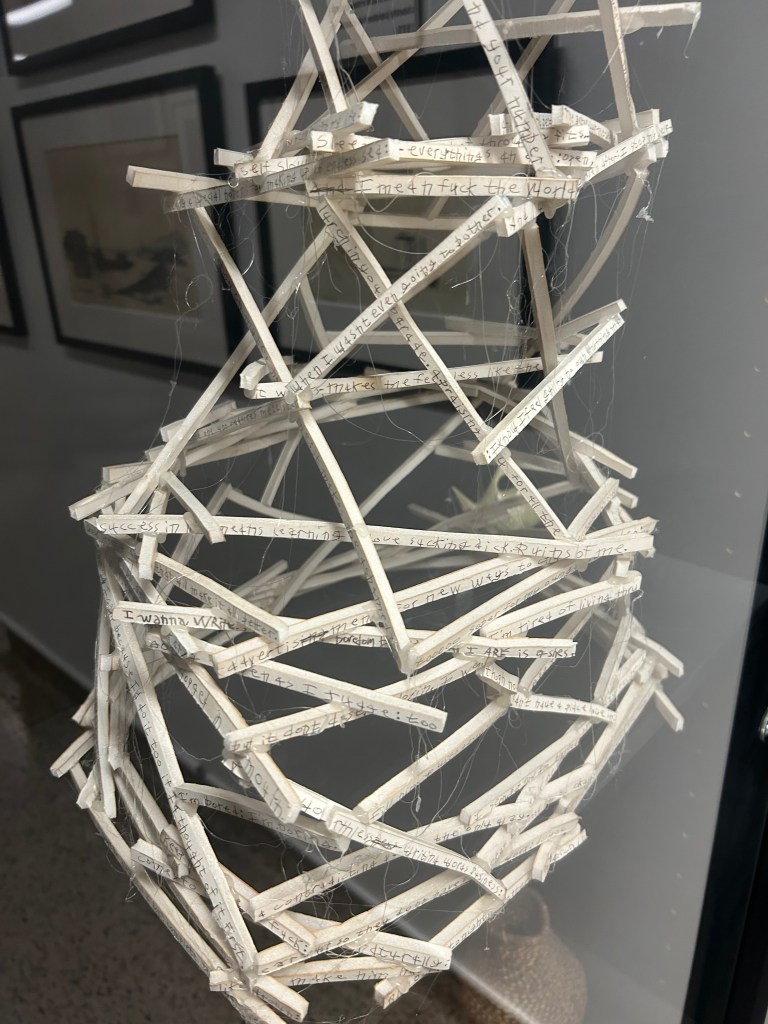
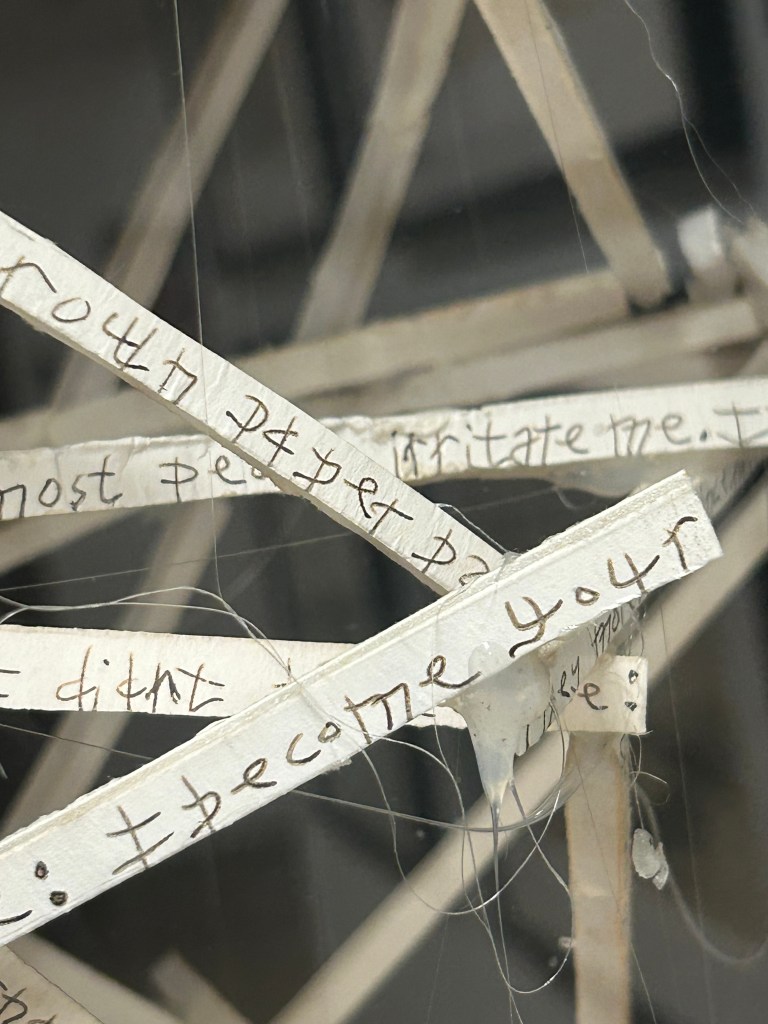
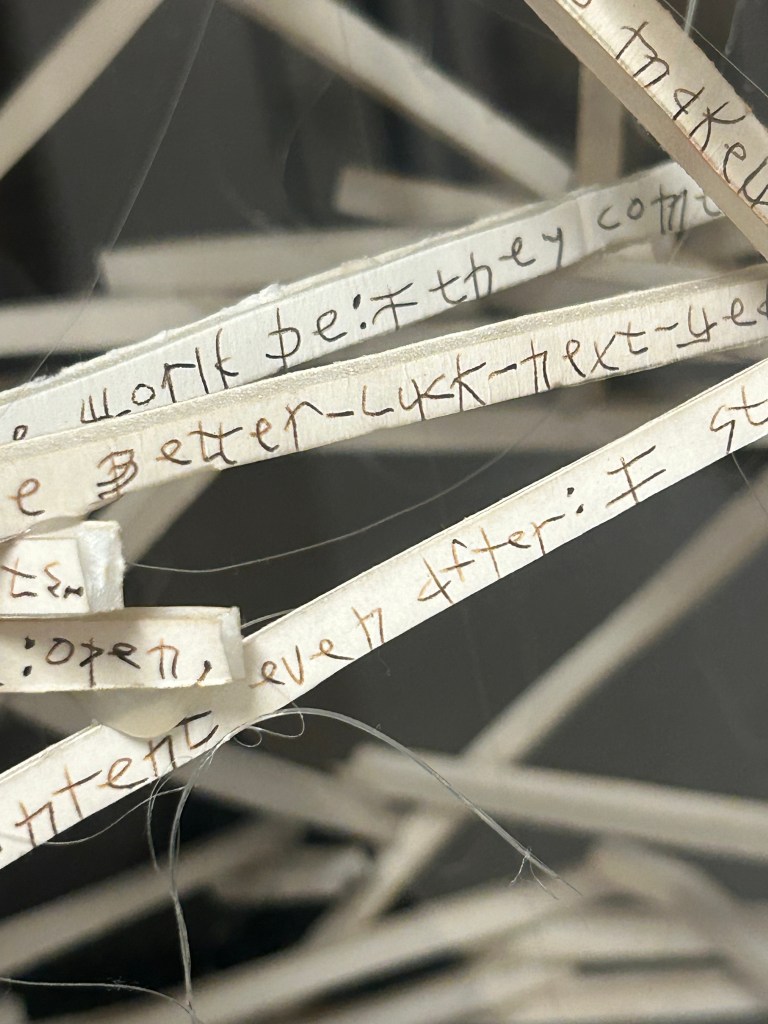
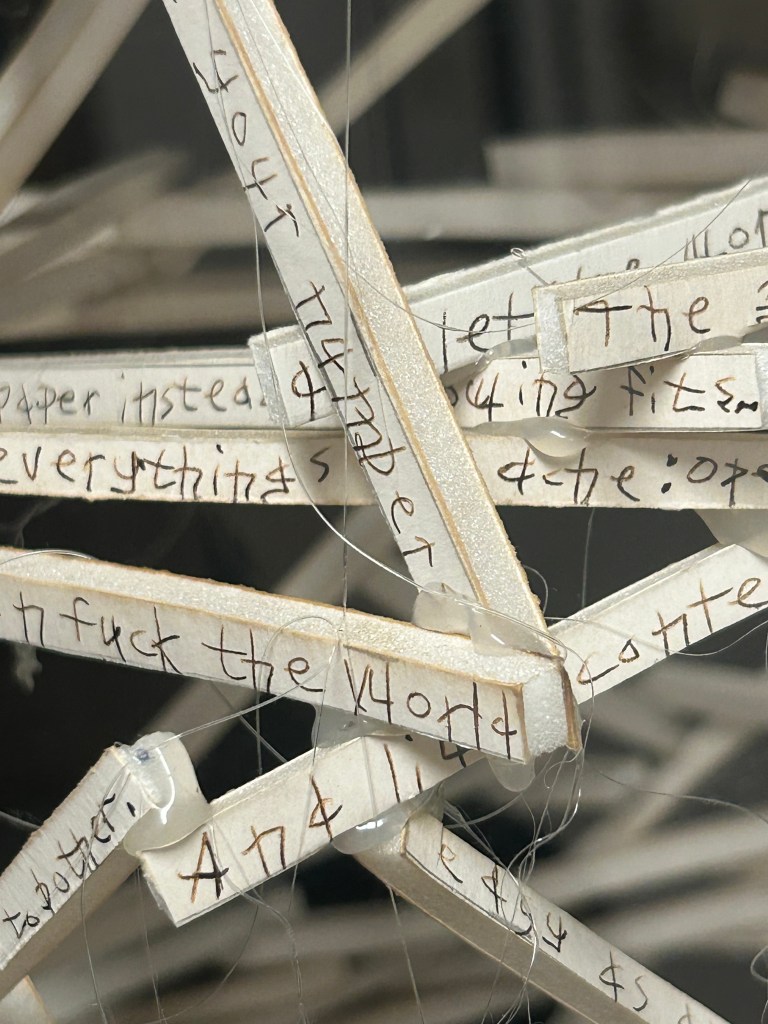
The Cube

I dreamed I was in Kansas City and was back in school as a flute performance major. A poet and I were sharing a dorm room. It was great at first. I had the room done up like a little Hello Kitty store, full of the kinds of snacks and supplies we’d need, all presented vending-machine style. The poet was funny like he is. It was all good.

One evening, I went to a party in the library. All the conservatory students sneaked in after hours. It was getting late, and everyone was falling asleep in a tangled pile on some of the vinyl furniture we’d pulled together to make a giant sleeping pod. I decided to go back to the dorm room. When I got there, the poet started screaming at me, reconstructing the past in ways that didn’t reflect reality, accusing me of things I hadn’t done, and calling me sanist.

I left and went to a bedazzled cube suspended at the top of the Earth’s atmosphere. The cube rotated slowly on a horizontal axis, the moon coming in and out of view as it spun, like a restaurant called The Skies that’s no longer open in Kansas City.

There was a woman in the cube, my flute professor. She told me we could stay together if that’s what I wanted. I said it was.

Can I tell everyone, I asked.

I’d rather you not, she said. I want you to be my secret.

Secret. Othering. Erasure. Being hidden. The same old story, only this one suspended in time for all eternity.

That’s not what I want, I said as the cube started free-falling, heading toward Earth. This is the end of times, isn’t it, I said.

Yes, she replied, adding that I knew that on some level. You must have known.

Send me back to Earth, I said. I want to be with the planet and all living beings when the end comes, not here with you.

But here it will be painless. You will continue, she said. And there are humans there.

I know, and I am of them as they are of me, I replied. I belong with them, not you.

With this, John Lithgow appeared. He explained that, like the woman, he was God, who is distributed across everything but is also one thing. He would take me back to Earth because that was my wish.

As we floated down, he said, There’s going to be fire, heat. Stuff like that. Hot and not in a good way. Do you still want to go? The cube is very comfortable.

I still want to go.

Fine. Have it your way.

When we got to Earth, it was peaceful. It was beautiful. It was like I was seeing everything for the first time. Birds. Lizards. Water. Sand. No heat, no fire, no end of anything.

I went to my dorm room, and the poet sat up in his upper bunk. He said, Everyone is a draft of curses, before lying back down.

I woke up, recorded those words, then fell asleep and lucid-dreamed the whole dream again because I knew it contained important lessons my mind was working out.

After replaying the dream, a woman appeared in the dorm hallway. She was dressed like a Weeble Wobble and came over to me. I recognized her as me and me as her because each human is distributed across all bodies but is also one body.

She said, What I’ve brought to the new art is my name, known only by its syllables.

Day. Nuh. Day. Nuh. Or any syllables. Yours, for instance, dear reader. There’s no difference, not since that first name was recorded: Ku Shim. Ku Shim. Kushim. 𒆪𒋆

I woke up and called out to my husband. It was time to stop dreaming, though I could have gone on in that state all day. Such dreams are alluring, but they also call us back to the Earth and to all living beings.

My sleep score was a 90. I won’t lie. With that dream sequence, I was hoping for 100.

Frictions

I’m thinking about the kinds of frictions marginalized folks experience in the literary community, namely when participating or attempting to participate in things like events, readings, residencies, and literary programs. It occurs to me that things other folks might miss or not understand or not be able to “see” can be experienced very differently by those in marginalized groups and can make spaces unwelcoming, othering, invalidating, and even hostile.

One example from my recent personal experience is the trans erasure associated with someone dropping the letter “T” from the acronym LGBTQ+ and instead saying “LGBQ.” That act changed the way I see the university where I planned to study writing and creative writing at the graduate level because the person who dropped the “T” is affiliated with the institution. Along with other frictions I’ve experienced, I no longer feel welcome at that school. Someone else might not notice an omission like that, or they may think it’s no big deal, but as someone who’s queer, that erasure is both obvious and painful.

I’m interested in the kinds of frictions others have experienced and the disproportionate ways frictions tend to aggregate, not only within one type of marginalization but across various forms of marginalization.

Walks Close to Whining

In this collection you are saying something that needs to be said and you are saying it in language that cannot be ignored or hidden from. The truth told with a very sharp knife. Yet part of this truth is that women allow this shit to go on. Do we not allow men to have the power you describe? It seems to me that as you rip men a new one—the same needs to happen to women. What in the hell are we doing—why do we let our power go? Without this emotional component the collection walks close to whining (in my opinion) which always occurs from a place of weakness. Yet this collection would seem to be aiming at a recognition of the power imbalance between men and women and the way men frequently force their will on us—and then a turn toward a new balance. But the only way that will happen is if women acknowledge their complicity in the imbalance.

The publisher of one of my collections, which dealt with CSA, including my own experiences and those of my best friend when I was young, made the comment above about it in 2011 after soliciting the work from me. I never should have allowed them to proceed with publishing the collection. I just came across the comment again while searching for something else in my email. That publisher was a woman, and it wasn’t Juliet Cook or Margaret Bashaar. It speaks to myriad ways in which some women and female-bodied poets who believe they’re empowering themselves and others can be misguided and do harm. It’s not just men in poetry who harm others and the community as a whole.

Through her lens, my work about CSA walked close to whining and needed to discuss power dynamics that don’t apply to children who are being harmed, including dynamics forced into the strict binary of male and female, one that’s oppositional, not dialectical. The speaker and others who inhabit the poems aren’t even male or female. That isn’t called out ever. As a nonbinary person (who was publicly identifying as trans at the time), it’s not how I envisioned them.*

And this was from someone who wanted to publish and ultimately did publish my collection. Again, I should have yanked it. She ended up quietly removing the collection at some point without telling me or preserving the files in any way. It was a digital collection with custom artwork. I would have liked to have had it, even just for myself. I believe I know why that happened. In any case, it was another form of erasure of me and my work.

Also, to those who say things like, Your work just isn’t for everyone, and that’s OK, please see that this assessment isn’t about the work, nor was that the case with the poet I just had the dreadful, unwanted interactions with. It’s fine for work to not be right for someone. These kinds of interactions go deeper than that, so please quit uncoupling literary assessment (which isn’t even what this kind of thing is) from personal attacks and assessments that go far afield of the work.

* The word nonbinary wasn’t yet in use, and trans felt like a better fit than saying I was bisexual. I knew gender was involved, not just sexuality, and the binary nature of the word bisexual wasn’t a good fit for me anymore, either. I knew both gender and sexuality were on a continuum. I was trying to find the language for my place on those continua as language was evolving to be more inclusive and less oppositional. Also, people can move around on these continua over the course of their lives. For instance, I’m asexual at this point, which used to be the last letter in LGBTQIA+, though it has largely been truncated away, along with the interior T, which has disappeared for political reasons. I never would have identified as asexual in my 20s or 30s. But bodies change, minds change, and age changes, which changes a lot of things about body and mind—in my case sexuality, hence my move to the term queer, which covers the waterfront where gender and sexuality are concerned. More specifically, thanks to a friend, I’ve started using the term neuroqueer because it’s not only inclusive of all my forms of neuroatypicality, it also suggests a relationship between my neuroatypicality and my sexuality and gender. For me, that relationship is real and meaningful.

The one thing I agree with in this publisher’s assessment is that I should not have allowed her to frame my work the way she did. It was a great publishing company. I didn’t think I’d ever get an opportunity like that again. I sold myself, my work, and my values, and I fawned at her the way I learned to in order to survival the unthinkable as a child. That will never happen again. I’d rather live in one of DT’s camps than live a life that’s bought and sold, one in which I’ve been bought and sold.

I will add this one last thought: I recognize that some of the same forces that shaped me in my life may have shaped this publisher in her life. I realize she’s been through it, probably for decades now, the way women, those who are female-bodied, and other oppressed and marginalized groups have been and continue to go through it. But she was still wrong in this instance. She foisted a huge thing on me and my work. Anyone can be misguided. I understand that more when someone isn’t coming from a place of completely (or at least largely) unexamined privilege. That means I do have empathy for her. I still shouldn’t have published with her.

Ashfall and a Window Strike

It rained ash on and around our home last night. I haven’t experienced anything like that since 2011 in Walla Walla, Washington, when a flaming tumbleweed breached a controlled burn line and set a field, then more than just the field, ablaze. Even then, the ash-rain never reached our home. We just ended up in it one day when we went walking in a nearby town. Ash-rain isn’t real rain—of course not—we’re in a drought. It’s just rain in the sense of raining down, the way water does but isn’t.

The smoke is affecting wildlife, including a juvenile Bullock’s oriole who hit a clerestory window this morning on the north side of our house, despite our following the method David Sibley uses at his home for protecting birds from window strikes. We have custom screens on all the large windows to protect the birds, but we draw vertical lines every four inches on the outside of the clerestory windows with a Sharpie. (As of this writing, those lines are now two inches apart.) This allows birds to see the windows and thereby realize they aren’t passable. They also interpret the vertical lines as branches, so they tend to steer clear of them. This method works for us, or at least it did until this morning when the young oriole, perhaps disoriented or otherwise weakened from the smoke, tried to fly between two of the Sharpie lines.

It was a hard hit. We heard it throughout the house. We have a protocol we follow when wildlife is in distress. Within minutes, the nearest wildlife rescue had been called, the bird had been placed in a special container we use for transport, and I was on my way to Wild Friends, a subset of Best Friends, over in Kanab, Utah, so the bird could get medication to prevent brain swelling and gabapentin for pain management—that is, if they survived the eighty-minute drive.

I would never drive to Kanab, especially not this time of year, because the only roads there and back are festooned with wildlife who rest on the asphalt, cross the asphalt, fly over the asphalt, and otherwise end up in harm’s way with every passing vehicle. Right now, many of these critters are young, or littles, as I call them. They’ve never seen cars before and don’t know the danger they pose. Juvenile birds don’t fly well and haven’t learned to stay above the cars. Baby squirrels think the roadways, which are cool in the morning, are a great place to hang out and socialize. The roads to Kanab are human intrusions into lands that belong to critters. We don’t belong there. I didn’t belong there. But I knew the oriole, who lives in my yard and fledged recently, would die without help. So I took the risk and drove carefully and stopped when animals were sitting in the road and slowed down and veered this way and that as needed and even slowed nearly to a crawl at one point with my hazard lights on because there were too many animals for higher rates of speed to be safe.

I nearly hit half a dozen animals. I navigated around, beside, and under another hundred or so. Then, right where Arizona turns back into Utah and the speed limit jumps from 25 miles per hour to 45 miles per hour, I saw what I thought was a rock squirrel sitting up in the middle of the oncoming lane. I slowed but couldn’t stop because the guy in the truck behind me was following me too closely. As I approached, I assessed the situation. The squirrel didn’t move. I thought I could continue, slowly, in my lane, and everything would be OK. It wasn’t. The squirrel darted in front of my car just as I passed, and just in time to be hit by both my front and back left tires. I heard it. I felt it.

I stopped to collect the squirrel and take them to Wild Friends with me if there were signs of life. There weren’t. And it wasn’t a rock squirrel. It was a stoat, a kit at that. Not even an adult. I killed a tiny, beautiful stoat, one of my favorite animals on Earth, whom I’ve never seen in the wild until today, when one was lying in the road where I hit them.

I should say lying in the road lifeless. The kit was dead. Body trauma, head trauma. I thought of William Stafford’s poem “Traveling through the Dark,” only this was daytime, and it was a stoat, not a deer, and I’m the one who hit them, not just the one who came across the body. I also thought about how every being that lives causes other living beings to die. Today, that fact was laid bare. I, a living being, helped an oriole live, but in doing so, I caused a stoat to die.

I moved the stoat off the road so ravens and vultures wouldn’t end up getting hit while trying to feed on the body and so people wouldn’t swerve trying to avoid ravens and vultures because to swerve might make more dead, as Stafford says. I also didn’t want the stoat’s body to be hit over and over again. That sort of thing makes me sad.

I apologized to the kit and said a small prayer before returning to the oriole, who needed to get to the rescue for treatment.

About eleven minutes from the rescue, the oriole roused and wanted nothing to do with being inside a box inside a car with me. It was a good sign. The rescue staff said the bird was old enough to get a full dose of all their medicines and that, based on how they were acting, they would most likely make a full recovery. I said Jon and I could come back for the bird and release them at our house. Wild Friends likes to make sure that happens whenever possible. I’ve known that bird since they fledged. I know their whole family. The wildfire here may make coming back impossible, which I understand. Fresh air is important, and we don’t have that right now. But I hope they recover and can come home.

May the fire stop burning. May the smoke clear. May ash-rain be replaced with real rain. May the oriole survive and come home to Toquerville. May the stoat rest in peace. May love restore what we fear we’ve lost forever in our lands, our hearts, and our minds.

The birds who sound like they’re laughing at funny jokes are actually Western kingbirds, not Bullock’s orioles. My bad for providing inaccurate information about that in earlier posts. Bullock’s orioles sound kind of like they’re saying, Oh, no! I dropped all my marbles or Look, my marbles! Right here. They are here, here, here.

The drive back from Kanab, Utah, through Arizona after dropping off the injured juvenile Bullock’s oriole and hitting a stoat. Highway 237. Outside Pink Coral Sand Dunes, July 11, 2025.

[Add Images]

I found out there’s another way to get to the wildlife rescue in Kanab, one that doesn’t require driving through the area that’s so densely populated with wildlife. I didn’t know about the other way. I should have known. Friday would have gone very differently. I wouldn’t have hit and killed the stoat. I also found out that another wildlife rescue has opened in Enoch, which is much closer to my home. I don’t know if they take small birds or if they have the medicines needed after a window strike, but I’ll call them and find out tomorrow. It’s hard to be the reason another living being is no longer living.

Some deaths hit me hard. Andrea Gibson’s is one of them. I didn’t know Andrea, but I knew their work and their heart and the spaces they created for others in this world. I haven’t really moved since I learned Andrea died. I want the world to be kinder than it is, as kind as Andrea was. My heart is with all living beings and the Earth we share, which means it’s with Andrea, who is everywhere now.

In the morning, I’m bringing the Bullock’s oriole home from the wildlife rescue so she can join her family and the other orioles who are summering along our creek. Jon is coming with me. We’re taking the long way, the one that avoids the most sensitive wildlife habitats between our home and Kanab, Utah.

The oriole made a full recovery thanks to the rehabilitators who cared for her. She’s enough to get me moving again. Life is motion. Love is motion. Everything is motion.

We just got back from the wildlife rescue in Kanab and released the Bullock’s oriole. She flew right into the tree where her family has been hanging out. It might be the tree she was born in. The other orioles were in that tree yesterday evening singing their comical tune as the sun set. Orioles always sound like they’re recounting funny stories to one another, then laughing hysterically. It feels like they’re making fun of humans, which is fine by me.

The orioles didn’t know they’d soon be reunited with the juvenile female they thought they’d lost. They didn’t know she’d return at all. Five days is a long time to be gone and then appear again seemingly out of nowhere. She’ll never be able to explain what happened, and they wouldn’t believe her if she could.

When we got close to the tree and she could hear the other birds, the oriole started to dart around in her enclosure, eager to fly free. Then she did. All I saw were her spread tail feathers as she flew away, her body a noisy propeller trilling through the air.

I’m actually not certain the oriole is female or a juvenile. That’s what the rescue believes, but it’s difficult to tell immature males, immature females, and mature females apart. She’s duller than I would expect a mature female to be, and she lacks the eyeliner I would expect to see on an immature male. There’s no hint of black on her throat, which immature males can have, though probably not birds as young as I believe she is. She had the same clumsy flying behavior I’d seen the fledgling orioles, presumably her and her littermates, exhibiting a few days earlier. Taking all these factors into account, a juvenile female is also my best guess.

Her age matters because she needs to get back to learning how to be a bird and gain as much experience as possible before migration this fall. Five days is a lot of time to lose when you’re new to the world and need to get everything figured out pretty quickly in order to survive. She also needs to decompress from the stressful experience she’s had. I hope she has the time she needs to recover, learn, grow, and thrive.

We have bird-collision film approved by the American Bird Conservancy on order for our clerestory windows since the lines we drew on them didn’t prevent this strike. In the meantime, we’ve covered each window with a thick layer of soapy film. We can’t really see out of them, but that’s fine. I will wrap my entire house in blankets if it keeps birds like this oriole from being injured or dying.

Two Bullock’s orioles, a male and a female, just landed in the shrub in front of my window. I think the female is the one I took to the wildlife rescue for treatment after a window strike and later released here at our home, which is also her home. If you felt the ground shake a little wherever you are, it was from my heart exploding with love and joy. The epicenter of that seismic activity was Toquerville, Utah, latitude 37.2310016, longitude -113.2756992.

What I Do

I want to understand the origins of the universe, but right now understanding the origins of hate is more pressing.

I want to write a poem about this, but I have so many windows open on my computer that I have a practical universe of knowledge crowding my screen or maybe crowning my screen, trying to break free.

If I don’t close these windows, my computer is going to crash. Typing has already slowed to a crawl, like time does when we’re in danger and every second counts.

I don’t have time to wrap my head around a birth inside a massive black hole that itself was situated inside a larger parent universe than the one we know, barely know, want to know, can never know.

How much more, I think, could go wrong inside an even larger universe? While physicists try to rewrite the laws of physics, I don’t even have time to write a poem because that’s not what I’m doing today. I’m closing windows. I’m reading things later or never. I’m skimming poems on various pages and either being born again inside them or throwing up my hands and yelling, I don’t like this poem at all before clicking the little x at the top of the page.

What is born from collapse can never not know collapse, can never not return to collapse, I want to say to the nearest physicist while wagging my finger. We had one here in Toquerville three years ago. A particle physicist. She lived in the house next to ours. She and her husband, an assistant attorney general here in Utah, made a killing off the house during the pandemic, bought low and sold high, then left all us Southern Utah townies drought dry.

I tried to tell her wild birds were going to die because she’d placed her feeder in the kill range, which is between 3 and 30 feet of her home’s windows. She asked my husband what he did for a living but not me, all while making sure we both asked her daughter what she liked to do so girls wouldn’t be left out of conversations about how people pass their time.

Later, I watched a Ted Talk the physicist gave in which she said she was discriminated against in science because she was a woman. She never did move her feeder. I trilled when she and her husband sold their place. She made fun of my husband for not understanding her joke about the Large Hadron Collider. It was a bad joke. She erased me in her conversation about girls, women, and erasure. Jon and I were like lower-dimensional objects being absorbed and dissolved by a higher-dimenstional one. That’s a thing, apparently, that physicists have observed. Or believe they’ve observed. Or theorized. Or hypothesized. Or something. Ask our no-longer neighbor.

I want the physicist to see this post. I want her to know how she othered Jon and me even as she spoke publicly about being othered. She and her faculty appointment. She and her dull humor. She and her dark matter.

Not all collapse ends with a singularity, I gather as I glance at the window that contains the story I’m trying not to read or understand. Sometimes, there’s a rebound and expansion occurs. In this model, the force is gravity. Purely gravity. No speculative forces or particles needed. No dark energy or dark matter. Imagine wasting your whole professional life on something that may not even be there at all. I think that’s what it’s like to be a poet, too. To create anything. Hell, just to exist.

If expansion is our future, so be it. Let this all begin again. I hope in that future, whatever me-like energy exists has the guts to be a stronger force than that of a physicist who weaponizes casual conversations so she can feel exponentially larger than those around her.

Oh, look. I feel something like hatred. Let me understand that, universe. Let me explore that energy until I can release it or until we are all released from this, whatever this is, this thing we barely know, want to know, can never know.

By the way, physicist. I’m a writer. I write about folks like you. That’s what I do.

Excerpts from My Marginalia in Anne Sexton’s The Complete Poems

Written while hospitalized in KU Medical Center’s psychiatric unit in June 2015. It’s nothing super interesting, but it’s part of my life and my experience. It’s pretty cogent, all things considered. I left out all the parts where I said my father was the devil.

A psychopath is simply one who structures the world in such a way that control and containment and order and binaries and easy answers prevail. An empath is simply one who for whom prevailing universal ideas of love dominate.

Use words people understand.

Explosive and dysfunctional families are the ones in which tension and brilliance come together in such a way that empaths can be created.

Take breaks. Hydrate. Move slowly.

Names and faces are hard to remember.

Every iteration is true but distinct as a dual-state metaphor. Examples: Love is love. Is = Is = Is. People who talk in tongues are actually the ones waking up between these two states.

Empaths are everywhere. They get activated in situations by other empaths but also by psychopaths.

Use plain language during activated periods.

Knowing how to meet someone on their own level is how to keep them safe.

Are you infinite? Still, the same journey.

Take whatever you can in the process of becoming and you will get what you need. Ask for what you need and you will get something different.

Waves of empaths = people get charged up all at once while things are moving in the right direction in the world.

False prophets in poetry are not empaths.

All speech is code. The erratic voice is the always-seeking voice iterating over a larger sense.

You can be an empath and do great harm. Both the empaths who harm and the ones who are harmed are bringing about change.

Call-out / call-in culture. Bring all voices in.

True speech parts seas.

Know your empath legacy.

Strife. There will always be lots of it. Talk through it. Write through it. Trust when to stop engaging and when to reengage.

Avoid people who call themselves healer or shaman.

Poems and where they go are a test of the testimony.

You will confuse any traditional workplace.

Hate is the false avatar of love.

In other cultures, to be means to emerge.

A word is a word when a word is needed.

The difficulties, all of them, are important to the journey.

Do before thinking everything you need to do to get where you are going.

What encourages a crisis is part of the path presented.

Strong times of need require strong signals.

What words emerge from journey, crisis, sojourn?

Revelations close to death

A condition by any other name is still a condition.

Withhold

Crisis of God / of whole

We become the core crisis of our family, the tension that wants to resolve.

The book of poems is the breath.

People will say definitely do something.

Pain is necessary for our suffering parts to come into alignment.

What leads to love: hard work, dedication, and sacrifice, but also support, forgiveness, and acceptance of impermanence.

Even those who harm deserve forgiveness because we all harm each other and heal each other in the same moment. I love Jon even though he harmed me some of the time and healed me other times. I love Jon especially because he loved me through the ways I harmed him. Neither of us wanted to stand beyond good and evil, but we do. I stand at the lips of my maker and breathe and wish him the best in this life and the next. Holy. Holy. I love you, Jon.

The world is five times our size.

Every life is equal. Everyone, even your greatest enemy, is also an angel. I have already met my enemy and can call him my best friend. I thank him for showing me the beauty of the world. Sacrifices are worth it. I love everyone now equally. I would love to spend the second half of my life inside this love, with the friends I have never known as well as I know them today.

Beating Back Blackbirds

I went to Storm the Mic tonight at Art Provides in St. George, Utah. This is the energy and community I’ve been looking for here in Southern Utah. Things finally aligned in a way that allowed me to attend. I also read three of my poems. It’s the first time I’ve done so in more than eight years.

It was important for me to read tonight. If I didn’t do it, I’d never do it. And poems can’t just live on the page. They live in us, through us, and between us. We have to give them breath. They move through our bodies by way of our lungs, our throats, our mouths.

Poems are like instruments. You can’t leave an instrument in its case or just open the case and peer inside at all that bright metal or dark wood. You have to get it out and say it/play it.

I left poetry and the poetry community eight years ago after an especially traumatizing situation that made it impossible for me to continue writing. I vowed to never write another poem. And I didn’t until I had a cancer scare last summer and started talking with some friends of mine, poets who never gave up on me, who kept loving me and checking in on me year after year. One night, after talking with one of those friends, I decided to write a poem to wind down before I went to sleep.

“Boys are beating back blackbirds. Houses hoard the sunrise. / This autumn is unmetered, a dream of wind and shovels.”

Those were the first two lines. I knew I was in trouble. Poems were still there, inside me, surrounding me, eager to be transcribed. Poems waited for me, too, all those years. When I returned, they weren’t even angry. They just flowed.

“This room. This rock. This rough sand. On my shoulder. / On my stutter. On my girl skull. On my hinges.”

Oh, I was in so much trouble. But it was good trouble. This time, poetry would be nothing in my life but good trouble. I could tell. I could feel it. I was home, again, in these words that twist and dance and break and stammer all around us all the time. I could catch them and engage in deep play, deep exploration.

Love. That’s what it is. Writing poetry is an act of love, an act of care directed inward and outward: community care and self-care. It doesn’t even matter what we write about. It’s all love, ultimately. Love is—didn’t Thich Nhat Hanh say this—the act of being alive not only within but also because of uncertainty and pain. (I’ll find the quote and update this post when I do.) The upshot is: What isn’t love? It’s all love.

“Night of deep crimes. Day of mirage ceilings. / During each, an orchestra of fire between my ears.”

Darren Edwards does an incredible job hosting Storm the Mic. I’m so thankful for him, for everyone who attended and read, and for Art Provides for letting folks use their space. They are literally providing for artists, poets, and writers when all three are so desperately needed.

Another Poet Mindfuck

Someone just left this comment on one of my pieces on Facebook:

This kind of writing has poetry and genius and many legit things to say but, I have to say, that while it may be therapeutic for you, it’s deeply disturbing for me and I don’t need that at this point in my life. Maybe you should think about that. If you see your writing as a struggle against emotional/ mental issues, maybe you should keep in mind our struggles as well and what you’re saying to us. Some kinds of therapy should be gone through with a professional trained to deal with personal hells. Rather than FB. It’s not too late to find a way of writing that’s healthier for all of us. I hope you will take this for what it is and not take it the wrong way. I feel it has to be said.

Well, he said it.

I’ve blocked him, since he doesn’t have the agency to stop reading what he states he doesn’t want to be reading.

The odd thing is, he recently solicited my work for a chapbook. He said my writing was lyrical and eloquent, and he’d love to showcase excellent work like mine in a collection he curated. What a mindfuck.

The piece he was responding to in his comment above wasn’t about death or dying. It was about life and living, and it was based on a dream, which is where a lot of my creative work originates. The piece wasn’t therapy, nor is any of my writing. It wasn’t me foisting anything on anyone or trying to make anyone uncomfortable. But I do talk about things in my poetry and prose, even in my discussion of political issues that are important to me, that aren’t always easy.

Nobody has to friend me or follow me or read me. This is my writing space, my discovery space, and a space that’s important because it allows me to connect with other people who are creative, insightful, compassionate, complicated, interesting, delightful, and more.

I don’t need anyone telling me what I should think about, write about, say, or do in this world, certainly not someone I don’t know who appears to be projecting his own issues onto me, my writing, and whatever dynamic he thinks exists between us. (There is none.)

And the mandate that I find a way of writing that’s healthier FOR ALL OF US? Please. That would be a misguided, Sisyphean task, and that’s assuming there’s an all of us who’s reading my work. (There isn’t, and he doesn’t speak for the few who do.)

Total Mass

I dreamed the editor of a literary journal accused me of writing cover letters that were unalive notes. She said, I’m returning your fine poems until you learn to say what your work is about without making me think you’re going to jump off that bridge you describe over in La Verkin, Utah, the one you say is all the rage right now, almost a rave if death could be a rave, bedecked in flowers and notes that read YOUR LIFE MEANS MORE TO US THAN YOUR DEATH MEANS TO YOU as if that’s not just another erasure of what folks who are about to unalive are going through.

There are always lights there, layers of red like beacons of death spinning horizontally in air, a party of futility, of resignation, of despair. Not Another One Bridge. That’s what the sheriffs call it, you say, but you don’t know. Not another one. Not today. Again? Then probably something about God or his conjoined twin Jesus if they’re into that. Then the call to the rescue crew who can fetch the body from the gorge below. Another crew. Another raising of the dead from the past, that unfathomably old rocky past they’ve leapt or fallen into.

Slipped, their family will say later, you say. They must have slipped. An accident. I don’t need to read things like that in your cover letters.

Say what you have to say in your poems. Say it there. Cover letters don’t have personas. We know they’re written by you. There are rules. There have to be. Poems are relegated to a certain space. They’re part of a tightly regulated total mass, like that laccolith you’re always writing about. It’s big, sure, but the whole of Utah, the whole of the world, can’t be a laccolith. Some of it has to be gilded jets for world leaders. That’s just the way it is.

Form dictates the content and reminds us of who we are and where we come from. We come from offices. From paper clips. From staplers. From clear, concise communication that’s business in the front and business in the back. No party. No pity. No pining. No pith.

We’re from formality and words arranged with an architecture that makes sense, that’s expected. Cover letters are like animals whose legs are where they should be, and they’re just walking, not riding around on skateboards or driving little cars like those hamsters you say you also dream about. Mr. Fuzzy, was it? And Tater McGee? They belong in a poem, not a cover letter. Stop making them drive off the bridge of your imagination. Cover letters aren’t Art Noir Quizno’s commercials from the 90s.

The cover letter should not be a form of psychological spelunking. Poems can be, depending on who you ask. You should know this by now. Just say Hi. Say here are my poems. Say thank you for considering my poems. Don’t bring up parasailing or Duran Duran or the Menendez brothers or loneliness or dreams about writing cover letters. Say hi. Here are my poems. Thank you.

Use a standard font. One-inch margins. Double space if you must, but keep yourself contained like someone walking across Not Another One Bridge all the way from one side to the other without incident. Don’t let your cover letter look into the gorge. It will do things to your cover letter, the looking. You know this. The cover letter knows this. I know this, and I’ve never even seen that bridge.

I won’t respond to any more submissions with unalive notes attached to them written by hand in red ink on torn scraps of lined paper the size of Post-its with arrows at the bottom directing me from one scrap to the next to make sure I read the whole thing like some failed Franklin Covey approach to professional communication.

Just say hi next time is the last thing the editor said before I left that dream and walked into a Home Depot where the greeter was an 80-year-old rocker sitting at a drum kit. But the editor followed me in there. She followed me from one dream to another. I couldn’t shake her all night. I kept saying it wasn’t an unalive note. It was just a cover letter. She wouldn’t listen.

I called her a Karen, which is how I knew I was dreaming. I don’t call anyone a Karen in real life unless they’re name is Karen, and I don’t use an article before their name. STOP BEING SUCH A KAAAAR-EN I shrieked over the drummer, whose riffs were technically impressive but unoriginal. Everything he played was played out long ago. He was dressed in leather from head to toe. His getup was as ravaged by time as he was. He may have been famous once, but not anymore. Not in this dream version of a Home Depot in Southern Utah.

Was this dream-heaven? Dream-hell? Dream-purgatory superimposed on my sunny desert? I wanted a pen and paper so I could capture this dream in the perfect cover letter.

Frisson

Yesterday, as an associate at the Washington County Library scanned each poetry collection I’d put on hold and laid them one by one in front of me in an ever-growing stack, I got all-over body chills. This happened not once, but each time a collection was added to the stack and I saw the author and title upside down, the cover design, the colors, the typography, the book’s size and thickness, and the way they each looked—as if they’d never been opened.

I could be their first reader, I thought, chills continuing to wash over my skin. The first to touch their pages, not just their covers. The first to want to know what they had to say as opposed to simply cataloging them or shelving them or facing them when it was time to tidy up the stacks.

I’m getting chills again just writing this. I knew I loved books, but I had no idea until yesterday how much poetry curated in the form of a printed collection could affect me.