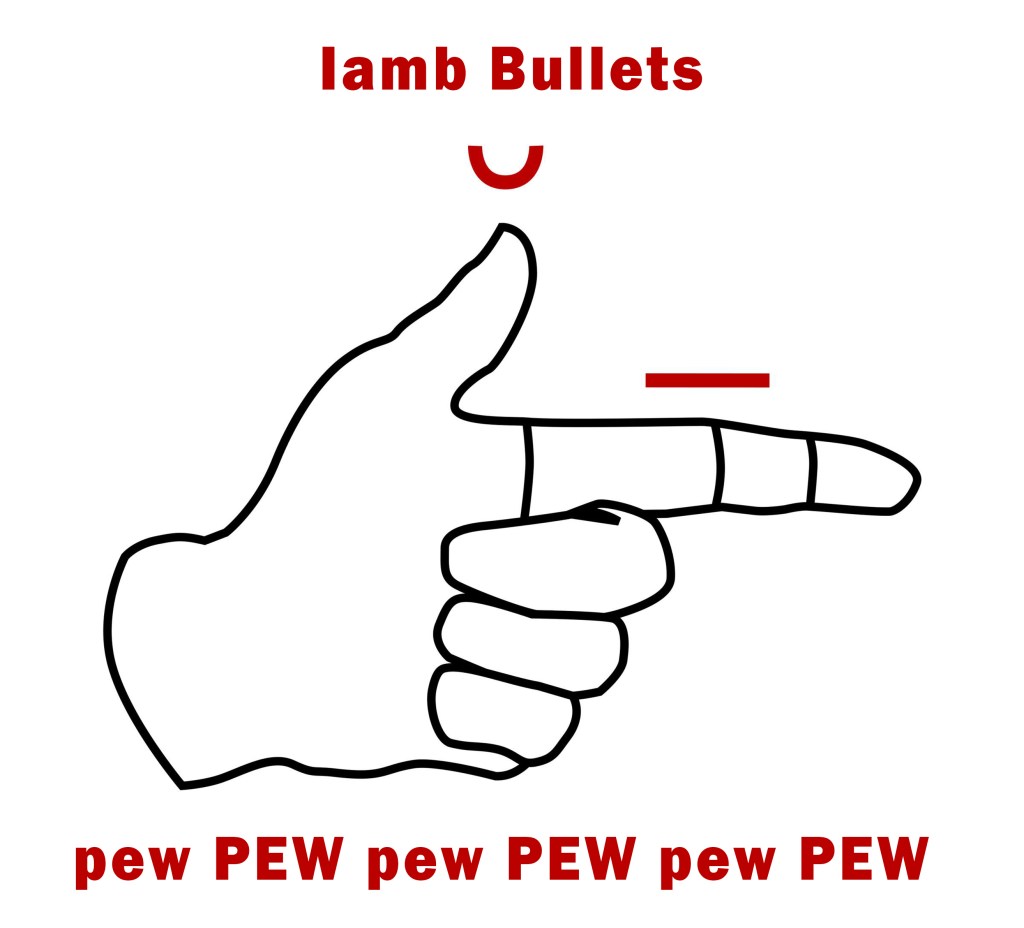
Made by modifying a Creative Commons image from Wikipedia that uses a hand to illustrate a dactyl. Inspired by a conversation with Elizabeth Macduffie. I want to make this into a T-shirt.
Made by modifying a Creative Commons image from Wikipedia that uses a hand to illustrate a dactyl. Inspired by a conversation with Elizabeth Macduffie. I want to make this into a T-shirt.
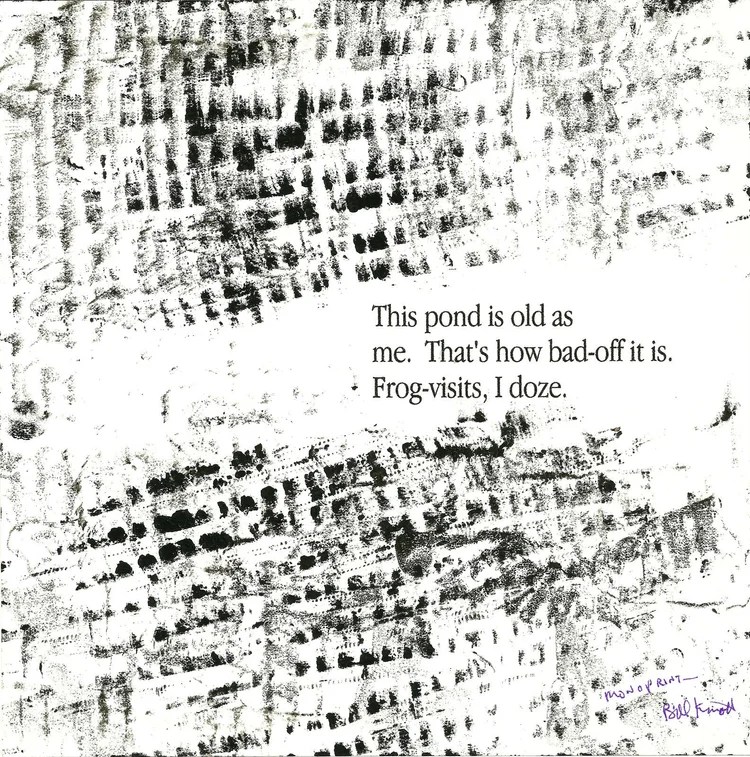
This pond is old as / me. That’s how bad-off it is. / Frog-visits, I doze. — Bill Knott
Source: Bill Knott Archive.
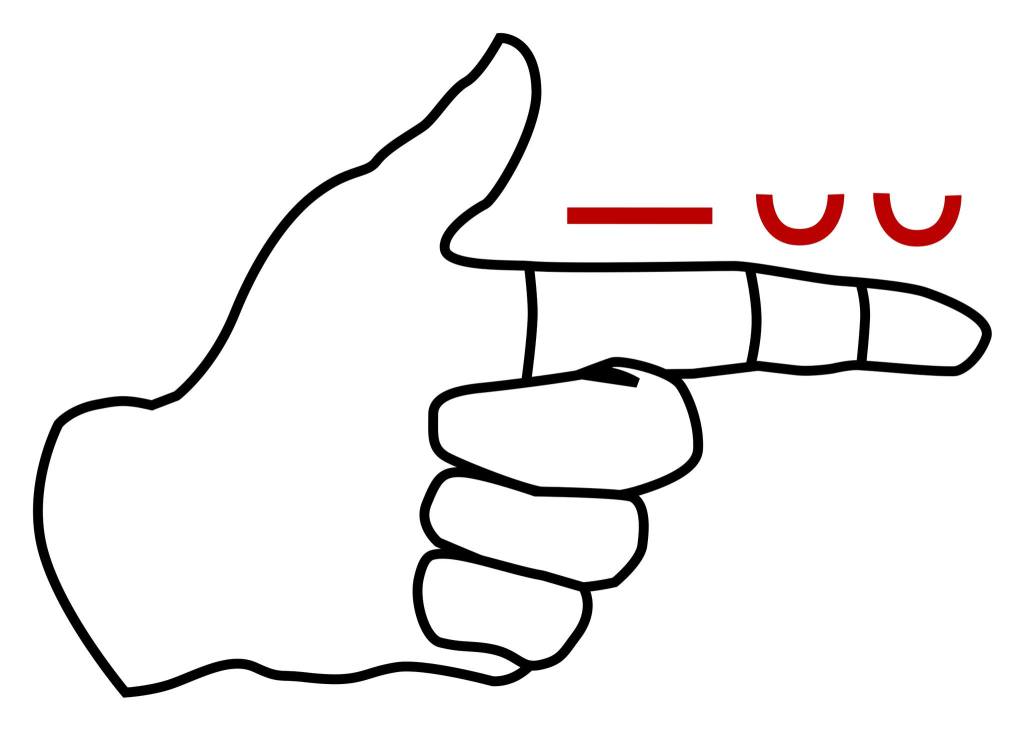
Poetry is my weapon. Baby, you don’t wanna mess with these dactyls.
Image: an outline of a left hand with the thumb pointing up, the bottom three fingers folded back, and the index finger pointing out. A long red line (representing a stressed syllable) is above the finger’s bottom bone (proximal phalanx), as well as two red curved lines (representing unstressed syllables) above the middle and upper bones (middle and distal phalanges). Image fromWikipedia and used in accordance with its Creative Commons Universal license.
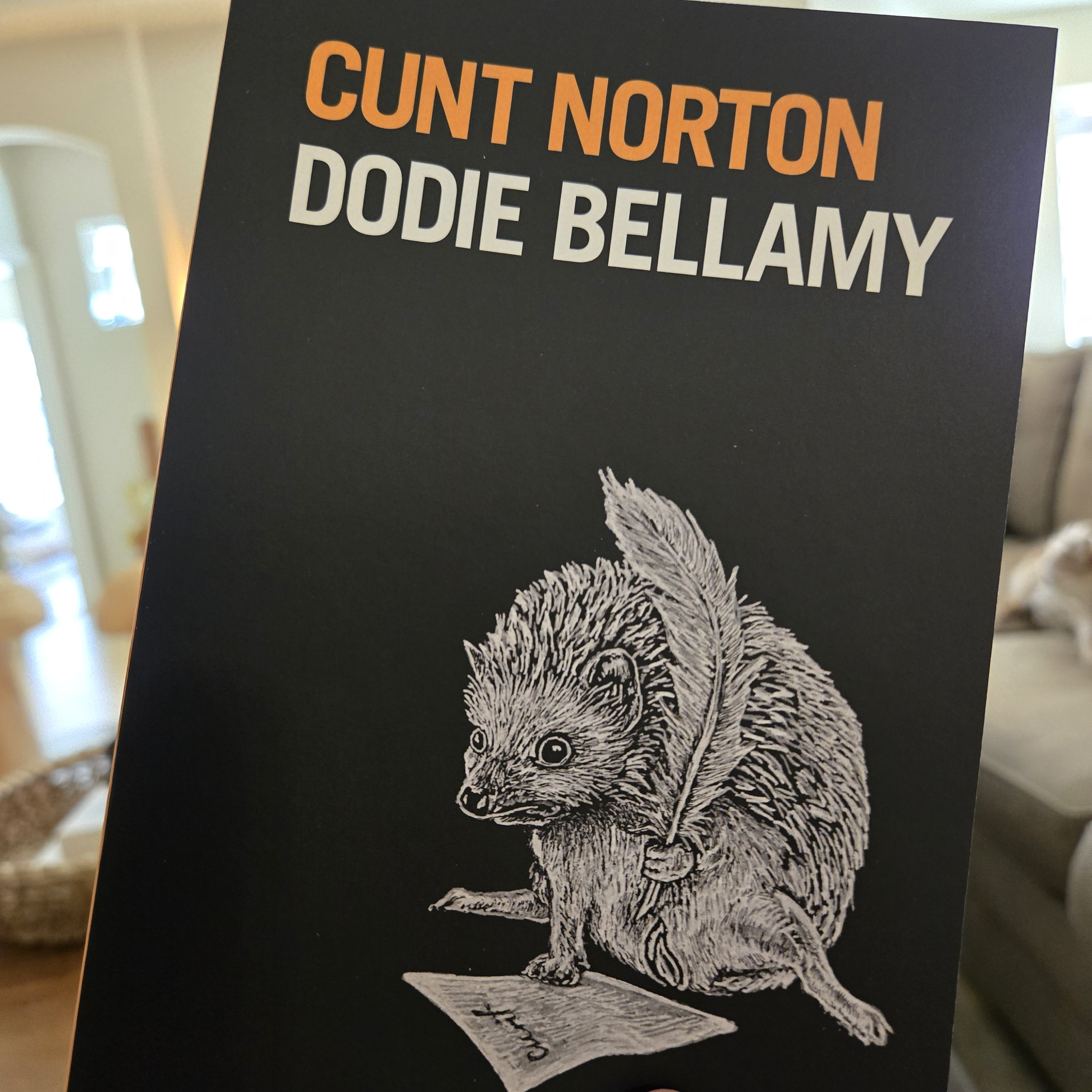
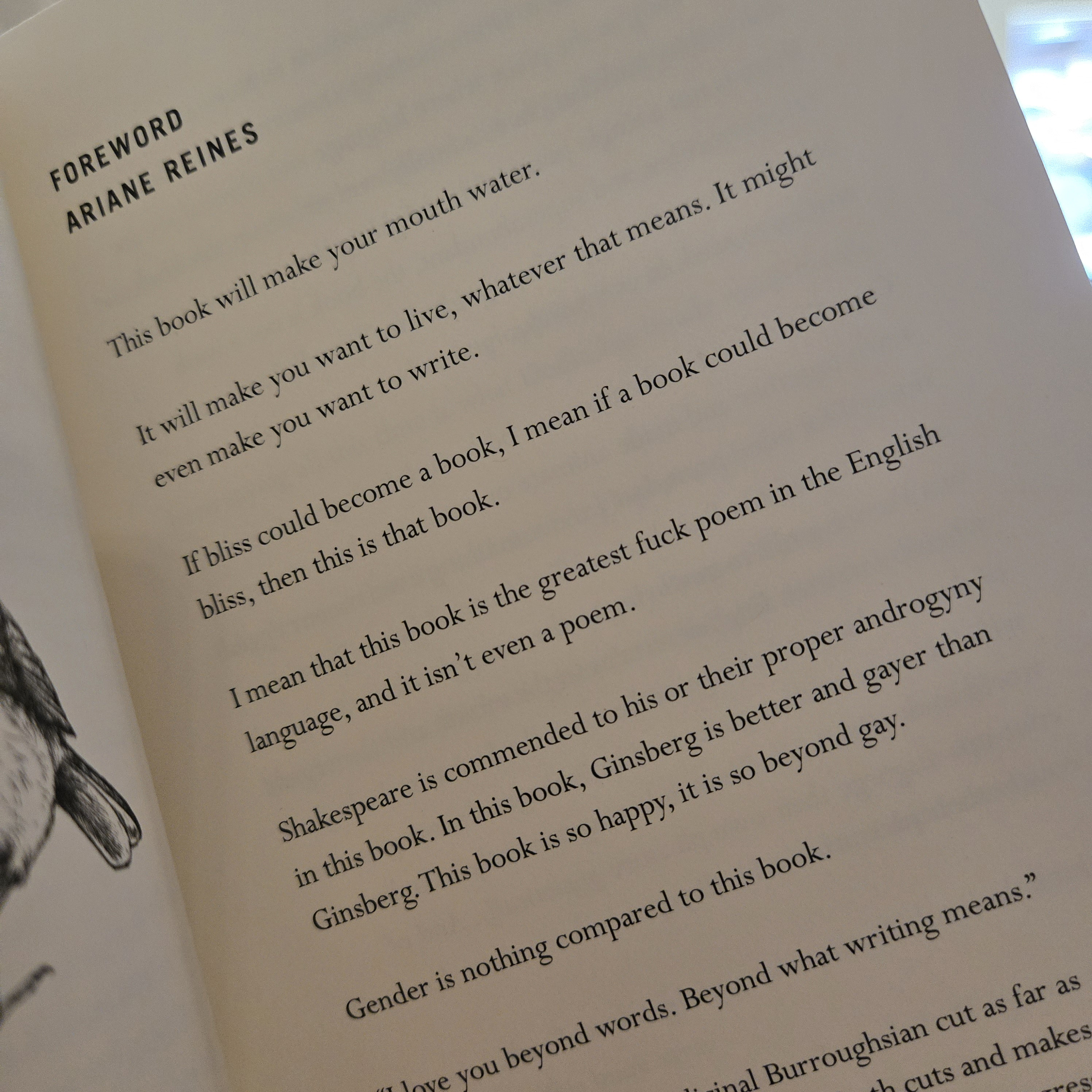
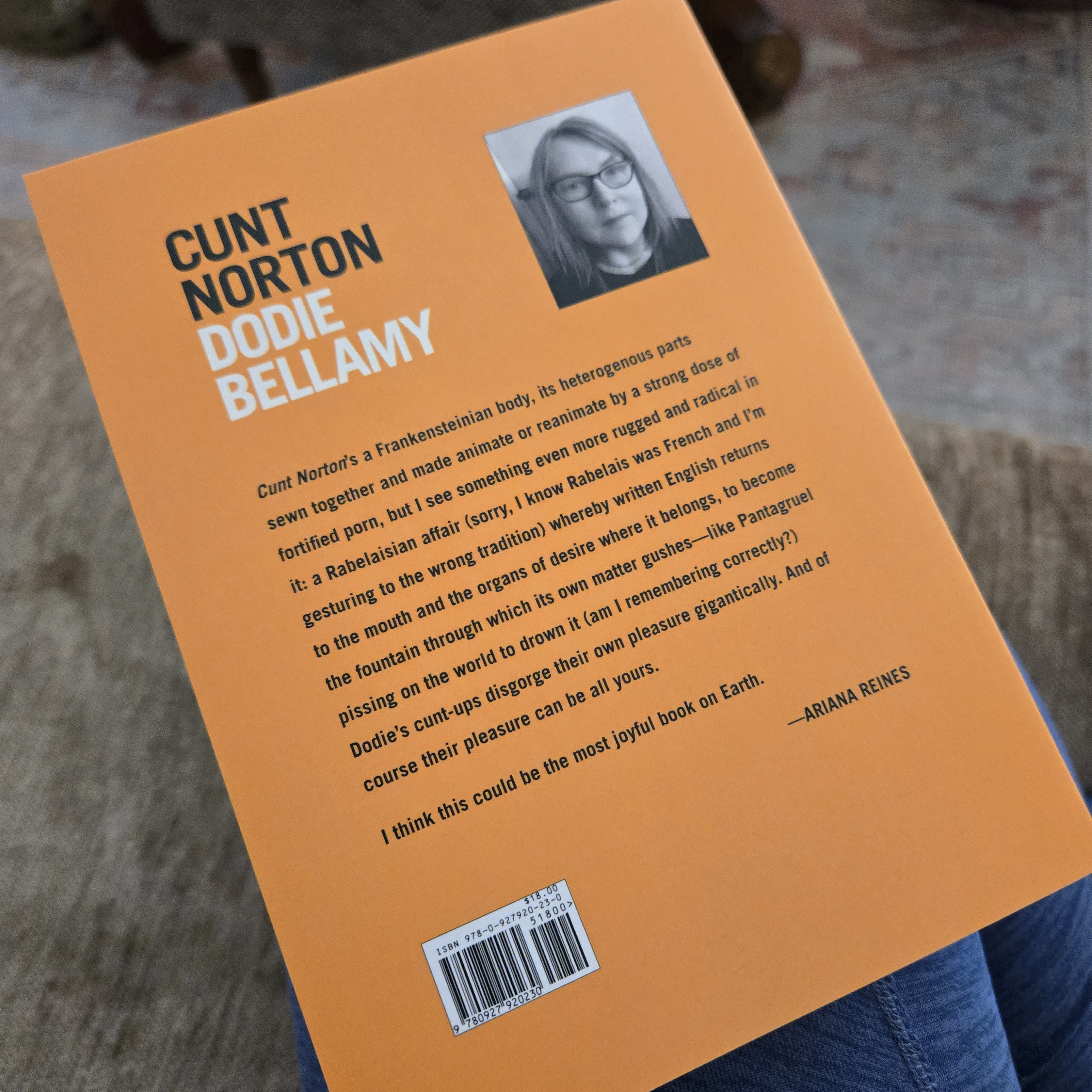
Why am I scarfing down a whole thing of chocolate hummus all at once? Because I’m reading Cunt Norton, by Dodie Bellamy. Here’s an excerpt from the introduction by Ariane Reines:
This book will make your mouth water.
It will make you want to live, whatever that means. It might even make you want to write.
If bliss could become a book, I mean if a book could become bliss, then this is that book.
I mean that this book is the greatest fuck poem in the English language, and it isn’t even a poem.
Shakespeare is commended to his or their proper androgyny in this book. In this book, Ginsberg is better and gayer than Ginsberg. This book is so happy, it is so beyond gay.
Gender is nothing compared to this book.
If you hear me screaming yes yes yes with my volume maxed out, trust me: I’m just reading this book.
(Personally, I think it is a poem.)
—
Images: 1. The front cover of Cunt Norton. 2. An interior page from the collection. 3. The back cover of the collection.
Source: Bill Knott Archive.
I lost my phone for a while today and had the exact same feeling of being untethered that I experienced when my mother died. Unfortunately, this played out in front of my therapist, so he no longer has some image of me as a moderately reasonable or quasi pulled-together person.
I wrote a poem. It’s not about my phone, but I do have a poem about my phone because I love it. I mean her. I mean Aluminium. That’s her name. She and I have bonded over the fact that we both contain lithium. She has a little case with a cover on it that’s kind of like the leather pocketbooks my mother’s cigarette company used to give its customers for free. I love her. I also love my mother, who died on December 20, 2004. Oh, that’s what’s happening. That anniversary’s coming up in two days, hence all the big emotions directed at Aluminium.
This Calibri T-shirt is getting tighter as the night wears on. It feels like a corset and not in a good way. Bloatano has entered the building. I mean my body. I mean I’m bloated, but Bloatano sounds better, like the monster that GI distress is. The internet says I’m the first person ever to use the word Bloatano, so that’s kind of a big deal, which means I’m kind of a big deal. Bloatano also affects my ego from time to time, clearly.
I blocked three people today. It was super. My image of the medieval badge gave me the courage I needed in the precise moment I needed it. I can’t wait to hold all those little phalluses in my hand when the actual badge arrives. If phalluses really ward off evil, I’ll have ample protection.
There are black vultures in parts of Oklahoma. Tell me that’s not a reason to move back there.

Your near rain is my far rain. You, there. Me, here. Native sparrows gather in the wildlands behind my house as winter surrounds yours. They say what you won’t, what you can only feel. Cold, they say. Seed. Wind, they say. Wind.
Something happened a couple of days ago that has me so shaken I woke in tears this morning. It’s related to poetry, to poets. Of course it is. For my health, for my life, for my future, I need to limit who I’m intacting with, where I’m publishing my work, and where I’m spending my time in poetry and as a poet. I support kind, generous, compassionate poets and the journals and presses they run. I will continue to support those poets, journals, and presses. But all the rest? It doesn’t have a place in my life. I’ve seen enough. I choose a different approach to writing, a different community, a different way of being in the world.
Watching a baby goat take a shower is how I am.
For only $69.99, you can send a bag of mystery bones to someone you love. So there’s that.
I’m spending Thanksgiving with my loved ones: the life partner, our dog, and Bo Burnham.
Despite everything, I’m thankful for everything.
My poems are like webs I weave under every bridge, every cliff, here in canyon country. They’re not just for me. They’re for everyone who lives here and needs something to catch the light when they look down, when they find themselves leaning forward.
Ironically, I really need a paperweight right now.
In a stunning turn of events, I don’t like handblown glass paperweights as much as I thought I did.
I dreamed I was made of cotton and kept pulling parts of myself from myself until there was no me left.
Marbles are so emotional. One member of the marble-identification group shared a note a woman wrote about the marbles she played with when she was a child in the early 1900s. Her name was Lulu. She kept her marbles and note in a face-powder box. Another person found a coin purse at an estate sale with three wheat pennies and a single marble inside. The poster writes: This was somebody’s treasure.
I dreamed I married my husband’s brothers, even the dead one, and was also an evil clown is how I am.
I just joined a marble-identification group on Facebook is how I am.
The life partner woke me up eating a pickle on the other side of the house is how I am.
I don’t have a lot of words right now. It took me twelve hours to get out of bed and onto the sofa today and another two to make it to my desk. Now, I’m headed back to the sofa and then back to bed. It is very hard to be outside of language. It means I’m outside of hope. It’s going to take some time to come to terms with that feeling, if that’s even possible.
I don’t know who Facebook thinks I am, but it’s trying to send me a vacuum-packed cow brain in the mail. Also, a pig heart in its pericardium. A sheep-organ set. A turkey gizzard. Petrfied snapping turtle feet. A cat in a box, a skinned cat, an economy cat, a pregnant cat, a small cat, and a cat skull. A cut-open dogfish shark. A sea squirt. Half a sheep’s head.
I just misread something as Mr. Bananajeans, and now I need to find an animal I can call Mr. Bananajeans.
The life partner saw the two-person steam sauna I put in our Amazon cart and removed it is how I am.
In my despair, I put a two-person steam sauna in my Amazon cart is how I am.
Lines from my dream: Alive to the moment, / unaffected by the heat, / penetrated by the Midwestern sun / pocked with chicken-laden pastures, / I wait for a rapture that never comes.
I’m a little bit grumpy. The life partner and I are having a funeral tonight for the part of me that can no longer live safely in the world, but he keeps saying mixed weenies over and over because, hours ago, that’s what he thought I was saying when I actually said McSweeney’s.
Grammarly says I wrote 122,765 words last week. Really? Where are they?
I live in poetry. I survive in prose.
Maybe I cast light on poetry’s shadow. Maybe that’s part of the problem. Come to terms with that shadow and with what you are in response to it. That’s the work that must be done before understanding and integration can occur at the individual and collective levels. Don’t blame me for the shadow. I didn’t create it. I am not it. You’ve conflated me with a system, with you.
I dreamed my ex told me he couldn’t choose me because all choice is limitation and restricts freedom. I’ll take you for now, he said. But I don’t choose you and never will. He said this as I cleaned the dirt from his boots off his favorite ottoman.
Ten years is nothing to eternity.
I don’t think I’m ever going to heal. I don’t know if I’m even going to survive.
My love is in my feet today so it can hit the ground as I walk.
My neighbor blows all the dust down the street and back into the wildlands.
As hard as it is at times to live with empathy, I wouldn’t want to live without it.
During the election coverage, I rubbed my boobs on the TV.
While you sleep, bees will honey your lips the way they did when Plato was an infant. Then you will kiss me sweet, love me sweet. I will die sweet on your vine. Oh, sugar. Oh, conjecture turned confection. Do not tell me why you are bad for me. Waggle. Buzz. Make my whole body vibrate. There, there, little love, little bee. Feed me.
Two million flowers
make a pound of honey
a riot of blossoms
If those who are being harmed refuse all collective language to describe those who are being harmed, those who harm will continue to harm. Collective language leads to being seen collectively. Being seen collectively leads to acting collectively. Acting collectively leads to change.
Sand at the foot
of the mountain forgets
it was ever part mountain
Because Thanksgiving somehow marks the start of the new year for me, I spent part of the day doing what people do as they move from the old year to the new one: creating a schedule for the thirty-three vitamins and supplements and five medications I take.
Half of what I take interacts with one or more of the other things I take, so putting this schedule together feels like getting a poetry manuscript in the right order. It’s also like doing calculus, which I vaguely remember. Math was always fun and games for me until the answer invariably came out wrong and I had to start all over.
I have diagrams with things that are crossed out, things I’ve moved multiple times, pictures I’ve drawn of pills fighting with each other, little swords in their little pill hands. My floor, covered in sticky notes, has been transformed into a pink-paper sea of faded, flattened blossoms, each a failed attempt to meet every substance’s needs without compromising any other substance’s needs or my needs, which is the whole point of this undertaking. I have to be careful about how and when and why I introduce new substances to the watery admixture that is me.
I have a bunch of tabs about chemical interactions open on my computer. I have a brand-new Trello board full of notes. I’m very close to writing a raggedy-edged poem ranting about pills and people in the style of Charles Bukowski.
The Trello board has a white-stucco background depicting stairs leading to a colonnade whose immersive columns rise all around me, or so it seems, like bleached bones. I chose the photo for all my boards related to my health. It makes me feel safe somehow, like I’m inside my own body, which is at once dead and also impenetrably strong. It’s almost like one of the liminal spaces in my dreams, but I never futz with pills in my dreams or boluses I empty under my tongue or sticky fluid made from other people’s plasma that I absorb under the skin through needles I jab into my upper arms. I’m too busy running in my dreams or flying or falling. Unless I’m in the grotto. I could stay in the grotto forever, and I will if we get to choose where we go next, once the pills stop working and the cathedral of the body collapses and someone burns me like a banned book, like a bra, or maybe like a flag.
My severe hypothyroidism is taking a toll. For the past two weeks, gobs of hair have been falling out every day. I’ve been in bed since Friday. I need to have blood work done to see if the new dose of thyroid-replacement medication is improving things at all, but I didn’t have the energy to call the lab to schedule an appointment because the required opening up the cabinet where I put the lab paperwork, pulling it out of a stack of papers, finding the phone number, dialing the phone, and talking to someone. Too much. Also too much: doing my immunoglobulin infusions, the ones that keep me alive; preparing for the support group I’m facilitating that starts this week; hydrating; exercising; bathing; eating.
In this hypothyroid state, which has been creeping up on me since last fall, I’ve also been thinking a great deal about poetry and what I’m doing as a poet. A hypothyroid state isn’t the best one to be in when having these thoughts, but anyone who’s been hypothyroid knows these are the kinds of thoughts one has when hypothyroid.
Here’s my conclusion. Poetry is, at its worst, a discriminatory and harmful system. I’ve experienced discrimination and harm firsthand. But the system being what it is doesn’t make it one I can walk away from. I’m a poet. Being a poet isn’t something I chose or can unchoose. It’s a way of being.
When I was close to death in 2022, writing an imitation poem after Richard Siken is what brought me back to life and what allowed me to continue living. There was no question for me then that I was bound to poetry, to being a poet. It doesn’t matter that it was a Richard Siken poem. It could have been any poem, imitation or otherwise. I time-traveled in that poem. I found my way into and through time itself, not because I’m special or any given poet is special. What’s special is poems: who we are in them, who we aren’t, what we see, what’s beyond seeing. That dissolving when we need to dissolve. That emerging when we need to emerge. That liminal space between dissolving and emerging where we can live more expansively.
I came back to poetry. I can’t leave it again. I think my presence makes poetry better, not worse. I’ve written about what happened to me in poetry and beyond. I see issues at the systemic level and call attention to them. Because I’m older, I have a longer memory than a lot of poets do, which gives me insights others may not have. I make choices about where to send my work and who to associate with accordingly, which is necessary when poems enter the world of poetry, that less-than-optimal system that can and does do damage.
I’m neither a sycophant nor the poetry police. I call things like I see them. I’m not trying to make anyone feel bad about the unexamined biases that exist in poetry or the ways in which they may be contributing to those biases or at least not helping alleviate them. I do think we should all pay more attention to the institutions and organizations we support, the people we defend, and how we talk about those who are exploited and otherwise victimized within the system. But I know I can’t change anyone or the system as a whole. I can only control how I navigate it and who I am within it.
I suspect things would be different if poets didn’t have jobs to worry about or tenure or getting published or securing money for their projects or any of the other pressures that keep the system humming along without much change over the past several decades. I’m not fettered by any of that. I just read and write poetry.
I still remember Carolyn Kizer telling a group of poets that another famous poet tried to rape her. It was at a dinner before a reading she was giving. I also remember how the other poets at the table responded, which was to react in a flustered way and quickly change the subject. That was nearly thirty years ago, when I was just starting to write poetry. But what happened to her occurred decades earlier.
Poetry has had systemic issues that affect individual poets for a long time. These issues didn’t start yesterday, and they won’t end tomorrow. That’s why I’m not going to stop writing poetry or talking about what I’ve experienced and seen in the poetry community. Carolyn Kizer was talking to me that day in 1997. She was warning me. I heard her. I try to hear everyone who speaks.
I came across a thread today from ten years ago. It’s about the poet who sexually assaulted me. I’d never seen the thread before or the assertions it contains. I want to be very clear about something: I never retracted or changed my story. The essay that was slated to run in VIDA did not run because another poet divulged the name of the poet who sexually assaulted me to one of the publication’s editors, and that compromised me as well as VIDA. The piece did not name or otherwise identify the poet in question, which was a requirement for the essays in that series.
I have since published that essay and made it publicly available. It took me ten years to do so after what happened. I’ll link to it in the comments.
The thread I saw sickens me even now, a decade later. I don’t have words to describe how atrocious it is. It reminds me why I left poetry in the first place. It wasn’t just because of the sexual assault. It was because of how poets, in particular women poets, responded to the situation.
The poetry community terrifies and horrifies me.
 Dana Henry Martin