The Architecture of Mental Illness

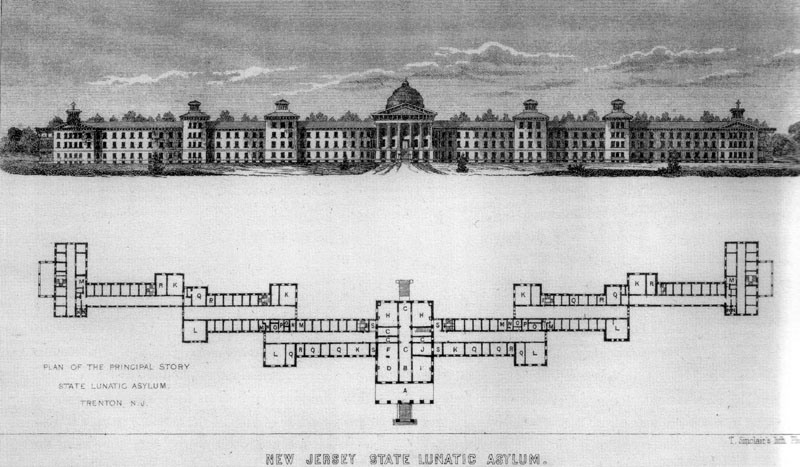
Mental illness has an architecture. That’s part of the story of asylums and treatment in this country. Central State Griffin Memorial, the hospital in my hometown, wasn’t laid out like this, but it had that same grand feel juxtaposed against the lives of those who inhabited the buildings.

Throughout its history, which spans more than a century, Central State’s story has been one of hope, ignorance, dehumanization, and harm: the same story from the asylum era to era of deinstitutionalization to today. I can barely tell any of it but have to before that history is lost. My mother worked there as a nurse and was treated there as a patient. Her relationship with Central State spanned more than three decades. That architecture was in her body, her bones part of the structure of those buildings and that land. Now, we need to make sure these places don’t come back with a new story: one of coercion, exploitation, profit, and greed.

Source: PBS Utah video about The Kirkbride Asylum, which was the template for many other asylums across the country.

Loosening Our Ties

My father had a tiger’s eye bolo that I loved. I wore it in grade school when we reenacted the Oklahoma Land Run. (Yeah, we did that. Also, there was more than one land run, but we only learned about and celebrated—for lack of a better word—the main one for simplicity’s sake.) I wanted to be a cowboy. My teachers protested. They wanted me to do whatever the girls were doing.

I’ve been looking for a bolo that’s like my father’s for a long time, but most of them are turquoise, and my father’s was shades of brown. I found one today tucked into the back corner of a gift shop. It was made of tiger’s eye. As soon as I saw it, I remembered that’s what my father’s was made of, and it’s also why tiger’s eye was my favorite gemstone as a child.

As I held the tie, I thought, “My father was more than the sum of everything terrible that happened to him and everything terrible he did, including what he did to my mother and me.” It was a surprising thought. I want to believe that—that there was an untarnished part of him tied to the traintracks inside his heart. He may have tied that part up. He may have wanted it tied up. But it still existed, whether or not he longed to free it.

I bought the tie to commemorate continuing to be in mental-health recovery after my trauma-induced mania two years ago. As I drove home, 104.1 played “Dust in the Wind” by Kansas. The sky was lapis lazuli polished and held to the light. The cliffs in and around Zion looked at once eternal and ephemeral. As much as their presence hints at forever, they are also literally dust in the wind.

I started crying. How could I not? How could anyone spend time with this land, this sky, and not untie the parts of themselves that are immobilized in their hearts?

Let the heart run. Let it rewild. Let it forget suffering. Let there be nothing to suffer from or for. Let us all loosen our ties and help others loosen theirs.

Hope Hall

Now, Hope Hall is an empty and quiet place, one where footsteps echo down tunneling hallways. Bob McDonald, who once stayed in an open barrack on the campus, said “the noise level was huge” when patients were “warehoused” in the mental health ward, back in the 1980s and before. Their cries reverberated throughout the building, he said, and patients pounded on their doors. Some had only an eyeball-sized peephole to the outside world.

And more important, perhaps—the patients had little or no treatment for their illnesses. They were the castaways from generations that didn’t understand them. They were locked up and kept out of sight.

From a story about Central State Hospital / Griffin Memorial Hospital, where my mother worked for thirty-five years. We need to seriously evaluate where mental-health care is headed under the July 24 executive order. It’s headed back, not forward. Back to the days of warehousing human beings like sacks of grain. Story link in comments.

Pinfeathers

There are some things you can’t show, things you can’t share once you’ve seen them, so you turn them into a poem, and you can barely do that. Because they happened in the state you’re from. Because they happened in the state mental hospital where your mother worked. Because they happened while everyone looked away. Because we were not much better here in the United States than the Nazis were where those sent to mental hospitals were concerned.

Because in a day room in Taft, Oklahoma, we let a little boy sit wet with his own excrement or urine or blood or all three, a strip of white cloth cinching his arms to his neck. Because he’s not the only boy or the only man in the photo. Because this is what we did to human beings in the 1940s but also now or again or now and again with a new face, a new flavor, a new reason, from a new hatred, a new greed, a new form of consciouslessness.

What did I leave out? That the boy was Black. Everyone in the photo was Black. This was at the State Hospital for the Negro Insane. That’s what they called it. Are you sick yet? Do you want to turn away? You already have, from all of us, as the cages are built in Florida, as we find new reasons to cage. Will PETA come to the rescue? People are animals, too, and being treated worse than animals.

People who cage people are animals in a different sense of the word. They should start an organization called People for the Obliteration of People. POP for short. It has a ring to it. It’s weaponized.

Here, drink from this metal cup. Here, sit on this wooden bench. Here, look through this barred window for the rest of your life. Here, here. Here, here.

The photos I’m looking at include one of the back ward at the hospital where my mother worked in Norman, Oklahoma. These are not easy images to see, but this history matters. What’s been happening to people like me has been happening to people like me for a long time. This country could learn a lot from this history as its pinfeathers break our democracy’s skin.

The Oklahoma History Most Oklahomans Never Learned

On the desegregation of American psychiatric institutions and structural racism in American psychiatry. Link in comments.

Oklahoma,1964: Taft State Hospital was an all-Black facility, with an all-Black staff, located in an all-Black town. In 1940, its 738 patients were cared for by three psychiatrists (including the superintendent), three nurses, and an unknown number of direct care staff, who apparently all lived in one room. In 1949, Oklahoma consolidated the state hospital with the Institute for Colored Blind, Deaf, and Orphans and the Training School for Negro Girls, creating one large facility for Blacks with all manner of clinical needs. Oklahoma desegregated its public facilities in 1964. Rather than admit white patients to its state hospital for Black patients, as most of the other states would do, Oklahoma transferred the Black patients to its two other (all white) state hospitals. Taft was closed in 1970 and converted into a correctional facility, thus confounding in the public’s mind people with mental illness and criminals. (Some state hospitals have converted some of their units into correctional facilities, leading some people to think that psychiatric patients are being held behind multi-layered, barbed wire, razor-topped fences.)

What Happened

Sexual violations can take time to understand, to come into our consciousness. What is was. What it’s called. Knowing what happened, knowing the name of what happened, can lead to a whole other level of distress that needs attention and healing. Even though nothing about the experience changes, knowing what it is, what a violation it is, changes everything.

I grew up being so violated I didn’t have names for anything. It wasn’t until I was in my forties that I really started to understand. I was watching a news story that included the details of a woman’s rape by multiple classmates. I was like, That’s rape? I’d been in a nearly identical situation once with two older classmates, which meant I was raped. That’s the first time I realized what happened, what it was.

Then I went through a list of other incidents in my head and was like, Then what was this, and what was this, and what was this? It turns out it was a combination of rapes and sexual assaults. Also child sex abuse. Also, much later, in 2023, I realized I’d been trafficked. I’d just learned that there was a huge sex-trafficking ring in my hometown and in other parts of the state my father frequented with me. It’s one of the largest in the country. I don’t know that my father was formally part of that or if he just found his way into those spaces because he was drawn to them. But I do know he sexually abused me. And his best friend sexually abused me. And his best friend’s adult son was extremely inappropriate with me in a sexual/grooming way. And his work associate came around the house with his penis sticking out of his short shorts while I was told to sit on the ground in front of him, putting me at eye level with it, while my dad was there watching both of us. And I know that man was also sexually abusing his children. And my father’s former friend was sexually abusing his daughter. And I was in that house a lot, all the time, and it never felt safe there, and it wasn’t because he was hitting her or throwing her down the stairs. It was another kind of unsafe, one she wouldn’t be able to talk about until she was in her fifties.

And I know my father made me talk to truckers on the biggest sex-trafficking highway in Oklahoma. I know I had a CB radio handle. I know the truckers knew the handle. I know they would get on the CB radio and ask for my father by his handle, then ask if I was there and if they could talk to me. And I know I obliged. And I know I thought it was fun. I believe I was on my father’s lap some of the time, but that may just be how it felt emotionally—that closeness and tension. And I know my father stopped once, with me, to meet up with a man who saw me and looked scared and wanted to leave. That’s where what I know ends. I don’t remember the rest.

When I learned that there was a name for all of that and the name was child sex trafficking and abuse, it was too much of a shift, though nothing that happened had changed. What it was had changed. I spent parts of 2023 delusional and terrified. I felt like I’d come to understand something the human mind isn’t meant to understand and that I’d survived something the human body isn’t meant to survive.

So yeah. Maybe fuck [poet’s name redacted] or at least that comment she made and the similar ones other folks made in 2015. What happened with the poet who harmed me was nothing compared with what my own family and namely my father did to me and allowed to be done to me. But it was still sexual assault, and it was still fucking awful, especially because the poet made me talk about my child sexual abuse as he was assaulting me. It turned him on.

This post was initially a response to a comment on another post on my Facebook page.

The Closet

My teacher says the penis just finds its way into the vagina, knows where to go, doesn’t need any help getting up in there. She says it goes right in the way her husband’s does. She’s pregnant, so we’re pretty sure she’s telling us girls the truth. We’re fifth graders. This is our sex-education class in Norman, Oklahoma, in 1981 at McKinley Elementary School.

We are fifth-grade girls being told the penis just finds its way into the vagina while the boys are in the other classroom with the nice teacher being told who knows what. They will squirm a lot when they come back, the boys, which will be unsettling given what we are just now learning about their penises.

Most of us barely know what a vagina is or how it’s different from the part we pee out of or the vulva as a whole or that there’s a magical subcomponent to the vulva called the clitoris. She doesn’t tell us about the clitoris. She leans back onto one of the little desks at the front of the room, probably one of the reject left-handed ones like the one I beg to use since I’m left-handed but that’s always denied to me because our teacher, Ms. Malecki, is not the nice teacher. She’s no Mrs. Brown, that’s for sure.

Ms. Malecki once left me in the coat closet as a punishment for the entire day. I wasn’t allowed to come out to use the restroom or eat lunch or play on the Big Toy outside. She turned off the lights and left at the end of the school day with me still in the coat closet. I waited at least an hour before coming out. She’d threatened me several times in front of the whole class for occasionally whimpering from the closet. The paddle. I’ll tell your mother. I’ll tell the principal, all of that. The principal was related to James Garner, so of course I didn’t want him involved. It would make me uncool forever, and I was already well on my way to being uncool forever without celebrity-adjacent involvement.

I was understandably terrified of Ms. Malecki. Now, I was terrified of her husband’s penis and penises in general, things that seemed like they acted on their own and without authorization and without thought and without consequences the way DOGE will in a future I can’t imagine, one that’s completely out of alignment with the pledge of allegiance we all take every morning unless we’re one of the kids who have to wait out in the hall because their parents don’t want them saying the pledge or singing the national anthem. The scariest thing in my world thanks to Ms. Malecki was the fear that one or more penises would be up inside me all of a sudden while I was hyperventilating on the monkey bars or trying to grab an extra cookie in the lunch line.

Ms. Malecki’s still perched on the little reject desk, which makes her stomach tilt upward. Her exposed belly button gazes at the fluorescent lighting as we ask questions. How do you know if you’ve had an orgasm? You just know. What does the penis look like? You don’t want to know. Are penises going to get inside us as we walk around on the playground or sit in class next to boys? I hope not.

This is a story in which I don’t talk about the sexual abuse I was already experiencing without understanding what was happening. Because the penises stayed tethered for the most part. Because one of the men was a boy, an older boy who’d been held back in school, and I didn’t understand what child-on-child sexual abuse was, that it wasn’t play and wasn’t normal and shouldn’t have happened. (I mean, I knew it shouldn’t have been happening, and I begged for it to not happen, but I didn’t know what it was that was happening.) Because things didn’t get really bad until I hit puberty. Because that’s when the penises came out. But they didn’t just find their way into my vagina and mouth. They were forced in. They were forced entries. These were things nobody, not even Ms. Malecki, could have prepared me for or helped me understand. We failed to ask all the right questions. Will we be molested? Will we be raped? Will we be sexually assaulted? I imagine her answer would have been I hope not.

I lived in a closet for a long time. Too long. In so many ways, I lived in a closet not unlike the one in my fifth-grade classroom. Afraid to come out. Afraid to make a sound. Afraid that, even once the lights were turned off, the threat would still be there, waiting for me to make a move, to run.

Moving Mountains

Utah Senator Dan McCay, who shepherded the bill banning pride flags in Utah’s schools and government buildings through the State Senate, took to X, formerly known as Twitter, to attack the Sundance Film Festival. Here’s what he wrote:

“Bye Felicia. Sundance promotes porn. Sundance promotes alternative lifestyles. Sundance promotes anti-LDS themes.”

Sundance is considering leaving Utah, where it’s been held since its creation in 1978. The ban on pride flags could ensure Sundance’s departure from the state.

This is how Utah’s lawmakers are behaving these days, just a couple of years after cloaking their homophobia and transphobia in purported support for federal protections for same-sex marriage. They wanted to be seen as the good guys back then. Not anymore. What’s infected our government at the highest levels has infected Utah lawmakers and many of those who live in the state.

Almost three years ago, I contacted every LGBTQ+ organization and group in Utah to address the hatred and outright bigotry several Southern Utah lawmakers in places like St. George and Leeds were espousing through far-right groups with militia ties. The only organization that responded—the largest one in the state—told me they had decided not to address the issues with our lawmakers. They thought everything would blow over and wouldn’t amount to anything. They perceived themselves as the leaders of Utah’s queer community. As such, they were encouraging everyone else who was queer to stay quiet, too. Like me. I was told not to talk about what was happening.

I told them they were wrong. I’m from Oklahoma and have lived through this. I lived through the AIDS epidemic, the Reagan years, and more. I lived in Kansas and know the Koch brothers and their playbook, which was being carried out in Washington County, Utah, where I lived and across the country in rural areas with a couple of tweaks: guns and violence and, in the case of Southern Utah, with a post-Mormon hatred that was unbounded. I said what was happening in Southern Utah was going to spread to the rest of the state—and quickly. They didn’t believe me. They were Salt Lake City-centric and didn’t see the power lawmakers in Southern Utah had or understand what they were capable of.

I told them anti-trans legislation was going to hit them like a tsunami, and they had a responsibility to address what was happening before it was too late. Weeks later, they flew the director of the organization down to Ivins, a town just outside St. George. People with power and influence in the queer community were invited to a mansion to discuss what to do, how to move forward. It was a private event. Members of the queer community at large were not invited or even told it was happening. Stay quiet was pretty much what they came up with at that meeting. Several people who attended also discussed the past of one of the alt-right group leaders, which involved extremely inappropriate behavior with her female students. (She’d been a high-school teacher in the area at one point.) The group wasn’t talking about that publicly, either.

In a matter of months, nine anti-trans pieces of legislation were signed into Utah law by Utah’s Governor. More laws have been passed since then. Queer organizations have been hobbled and/or gutted. The Church of Jesus Christ of Latter-day Saints has enacted more hateful and harmful policies that target queer members and their families. Queer folks are being threatened, disowned, harmed in myriad ways, erased, and more—more than ever. And now lawmakers are telling everyone in the state what they really think, what they thought all along but didn’t feel they could say.

I’m not a seer. I didn’t see into the future. I’ve just seen all of this before. I’ve lived through it, survived it, and been shaped by it as someone who’s nonbinary and queer. I didn’t stay quiet like the queer organization told me to. I wrote two letters that The Salt Lake Tribune published, one of which discussed a column by Pat Buchanan that ran in The Daily Oklahoman on Oct. 17, 1990. It was titled “Homosexuals Mainstreaming Satanism.” I compared that piece to what was currently happening at meetings and rallies in the St. George area. I also pitched stories to local reporters and provided background material and comments on several stores. This only served to drive a bigger wedge between me and the queer community who didn’t seem to want me or my voice to exist. Ironic? Yes. It’s ironic.

Even with everything unfolding the way I said it would, only worse than I could have imagined, I’m still not welcome in Utah’s queer circles. Last fall, I attended a Zoom meeting for members of NAMI Utah to discuss changes within the organization. That meeting was comprised primarily of queer participants. They recognized my name from the pieces that ran in the Trib, and they thought I was there to glean information about the organization and report on it in The Salt Lake Tribune. I wasn’t. I attended the meeting because I’m in training to become a peer specialist here in Arizona through NAMI, because I’m a mental-health advocate who stays informed about issues that affect mental-health care in my communities, and because I live with mental-health issues and am as deserving of support as anyone else in Utah who lives with mental health issues.

The folks in the NAMI group also believed I was a journalist because they apparently don’t understand the distinction between editorial content and letters to the editor. I’m a poet and writer who’s worked as a medical writer and health advocate. I have a degree in journalism but am not working as a journalist. I certainly wouldn’t “inflitrate” a NAMI meeting. (Please.) Or use my full name in my Zoom profile if I was trying to be sneaky.

The group moderator contacted me individually after the meeting through email to admonish me for being unethical, to insinuate I was there to undermine the organization, and to ask what I planned to do with what I learned during the meeting. It was a stunningly inappropriate communication that was never properly addressed by NAMI Utah’s interim director. She passed it off to a lower-level volunteer as opposed to addressing the infraction herself as the organization’s leader. Here were my concerns, in short: You can’t use an email list your organization maintains to gather information about a member and reach out to them to ask probing accusatory questions. Doing so is discriminatory, borders on bullying and intimidation, and jeopardizes the well-being of a fellow NAMI member who’s seeking inclusion and support.

This is where I’m at in Utah. I’m an advocate whose advocacy is unwelcome and unwanted in both the queer and mental-health communities. The fear that permeates Southern Utah and drives folks to paranoia and conspiracy theories is embedded in the state as a whole, even in the very communities many Utah lawmakers want to eradicate. Queer folks and folks with mental-health issues need to learn how to stand up for themselves and each other, how to bring in and welcome outside voices and perspectives, and how to be true advocates and allies who don’t end up doing more harm than good in their respective organizations. Rolling over, fear, othering bordering on shunning, and baseless accusations aren’t going to get us anywhere, nor is silencing queer voices in the name of queer solidarity. We need to start moving mountains more than one spoonful at a time. And we certainly don’t need to be creating more and larger mountains.

Utah has work to do. We have work to do. We need to show up. My voice isn’t going anywhere, as much as I’ve been asked to remove it from the state, even by some folks in Southern Utah’s poetry community who’ve called my work inappropriate, graphic, and pornographic (just like the Sundance Film Festival, apparently). Hell, I’ve been called a pedophile several times by my neighbors up in South Jordan and later in Toquerville, where I still live part of the year. (One of Utahns’ big go-tos is calling anyone they don’t like a “pedophile,” which is sad given all the actual acts of pedophilia in the state.)

I’ve heard it all at this point. I’m surviving it all on my own, outside of any Utah-based communities focused on support and advocacy. I hope Utah can come back from what’s happening right now. I do. I feel for folks who are being crushed by all of this. But when a bulldozer’s coming, you have to warn others and get out of the way until you can dismantle that bulldozer. You’ll get nowhere if you pretend it’s not coming or throw others from your community in its path or tell them you don’t need their help. Communities who are harmed cannot harm others within their communities. That’s just a reframing of the very paradigm that caused those communities harm in the first place.
Realms Beautiful and Terrifying

Awake is my least favorite word when I don’t want to be. Our water purifier started making a high-pitched noise a few minutes ago, a steady ewwww like a piece of industrial equipment humming in the distance, at once piercingly but almost inaudibly. I unplugged it, but the sound made me hyperfocused on my tinnitus, so now I’m just a body that screeches and won’t stop.

I took some sleep medicine, something I rarely do. As I wait for it to kick in, night thoughts do their dark work. I don’t ruminate about minor issues like some folks. My waking nightmares are about my father, my family, Oklahoma, me, the ways in which I’ve been purged, and the things I feel like I need to purge that find me at night when I’m closer to my personal unconscious and the collective unconscious than I am during the day.

I had an unthinkable thought that was immediately ushered by my circuitry to every central and distal part of my body. My feet. My hands. My tongue. My scalp. My shoulders. My gut.

What if, I thought. What if it’s true?

This particular thought is a hard one to put on a shelf until I can process it in the light of day. The “what if” feels less like a possibility than a haunting, a visitation declaring what the world is and who I am in it. I don’t like either. I hope I’m seeing an old lady that’s really an owl, like in one of those optical illusions.

The unconscious realms are beautiful and terrifying. I’d prefer a different ratio of beauty to terror right now. I’d rather experience both while asleep, not while sitting in bed awake, my warm dog pressed up against my calf doing what I can’t do: slumber. I feel her breath on my foot. I feel her chest rise and fall. I feel how soft and small and fragile she is. I feel how much I love her and how much I don’t want to be a monster in a monstrous world.

Awake is my least favorite word when I don’t want to be. Terror is my second least favorite. Monster is my third least favorite. To be an awake, terrified monster inside of what is monstrous is nothing I’d wish on anyone.

Neighborly

Morning Prayer October 16, 2024

I’m listening to the chickens on the other side of La Verkin Creek over in the Cholla neighborhood where people have lawns and shade trees and gardens and orchards and side-by-sides and motorcycles and religion-themed Little Free Libraries and trampolines and waterfall-edge pools and corrupt former city council members and huge parties with DJs where all the dirty words in songs are replaced with nice words and big flags and banks of photovoltaic panels and gazebos and bermed landscapes and guns that they wear all the time and men who come out of their homes and surround you and ask what are you doin’ and accuse you of looking in their windows when you’re just out birding and saying you better not be a liberal and asking you what state you’re from ’cause if it’s California, you got no place here and telling you that you can’t be on city property and pointing to the No Trespassing sign they’ve posted on the city-owned bridge that connects your neighborhood to theirs and they pretty much do whatever else they darn well please, like having chickens.

I’m clearly not a fan of Cholla, but I do love those chickens. Listen to the way they greet the day. Bu-bu-bu-bu-bu bu-CAW. Bu-bu-bu-bu-bu bu-CAW. They don’t care about Cholla. Bu-CAW. They just want to chicken. Bu-CAW. So they chicken. They chicken hard, and I get to listen to it from the relative safety of my home because their vocalizations don’t stay in Cholla. They go where they want and are received by those who need to be reminded how to live above repression, above cultural toxicity, and on their own terms.

Bu-bu-bu-bu-bu bu-CAW.

Anyhoo. For the record, I’m not from California. I’m from Oklahoma. And I’m not a liberal. I’m an outsider American Leftist who’s not a tankie. And I really was surrounded by three of Cholla’s HOA members a week after we moved here when I decided to go out birding. The city almost took the bridge away when it found out what the Cholla folks were doing to intimidate folks in our neighborhood. I wrote a letter to the city saying it was all good. I made those men chocolate-chip cookies, and they brought me a passel of pomegranates, and we smoothed everything out on our own. So the bridge remains. You’re welcome, Cholla. (You can look all this up in the Toquerville City Council Meeting Minutes from 2020, which are online. I am not even exaggerating about the city threatening to take away the bridge if residents couldn’t play nice. The whole thing was ridiculous but not inconsistent with the rest of my experience in Southern Utah.)

I got distracted. Here’s the prayer part: May we all Bu-bu-bu-bu-bu bu-CAW today. Let’s chicken. Chicken like there’s no tomorrow. Chicken for those who need to hear you chicken—maybe across a creek, maybe on the other side of the world. Chicken because chickens rock and you rock, so you really should chicken.