Neuro-

Neuro- is a combining form that means nerve, nerves, and nervous system. It does not mean brain, though the nervous system includes the brain. So when I talk about neurodiversity, I am not reducing folks and their experiences, identities, or labels to their brains, and I am not situated inside any kind of bioessentialism or biomedical framework. We are biological organisms. Everything that happens to us is biological. Our biological experiences are largely informed by our nervous systems. Our nervous systems are—both acutely and chronically, and both idiopathically and collectively—affected by everything around us, including our experiences, our abuses and traumas, the ways in which we are marginalized and oppressed, and more. Saying something is neuro-, including using terms like neurodiverse within the framework of neurodiversity, is not saying this, that, or the other thing starts and ends in the body. It is not the equivalent of denying or discounting the larger systems, functional and otherwise, in which we as biological beings exist or the forces those systems exert on our lives.

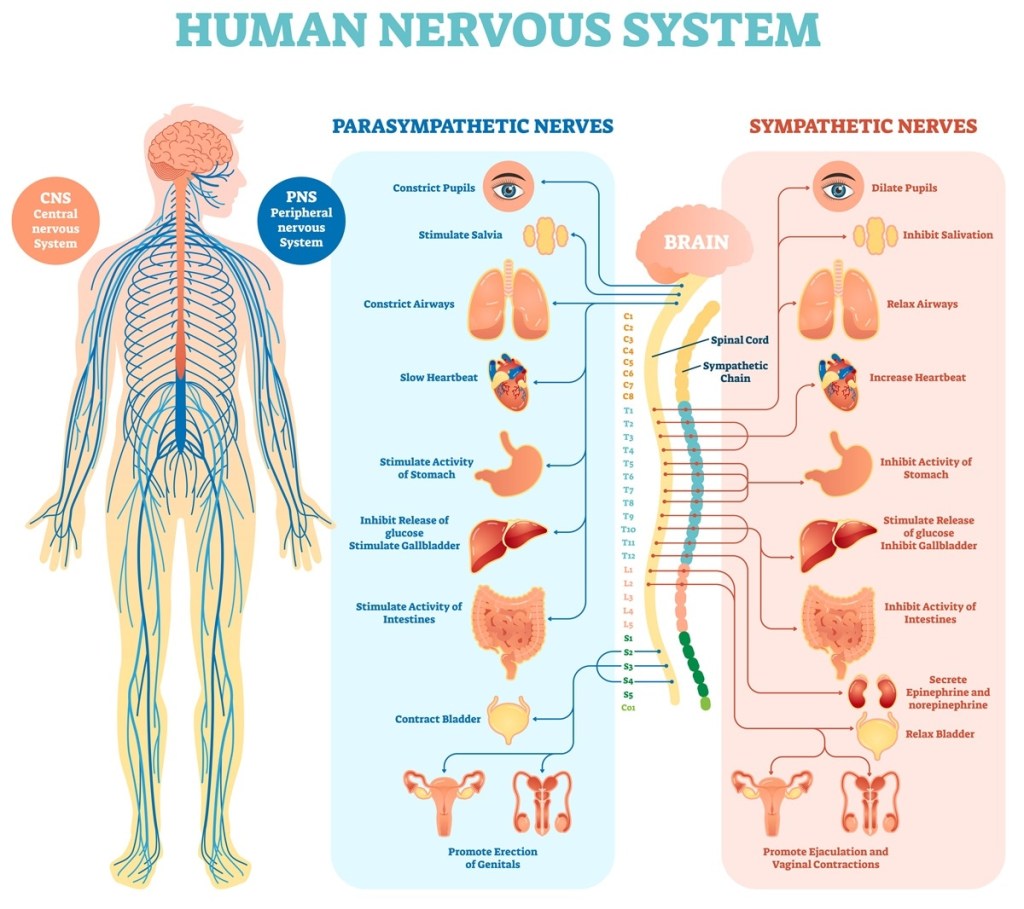
Image: A graphic depicting the human nervous system, including the parasympathetic nerves and the sympathetic nerves. The functions of the former include constricting pupils, stimulating saliva, constricting airways, slowing heart rate, stimulating stomach activity, inhibiting the release of glucose, stimulating the gallbladder, stimulating the intestines, contracting the bladder, and promoting the erection of genitals. The functions of the latter include dilating pupils, inhibiting salivation, relaxing airways, increasing heart rate, inhibiting stomach activity, stimulating the release of glucose, inhibiting the gallbladder, secreting epinephrine and norepinephrine, relaxing the bladder, and promoting ejaculation and vaginal contractions.

Image source: News Medical.

Maria Gugging Psychiatric Clinic

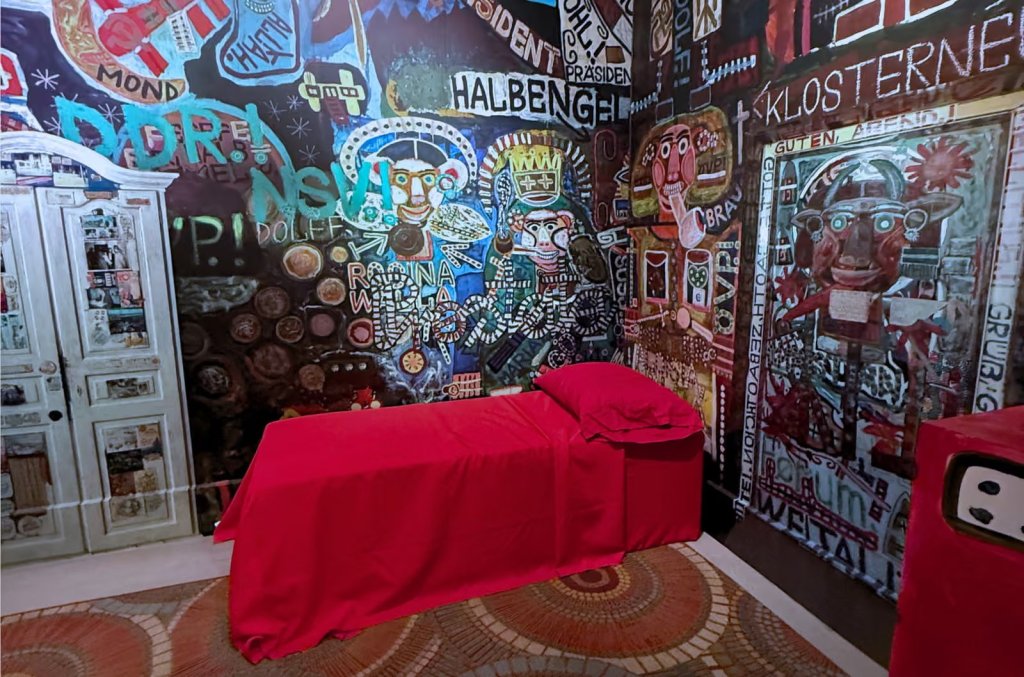
In September 1994, [David] Bowie and Brian Eno—who had reunited to develop new music—accepted an invitation from the Austrian artist André Heller to visit the Maria Gugging psychiatric clinic. The site’s Haus der Künstler, established in 1981 as a communal home and studio, is known internationally as a centre for Art Brut—or Outsider Art—produced by residents, many living with schizophrenia and other psychiatric disorders.

The acclaimed Austrian photographer Christine de Grancy documented the visit, capturing Bowie engaging with these so-called outsider artists—a term often criticised for framing artists through illness or marginality rather than authorship. For the first time, these intimate portraits will be shown in Australia, when A Day with David opens at Joondalup festival in Western Australia in March, in collaboration with Santa Monica Art Museum.

And, of note: Gugging itself carries a darker weight. Founded in the 19th century, the clinic was later absorbed into the Nazi’s Aktion T4 program, which targeted those with mental and physical disabilities, and resulted in the mass murder of an estimated 250,000 people. At Gugging alone, hundreds of patients were murdered or sent to extermination facilities.

Source: The Guardian.

Pill Fight

Because Thanksgiving somehow marks the start of the new year for me, I spent part of the day doing what people do as they move from the old year to the new one: creating a schedule for the thirty-three vitamins and supplements and five medications I take.

Half of what I take interacts with one or more of the other things I take, so putting this schedule together feels like getting a poetry manuscript in the right order. It’s also like doing calculus, which I vaguely remember. Math was always fun and games for me until the answer invariably came out wrong and I had to start all over.

I have diagrams with things that are crossed out, things I’ve moved multiple times, pictures I’ve drawn of pills fighting with each other, little swords in their little pill hands. My floor, covered in sticky notes, has been transformed into a pink-paper sea of faded, flattened blossoms, each a failed attempt to meet every substance’s needs without compromising any other substance’s needs or my needs, which is the whole point of this undertaking. I have to be careful about how and when and why I introduce new substances to the watery admixture that is me.

I have a bunch of tabs about chemical interactions open on my computer. I have a brand-new Trello board full of notes. I’m very close to writing a raggedy-edged poem ranting about pills and people in the style of Charles Bukowski.

The Trello board has a white-stucco background depicting stairs leading to a colonnade whose immersive columns rise all around me, or so it seems, like bleached bones. I chose the photo for all my boards related to my health. It makes me feel safe somehow, like I’m inside my own body, which is at once dead and also impenetrably strong. It’s almost like one of the liminal spaces in my dreams, but I never futz with pills in my dreams or boluses I empty under my tongue or sticky fluid made from other people’s plasma that I absorb under the skin through needles I jab into my upper arms. I’m too busy running in my dreams or flying or falling. Unless I’m in the grotto. I could stay in the grotto forever, and I will if we get to choose where we go next, once the pills stop working and the cathedral of the body collapses and someone burns me like a banned book, like a bra, or maybe like a flag.

The Fog

Writing used to be my way of working through things in order to discover beauty, complexity, and meaning, as well as what escapes meaning, to feel those textures and colors the body and mind together send to the surface like koi in a pond waiting to be fed. All those little mouths mouthing at once. All those fat bodies and watery fins. So much movement but not without pattern, like music.

Writing used to be my music, its notes distributed like lilypads the bodymind somehow reads through touch, for that’s what language is. Something we touch, not something we see. Something we touch and hear.

I worked hard to learn how to write despite my dyslexia. To write, to read, to understand. I wanted into that world because of what poems could do.

              The fog comes
              on little cat feet.

If fog could be a cat, I could be anything in language, not what I was in my home. I didn’t have to be that child or a child at all. I could be something that made sense or was so far beyond sense that sense wouldn’t matter anymore. I wanted to do that with language, to unlock its magic. It took decades, but I did. I think I did.

I’ve come to identify with being a poet and writer, with sitting down at my desk and writing every day. I told people poetry was everywhere, always, like a faucet you can just open up and there it is.

I don’t feel like that anymore. I open the tap and there’s nothing. People are cruel. I’ve encountered more cruelty in the past three years, which is when I started writing again, than in the other twenty years of writing combined, with the exception of some awful things that went down in the poetry community in 2015. I’ve been personally threatened, accused of appropriating the term CPTSD (as if my trauma isn’t real), attacked both for not really being neuroatypical (based on how I appear) and for using the neurotype framework, told nobody should listen to me because I have bipolar, that I’m morally unclean, that my writing is doing harm, and more.

That’s on top of the more general comments people have made in response to my writing: things like everyone who has a mental-health label should be round up and forcibly removed from Utah or queer people are evil and satanic.

               It sits looking
              over harbor and city

These comments are like gargoyles draining the life from my writing and from me as a person. They go well beyond discourse. They’re attacks. They’re erasures. They’re discriminatory. They’re scary.

They’re what passes for engagement these days. We’re all seeing comments like this day in and day out, especially on social media. Some of us are participating in it in our own ways. Most if not all of us are negatively affected by it. Even outlets that are designed to give us a voice can end up sending us to slaughter with every piece of ours they publish. For civil discourse? For freedom of speech? Or for clicks, shares, page views, and increased reach? If an outlet wants to keep you angry at those who also trying to speak to the larger issues in our culture, our country, and our communities rather than catalyzing you to also speak and act in response to those larger issues in your own way, ask yourself what that outlet’s motives are and what effect the infighting it generates has on anyone’s ability to advocate for anything—or even to survive what’s become increasingly difficult to survive.

How is a writer who, for years, wrote for some of the largest medical organizations and research universities in the country, as well as an esteemed consortium comprised of the top medical and research centers, in this position? Who’s routinely had work in competitive literary journals and with well-regarded indy presses? Some of this is coming from social media and website comment threads and is in response to my essays and opinion pieces. Some of it’s happening with friends on Facebook, namely people who read my work and then project things onto me so that, when I am not what they think I am or what they want me to be to them, they can and sometimes do become irate, belittling me and my poetry.

This is how things are now. And they’re going to get worse. But I don’t have to keep saying OK to it. I’ve already started saying none of this is OK. Now, I’m grieving on many levels—what poetry and writing can and can’t be, what kinds of audiences it can and can’t have, what the writing community and our communities in general are and aren’t—and I’m waiting for the faucet to flow again. That may be the only faith I have left in me. I believe I can find my way back to poetry, and poetry can find its way back to me. I have to believe this to survive.

              on silent haunches
              and then moves on.

May the fog that obscures poetry move on. May the fog that keeps us from seeing each other move on. May the fog that blankets our entire country move on. Let it move on. Let it move on.

I appreciate my friends on Facebook who feel their way through the world using language and take the time to communicate thoughtfully. You are the antithesis to much of what passes for communication these days.

The poem used in this essay is “The Fog,” by Carl Sandburg. It is in the public domain.

The Order

I want to talk about the concentration camp being built in Utah, where I live, that will warehouse people who are unhoused and force treatment on them for real or perceived mental-health issues and substance-use issues. I want to compare it to the Topaz concentration camp that was built here in 1942 and operated until 1945 under Executive Order 9066, whose name I know because I have to know it. To survive. To advocate. To resist. To not repeat the past even as we repeat the past because others don’t know the name Executive Order 9066 or what it did, what it made our country and its people: ugly, cruel, inhumane. Those who don’t (or don’t want to) know about EO 9066 also may not know that another EO made this new concentration camp in Utah possible, the one written July 24, 2025, whose official title I won’t mention because it doesn’t describe what the order does, what it enables. It would be better if it just had a number, not a misleading title. It would be better if it didn’t exist at all.

But I can’t talk about the concentration camp because my language isn’t welcome, especially among those who also have lived experience with mental-health issues. Those I most want to communicate with will attack me for using the diversity model to give context to what I’m conveying. Those of us with lived experience with mental health have different experiences and use varied frameworks for communicating our experiences. We are and should be polyvocal. Yet there’s a growing push for monovocality—for one way of speaking, for one way of perceiving and communicating human experiences. So I’m not talking, not the way I want to be or to the audience I want to talk to. At least I have this loose take on the haibun.

              The age of pastures
              is over. Detention is
              involuntary.

                            Your right to exist
                            on your own terms ends now.
                            You belong on outskirts.

              Get used to the word
              stern. Your life is a concrete
              slab if you’re lucky.

                            Say no and go to jail.
                            What is this if not jail
                            by another name?

              Like a rose. You think
              you’re like a rose when really
              you’re a line item

                            in a multi-million
                            dollar budget. You’re our
                            ticket, our future.

              Containing you is
              business. Here’s a pill.
              We’re sorry it’s come to this.

                            Swallow. Concentrate
                            means gather. We gather you
                            today for Holy

              Capital, for the bottom
              line. You’ve lost your right
              to leave, so don’t try.

Frictions

“Nothing about us without us.” That’s a guiding principle in the disability-rights movement. It applies to the mental-health justice and recovery movements as well because mental-health issues are often disabilities for those of us who live with them—sometimes because they are truly disabling and sometimes because our cultures disable us, our communities disable us, and those around us disable us because they don’t understand us (or try), don’t include us (or try), discriminate against us (often because of unexamined or dismissed bias), and subject us to their versions of who we are, which happens daily through language and actions and the way real and conceptual spaces are structured.

I bought a clicker, one of those old-fashioned ones that employees at the academic library where I worked in college used to track how many people came in each day. I’m going to use it for two weeks and track how many times I encounter instances of sanism, both in real life and on social media. I started doing something similar last week by making ticks on a piece of paper. But I like the idea of using a clicker in part because it’s an object I can hear and feel as I operate it, in part because it fits in my hand, and in part because it’s a bright color. I have the kind of sensory processing that appreciates those things. The clicker also feels more formal and official, and I can use it even when I don’t have a pen and paper with me, which makes it more practical. I may include notes about each instance, including the context, date, and time.

OK, I actually bought six clickers in an array of colors because they came in a set, but that’s beside the point. You may think that’s too many clickers. I don’t. I’m mildly tachycardic right now just thinking about their arrival. There’s a black one and a green one and a pink one and a red one and a white one and a yellow one. I’m actually trying to humanize myself in this paragraph and the last one because I made some big assertions in my opening paragraph, the kind that make people (in this case me) unlikable mostly because they fall under the information you didn’t ask for that I think you should know category but also because they may apply to you or those you know rather than some far-off “they” that we can all join in both hating and distancing ourselves from together.

“Nothing about us without us.” I take this principle seriously. It’s like no taxation without representation, only it’s like no characterization, no proclamations based on misinformation, no policy decisions, no representations in the arts and the media, no casual or formal conversations, no application of diagnostic labels especially when used in a pejorative manner, and no limited or completely erroneous lay insights without our representation. That means we are centralized, not marginalized. We are present, not absent. We are heard, not talked over, not silenced, not discounted. It means if we say there’s an issue, you listen. You don’t shift in your seat or put up a wall or fail to respond or shift blame to us. 

I’m no longer entering rooms where there are frictions only I appear to see and concerns only I appear to discern, one thousand frictions that are invisible to those who are not queer or neuroatypical or living with trauma or serious mental-health issues. That doesn’t mean those frictions don’t exist. It just means they may not exist for you, and if that’s the case, I’m happy for you. I’m glad a room is just a room is just a room. But your inability to see what others see, feel, and experience in those rooms—your failure to cultivate literacy about the things those who are oppressed and marginalized have to see in order to survive every day—is part of why rooms continue to not be the same rooms for you that they are for others.

These rooms are exhausting. Click click click (click click). If in addition to instances of sanism, I count instances of trans erasure (click), ableism (click), neurotypical bias (click), discounting of women and those who are female-bodied (click), jokes about diversity (or the lack thereof) in a space (click), and more,* there will be no end to the clicking in too many rooms, even rooms full of poets.

It’s impossible to know which rooms will be full of frictions. I’m trying to figure out what clues I can look for ahead of time and to develop a matrix I can use so I know when to call any given room quits. I no longer believe I can change hearts and minds with my presence, my words, or my work. I feel like, more than ever, I’m in a box called “crazy” and that terrifies people, no matter how I live, what I accomplish, how I treat others, or how wonderful folks think I am before they learn I have a DSM diagnostic label or that I’m queer or that I’m neuroatypical in numerous ways. I’ve seen that semipermeable membrane more times than I can count: the one where inclusion becomes exclusion and being part of becomes being removed from.

I feel like my attempts to address frictions only lead to more frictions, many of them in the form of irritation, denial, resentment, and even fear and disgust. But I will do what I can until I realize I can’t do any more. Then I’ll leave before I accept my own erasure and even start erasing myself. I can’t abide that or any other form of complicity.

I’ve mainly seen this level of friction in Utah. At least in other places, my experience has been that I become more human when I talk, when I write, when I take part in things. Of course, I was largely in the closet about my bipolar until two years ago. That may be part of why people accepted me as a human being and not as an amalgam of their stereotypes, biases, and misunderstandings about bipolar. Who knows what those places are like now, in this new world that has us all doing the work of marginalizing and dehumanizing others on some level.

The rooms with poets are the ones I must approach with care above all the others because I need to believe in poets, even if that belief is misguided. I’m not ready to let go of that yet. I know better. I think I know better. I want to know better but, more than that, I want to be wrong. I want to believe in poets the way some people want to believe in God. It’s like that for me.

I also can’t help but see something else in those rooms, wherever they’re located: a kind of arts-driven traveling medicine show meets multilevel marketing network. It’s not quite either of those things, but it does feel like a system that created itself and now uses its existence as a way of validating itself, one that enriches the few and relies on the many, and one that’s unhinged from actual oversight or governance by the institutions many of these poets actually work or once worked for, which means those institutions will not act based on anything that happens, up to and including sexual assault, in or near those rooms. It’s hard not to see it like that, especially after some of my personal experiences in such rooms, which makes it even harder to find spaces that are safe and poets who are doing good work in those spaces.

* I’m just listing ones I’ve encountered recently.

Updated Immunotypical Privilege List

In 2014, I wrote a piece titled “44 Signs of Immunotypical Privilege” shortly after my diagnosis with common variable immunodeficiency. It’s a compilation of my experiences and those articulated by others living with various forms of primary immunodeficiency. The Irish Primary Immunodeficiencies Association published it on their site and had plans to make it into a brochure, though I’m not sure the brochure ever materialized.

My piece was inspired by Peggy McIntosh’s famous essay, “White Privilege: Unpacking the Invisible Knapsack,” written in 1998. I later updated my piece when “COVID” and “monkeypox” became household names. It’s now titled “46 Signs of Immunotypical Privilege.”

I plan to write a new piece titled “44 Signs of Neurotypical Privilege in the Poetry Community.” It won’t make people feel comfortable. That’s not the point. The point is that it needs to be written, and it matters, and I can’t see how to not do so after what amounts to an executive extermination order against those with mental-health issues. Ask Brian Kilmeade. He sees that order for exactly what it hopes to be and understands exactly what it allows those who hate us through and through to say, including my fellow Utahns.

46 SIGNS OF IMMUNOTYPICAL PRIVILEGE

Every day, as an immunotypical person—

  1. I can go out when COVID is circulating without being in a high-risk category that makes me much more likely to be hospitalized, die, or develop long COVID.

  2. I can go out during flu season without worrying too much about how serious contracting the flu could be.

  3. I can see the exponential rise in monkeypox cases and not worry that I might be especially vulnerable to the disease.

  4. I know my immune system will respond to flu and COVID vaccines. I might even skip vaccination altogether without serious health consequences. Attenuated, live vaccines such as the one for monkeypox are safe for me because my immune system works properly.

  5. I can read about measles resurgences without feeling alarmed. After all, the measles vaccine isn’t contraindicated for me, and I know my body has mounted an immune response to the disease.

  6. I can touch door handles and other surfaces in public without much concern.

  7. If I get a slight cough, I don’t have to worry about it turning into bronchitis or pneumonia.

  8. My health status never goes from relatively normal to life-threatening in a matter of hours.

  9. When I take antibiotics, they work quickly, and I only need one round.

  10. I haven’t been on antibiotics dozens or even hundreds of times over the course of my life.

  11. I’ve never been on prophylactic antibiotic therapy. I don’t even know what that is.

  12. I don’t have to routinely take medicines such as prednisone that weaken my bones and put me at greater risk for osteopenia and osteoporosis.

  13. I don’t have to wonder what comorbidity might be lurking just around the corner and if it will be a noninfectious condition, a malignancy, or an autoimmune disorder.

  14. I’ve never heard the phrase “immune dysregulation” and don’t have to concern myself with what that might mean.

  15. For me, boosting immunity means popping more vitamin C or Airborne. I have no idea what immunoglobulin is or why it’s essential to the human immune system.

  16. When I attempt to eat out, I don’t have to think too much about how long items are left on buffet tables or how well food is washed and prepped by food handlers.

  17. When I’m out in public, I don’t have to worry when people cough into their hands or without covering their mouths.

  18. I can be sure that, when I go to classes, movies or restaurants, I’ll find a place to sit in which I’m free from issues that exacerbate my breathing problems, such as perfumes, fragrances, and cigarette smoke.

  19. I know I won’t have to pass on social activities because they would put my health at risk.

  20. I know family gatherings won’t pose a threat to my health, even if young, potentially unvaccinated, children are present.

  21. If someone I love is in the hospital, I don’t have to think about when I can visit, how long I can stay, or other health considerations. I can fully focus on that person and their health needs.

  22. I can attend school, have a full-time job, raise a family, and engage in recreational activities without also having to manage the many conditions that would affect me if my immune system didn’t function properly.

  23. I can leave meetings, classes, and conversations and not feel excluded, fearful, attacked, isolated, outnumbered, unheard, held at a distance, stereotyped, or feared because of my immune system.

  24. If I pick up a magazine or watch television, I’ll see images that represent me and my experience of my health.

  25. I never have to speak on behalf of all those who are immunotypical. My thoughts about my immune system can be my own with no need for political alliance relative to my immune function.

  26. My actual and potential contributions to society will not be challenged because of my immune system.

  27. I can go for months without thinking about or being spoken to about my immunotypicality.
  28. I’m not identified by my immunotypicality.

  29. I won’t lose friends who can’t relate to what I’m going through, who think I’m exaggerating about my symptoms, or who just can’t deal with having a friend with my health status.

  30. I know I won’t be discriminated against by employers who neither understand my condition nor have the desire to provide a reasonable accommodation, despite the legal requirement that they do so.

  31. I don’t have to be afraid that, when I talk with others about my health, they will suggest unsolicited supplements, dietary approaches or exercise programs.

  32. I won’t be told by friends, family, and even uninformed members of the medical community that my condition is really just a psychological problem such as anxiety or depression.

  33. I know nobody looks at me and makes assumptions about why I appear to be ill (or well), or why I am too thin (or too heavy), or why I am not fit (or manage to stay fit despite my illness), or why I do (or do not) eat what I do (or do not) eat.

  34. I don’t have to explain why I have a lingering cough, why I might sometimes need to wear a mask in public, or why situations and settings that are safe for others may not be safe for me.

  35. Because I have never had to wear a mask in public, I have never been asked to leave a public place because the manager or owner of the establishment believes I am putting others at risk, when in fact the mask is to protect me from the pathogens others carry.

  36. I don’t have primary immunodeficiency, so I never encounter people who make the assumption that, despite the condition being genetic, I somehow brought it on myself through my diet or lifestyle.

  37. People aren’t embarrassed to be seen with me because of my health status.

  38. When I talk about my health, I can be certain that friends, family, co-workers, and others won’t become uncomfortable and change the subject.

  39. My partner doesn’t suffer from undue stress and hardship because they’re my primary or only caretaker.

  40. Nobody tells me I should feel lucky to have primary immunodeficiency because it means I don’t have to work or accomplish anything during my lifetime.

  41. My doctors have seen a lot of patients who are immunotypical. This means I’m not put in the position of having to educate them about my immunotypicality, since they’re already familiar with it.

  42. When I present in a health crisis at the emergency room, I’m given prompt medical treatment, not told I’m merely having a panic attack.

  43. I’ve never had the experience of being misdiagnosed over and over again throughout my life.

  44. I don’t have old misdiagnoses in my medical record that can’t be removed without a great deal of time and effort on my part.

  45. I don’t have to deal with the financial burden of expensive, ongoing medical care and therapy.

  46. I don’t have to face insurance companies that must review coverage for my life-saving therapy before that treatment is approved; that sometimes make patients go off their therapy for months in order for those patients to prove they still have the condition; and that sometimes deny therapy because they don’t feel the patient is ill enough to warrant it, despite documentation to the contrary in the patient’s file.

Frictions

I’m thinking about the kinds of frictions marginalized folks experience in the literary community, namely when participating or attempting to participate in things like events, readings, residencies, and literary programs. It occurs to me that things other folks might miss or not understand or not be able to “see” can be experienced very differently by those in marginalized groups and can make spaces unwelcoming, othering, invalidating, and even hostile.

One example from my recent personal experience is the trans erasure associated with someone dropping the letter “T” from the acronym LGBTQ+ and instead saying “LGBQ.” That act changed the way I see the university where I planned to study writing and creative writing at the graduate level because the person who dropped the “T” is affiliated with the institution. Along with other frictions I’ve experienced, I no longer feel welcome at that school. Someone else might not notice an omission like that, or they may think it’s no big deal, but as someone who’s queer, that erasure is both obvious and painful.

I’m interested in the kinds of frictions others have experienced and the disproportionate ways frictions tend to aggregate, not only within one type of marginalization but across various forms of marginalization.

Realms Beautiful and Terrifying

Awake is my least favorite word when I don’t want to be. Our water purifier started making a high-pitched noise a few minutes ago, a steady ewwww like a piece of industrial equipment humming in the distance, at once piercingly but almost inaudibly. I unplugged it, but the sound made me hyperfocused on my tinnitus, so now I’m just a body that screeches and won’t stop.

I took some sleep medicine, something I rarely do. As I wait for it to kick in, night thoughts do their dark work. I don’t ruminate about minor issues like some folks. My waking nightmares are about my father, my family, Oklahoma, me, the ways in which I’ve been purged, and the things I feel like I need to purge that find me at night when I’m closer to my personal unconscious and the collective unconscious than I am during the day.

I had an unthinkable thought that was immediately ushered by my circuitry to every central and distal part of my body. My feet. My hands. My tongue. My scalp. My shoulders. My gut.

What if, I thought. What if it’s true?

This particular thought is a hard one to put on a shelf until I can process it in the light of day. The “what if” feels less like a possibility than a haunting, a visitation declaring what the world is and who I am in it. I don’t like either. I hope I’m seeing an old lady that’s really an owl, like in one of those optical illusions.

The unconscious realms are beautiful and terrifying. I’d prefer a different ratio of beauty to terror right now. I’d rather experience both while asleep, not while sitting in bed awake, my warm dog pressed up against my calf doing what I can’t do: slumber. I feel her breath on my foot. I feel her chest rise and fall. I feel how soft and small and fragile she is. I feel how much I love her and how much I don’t want to be a monster in a monstrous world.

Awake is my least favorite word when I don’t want to be. Terror is my second least favorite. Monster is my third least favorite. To be an awake, terrified monster inside of what is monstrous is nothing I’d wish on anyone.

The Brain

When I was a senior in high school in Oklahoma, a local bank sent toys out to folks in the community as a promotion. The toys didn’t come with instructions. To get them, you had to visit the bank, where they would try to get your business.

The toy was called The Brain. It was a gorgeous thing with a black base, moveable black wedges attached to black pins and transparent layers of clear plastic stacked on top of each other. Each layer had different shapes cut into it. Together, they could either lock or unlock each pin. The goal was to figure out how to move all the pins out and then back in.

It wasn’t easy, but I cracked the code. That’s not what’s important, though. What matters about this toy is that it was the first time I was able to wire up my brain and my muscles and my whole being. I not only cracked the code, I learned how to solve the puzzle in record time. My fingers moved without conscious thought or, rather, so fast my thinking couldn’t get in the way of the movement.

There was a tactile component to the game that was central to the experience. The moving pins clanked like a computer keyboard. To this day, I still look for keyboards that sound like The Brain. Tick-tick-tick-tick-tick-tick-tick-tick. Tick-tick-tick-tick-tick-tick-tick-tick. It wasn’t just one sound, either. The components in each layer of the toy rattled slightly alongside the ticking of the main pins. In the right hands, that toy was a tiny, quivering percussion instrument that sounded like ice cubes rattling in a glass. Its real calling wasn’t being a toy sent out to promote banks. It was being an instrument in an avant orchestra that only performs graphic scores.

The Brain made such an impression on me that, the other day, I noticed I was re-creating its rhythm and sound while taking my vitamins. Tick-tick-tick-tick-tick-tick-tick-tick. I have a complicated system for retrieving a vitamin bottle, tick, taking a vitamin while retrieving the next bottle, tick-tick, and so forth while also arranging the bottles, tick-tick-tick, in a particular way on the counter and then placing them back on the shelves, tick-tick, following another pattern once I’ve taken them all.

The Brain taught me how to be a better flutist, how to be a writer—how to live in language at all for that matter—and how to process and store information with exceptional efficiency. Runs of notes became compact units that could be compressed in my memory and expanded when I needed to retrieve them. Tick-tick-tick-tick-tick-tick-tick-tick.

Language became something I could enter into because I could type at least as fast as my thoughts. Tick-tick-tick-tick-tick-tick-tick-tick.

Memory in general became something I could store in chunks without taking the time to think the words I was thinking. Tick-tick-tick-tick-tick-tick-tick-tick.

Notice there are eight ticks, one for every pin. The Brain taught me to compress language, music, and thought in packets based in octals, like a computer. The Brain is actually billed as a computer. The side of the box reads, “Can you out-think the computer?” But that’s not what it was about for me. It was about streamlining my thoughts, perfecting my movements, bringing my whole self into unity, into the present, into being-ness, and not having to slow down or get mired in the difficulty of whatever I was performing or creating.

This was profound, and it was my way of making my dyslexia work for me rather than against me. It was an assistive technology that unlocked me as a person. It was an extension of me that led me back into me in ways that had been inaccessible before The Brain. It was a teacher. It was a sage. I will forever be grateful to the bank marketing team who mailed The Brain to my home and to the company that created and sold it.

Someone stole The Brain from me in college. I think it was my friend Terry Holsti. He played the trumpet and had a bag full of teeth and hair and giggled all the time and had a different moral compass from most people. He was fascinated by The Brain. He always asked me to give it to him. I hope it’s making him as happy as it made me. I really do.

O The Brain! It’s smart. It’s beautiful. It’s mysterious. It’s a see-hear-touch explosion waiting to happen with the patience of a lama. And it’s marked sold because it’s on the way to my house in Utah. I shall not navigate this place alone. I shall have The Brain by my side. Together, we will gleefully tick-tick-tick-tick-tick-tick-tick-tick who live in this area instead of allowing them to tick-tick-tick-tick-tick-tick-tick-tick run us out of here.