Coerced Treatment

Matthew Yglesias today, on the heels of the July 24 executive order and its implementation in states like Utah: … there is a non-trivial population of chronically homeless people who suffer from addiction and other illnesses who probably should be coerced into treatment.

This is my red line, and it’s one of the areas in which I’m most in alignment with Mad In America: Coercive treatment isn’t treatment. It’s often abuse that takes myriad forms, and that abuse can happen even in something as short as a three-day hold. I know because it’s happened to me, but I’m not using inductive reasoning here. There’s data from studies and accounts from those with lived experience with mental-health issues that backs up my claims about forced treatment being harmful.

There’s also what I saw as a child in the psychiatric hospital where my mother worked as a nurse. And there’s my mother and the treatments that were forced on her and nearly killed her.

I’m not saying Matthew Yglesias is a terrible journalist or human being. I’m saying he doesn’t know what he’s saying. This is privilege at work, the privilege of not knowing and not having to know about these kinds of issues and experiences, which results in his slipping an incredibly dangerous statement into a longer piece about whether prisons have replaced mental hospitals. I’m not talking about the piece as a whole. I’m talking about that statement because it matters. He can’t even commit to it, as evidenced by that probably. Probably should. Probably should be. Probably should be coerced.

Yglesias probably. Probably should. Probably should be coerced away from privilege. Oh, wait. We would never coerce anyone in that way or in any way unless we don’t see them as fully human and therefore entitled to the same human rights as everyone else, would we? Link in comments.

The Order

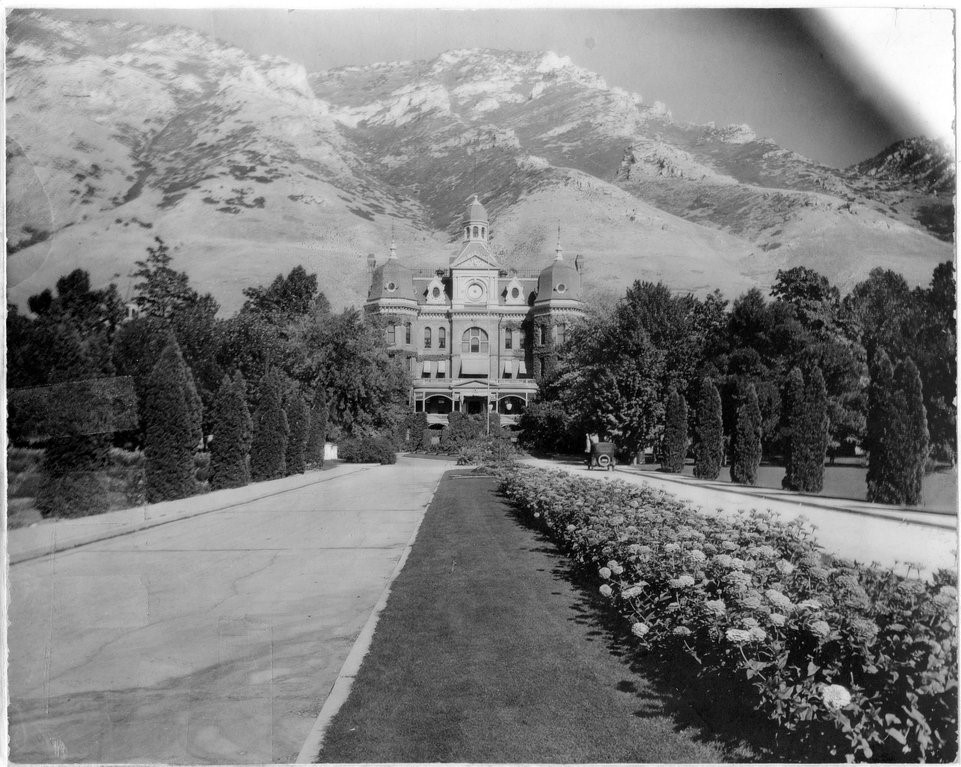
I want to talk about the concentration camp being built in Utah, where I live, that will warehouse people who are unhoused and force treatment on them for real or perceived mental-health issues and substance-use issues. I want to compare it to the Topaz concentration camp that was built here in 1942 and operated until 1945 under Executive Order 9066, whose name I know because I have to know it. To survive. To advocate. To resist. To not repeat the past even as we repeat the past because others don’t know the name Executive Order 9066 or what it did, what it made our country and its people: ugly, cruel, inhumane. Those who don’t (or don’t want to) know about EO 9066 also may not know that another EO made this new concentration camp in Utah possible, the one written July 24, 2025, whose official title I won’t mention because it doesn’t describe what the order does, what it enables. It would be better if it just had a number, not a misleading title. It would be better if it didn’t exist at all.

But I can’t talk about the concentration camp because my language isn’t welcome, especially among those who also have lived experience with mental-health issues. Those I most want to communicate with will attack me for using the diversity model to give context to what I’m conveying. Those of us with lived experience with mental health have different experiences and use varied frameworks for communicating our experiences. We are and should be polyvocal. Yet there’s a growing push for monovocality—for one way of speaking, for one way of perceiving and communicating human experiences. So I’m not talking, not the way I want to be or to the audience I want to talk to. At least I have this loose take on the haibun.

              The age of pastures
              is over. Detention is
              involuntary.

                            Your right to exist
                            on your own terms ends now.
                            You belong on outskirts.

              Get used to the word
              stern. Your life is a concrete
              slab if you’re lucky.

                            Say no and go to jail.
                            What is this if not jail
                            by another name?

              Like a rose. You think
              you’re like a rose when really
              you’re a line item

                            in a multi-million
                            dollar budget. You’re our
                            ticket, our future.

              Containing you is
              business. Here’s a pill.
              We’re sorry it’s come to this.

                            Swallow. Concentrate
                            means gather. We gather you
                            today for Holy

              Capital, for the bottom
              line. You’ve lost your right
              to leave, so don’t try.

Worthless Words

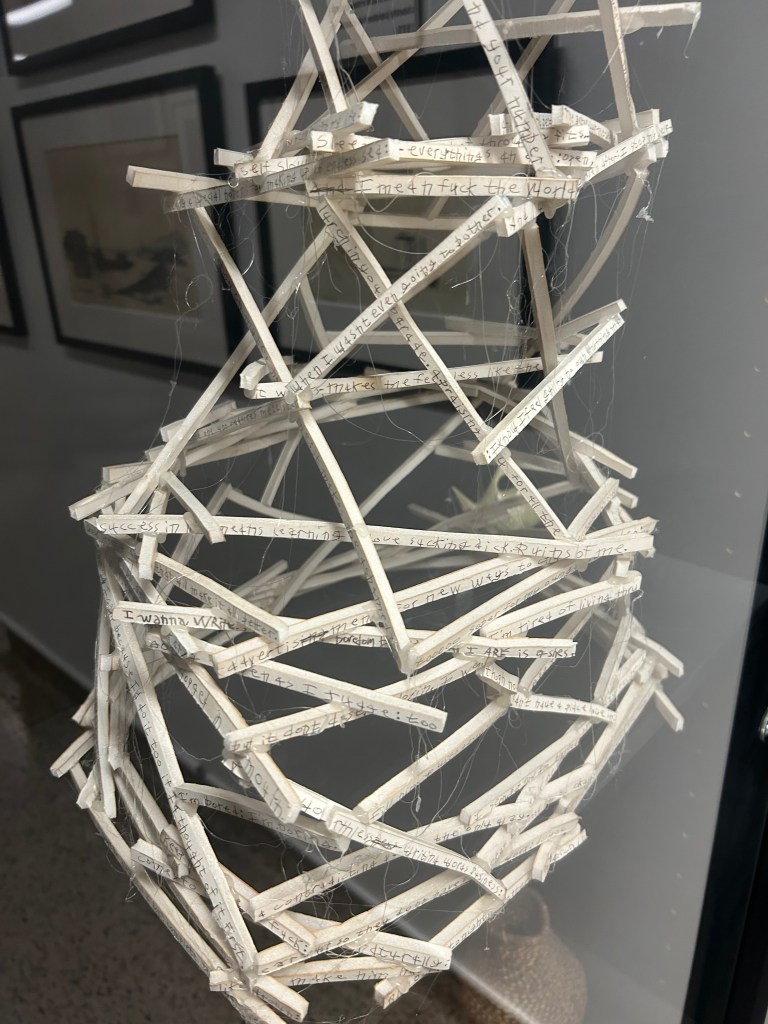
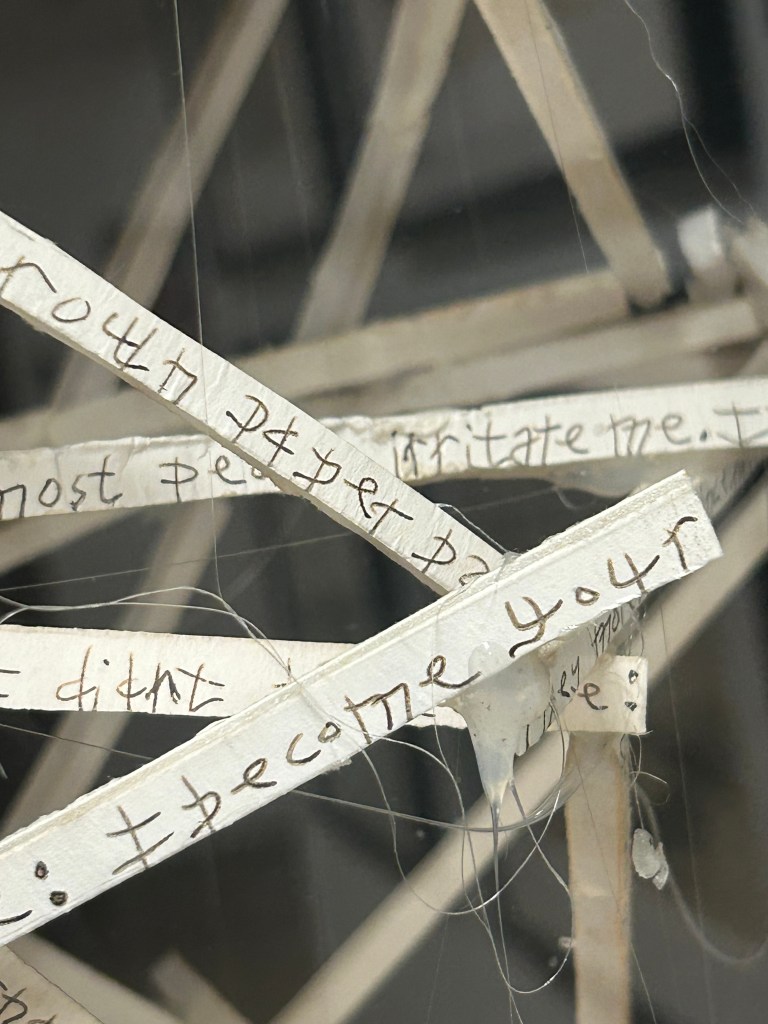
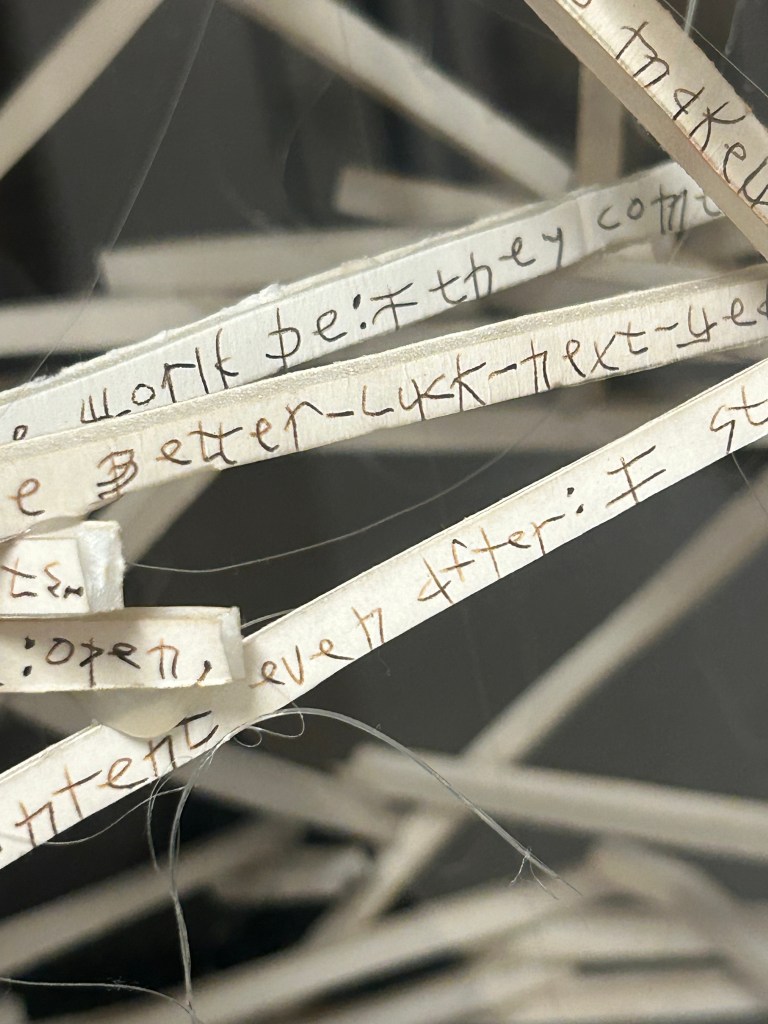
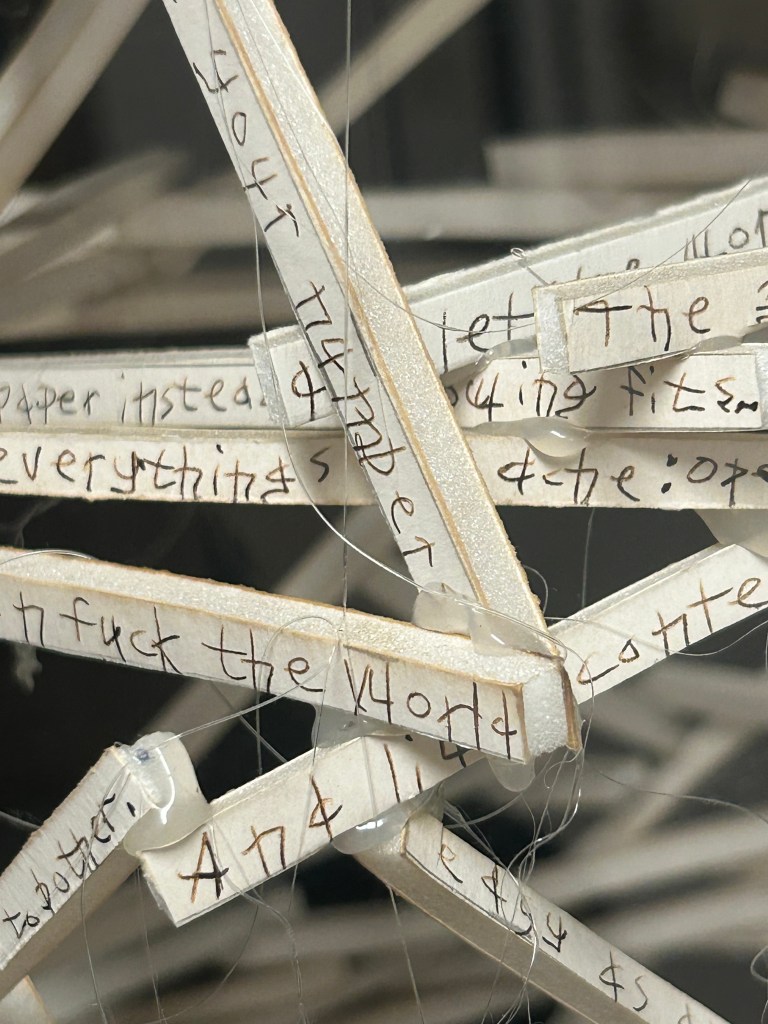
These are photos of the sculpture at Glore Psychiatric Museum in St. Joseph, Missouri, that I incorporated into a poem titled “The Sculpture.” (It was first published in Muzzle’s 2015 mental-health issue as “The Letter.”)

A patient at Glore made the piece when the hospital was still in operation. I’m visiting the museum in the spring to document the writing on each piece of foamboard along with a diagram that shows where the pieces are situated in the work.

One of the museum’s employees took these photos and sent them to me. I haven’t seen the piece in person since 2015. I’m happy it’s still on display and in good condition. Anything can outlive us. Anything can matter after we’re gone, just as we matter while we’re here. These words are not “worthless,” as the sculpture’s creator says on one of the foamboard strips.

Frictions

“Nothing about us without us.” That’s a guiding principle in the disability-rights movement. It applies to the mental-health justice and recovery movements as well because mental-health issues are often disabilities for those of us who live with them—sometimes because they are truly disabling and sometimes because our cultures disable us, our communities disable us, and those around us disable us because they don’t understand us (or try), don’t include us (or try), discriminate against us (often because of unexamined or dismissed bias), and subject us to their versions of who we are, which happens daily through language and actions and the way real and conceptual spaces are structured.

I bought a clicker, one of those old-fashioned ones that employees at the academic library where I worked in college used to track how many people came in each day. I’m going to use it for two weeks and track how many times I encounter instances of sanism, both in real life and on social media. I started doing something similar last week by making ticks on a piece of paper. But I like the idea of using a clicker in part because it’s an object I can hear and feel as I operate it, in part because it fits in my hand, and in part because it’s a bright color. I have the kind of sensory processing that appreciates those things. The clicker also feels more formal and official, and I can use it even when I don’t have a pen and paper with me, which makes it more practical. I may include notes about each instance, including the context, date, and time.

OK, I actually bought six clickers in an array of colors because they came in a set, but that’s beside the point. You may think that’s too many clickers. I don’t. I’m mildly tachycardic right now just thinking about their arrival. There’s a black one and a green one and a pink one and a red one and a white one and a yellow one. I’m actually trying to humanize myself in this paragraph and the last one because I made some big assertions in my opening paragraph, the kind that make people (in this case me) unlikable mostly because they fall under the information you didn’t ask for that I think you should know category but also because they may apply to you or those you know rather than some far-off “they” that we can all join in both hating and distancing ourselves from together.

“Nothing about us without us.” I take this principle seriously. It’s like no taxation without representation, only it’s like no characterization, no proclamations based on misinformation, no policy decisions, no representations in the arts and the media, no casual or formal conversations, no application of diagnostic labels especially when used in a pejorative manner, and no limited or completely erroneous lay insights without our representation. That means we are centralized, not marginalized. We are present, not absent. We are heard, not talked over, not silenced, not discounted. It means if we say there’s an issue, you listen. You don’t shift in your seat or put up a wall or fail to respond or shift blame to us. 

I’m no longer entering rooms where there are frictions only I appear to see and concerns only I appear to discern, one thousand frictions that are invisible to those who are not queer or neuroatypical or living with trauma or serious mental-health issues. That doesn’t mean those frictions don’t exist. It just means they may not exist for you, and if that’s the case, I’m happy for you. I’m glad a room is just a room is just a room. But your inability to see what others see, feel, and experience in those rooms—your failure to cultivate literacy about the things those who are oppressed and marginalized have to see in order to survive every day—is part of why rooms continue to not be the same rooms for you that they are for others.

These rooms are exhausting. Click click click (click click). If in addition to instances of sanism, I count instances of trans erasure (click), ableism (click), neurotypical bias (click), discounting of women and those who are female-bodied (click), jokes about diversity (or the lack thereof) in a space (click), and more,* there will be no end to the clicking in too many rooms, even rooms full of poets.

It’s impossible to know which rooms will be full of frictions. I’m trying to figure out what clues I can look for ahead of time and to develop a matrix I can use so I know when to call any given room quits. I no longer believe I can change hearts and minds with my presence, my words, or my work. I feel like, more than ever, I’m in a box called “crazy” and that terrifies people, no matter how I live, what I accomplish, how I treat others, or how wonderful folks think I am before they learn I have a DSM diagnostic label or that I’m queer or that I’m neuroatypical in numerous ways. I’ve seen that semipermeable membrane more times than I can count: the one where inclusion becomes exclusion and being part of becomes being removed from.

I feel like my attempts to address frictions only lead to more frictions, many of them in the form of irritation, denial, resentment, and even fear and disgust. But I will do what I can until I realize I can’t do any more. Then I’ll leave before I accept my own erasure and even start erasing myself. I can’t abide that or any other form of complicity.

I’ve mainly seen this level of friction in Utah. At least in other places, my experience has been that I become more human when I talk, when I write, when I take part in things. Of course, I was largely in the closet about my bipolar until two years ago. That may be part of why people accepted me as a human being and not as an amalgam of their stereotypes, biases, and misunderstandings about bipolar. Who knows what those places are like now, in this new world that has us all doing the work of marginalizing and dehumanizing others on some level.

The rooms with poets are the ones I must approach with care above all the others because I need to believe in poets, even if that belief is misguided. I’m not ready to let go of that yet. I know better. I think I know better. I want to know better but, more than that, I want to be wrong. I want to believe in poets the way some people want to believe in God. It’s like that for me.

I also can’t help but see something else in those rooms, wherever they’re located: a kind of arts-driven traveling medicine show meets multilevel marketing network. It’s not quite either of those things, but it does feel like a system that created itself and now uses its existence as a way of validating itself, one that enriches the few and relies on the many, and one that’s unhinged from actual oversight or governance by the institutions many of these poets actually work or once worked for, which means those institutions will not act based on anything that happens, up to and including sexual assault, in or near those rooms. It’s hard not to see it like that, especially after some of my personal experiences in such rooms, which makes it even harder to find spaces that are safe and poets who are doing good work in those spaces.

* I’m just listing ones I’ve encountered recently.

Get in Line, Brian Kilmeade

Days of Bruising in the Sunflower State. Kansas City, Kansas, June 19, 2015.

You want me dead, Brian Kilmeade? Trust me, there’s a psych tech in Kansas who couldn’t agree with you more. This photo was taken three days after leaving KU Medical Center in 2015 with bruises all over my body after being beaten by a psychiatric nurse who also put me in a face-down hold, despite that position being illegal in most states and despite my having asthma. He threatened to hurt me even more if I ever “tried anything.”

What I had “tried” was getting my inhaler because I couldn’t breathe. The staff refused to give it to me, saying it was expired by one day, and they didn’t have orders for another one. I’d just been diagnosed with common variable immunodeficiency by the lead immunologist at KU Medical Center, but the staff in the psychiatric unit said I was making my diagnosis up. I also had thyrotoxicosis at the time, but nobody at KU Medical Center did the simple test necessary to reveal that was the case, even though it’s in their algorithm to test the TSH level of anyone who presents with symptoms similar to mania. The psychiatric unit’s former director implemented that policy.

Photos of these bruises are also on file at Shawnee Mission Medical Center, where social workers from KU Medical Center and a local organization for women took me to document what had happened to me. Of course I never did anything about what happened. Lawyers weren’t interested in my case. The state human rights organization wanted me to tell my story over and over again, which was retraumatizing. And my records from KU Medical Center were not accurate. This incident, for example, didn’t make it into the record. Nor did the EKG they had to do while I was blacked out, which I’m only aware of because I woke with a node still stuck to me. Nor did my being undressed, washed enough to be wet all over, and dressed again, but without my underwear.

The staff withholding my medication didn’t make the record. Nor did the staff throwing food on the floor for me to eat. Nor did two male techs standing in the doorway laughing at me. Nor did a female nurse dogging me in the hall outside my room while saying “I didn’t do anything to you,” as if this absolved her from everything that was done. Nor did the staff hanging up the phone on me while I was trying to call my immunoglobulin company, which I’d been instructed to do to set up my infusion deliveries after I left the unit,* or important organizations like the one that was trying to advocate for me, or my friends, or my family members. Nor did their crushing me in the doorway to the room where the phone was located while trying to remove me from that room. Nor did their playing violent movies in which women were being beaten. There are more nors, I’m sure. But you get the idea.

* Having these infusion deliveries set up was a condition of leaving the unit. The staff repeatedly refused to let me use the phone or hung up mid-call in an attempt to keep me from being discharged.

Black Box

I had an exciting thought about a poem at the tail end of a dream, and now I can’t go back to sleep. The fact that poems thrill me after three decades says a lot about poems. Perhaps it’s not just the Earth and sky that last forever, as the band Kansas asserts. It’s also the verse, the line.

I will never remember what happened to me two years ago today because I was overmedicated in the emergency room at Intermountain Health after being turned away when I went to the mental-health access center there for help the day before, but not before the access center kept me in a loud, brightly lit room for 24 hours with no bed, where I was left alone with two male nurses. What a terrifying thing for someone with a history of abuse at the hands of men to endure while in a state of trauma about her childhood abuse. Also, sleep deprivation and exposure to lights and noise, including music, day and night are more in keeping with prison torture tactics than with mental-health care, but sadly, the two are often one in the same. Shame on Intermountain for engaging in such practices.

To top it off, they failed to give me my thyroid-replacement medicine for hours, thereby exacerbating the state I was in by disrupting my endocrine system, which in turn negatively affected my HPA axis. That axis is key to emotional regulation. I don’t have a thyroid thanks to thyrotoxicosis and cancer, so my thyroid-replacement medication is critical. My TSH was already 11mIU/L when I got to the access center. It should have been less than 1mIU/L. The access center made my hypothyroid state even worse by not administering my medicine in a timely fashion.

The ER overmedicated me after I said Joseph Smith was delusional. What I actually said was, Sure. It’s fine when Joseph Smith does it, but not me. I wasn’t being hyperreligious. I was deconstructing religion, in that moment Mormonism, as well as the unwritten social rules that appear to govern when someone is seen as insane, divine, or both. Crazywise, as some call the latter. But not, largely, Southern Utahns, and certainly not ER workers at Intermountain.

That’s the last thing I remember. I blacked out for more than a day, this one: September 9, 2023. It’s a dark, rough-hewn box I can’t open, but I think Sharon Olds’ devil from her collection Satan Says might be inside it. By that, I mean my father.

Folding

This is the two-year anniversary of my stay at the local inpatient psychiatric hospital where the psychiatrist described me as being involved in sex trafficking, as if I was trafficking others as an adult as opposed to having been trafficked as a child. The psychiatrist also said my trauma had nothing to do with my mania, told me in so many words to be a better wife when I expressed my concerns to him about my husband’s behavior, refused to help me get services from the local organization that helps people who’ve survived sexual abuse, and wrote in my chart that I had a poor prognosis because I have no insight into having bipolar.

And he was supposed to be one of the better psychiatrists at that hospital.

This is also the day I briefly saw Utah poet laureate Lisa Bickmore and thought she was some kind of healing Earth goddess, which I still think is the case. When I’m manic, I see essences. Lisa is a lot more than a healing Earth goddess, but she also has the essence of a healing Earth goddess.

These are the final days of my hegira, the one I declared over before it was over. Over the next few days, I’ll be sitting with everything that happened two years ago in a process that’s like folding now and then together the way two ingredients are combined in baking. Not that I bake. I prefer folding time to folding things like whipped eggs and melted chocolate. When I need to eat something, I just eat it. I rarely mix it with something else.

Documenting Social Death

There’s a lot happening in this paragraph from Shuko Tamao’s “Picturing the Institution of Social Death: Visual Rhetorics of Postwar Asylum Exposé Photography.” The observation about women and Black Americans being portrayed as anonymous others is spot on, as is the description of their “social dead” status, but the idea that the asylum system shouldn’t have be reformed and should have instead abolished actually had merit, as did the “visual rhetoric of unfreedom” that post-war journalism in the United States gave rise to, despite that not being their goal. People should never be out of sight, out of mind, and many folks are advocating for an end to forced treatment, no matter how humane it looks on the surface.

Despite well-intentioned goals, these exposé photographs had the unintended effect of portraying asylum residents—especially women and African Americans—as unsettling, anonymous others whose long-term institutionalization was an additional exclusion from the body of the citizenry, signifying their socially dead status. For example, journalist Albert Deutsch frequently mentioned how attendants gathered naked asylum residents together, treating them as if they were animals (1948, 42). His writing was meant to sell a sensationalistic narrative, ultimately aiming to win the public’s approval for improving asylum-based care. He hoped that a series of reforms would transform asylums into hospitals. Thus, he meant to use the photographs of restrained women with no treatment, therapy, or recreation to argue that they deserved medical care so that they could eventually live outside as productive members of American society (Rose 2017). However, these photographs of asylum residents in physical restraints communicated what I call a “visual rhetoric of unfreedom” that elicited a powerful emotional reaction in readers, forcing them to question the validity of the asylum system itself.

‘Socially Dead’ Others

Disability researcher Shuko Tamao on using photos of patients in an attempt to bring about reform in postwar asylums in the United States:

Devoid of any opportunity to communicate their personal experiences, these asylum residents became illustrations on popular magazines and on the front pages of newspapers, serving as vehicles for eliciting the pity of readers. Because the reformers elicited pity for their cause while simultaneously inciting a morbid fascination in their readership, these photographs had the effect of giving their subjects the status of socially dead other, whether that meant a mad other or a racial other.

I don’t know that I agree with the conclusions this researcher draws, but she makes important points. I think the way we receive and perceive visual information is contextual and socially constructed, so it’s fluid and can change over time. The point about not allowing patients to tell their own stories is important, as is the way these patients were used to sell magazines and newspapers, which is another form of dehumanization and objectification. Still, I see value in these images, and I feel each person’s humanity when I look at them. But their use and reception in 2025 is different from the way they were initially used and received in the 1940s.

This article includes a photo taken in the back ward at Central State Hospital in Norman, Oklahoma, where my mother began working a few years later.

From “Picturing the Institution of Social Death: Visual Rhetorics of Potwar Asylum Expose Photography,” published in Journal of the Medical Humanities, September 30, 2021. Link in comments.

Pinfeathers

There are some things you can’t show, things you can’t share once you’ve seen them, so you turn them into a poem, and you can barely do that. Because they happened in the state you’re from. Because they happened in the state mental hospital where your mother worked. Because they happened while everyone looked away. Because we were not much better here in the United States than the Nazis were where those sent to mental hospitals were concerned.

Because in a day room in Taft, Oklahoma, we let a little boy sit wet with his own excrement or urine or blood or all three, a strip of white cloth cinching his arms to his neck. Because he’s not the only boy or the only man in the photo. Because this is what we did to human beings in the 1940s but also now or again or now and again with a new face, a new flavor, a new reason, from a new hatred, a new greed, a new form of consciouslessness.

What did I leave out? That the boy was Black. Everyone in the photo was Black. This was at the State Hospital for the Negro Insane. That’s what they called it. Are you sick yet? Do you want to turn away? You already have, from all of us, as the cages are built in Florida, as we find new reasons to cage. Will PETA come to the rescue? People are animals, too, and being treated worse than animals.

People who cage people are animals in a different sense of the word. They should start an organization called People for the Obliteration of People. POP for short. It has a ring to it. It’s weaponized.

Here, drink from this metal cup. Here, sit on this wooden bench. Here, look through this barred window for the rest of your life. Here, here. Here, here.

The photos I’m looking at include one of the back ward at the hospital where my mother worked in Norman, Oklahoma. These are not easy images to see, but this history matters. What’s been happening to people like me has been happening to people like me for a long time. This country could learn a lot from this history as its pinfeathers break our democracy’s skin.