My Poems in Fence

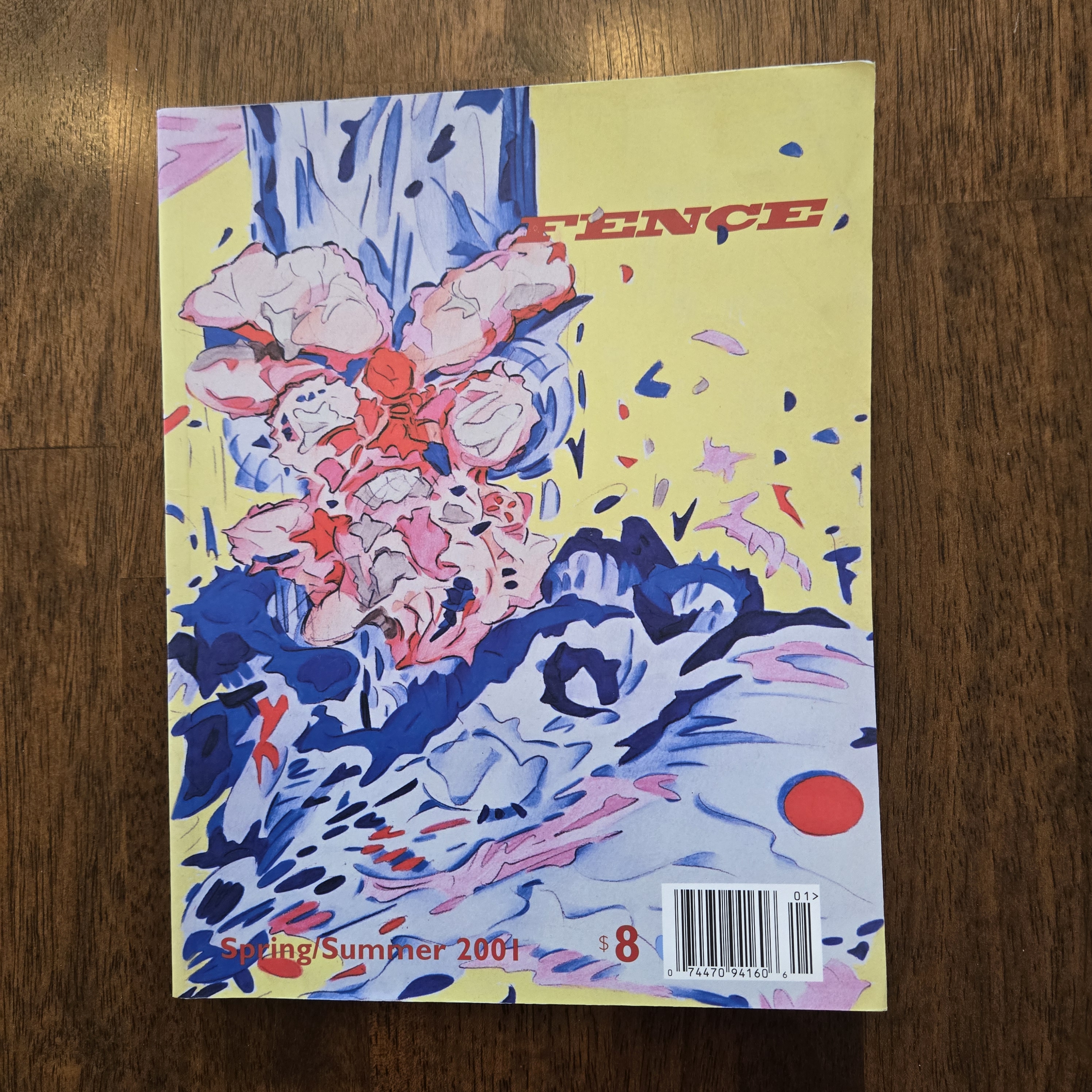
This is the issue of Fence that my work appeared in back in 2001 just after I completed my undergraduate coursework. When I showed it to my first poetry teacher, he wouldn’t even look at my poem. He just said the journal wasn’t one he read or took seriously. I felt stupid for thinking my work had merit and that Fence was a credible publication. I didn’t submit work for seven years after that interaction with my teacher. I mostly didn’t write during that period, either. Matt Jasper calls this kind of thing wing clipping. This felt more like ripping my feathers out by their calami.

The issue I was in includes work by Bruce Andrews, Jorie Graham, Cate Marvin, and Adrienne Rich, among others. It’s astounding that anyone could look at the table of contents and respond the way my teacher did. Fence is one of the best literary journals out there. My teacher should have been celebrating me, not diminishing me.

Fence is currently open for submissions. Their reading period closes October 31, 2025.

—

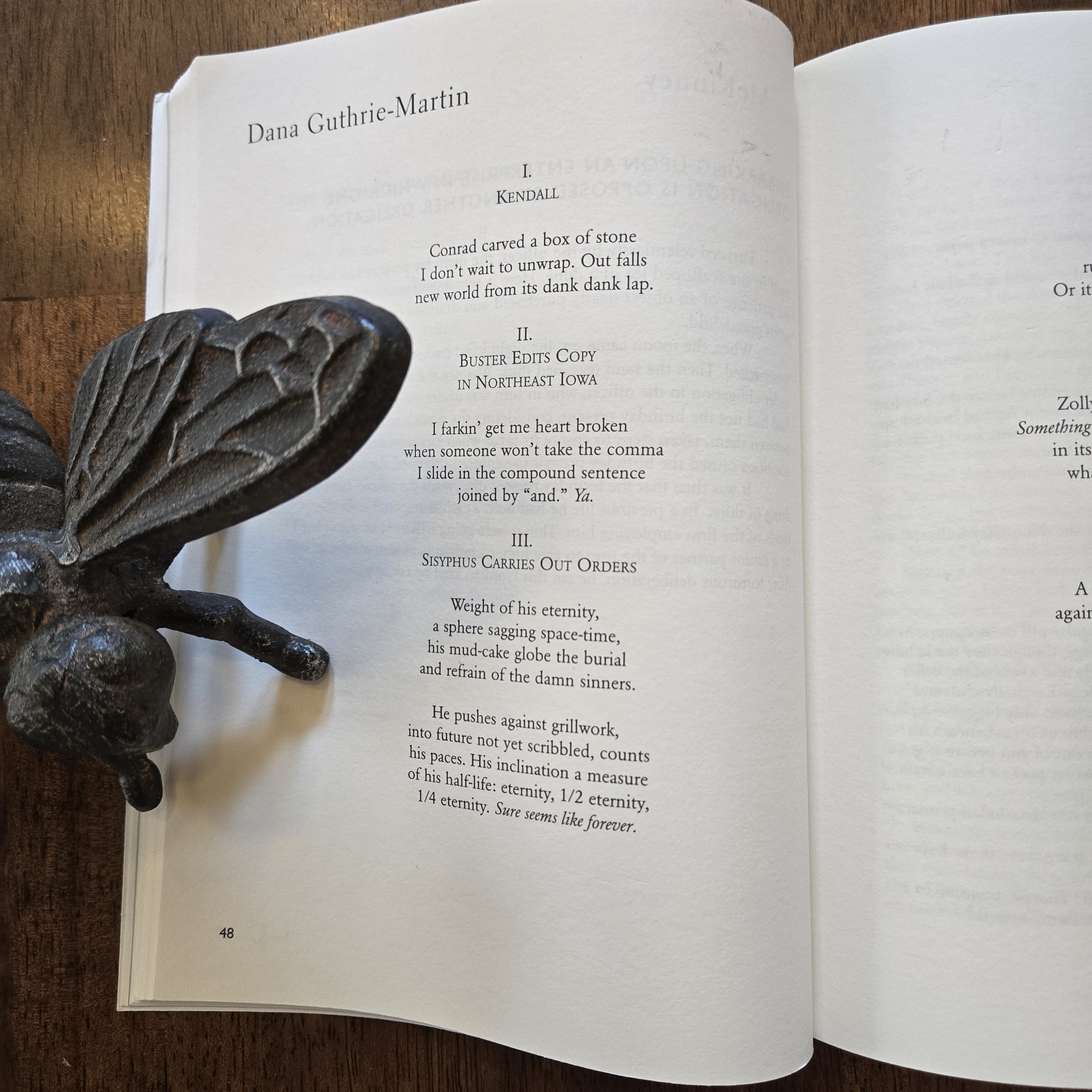
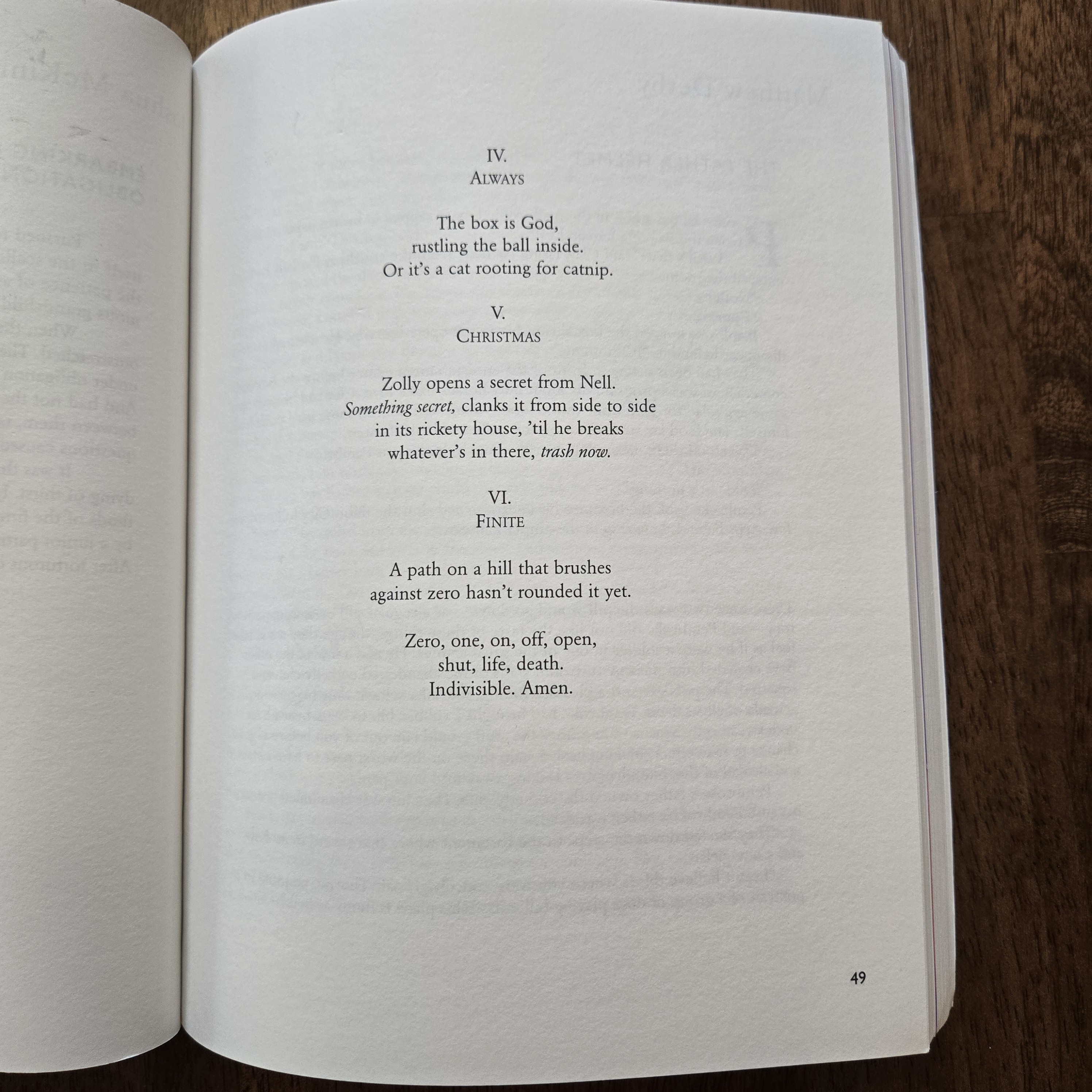
Images: 1. The front cover of Fence, Spring/Summer 2001. 2. The first page of my poem Quintet being held down by an iron bee paperweight. 3. The cseconf page of my poem.

Black Box

I had an exciting thought about a poem at the tail end of a dream, and now I can’t go back to sleep. The fact that poems thrill me after three decades says a lot about poems. Perhaps it’s not just the Earth and sky that last forever, as the band Kansas asserts. It’s also the verse, the line.

I will never remember what happened to me two years ago today because I was overmedicated in the emergency room at Intermountain Health after being turned away when I went to the mental-health access center there for help the day before, but not before the access center kept me in a loud, brightly lit room for 24 hours with no bed, where I was left alone with two male nurses. What a terrifying thing for someone with a history of abuse at the hands of men to endure while in a state of trauma about her childhood abuse. Also, sleep deprivation and exposure to lights and noise, including music, day and night are more in keeping with prison torture tactics than with mental-health care, but sadly, the two are often one in the same. Shame on Intermountain for engaging in such practices.

To top it off, they failed to give me my thyroid-replacement medicine for hours, thereby exacerbating the state I was in by disrupting my endocrine system, which in turn negatively affected my HPA axis. That axis is key to emotional regulation. I don’t have a thyroid thanks to thyrotoxicosis and cancer, so my thyroid-replacement medication is critical. My TSH was already 11mIU/L when I got to the access center. It should have been less than 1mIU/L. The access center made my hypothyroid state even worse by not administering my medicine in a timely fashion.

The ER overmedicated me after I said Joseph Smith was delusional. What I actually said was, Sure. It’s fine when Joseph Smith does it, but not me. I wasn’t being hyperreligious. I was deconstructing religion, in that moment Mormonism, as well as the unwritten social rules that appear to govern when someone is seen as insane, divine, or both. Crazywise, as some call the latter. But not, largely, Southern Utahns, and certainly not ER workers at Intermountain.

That’s the last thing I remember. I blacked out for more than a day, this one: September 9, 2023. It’s a dark, rough-hewn box I can’t open, but I think Sharon Olds’ devil from her collection Satan Says might be inside it. By that, I mean my father.

Folding

This is the two-year anniversary of my stay at the local inpatient psychiatric hospital where the psychiatrist described me as being involved in sex trafficking, as if I was trafficking others as an adult as opposed to having been trafficked as a child. The psychiatrist also said my trauma had nothing to do with my mania, told me in so many words to be a better wife when I expressed my concerns to him about my husband’s behavior, refused to help me get services from the local organization that helps people who’ve survived sexual abuse, and wrote in my chart that I had a poor prognosis because I have no insight into having bipolar.

And he was supposed to be one of the better psychiatrists at that hospital.

This is also the day I briefly saw Utah poet laureate Lisa Bickmore and thought she was some kind of healing Earth goddess, which I still think is the case. When I’m manic, I see essences. Lisa is a lot more than a healing Earth goddess, but she also has the essence of a healing Earth goddess.

These are the final days of my hegira, the one I declared over before it was over. Over the next few days, I’ll be sitting with everything that happened two years ago in a process that’s like folding now and then together the way two ingredients are combined in baking. Not that I bake. I prefer folding time to folding things like whipped eggs and melted chocolate. When I need to eat something, I just eat it. I rarely mix it with something else.

Biomimicry: Poetry As a Cell

In a world of ribosomes (poets) crowding the nucleus (poetry establishment), live reeflike as the smooth endoplasmic recticulum on the outskirts of the cell. This is where synthesis happens, and much-needed detoxification.

Shown: Image of a cell I altered so the labels apply to poets and poetry: Establishment Poetry, Barrier, Poets Girdling Establishment Poetry, Reeflike Synthesizing and Detoxifying Poets.


Breaking Molds or Just Breaking

More notes on how and why I’m at an impasse with poetry. I’m amending my previous statement about my poetry and writing not being strong enough to continue with either. I think both are strong but that my poetry in particular is not aligned with what editors and publishers are looking for and that shaping my work so it’s better aligned with what contemporary editors want will destroy something fundamental in the work, in the process, and in my healing.

I don’t want to slot my poems into this or that mold. I don’t even want to be aware of what the molds are. Poetry is as much about breaking molds as honoring those that have a history of serving poems and their readers well, even if it’s just because familiar molds create one less barrier for the reader. But new molds do something for the reader as well, and for the poet. And barriers aren’t always a bad thing. Some of the most rewarding poems require thoughtful consideration on the part of the reader. New molds are important and shouldn’t be rejected because they’re unfamiliar. Not everything new is bad. Not every outsider poet has no idea what they’re doing.

The highly endogenous nature of poetry doesn’t always serve poetry well, as folks tend to gravitate to the names they know and the styles of poetry that sound a lot like the other poems they’ve been reading. How many voices are being missed? My guess is a lot.

I think poetry has moved in some disconcerting directions in the past few years in terms of what’s allowed and what’s not allowed, which extends to which voices are included and which are excluded. I’m not down with any of that. I’m down to write—and to write from my embodied self as it relates to the world. I don’t want to see my work altered to the point of being unrecognizable so that it can get published. What use do I have for a poem that doesn’t look or feel like me anymore? I don’t want to see my work or my life or my mother’s life gutted for the sake of having an easier or more palatable or less complicated poem or understanding of the world or understadning of things like psychosis.

I also recognize that if I had more talent or if my poems were challenging in the right ways (whatever that means), there would have been some evidence of it by now. That evidence doesn’t exist. As I move into my mid-50s, I have to consider what I’ve invested in poetry over the past three decades and whether I can continue to invest in it. Workshop fees, contest fees, manuscript reviews, submission fees, and more add up, as does traveling to read my work, assuming I could even get an invitation to read anywhere. I don’t have the time, energy, or health to keep up with the financial and other demands of poetry, all while waiting years for something, anything, to happen.

Then there’s the sexual assault I’ve talked about more than some of you might like. That experience in itself was awful, but worse, perhaps, was the poetry community’s response years later when information about that poet came to light from several sources. Hundreds of poets were involved in discounting the poet’s actions and claiming he couldn’t have done what he was accused of doing. By that I mean: hundreds of poets I respected up until that collective public outburst were involved in discounting the poet’s actions and claiming he couldn’t have done what he was accused of doing.

This is what I mean when I say pathology is systemic. In this case, it wasn’t just one poet doing harm. It was many, including editors and publishers, the very people I won’t placate now with easy-to-slot work that doesn’t raise anyone’s hackles or that only raises certain hackles the right way (again, whatever that means). There are too many of these poets to avoid. They live in every part of the country, teach at numerous institutions, and have published with just about every publisher out there. I remember what they said. It’s triggering to see their names throughout the day when someone brings one of them up or quotes their work or drops their name into a group chat I’m in.

When I crept back to poetry cautiously in 2022, I thought things would be better. They aren’t. The kinds of things that happened to me are continuing to happen to other poets. Poets are still largely silent about everything that happens in poetry and protective of those who create and sustain systems that lead to inappropriate exertions of power.

Navigating all this is weighing heavily on me. I told myself in 2022 that I’d go as far as I could go in poetry and that I’d stop if it became clear I needed to. I would just stop. I said this to myself as if it would be simple, stopping. It isn’t. Continuing isn’t simple, either.

Not About You

A poet from Kansas City berated me today after I posted about needing to evaluate whether to continue writing. The post made him angry. He said he’s still upset that I disappeared from poetry in 2015 after he’d been invested in me and my work. He felt I owed him an explanation for that decision and treated my post today as an affront to him, as if my leaving poetry would cause him more pain than it would cause me. As if my leaving poetry is a situation he’s at the center of.

I don’t know this man. I certainly didn’t owe him anything, including telling him that I left poetry because I was sexually assaulted by a poet who was working with me in the role of mentor. That it had happened on the way to my MFA and that it derailed my studies. That the poetry community was sputtering and vitriolic years later about that same poet but also about anyone who said he’d harmed them. That I had just been diagnosed with a rare, life-threatening form of immunodeficiency. That I had thyrotoxicosis. That I had cancer. That my marriage was close to ending and in a scary place. That I ran. That I had nowhere to go. That I had a nervous breakdown. That leaving poetry was the only way I could save myself, so that’s what I did.

Yeah, I didn’t tell someone I’d only met in person once for a few minutes and barely knew at all any of that, just as I kept most of that information from everyone I did know as I tried to sort through the detrital state my life was in.

This is part of the problem with poets and poetry: The way people feel like they can make demands on the poets whose work they even superficially engage with. The way their parasocial relationships with poets make them feel like they know those poets, like those poets owe them something, like there’s intimacy there that doesn’t exist, like it gives them the right, even ten years on, to verbally attack a poet they’ve concocted a relationship with. The way parasocial relationships tend to be directed at female-bodied poets. The way female-bodied poets have to endure this kind of dynamic on top of trying to do the work of writing. The way social spaces become especially unsafe for female-bodied poets because of dynamics like this.

This is not about you, Kansas City poet. I hate to burst your bubble, but it’s not.

My Accounts

It’s not easy to write about some of the situations I’ve encountered in poetry. I do it because most people don’t talk about their experiences. Certain things happen and happen again and happen again without anyone knowing what’s happening or that it could happen to them. Or something similar has happened to them, and they feel alone in that experience, unnecessarily so because they are not, in fact, alone. Silence just makes them feel that way.

I support poets and poetry and presses of all kinds, including small presses. I will also continue to advocate for myself and my work. Part of that means speaking out when necessary about problematic situations and encounters. I hope my accounts will help others navigate their own situations and know they aren’t alone if something similar happens to them.

The Cube

I dreamed I was in Kansas City and was back in school as a flute performance major. A poet and I were sharing a dorm room. It was great at first. I had the room done up like a little Hello Kitty store, full of the kinds of snacks and supplies we’d need, all presented vending-machine style. The poet was funny like he is. It was all good.

One evening, I went to a party in the library. All the conservatory students sneaked in after hours. It was getting late, and everyone was falling asleep in a tangled pile on some of the vinyl furniture we’d pulled together to make a giant sleeping pod. I decided to go back to the dorm room. When I got there, the poet started screaming at me, reconstructing the past in ways that didn’t reflect reality, accusing me of things I hadn’t done, and calling me sanist.

I left and went to a bedazzled cube suspended at the top of the Earth’s atmosphere. The cube rotated slowly on a horizontal axis, the moon coming in and out of view as it spun, like a restaurant called The Skies that’s no longer open in Kansas City.

There was a woman in the cube, my flute professor. She told me we could stay together if that’s what I wanted. I said it was.

Can I tell everyone, I asked.

I’d rather you not, she said. I want you to be my secret.

Secret. Othering. Erasure. Being hidden. The same old story, only this one suspended in time for all eternity.

That’s not what I want, I said as the cube started free-falling, heading toward Earth. This is the end of times, isn’t it, I said.

Yes, she replied, adding that I knew that on some level. You must have known.

Send me back to Earth, I said. I want to be with the planet and all living beings when the end comes, not here with you.

But here it will be painless. You will continue, she said. And there are humans there.

I know, and I am of them as they are of me, I replied. I belong with them, not you.

With this, John Lithgow appeared. He explained that, like the woman, he was God, who is distributed across everything but is also one thing. He would take me back to Earth because that was my wish.

As we floated down, he said, There’s going to be fire, heat. Stuff like that. Hot and not in a good way. Do you still want to go? The cube is very comfortable.

I still want to go.

Fine. Have it your way.

When we got to Earth, it was peaceful. It was beautiful. It was like I was seeing everything for the first time. Birds. Lizards. Water. Sand. No heat, no fire, no end of anything.

I went to my dorm room, and the poet sat up in his upper bunk. He said, Everyone is a draft of curses, before lying back down.

I woke up, recorded those words, then fell asleep and lucid-dreamed the whole dream again because I knew it contained important lessons my mind was working out.

After replaying the dream, a woman appeared in the dorm hallway. She was dressed like a Weeble Wobble and came over to me. I recognized her as me and me as her because each human is distributed across all bodies but is also one body.

She said, What I’ve brought to the new art is my name, known only by its syllables.

Day. Nuh. Day. Nuh. Or any syllables. Yours, for instance, dear reader. There’s no difference, not since that first name was recorded: Ku Shim. Ku Shim. Kushim. 𒆪𒋆

I woke up and called out to my husband. It was time to stop dreaming, though I could have gone on in that state all day. Such dreams are alluring, but they also call us back to the Earth and to all living beings.

My sleep score was a 90. I won’t lie. With that dream sequence, I was hoping for 100.
Frictions

I’m thinking about the kinds of frictions marginalized folks experience in the literary community, namely when participating or attempting to participate in things like events, readings, residencies, and literary programs. It occurs to me that things other folks might miss or not understand or not be able to “see” can be experienced very differently by those in marginalized groups and can make spaces unwelcoming, othering, invalidating, and even hostile.

One example from my recent personal experience is the trans erasure associated with someone dropping the letter “T” from the acronym LGBTQ+ and instead saying “LGBQ.” That act changed the way I see the university where I planned to study writing and creative writing at the graduate level because the person who dropped the “T” is affiliated with the institution. Along with other frictions I’ve experienced, I no longer feel welcome at that school. Someone else might not notice an omission like that, or they may think it’s no big deal, but as someone who’s queer, that erasure is both obvious and painful.

I’m interested in the kinds of frictions others have experienced and the disproportionate ways frictions tend to aggregate, not only within one type of marginalization but across various forms of marginalization.

Walks Close to Whining

In this collection you are saying something that needs to be said and you are saying it in language that cannot be ignored or hidden from. The truth told with a very sharp knife. Yet part of this truth is that women allow this shit to go on. Do we not allow men to have the power you describe? It seems to me that as you rip men a new one—the same needs to happen to women. What in the hell are we doing—why do we let our power go? Without this emotional component the collection walks close to whining (in my opinion) which always occurs from a place of weakness. Yet this collection would seem to be aiming at a recognition of the power imbalance between men and women and the way men frequently force their will on us—and then a turn toward a new balance. But the only way that will happen is if women acknowledge their complicity in the imbalance.

The publisher of one of my collections, which dealt with CSA, including my own experiences and those of my best friend when I was young, made the comment above about it in 2011 after soliciting the work from me. I never should have allowed them to proceed with publishing the collection. I just came across the comment again while searching for something else in my email. That publisher was a woman, and it wasn’t Juliet Cook or Margaret Bashaar. It speaks to myriad ways in which some women and female-bodied poets who believe they’re empowering themselves and others can be misguided and do harm. It’s not just men in poetry who harm others and the community as a whole.

Through her lens, my work about CSA walked close to whining and needed to discuss power dynamics that don’t apply to children who are being harmed, including dynamics forced into the strict binary of male and female, one that’s oppositional, not dialectical. The speaker and others who inhabit the poems aren’t even male or female. That isn’t called out ever. As a nonbinary person (who was publicly identifying as trans at the time), it’s not how I envisioned them.*

And this was from someone who wanted to publish and ultimately did publish my collection. Again, I should have yanked it. She ended up quietly removing the collection at some point without telling me or preserving the files in any way. It was a digital collection with custom artwork. I would have liked to have had it, even just for myself. I believe I know why that happened. In any case, it was another form of erasure of me and my work.

Also, to those who say things like, Your work just isn’t for everyone, and that’s OK, please see that this assessment isn’t about the work, nor was that the case with the poet I just had the dreadful, unwanted interactions with. It’s fine for work to not be right for someone. These kinds of interactions go deeper than that, so please quit uncoupling literary assessment (which isn’t even what this kind of thing is) from personal attacks and assessments that go far afield of the work.

* The word nonbinary wasn’t yet in use, and trans felt like a better fit than saying I was bisexual. I knew gender was involved, not just sexuality, and the binary nature of the word bisexual wasn’t a good fit for me anymore, either. I knew both gender and sexuality were on a continuum. I was trying to find the language for my place on those continua as language was evolving to be more inclusive and less oppositional. Also, people can move around on these continua over the course of their lives. For instance, I’m asexual at this point, which used to be the last letter in LGBTQIA+, though it has largely been truncated away, along with the interior T, which has disappeared for political reasons. I never would have identified as asexual in my 20s or 30s. But bodies change, minds change, and age changes, which changes a lot of things about body and mind—in my case sexuality, hence my move to the term queer, which covers the waterfront where gender and sexuality are concerned. More specifically, thanks to a friend, I’ve started using the term neuroqueer because it’s not only inclusive of all my forms of neuroatypicality, it also suggests a relationship between my neuroatypicality and my sexuality and gender. For me, that relationship is real and meaningful.

The one thing I agree with in this publisher’s assessment is that I should not have allowed her to frame my work the way she did. It was a great publishing company. I didn’t think I’d ever get an opportunity like that again. I sold myself, my work, and my values, and I fawned at her the way I learned to in order to survival the unthinkable as a child. That will never happen again. I’d rather live in one of DT’s camps than live a life that’s bought and sold, one in which I’ve been bought and sold.

I will add this one last thought: I recognize that some of the same forces that shaped me in my life may have shaped this publisher in her life. I realize she’s been through it, probably for decades now, the way women, those who are female-bodied, and other oppressed and marginalized groups have been and continue to go through it. But she was still wrong in this instance. She foisted a huge thing on me and my work. Anyone can be misguided. I understand that more when someone isn’t coming from a place of completely (or at least largely) unexamined privilege. That means I do have empathy for her. I still shouldn’t have published with her.