Obstacles and Destinations

The life partner has informed me that he’s no longer angry with me. We just woke up. We haven’t even interacted today.

The white-crowned sparrows have arrived for the winter, which means joy has taken up residence in this desert.

I just thought about baby animals, and I’m suddenly very happy.

When I see nothing but darkness, teach me to see the dark. When I hear nothing but darkness, teach me to hear the dark. When I feel nothing but darkness, teach me to feel the dark. When I realize I am darkness, teach me to love the dark that I am. The darkness of my body. The darkness of my mind. The darkness I came from and will return to. The darkness that is all that is.

I would really love to be in a room where I feel wanted, welcome, like I don’t have to hide essential parts of myself, where I don’t have to listen to things that are painful and othering, and where I can speak in full voice without shame and trepidation.

When you think you’re the destination, but you’re just the obstacle.

The only thing worse than having wet hair is having wet hair in a new place.

Your cracks are how the universe enters you.

I just googled what is a sand time thing called is how I am.

I wrapped my king-sized chenille blanket around my waist and am wearing it like a sarong is how I am.

Sentence from my dream: Like gods in Greek myths, we are gilded, guilted, and gutted.

You’d think I’d put all my dopamine to better use, but no. I make fiddly spreadsheets.

I’m doing a deep dive into facts and fictions about the Osage orange is how I am.

A list of my bad habits:

1. All of them.


Frictions

“Nothing about us without us.” That’s a guiding principle in the disability-rights movement. It applies to the mental-health justice and recovery movements as well because mental-health issues are often disabilities for those of us who live with them—sometimes because they are truly disabling and sometimes because our cultures disable us, our communities disable us, and those around us disable us because they don’t understand us (or try), don’t include us (or try), discriminate against us (often because of unexamined or dismissed bias), and subject us to their versions of who we are, which happens daily through language and actions and the way real and conceptual spaces are structured.

I bought a clicker, one of those old-fashioned ones that employees at the academic library where I worked in college used to track how many people came in each day. I’m going to use it for two weeks and track how many times I encounter instances of sanism, both in real life and on social media. I started doing something similar last week by making ticks on a piece of paper. But I like the idea of using a clicker in part because it’s an object I can hear and feel as I operate it, in part because it fits in my hand, and in part because it’s a bright color. I have the kind of sensory processing that appreciates those things. The clicker also feels more formal and official, and I can use it even when I don’t have a pen and paper with me, which makes it more practical. I may include notes about each instance, including the context, date, and time.

OK, I actually bought six clickers in an array of colors because they came in a set, but that’s beside the point. You may think that’s too many clickers. I don’t. I’m mildly tachycardic right now just thinking about their arrival. There’s a black one and a green one and a pink one and a red one and a white one and a yellow one. I’m actually trying to humanize myself in this paragraph and the last one because I made some big assertions in my opening paragraph, the kind that make people (in this case me) unlikable mostly because they fall under the information you didn’t ask for that I think you should know category but also because they may apply to you or those you know rather than some far-off “they” that we can all join in both hating and distancing ourselves from together.

“Nothing about us without us.” I take this principle seriously. It’s like no taxation without representation, only it’s like no characterization, no proclamations based on misinformation, no policy decisions, no representations in the arts and the media, no casual or formal conversations, no application of diagnostic labels especially when used in a pejorative manner, and no limited or completely erroneous lay insights without our representation. That means we are centralized, not marginalized. We are present, not absent. We are heard, not talked over, not silenced, not discounted. It means if we say there’s an issue, you listen. You don’t shift in your seat or put up a wall or fail to respond or shift blame to us. 

I’m no longer entering rooms where there are frictions only I appear to see and concerns only I appear to discern, one thousand frictions that are invisible to those who are not queer or neuroatypical or living with trauma or serious mental-health issues. That doesn’t mean those frictions don’t exist. It just means they may not exist for you, and if that’s the case, I’m happy for you. I’m glad a room is just a room is just a room. But your inability to see what others see, feel, and experience in those rooms—your failure to cultivate literacy about the things those who are oppressed and marginalized have to see in order to survive every day—is part of why rooms continue to not be the same rooms for you that they are for others.

These rooms are exhausting. Click click click (click click). If in addition to instances of sanism, I count instances of trans erasure (click), ableism (click), neurotypical bias (click), discounting of women and those who are female-bodied (click), jokes about diversity (or the lack thereof) in a space (click), and more,* there will be no end to the clicking in too many rooms, even rooms full of poets.

It’s impossible to know which rooms will be full of frictions. I’m trying to figure out what clues I can look for ahead of time and to develop a matrix I can use so I know when to call any given room quits. I no longer believe I can change hearts and minds with my presence, my words, or my work. I feel like, more than ever, I’m in a box called “crazy” and that terrifies people, no matter how I live, what I accomplish, how I treat others, or how wonderful folks think I am before they learn I have a DSM diagnostic label or that I’m queer or that I’m neuroatypical in numerous ways. I’ve seen that semipermeable membrane more times than I can count: the one where inclusion becomes exclusion and being part of becomes being removed from.

I feel like my attempts to address frictions only lead to more frictions, many of them in the form of irritation, denial, resentment, and even fear and disgust. But I will do what I can until I realize I can’t do any more. Then I’ll leave before I accept my own erasure and even start erasing myself. I can’t abide that or any other form of complicity.

I’ve mainly seen this level of friction in Utah. At least in other places, my experience has been that I become more human when I talk, when I write, when I take part in things. Of course, I was largely in the closet about my bipolar until two years ago. That may be part of why people accepted me as a human being and not as an amalgam of their stereotypes, biases, and misunderstandings about bipolar. Who knows what those places are like now, in this new world that has us all doing the work of marginalizing and dehumanizing others on some level.

The rooms with poets are the ones I must approach with care above all the others because I need to believe in poets, even if that belief is misguided. I’m not ready to let go of that yet. I know better. I think I know better. I want to know better but, more than that, I want to be wrong. I want to believe in poets the way some people want to believe in God. It’s like that for me.

I also can’t help but see something else in those rooms, wherever they’re located: a kind of arts-driven traveling medicine show meets multilevel marketing network. It’s not quite either of those things, but it does feel like a system that created itself and now uses its existence as a way of validating itself, one that enriches the few and relies on the many, and one that’s unhinged from actual oversight or governance by the institutions many of these poets actually work or once worked for, which means those institutions will not act based on anything that happens, up to and including sexual assault, in or near those rooms. It’s hard not to see it like that, especially after some of my personal experiences in such rooms, which makes it even harder to find spaces that are safe and poets who are doing good work in those spaces.

* I’m just listing ones I’ve encountered recently.

Doffered

Meanwhile, locals are sharing a hate flag—you know the one—in Facebook comments on a news story about someone here who’s trans, including one made by arranging four pride flags in a particular way. Tell me two poets misgendering Andrea Gibson over and over at a local literary event is no big deal, especially in this larger context. Tell me I need to be more forgiving. To forget. To get over it, all of it. To at least raise my concerns quietly, privately, and with decorum and grace. Tell me I’m the problem. Tell me.

Quiet never got anyone anywhere other than silenced, gone, or dead. What others say openly will never be a secret I carry. I’m done bouldering men’s shames. They won’t go with me to my grave. Hell, I won’t even have a grave. I’ll be the dust my life partner holds to the Southern Utah wind. I’ll be southwesterly then. You can sing a song to the four elements when the time comes. Right now, there’s work to be done. Do it with me or don’t. Draw scars on the face of the world if that’s your thrust. Make hate not peace if you must. Fulfill your flimsy purpose like a lace doily under a dusty candle in an abandoned cabin in some forgotten town. Be dimity. Go forth and doffer. Tell me again why I bother.

One (Sanist) Country for All

I emailed the organizer of the poetry event I was at and sent a letter to the faculty member whose comments concerned me. I don’t expect anyone to support me or even understand my concerns, but here’s the letter.

I’m deeply troubled by your comments yesterday about Ezra Pound at the [writing conference]. Many accounts support the fact that he had a psychotic disorder. Whether you believe that or not, your venom toward him and your characterizations about what a terrible person he was were emblematic of sanism. Your comment about the authorities not being able to put him in prison or kill him were incredibly painful given that they came on the heels of Fox news anchor Brian Kilmeade’s comments two weeks ago about those who are unhoused or who have mental-health issues needing to be killed, not to mention the July 24, 2025, Executive Order that trammels the rights of those who are unhoused, have mental-health issues, and have substance-use issues.

I stood up and took a risk by sharing my own mental-health issues with everyone at the conference in the context of helping those in my community overcome stigma about mental-health diagnostic labels and lived experience only to see you reinforce stigma and nearly seethe over someone who had a psychotic disorder. You undermined everything I tried to do, and you made that space unsafe for me and for those like me who are just trying to survive, which is especially hard to do here in Utah if you live with a mental-health label.

Your flippant comment about Pound being placed in an asylum (because he couldn’t be put in prison or killed) denies the reality of those institutions and the myriad harms they did to people in this country and all over the world. My mother worked in an asylum-turned-psychiatric hospital as a nurse. She was also subjected to great harm in similar hospitals as someone who lived with bipolar.

Those places are not a joke, should not be talked about lightly, and were the setting of, and justification for, countless human-rights abuses. This is the crux of my work as a poet and essayist: uncovering and documenting abuses that those with mental-health issues have experienced and continue to experience.

I was ashamed of myself yesterday, of my existence, as you spoke. Then I realized what I’m actually ashamed of is you: your attitude, your words, and your carelessness. Nothing you shared is why I paid the expenses associated with [the conference], why my husband took time off work to accompany me there, or what I hoped to learn during the event. If you hate Pound that much, you should have chosen a poem that wasn’t by him. Then the entire rant could have been avoided.

I’m nobody to someone like you, but I’m writing this to you anyway because I’m somebody to me, and I’m somebody to those I fight with and for. I will not stop speaking back to bigotry and hate, even when I encounter it in the unlikeliest of places.

I should mention the fact that, thanks to the July 24 Executive Order and its erosion of decades of protections for those it targets, it is now legal to hold anyone who’s affected by the order, including those with mental-health issues, in prison indefinitely. That’s yet another reason the faculty member’s comments are poorly timed and extremely insensitive.

In response to a comment on Facebook about this note, which was initially shared there: One of my concerns about Pound is that scholars who are not experts in psychiatry have tried to make the case that Pound either didn’t have a psychiatric issue or was feigning one. We aren’t in a position to make that determination, both because we aren’t there to assess him and because we don’t have the background that would allow us to do so.

The literature I’ve read that makes the case that Pound did not have psychosis doesn’t hold up and betrays more about the person doing the long-distance, time-traveling assessment than it does about what it’s like to have lived experience with mental-health issues or to have had them during a time when diagnoses, understandings, and treatments were rapidly changing.

Pound was in the asylum right before my mother had her own experiences both as a psychiatric nurse and as a psychiatric patient. There’s actual overlap there in terms of the dates. My mother’s diagnosis changed many times, as did her treatments, as did the degree to which she was affected by her psychosis.

Pound is challenging, difficult, and complicated. We can’t complicate him more by injecting one or more layers of sanism on top of his story. This was a class about concision in the poetic line. We weren’t there to study Pound or fascism or history or mental health. We weren’t. And to bring that into the conversation in a way that lacked skill and an understanding of what’s happening today in the United States to those who have mental-health issues, with a proposed resurgence of asylums and all, is alarming, heartbreaking, and soul-crushing, at least for me.

Just a couple of months ago, I saw a prominent poet get a whole group of poets riled up here on Facebook about another poet who was clearly experiencing psychosis. The pile-on was awful and included sanist labels, attitudes, and outright attacks. We need less of that kind of thing in the world and in the world of poetry, not more. I feel the way Pound was discussed two days ago promotes more of that kind of thing in the here and now, not less.

Be the Nudibranch You Want to See in the World

From Kumataro Ito’s Illustrations of Nudibranchs from the USS Albatross’ Philippine Expedition (ca. 1908). Source: The Public Domain Review. What’s your vibe? Which nudibranch are you? Which one do you aspire to be?

Shown: Watercolor illustrations by Kumataro Ito, the chief illustrator aboard the USS Albatross as it surveyed the aquatic resources of the seven thousand islands of the Philippines.

Loosening Our Ties

My father had a tiger’s eye bolo that I loved. I wore it in grade school when we reenacted the Oklahoma Land Run. (Yeah, we did that. Also, there was more than one land run, but we only learned about and celebrated—for lack of a better word—the main one for simplicity’s sake.) I wanted to be a cowboy. My teachers protested. They wanted me to do whatever the girls were doing.

I’ve been looking for a bolo that’s like my father’s for a long time, but most of them are turquoise, and my father’s was shades of brown. I found one today tucked into the back corner of a gift shop. It was made of tiger’s eye. As soon as I saw it, I remembered that’s what my father’s was made of, and it’s also why tiger’s eye was my favorite gemstone as a child.

As I held the tie, I thought, “My father was more than the sum of everything terrible that happened to him and everything terrible he did, including what he did to my mother and me.” It was a surprising thought. I want to believe that—that there was an untarnished part of him tied to the traintracks inside his heart. He may have tied that part up. He may have wanted it tied up. But it still existed, whether or not he longed to free it.

I bought the tie to commemorate continuing to be in mental-health recovery after my trauma-induced mania two years ago. As I drove home, 104.1 played “Dust in the Wind” by Kansas. The sky was lapis lazuli polished and held to the light. The cliffs in and around Zion looked at once eternal and ephemeral. As much as their presence hints at forever, they are also literally dust in the wind.

I started crying. How could I not? How could anyone spend time with this land, this sky, and not untie the parts of themselves that are immobilized in their hearts?

Let the heart run. Let it rewild. Let it forget suffering. Let there be nothing to suffer from or for. Let us all loosen our ties and help others loosen theirs.

Good Dreams and Bad Wakings

I had an exciting thought about a poem at the tail end of a dream, and now I can’t go back to sleep. The fact that poems thrill me after three decades says a lot about poems. Perhaps it’s not just the Earth and sky that last forever, as the band Kansas asserts. It’s also the verse, the line.

I will never remember what happened to me two years ago today because I was overmedicated in the emergency room at Intermountain Health after being turned away when I went to the mental-health access center there for help the day before, but not before the access center kept me in a loud, brightly lit room for 24 hours with no bed, where I was left alone with two male nurses. What a terrifying thing for someone with a history of abuse at the hands of men to endure while in a state of trauma about her childhood abuse. Also, sleep deprivation and exposure to lights and noise, including music, day and night are more in keeping with prison torture tactics than with mental-health care, but sadly, the two are often one in the same. Shame on Intermountain for engaging in such practices.

To top it off, they failed to give me my thyroid-replacement medicine for hours, thereby exacerbating the state I was in by disrupting my endocrine system, which in turn negatively affected my HPA axis. That axis is key to emotional regulation. I don’t have a thyroid thanks to thyrotoxicosis and cancer, so my thyroid-replacement medication is critical. My TSH was already 11mIU/L when I got to the access center. It should have been less than 1mIU/L. The access center made my hypothyroid state even worse by not administering my medicine in a timely fashion.

The ER overmedicated me after I said Joseph Smith was delusional. What I actually said was, “Sure. It’s fine when Joseph Smith does it, but not me.” I wasn’t being hyperreligious. I was deconstructing religion, in that moment Mormonism, as well as the unwritten social rules that appear to govern when someone is seen as insane, divine, or both. Crazywise, as some call the latter. But not, largely, Southern Utahns, and certainly not ER workers at Intermountain.

That’s the last thing I remember. I blacked out for more than a day, this one: September 9, 2023. It’s a dark, rough-hewn box I can’t open, but I think Sharon Olds’ devil from her collection Satan Says might be inside it. By that, I mean my father.

Poetry Is an Act of Living

I dreamed I was in the U.S. Senate chambers, where a politician was spewing the hate of the moment as faithfully as a geyser, when a feeling started moving through my body. It began in my gut and had me on my feet before it reached my brain. I didn’t even know what I was going to say, but it ended up being this:

What’s the point of poetry?

Why does it matter when it can lead you down some unknown path, and you don’t even know how it will end?

When it gets you so lost you feel like you’ll never be found?

When everything ahead of you is a blank page, and there’s nobody there to help you fill it?

What’s the point of starting out on that journey all alone, maybe never to finish, never to come back the way so many who wander lose in the end to their wandering, boots into snow, knees into dirt, head into clouds?

The point is to go forth anyway.

To try.

To make that creative journey, which is an existential journey, because it can bring us back to ourselves and each other in the end rather than relegating us to seats where hate lives and breathes, where the air is sucked out of the room every time we open our mouths, because poetry is an act of living and an act of love, and politicians, hell all of us, need to lean into love.

Leaning the other way, into darkness, is not an option because it’s an extinguishing.

The human spirit will not be extinguished.

Living beings will not be extinguished.

The Earth will not be extinguished.

We’re here.

Poems are here to remind us why.

The whole thing was somehow caught on a live camera and played to a gaggle of teens who were visiting the capital. As I left the chambers, they all threw their arms up the way I’d thrown mine up as I spoke. In unison, they yelled “POETRY!” Poetry gave them hope that day, as it gives me hope every day.

I’ve written before about how dreams may be more our reality than waking states. I hope that’s the case and that dream logic seeps into all our waking states today, tomorrow, and as long as we’re all sharing space here in time. Happy fall equinox.

Selections from ‘Love and Cruelty,’ Meat for Tea

8

I know we are in trouble
when you move your electronics
into the guest room

and start sleeping in that bed.
When I find the dark sock
you ejaculate into

tucked under a pillow sham.
When you leave every drawer
you touch ajar in the morning,

every cabinet door open,
not because you don’t want
to wake me with their closing

but because you don’t want me
to wake up and demand
your attention. In therapy,

you talk about boundaries,
your need to maintain them.
The therapist asks you why

you feel this way. I also want
to ask why, but for now I lie
in my bed each morning,

pretending to sleep in,
until I sense you’ve eased
the back door shut behind you.

9

For a long time I made up landscapes
because I didn’t know how to talk
about real ones—the red dirt
that stained my swimsuit

when I swam with water moccasins
in Lake Texoma, which wasn’t
even a real lake but one made
by and for men who wanted to fish

for fun, wanted to piss in the water,
to fall overboard in their work pants
and the cotton shirts that skimmed
their chests, which were flat, since

they spent their time behind desks,
not in the fields where their fathers
darkened in the sun each day
and at night revealed their light

foreheads, the bright skin hidden
by their sleeves. It was a privilege
to see that skin, fragile and untouched,
like snow-covered ground after

the season’s first snow. For a long time,
I made up landscapes because I wanted
to live inside them and to shout
from their hills and lakes that we

were in danger. Now I want to speak
from the Blue Mountains and the Columbia,
from sagebrush and western rattlesnake.
From silt and sediment and seed

and fruit, from scabland and butte.
I want to say that we are all in danger—
and that we are the danger. I want to be
a plane dragging a banner, a message.

10

At the border, the VACIS gamma-ray
machine has taken an image

of a truck carrying two stowaways,
along with a shipment of Styrofoam

trays, as it makes its way from
Canada into the United States.

Through the truck’s walls, the trays
appear as dark squares, almost

like dry-stacked bricks. The person
on the left stands, revealing a body

with sloped shoulders, which tapers
from its thickest point down

to ankles that disappear into the slats
which make up the truck’s floor.

The body on the right crouches,
knees pulled to chin, in meditation

or fear, or perhaps in boredom.
In the heat, probably. Or in the cold.

In the dark. Their shadows remind me
of thermal radiation, the snapshots

captured of victims in Hiroshima.
But of course this is not then or there.

This is here. This is the border.
Motherless, my own instinct

to protect kicks in. I want these
shadows to have privacy, to escape.

And since we’re being honest
about love and cruelty, I will

tell you that I want these two
to succeed, whoever they are—

the one standing and the one
crouching. I want, especially,

to check in on the one crouching.
That body is too thin and frail.

That body looks scared, a position
I know well. But most of all, I want

walls to be walls again. I want
curtains to be curtains and shrouds

shrouds. I do not want the vision
of a thousand scientists and technicians

that allows me to see into what is solid
so I can catalog the faces of the dead.

20

We need to update the stories
of coyote and hare. Neither outsmarts
the other because both are dead,

riddled with tumors, skin and muscle
coming away by the handful,
each body turned against itself

rather than toward annihilation
or evasion. We need to move
Adam and Eve from Eden

to the Gamma Garden, where atomic
seeds spill to Earth and Eve’s
apple has amazing properties

conferred by radiation breeding.
We need to make that apple larger
and crispier, with a longer shelf life,

more sugars and more seeds,
maybe even conjoin two apples
in one fruit for fleshier specimens,

since flesh is where delight lies
and since we’re on the cusp of being
able to do just about anything.

23

I knew we were in trouble
long before I knew you,

when as a child I learned
of the white trains moving

across the country like ghosts.
I knew when I hid under a table

as my father talked about Russian
bombs and how the next world war

was coming any day. Somewhere
inside as I practiced my emergency

drill position I knew, knew already—
long before you were an activist

tapping on military jets in the name
of peace—that the war had already

come, silent like fog. Had moved in
and staked claim, settled into our water,

our dirt, been taken up in our food
and our bodies, encroached on

the animals we sometimes professed
to care for—whose destiny we

sometimes admitted was entwined
with our own. I knew there would

one day be walls that would offer
no privacy, that no concrete

could stop what was coming,
that no matter what we did

or did not do, we would be
nothing more than protesters

on the tracks, our legs severed
as the white train came and went

in the sheer quiet, leaving a legacy
not one of us knows how to live

with or beyond. Slowly we are
turning the entire planet, every

living thing, to frass. I’ve known
this for years because the devil

himself held me in his arms, pressed
his tail against my thigh and told me.

These sections of Love and Cruelty first appeared in Wicked Alice.

Love and Cruelty is forthcoming from Meat 4 Tea.

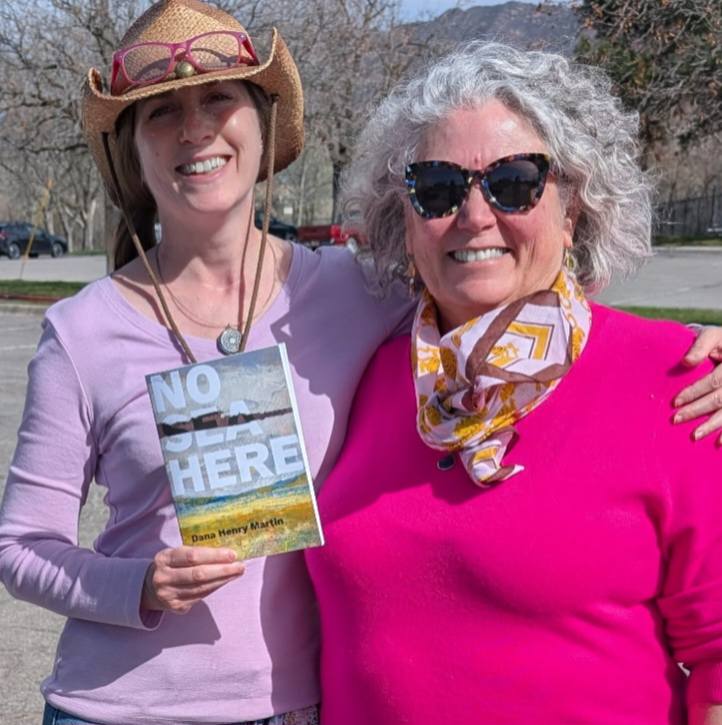
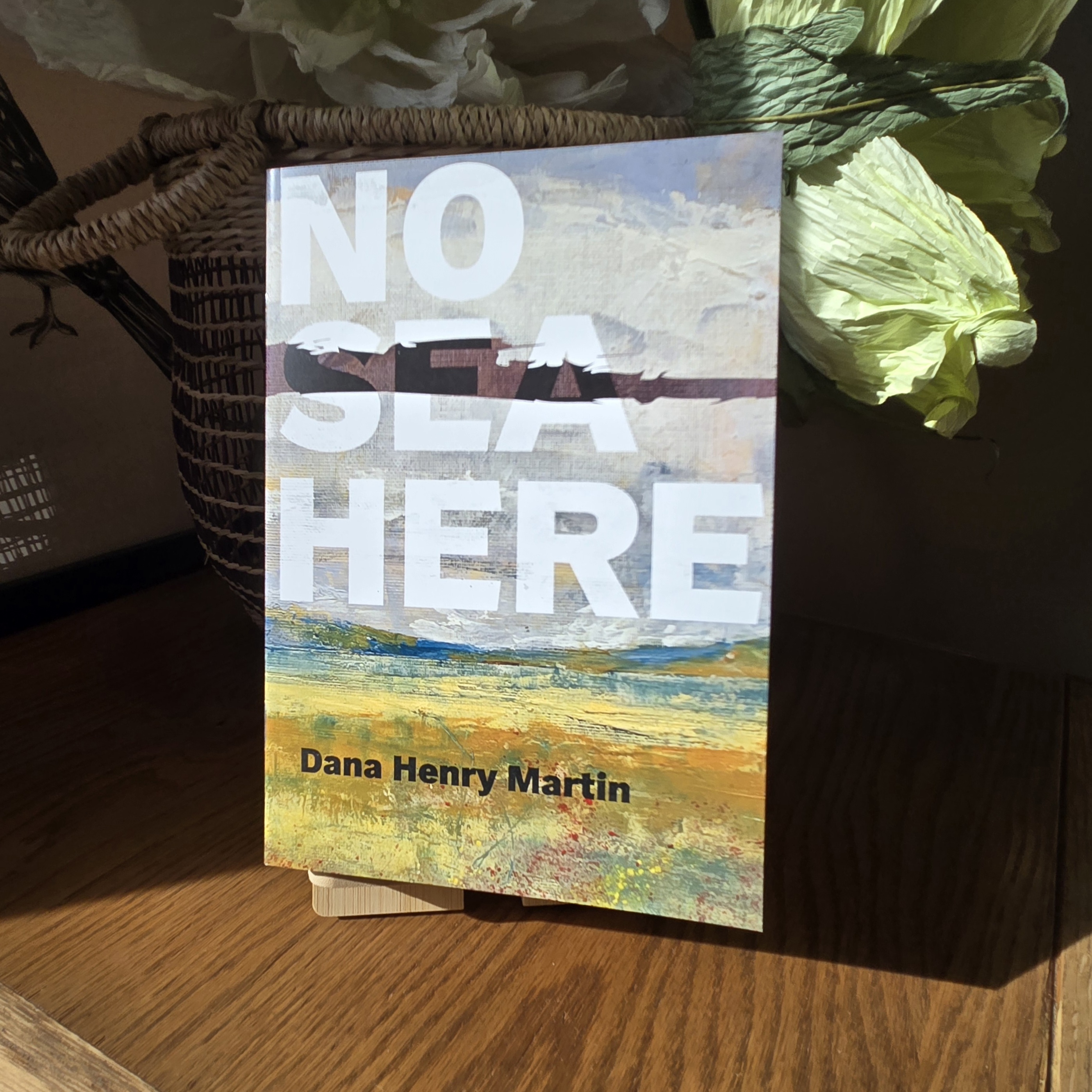
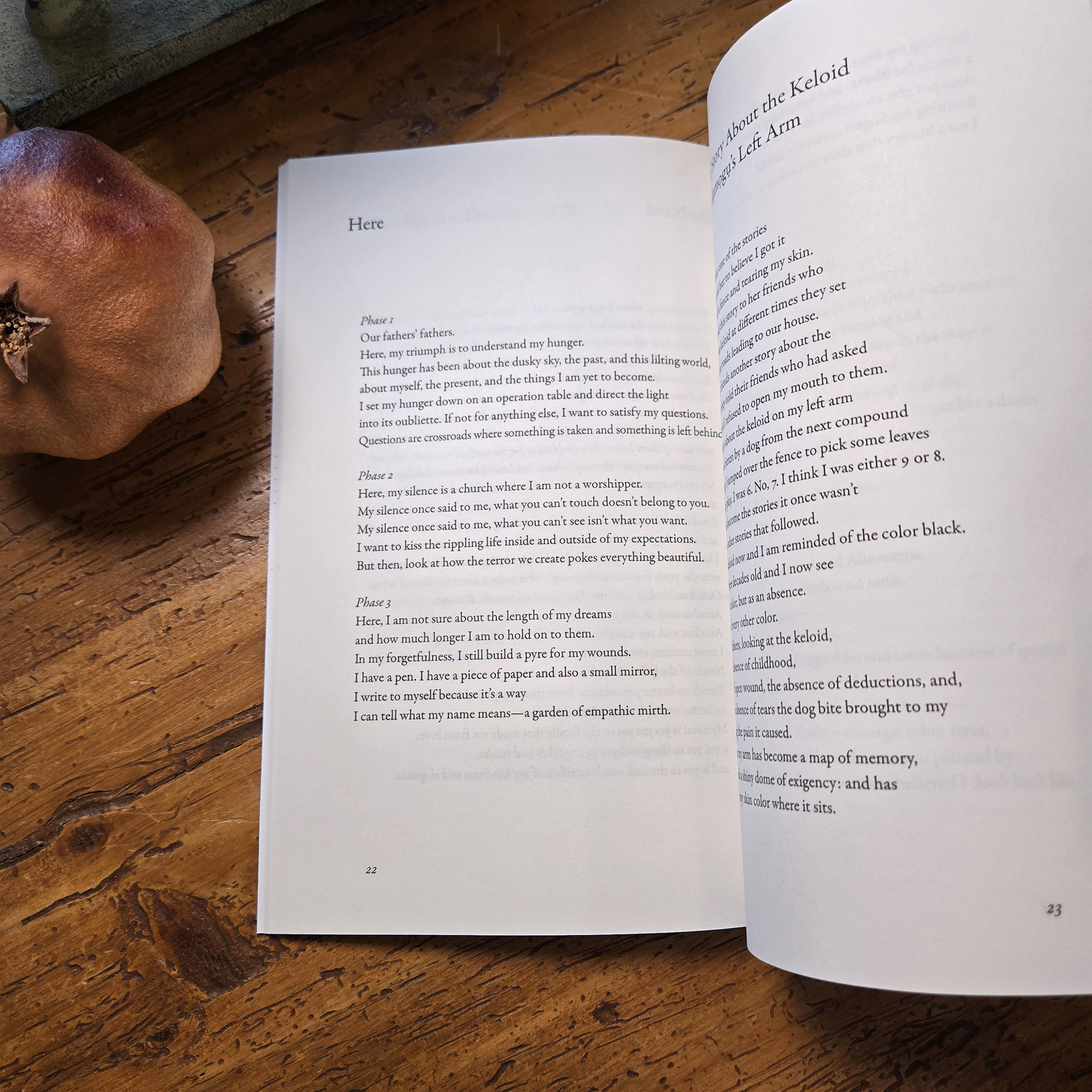
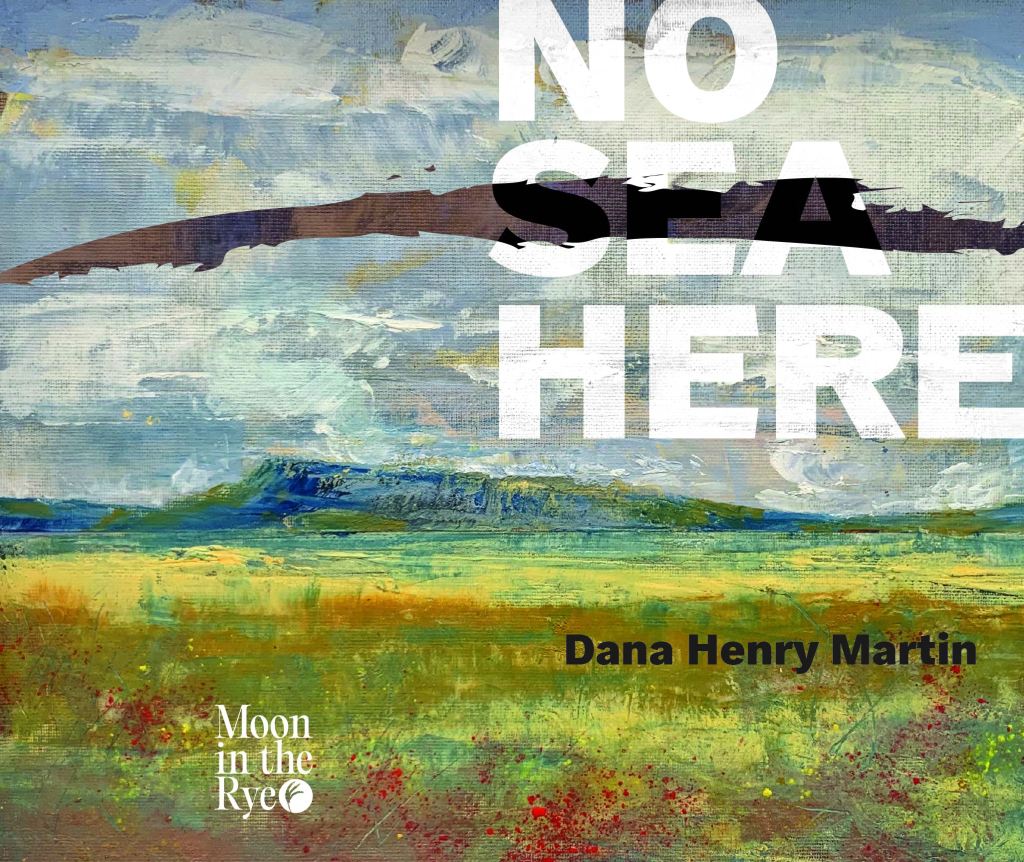
Selections from ‘No Sea Here,’ Moon in the Rye Press

And the Mountains Rising Nowhere

And there is a single boat on the water.

And the water is as still as the moment
………………………………………………before thought. And a bird

is about to fly, almost. And the wheat is gone,
harvested. And the fields are nothing more,
………………………………………………nothing less, without

wheat. And the sun hides behind a haze,
but it is there, it is there. And the mountains,

smooth as sculpting clay now hardened,
………………………………………………break into pieces around us.

And the trees hold up their branches, always.

Sermon

If a man is in a fruit, then when the fruit is taken and blessed, it is redeemed.
— Rabbi Amnon

If a woman is in a lake, then when the lake
is drained and filled in, it is rescued from water.

If a generation of boys is in trees, then when the trees
are felled and milled, the forest is delivered from shade.

If a party of lost girls darkens the air, then when the air
swells with toxins and haze, the sky is liberated from breath.

If a grandfather is in the soil, then when the soil
is dry and bare, the ground is saved from production.

If a grandmother is in the body, then when the body
is scathed and broken down, it is released from its own ruin.

If a man is in apple, then when the fruit is thieved
and cleaved, it is redeemed from the curse of being a man.

Inland Beach

Handful by handful, wind carries

sand over the tops of these lava flows.
My husband and I scale the barbed wire,

climb past sage and dry flowers.

Volcanic rock crumbles, shifts
under our feet, dark as a field

newly burned, dark as shame.

High above, the Twin Sisters
share the age-old story of marriage.

Coyote, their jealous husband,

turned them into pillars; turned
himself into a rock to watch over

them forever. Behind the pillars,

sand forms a waterless beach,
the river visible in the far

distance. We lie together in love

and regret, each of us a Coyote,
our fear turning us both to stone.

We rise and make our way to the twins

whose eroding bodies remind us
even love and its curses will pass.

Hanford Site, 1958

We find radioactive rabbit dung
up to two thousand acres from the site.
We find radioactive coyote dung.
We assume the coyotes found the rabbits
……………………………….in their burrows and ate them.

We have come to expect deaths out here
where no one will miss the dead—
more prey and predator where these came from.

We have come to expect—no, to anticipate—
……………………….the larger death for which we gather
while our wives give birth and keep house,
while we file in and out, in and out
…………………..………………………as we are told.

We burrow inside the site and inside our homes,
hoping no coyote will sniff us out
and put an end to this—
………………….our insurance, our bright future, our light.

No Sea Here

There are waves here, too. Each morning,
……………… … … ……..they pass from tree to tree.

These waves talk to the air the way a sea talks
……………………………………………to its shores.

Lower, the wheat makes its own waves,
………………………………which sound like streams.

The wheat’s movement reveals the shape
………………………………………of the land below

that, long ago, was carved, and carved again, by water.

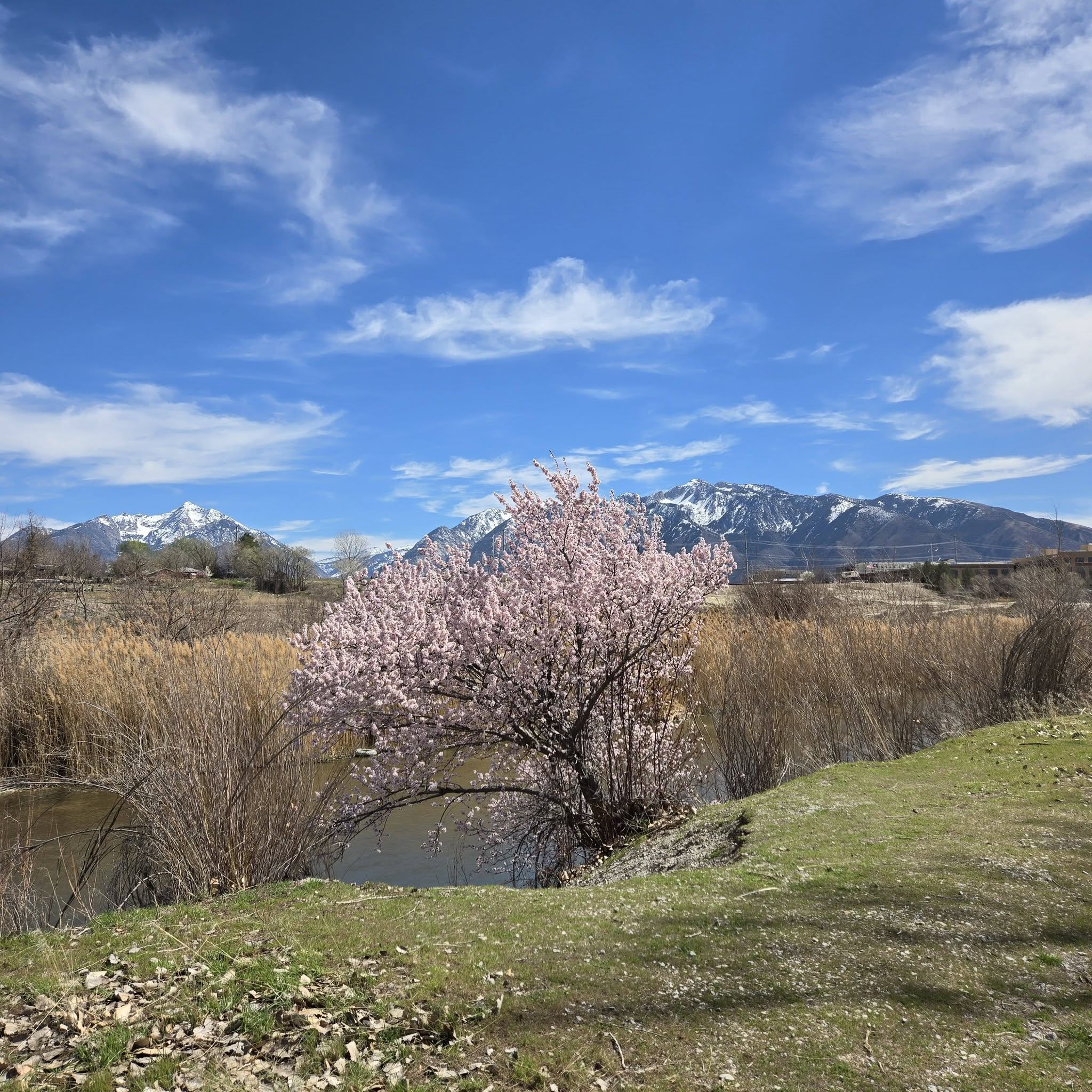
“And the Mountains Rising Nowhere” first appeared in Barrow Street. The poem takes its title from Joseph Schwanter’s composition by the same name. I was listening to the piece and thinking about the stillness of the Eastern Washington landscape as I wrote this poem.

“Sermon” first appeared in I-70 Review.

“Inland Beach” first appeared in Menacing Hedge.

“Hanford Site, 1958” first appeared in The Smoking Poet. I used to drive by the Hanford Site on my way from Eastern Washington to western Washington and back again. The landscape in that area is already strange, and the story of the Hanford Site makes the area feel even stranger. Its silence and stillness felt eerie to me, as did the sense I had that the world was not prepared for what Hanford would become. The land was not prepared. The air and water were not prepared. The vegetation and wildlife were not prepared. And the people who lived in the area before the site was built were certainly not prepared.

Even those who moved to Richland, Washington, to work at the site were not prepared for what their hands and minds were shaping out in the desert. For this poem, I went back in time and tried to enter the hearts of Hanford’s nuclear pioneers. The poem is based on a secret report from 1958 that was unclassified in 1989.

“No Sea Here” first appeared in Canopic Jar.

No Sea Here is forthcoming from Moon in the Rye Press.