Incrementally, Tenderly

Morning Prayer September 21, 2024

In the fall, Tucson smells like mildew, dirt, and cold metal. The wildlands behind our home are full of mouldering plant matter, animal matter, too. Every morning here is like an episode of my favorite series ever, Sunrise Earth, which aired on PBS years ago. The earth wakes up the same way everywhere: incrementally, tenderly, and without assistance from humans.

The coyotes are howling. They’ve been like this for days. They made it to fall. They’re anticipating winter, perhaps, bodily if not consciously. The moon has been big and glorious, which has affected us all, especially, it seems, the coyotes.

It’s like Sunrise Earth here with the birds calling and singing and buzzing, first the curve-billed thrashers, then the northern cardinals, then the house finches and the cactus wrens and the gila woodpeckers. A northern flicker even joined the crowd today, a rare treat.

The birds sing more as the sun rises higher, until it’s above the saguaros and palo verde trees. They sing until they stop, either because the sun is where it’s supposed to be and singing time is over or because the Cooper’s hawk has made an appearance. The birds are alarm clocks. They have a collective circadian rhythm that’s entrained on dawn. They help me keep my body clocks in sync and in working order.

Human sounds are here, too, which is where these mornings diverge from the Sunrise Earth episodes. Cars, too many of them, speed along Old Spanish Trail anticipating or dreading where they’re headed. Someone operates a chainsaw next door, an undertaking that started before six in the morning. If only humans would stop and watch the sunrise for five minutes and be part of the earth rather than setting themselves apart from it. I don’t know what that might change, but it might change us.

May we all be part of the Earth today. May we find a way to anchor ourselves on this planet and the lands we inhabit. My we be of this world, not separate from it.

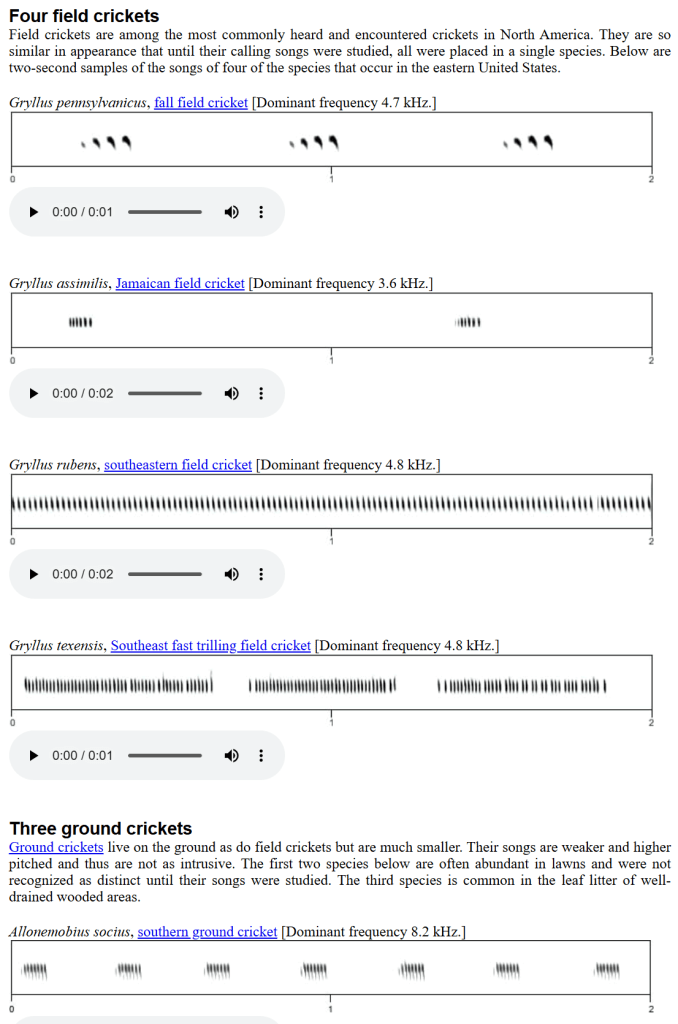
Snowy Tree Cricket

Oecanthus fultoni, snowy tree cricket, dominant frequency 2.9 kHz

This species occurs in dooryards and open stands of hardwoods throughout the United States except in the Southeast. Its song is memorable in at least three respects:

1. Especially at low temperatures, the song is melodious and haunting. Nathaniel Hawthorne wrote, If moonlight could be heard, it would sound just like that.

2. Because its chirps are produced regularly and at rates that are easy to count, the pace of the song can be used to estimate the temperature at which the cricket is singing.

3. Neighboring individuals synchronize their chirps so that a shrub or tree with many individuals throbs with the same rhythm as that of a solitary singer.

Click on the image below to listen to the songs of numerous crickets, including the snowy tree cricket.


Morning Prayer September 16, 2024

Trees don’t move in the wind. They’re moved by the wind, the way we all react to unseen forces, unseen faces, unseen lives, and unseen lies. But I digress. This isn’t about deleting and inserting letters to stumble on real or imagined connections. It’s about how, wherever I’m standing, I want to be standing somewhere else. A foot over, a mile, a state, a bioregion.

There, where I saw my first Blackburnian warbler. There, where I learned the name scissor-tailed flycatcher. There, the mud. There, the sand. There, the untidy rows of cows. There, tidy rows of roses a girl could hide in if it weren’t for the thorns.

I’m trying to stand still for ten minutes every morning while I watch the sun rise and listen to birds. Yesterday, a western screech owl. Today, a pyrrhuloxia, as in red or tawny, not as in pile of wood for burning the dead.

I’m trying not to think about how the northern cardinal should be the one named pyrrhuloxia, not the pyrrhuloxia, or about how that must mean the person who named the pyrrhuloxia had never seen a cardinal, or about how the person who named the pyrrhuloxia must have felt the first time they saw a cardinal after having named the pyrrhuloxia pyrrhuloxia.

I’m trying not to think, which is always the biggest impediment to not thinking. I just want to stand for ten minutes with my feet planted, my body unstirred, like palo verde trees on a calm morning after hard rain. I want to be here, with these birds and these trees and these cactuses in this desert. I want to feel safe enough to remain still for ten minutes. I’ve seen cottontail rabbits do as much, though their mouths were working incessantly because they move their jaws up to one hundred twenty times per minute when they chew. That’s twice my average resting heart rate but nowhere near the four thousand times a hummingbird’s wings beat per minute.

I’m trying not to think about facts and comparisons. This more than that. That less than this. Living beings are not just math, so I’m trying not to tilt my head and scan for rabbits or add up my heartbeats as they batter my chest or make a futile attempt to count the wingbeats of the Costa’s hummingbird who’s zipping past me.

I’m trying not to worry about Valley Fever and global warming and poisonous toads and communities in crisis and birds falling from the sky from avian influenza and assassination attempts and wildlife without habitat and unseen lies and unseen lives and unseen faces and unseen forces and my father and my family and my childhood. That’s what lies in stillness. All of that and more.

So I count. I compare. I slot things into more than that, less than this. I learn facts. I look around. I take in. I fill my head with details. And I move. I have a head full of analysis, a body full of terror, and the trauma to justify both.

Those last three things on my list are the crux of the matter: my father and my family and my childhood. They’re the real, lived dangers that tie me to the rest of the dangers in the world, the rest of the heartbreaks in the world, the rest of the injustices in the world. The broken wing. The dry lake. The toxic dust. The highway. The swimming pool. The bedroom.

My father didn’t have any guns. He’d had enough of them in Korea. We had an empty gun case built into a wall at our lake house. I wanted to fill it with flowers. He wouldn’t let me. It had to be empty, a sign for anyone who saw it that he meant them no harm.

My father was the weapon. He ultimately turned himself on himself but not until he destroyed everyone else. I mean us. I mean his family. I say his as if we belonged to him. Belonged as in were owned by, not as in were members of. He owned us all. Kin from the Old English cynn, which sounds like sin. To kin, to sin, to skin, again. Buckskin and doeskin and firing pins and deadly sins. No win, no wins, no whining, no whinneys.

I stood still for five minutes this morning. Five minutes in which I didn’t keep vigil, in which I watched the sun rise and listened to the birds. It’s not ten yet. I’ll keep trying for ten.

May we all be free from suffering for ten minutes today.

Good morning.
The Egg

I had a dream that all male software engineers were held in such high esteem that they became their own class that was positioned just below the richest tech billionaires, who had become the ruling class.

Elon Musk hatched a plan to get these engineers everything they needed to be comfortable and live a life of satiety. He developed what he called The Egg, which as the name suggests was an egg: a really big, high-tech, egg-shaped thing not unlike Mork’s egg on Mork and Mindy.

The engineers could spend as much time in their eggs every day as they liked. The eggs were designed for work, rest, restoration, and learning, but they were also virtual reality spaces where the engineers could create any immersive AI scenario they wanted simply by providing a verbal description of what they were interested in experiencing.

Guess what happened? The engineers did not work or rest or learn in their eggs. There was no restoration. The AI technology wasn’t used to expand on their horizons or as an expression of their imaginations.

They masturbated. That’s what they did. They made endless AI porn and went to town on themselves.

They masturbated over and over and over until all The Eggs had to be gathered up and disposed of in a mass landfill out in the West somewhere because they had become biohazards. Whole communities were redolent with the smell of ejaculate, which upset all the other classes. (Well, not the ruling class. They didn’t care. They were busy in their own souped-up versions of The Egg.)

In the dream, my husband had The Egg. Of course he did. He’s a brilliant software engineer (both in real life and in the dream). Musk loved him and personally delivered The Egg to our home, which as you can imagine was not as fun of a time for me as it was for the two of them. Musk offered to impregnate me and almost made it a requirement for giving my husband The Egg. Being menopausal saved me, though Musk said he’d try to cure menopause (?!?!), and he’d be back once he did.

Sadly, my husband was not an exception to the rule. I mean, he read some graphic novels, took a few comfy-cozy naps, and did some guided meditations. He even tried to use AI responsibly for a while. But ultimately, he succumbed and did what everyone else did inside The Egg. He defiled it from within. It had to be destroyed.

The Egg had to be destroyed, and we both had to live in the real world knowing full well what had happened in The Egg, what The Egg had brought out in him, and how The Egg had changed everything, every damn thing.

Listen, Listen

Morning Prayer September 14, 2024

Do not see the horrors of the world. Do not speak the horrors of the world. Listen, listen to the horrors. We only need to listen to know them in our bones. Then we can see. Then we can speak.

Cover your eyes until you hear. Cover your mouth until you hear.

I mean bomb. I mean siren. I mean gun. I mean blade.

I mean hand. I mean voice. I mean footsteps. I mean heartbeat.

I mean fire in wildlands. I mean fire in territories and cities and countries. I mean whole areas turned into carbon. Trees. Structures. Animals. People.

I mean the horror we hear coming and the horror we don’t hear until it’s come, until it’s sitting on our chests, pinning us down. To the bed. To the floor. To the sopping ground.

I mean flames and thermal winds roaring like jet engines, what feels like the whole world rumbling.

I mean horror like bones breaking because horror often breaks bones but also sounds like bones breaking when no bones are broken.

The horror of wrong death, wrong place, wrong time, wrong turn, wrong war, wrong leader, wrong policy, wrong hope, wrong prayer.

The horror of wrong family, wrong father, wrong town, wrong time, wrong words, wrong body, wrong hands, wrong home.

I mean bomb turning brick to sudden dust. I mean siren screaming aimless into night. I mean gun bucking in eager hands. I mean blade causing muscle to burst like distant thunder.

I mean hand turning body into target. I mean voice lulling child into trust. I mean footsteps like percussionists pounding out time. I mean heartbeat like another person inside the chest trying to tear themselves free.

The horror of why. The sound of that question as it sits on the tongue croaking like a toad.

I mean horror as gunshots down a long hall. Then in a room. Then in a library. Then in another room. Then back in the hall.

Horror in the school, in the business, on the base, in the place of worship, in the car, on the street, in the parking lot, in the neighborhood, on the highway, at the train station, on public lands, in the bedroom, at the splash pad.

The always-more of horror. The never-endingness of horror. Our faces like dry pools. Our skin dull as powder. We want no more of this screaming horror.

Now we hear it. Now we don’t. Now we do. Now we don’t. We are children, every one of us, playing games with our senses.

May we listen. May we see. May we speak.

Yesterday, I somehow managed to make one OK three-part poem out of what started as a single absolutely hideous poem. It was like fashioning one of those do-it-yourself wire tree sculptures that were all the rage in the ’80s. You had to keep twisting and untwisting until something at least passably treelike emerged, then you had to hang little leaves from the wire branches, which was its own surgical undertaking. I was the only one in my family who had the patience for that kind of thing. It wasn’t patience, though. It was something else: the need to destroy and create, to pare and repair, to make what I saw in my mind a reality in the world, not a poor approximation of my mindplay.

Compulsion was on my side as well, not just with the tree sculpture, but in all aspects of my childhood. I loved picking the tar bubbles in the road that formed on hot summer days and solving complicated puzzle games everyone else gave up on and memorizing impossibly long Simon tonal and light sequences because there’s no stopping, ever, until you absolutely can’t continue—maybe you’re out of tar bubbles and have to wait for the sun to make more or you can’t crack the stupid puzzle’s stupid code or your infuriating working memory deficits won’t allow your brain to hold onto any more BEEP BEEP BOOP BOOP BEEP BEEPs.

I stuck with that hideous poem yesterday because I’m an adult version of the child I once was: stubborn, driven, perhaps a little dysfunctional. That poem was a pig, and I put some better-than-Walmart earrings on it, dressed it up a little by tearing it apart line by line and reattaching those lines to create a different creature entirely. Half of it lay on the table by the time I was done. Word, words, words. So many words. Sometimes words are too much with us. They’re like metal tree branches that need to be trimmed or tar bubbles that need to be picked or puzzles and toys that need to be put away and silenced.