Whenever I play chess with my body, it always wins by making me vomit or have diarrhea or both in a phenomenon I aptly refer to as diavomarrhea. Let me give you this example:
Me: Let’s go to sleep now, body. The second half of the night was hellacious. We really need to rest.
My Body: How about, instead … just hear me out … we have violent diarrhea all morning long? Hmm? How. [claps] About. [claps] That? [claps] Let’s to that. [Jumps up and down with glee]
And here’s the thing: My body never bluffs, ever. It’s down to destroy me. It really is.
Clare, last night I saw horses, more than a dozen of them. First, I saw the dust they were raising as they ran, then I heard their hooves on earth, that dry drumming, then I saw them through the trees just on the other side of the Virgin River. They weren’t wild but they had enough space to act wild. There they were in the sage and dry grass moving like the river when it’s boated, fluid like that and strong, wanting nothing but this moment, nothing but each other. Keep writing your horse poems, Clare. A horse is a heart outside the human body who reminds us we each carry a heart within us, one that beats like a hoof hitting dirt. We need horses more than ever. We need your poems.
I am grateful for this pain. This pain is a compass. This pain is a signal. This pain is my dearest friend, my greatest protector, my guide, my heart. This pain is everything.
Me: I’m going to stay up late. I do my best writing at night
Also Me: In bed at 9:29 p.m.
I’d rather be trampled by horses than trammeled by poets.
The word of the day is ikigai, the convergence of one’s personal passions, beliefs, values, and vocations, translated loosely as one’s reason for being. What’s your reason for being?
As long as there are poets, something will survive.
There are lots of ways to lose if your focus is love. Lots of ways to gain if your focus is power. Pay attention to what you’re losing and what you’re gaining.
Bleary, I just misread “The Middle Ages” as “The Middle Oranges.” Now, I can’t stop thinking about The Middle Oranges, that period in history that can be divided into Early Oranges, High Oranges, and Late Middle Oranges.
Maybe, in all those words Frank O’Hara wrote about orange, he said something about The Middle Oranges. We’ll never know, will we?
I write a line about orange. Pretty soon it is a whole page of words, not lines. Then another page. There should be so much more, not of orange, of words, of how terrible orange is and life. Days go by. It is even in prose, I am a real poet. My poem is finished and I haven’t mentioned orange yet. It’s twelve poems, I call it ORANGES. And one day in a gallery I see Mike’s painting, called SARDINES.
— Frank O’Hara, from “Why I Am Not a Painter”
Gray wind. Gray branches. A horse on the hill and no ships in sight.
My suffering dies inside Ocean Vuong’s poems.
Lay it all aside and love.
To those who live with trauma: I’m glad you survived; I’m sorry you lived through what you lived through; I see you; I love you; I carry you in my heart.
It’s OK to buy blueberries and not eat them all. We all love imperfectly.
Morning: fire. Evening: fire. The first, literal, accidental, and brief. The second, metaphorical, intentional, and eternal.
Emotion is consistent. It’s only specific emotional states, which we perceive as separate from emotion as a whole, that are inconsistent. We learn that. We learn that we feel happy or sad or joyful or sorrowful or, or, or, ad nauseam. We cleave and cleave emotion until it’s all these little slices of pie sitting beside each other or across from each other. We’re doing the separating. We’re creating the binaries, the opposites. Emotion is emotion. It’s a whole. And, as a whole, it’s a constant.
I saw two cups and, in my haste, mistook them for a single cup. In my mis-taking, I divided my perceived single cup and suddenly had two cups again. But they were crucibles. Contaminated and useless. Each half couldn’t contain anything, not even contaminants, without the other. We are ore. We are bright, sometimes. We are chlorinated, sometimes. We are isotopes, sometimes, that glow hot like embers, like iodine-131 or its cousin, I-123.
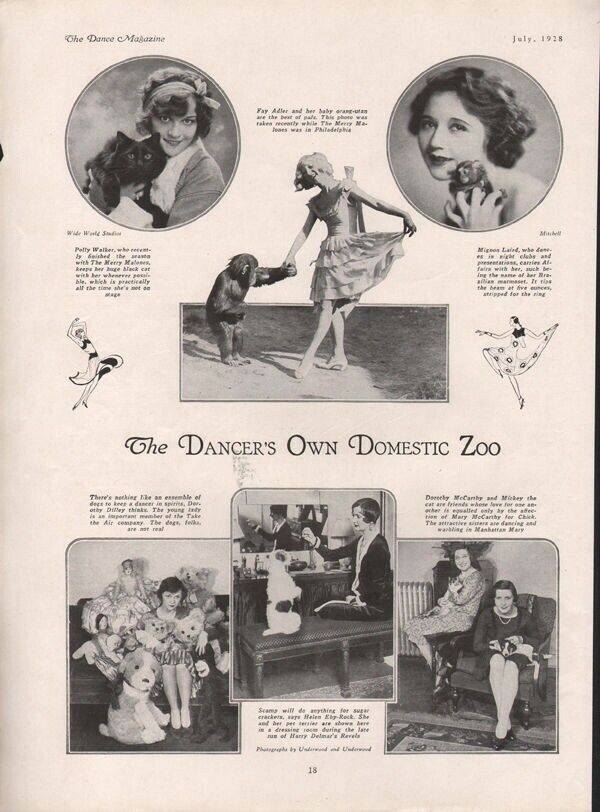
This page from The Dance Magazine, dated July 1928, features Mignon Laird. She was one of the dancers at the time who had their own domestic zoos. Laird’s father was involved with the circus. I believe he was promoting circuses, but he also had elephants at one point and aspired to have his own circus. The Thornton side of our family knew the Lairds, and my mother was named after Mignon.
So I’m ill again. The usual with a side of falling to the floor hard this evening when my lower extremities tightened and everything from my toes all the way to the middle of my thighs contorted until I looked like something with gnarled roots—maybe Donne’s mandrake—that had been unearthed and hosed off before being tossed to the ground until it could be transplanted elsewhere or fed to the wood chipper or cut into little slices as part of a fiber-filled culinary adventure.
I mean, I know I’m not fibrous. I’m meat and bone. But I’m doing an extended tree metaphor thing here, so just let me be fibrous for the purposes of this essay.
My floor routine went on for several excruciating minutes and I couldn’t get my legs under me and I couldn’t pull my legs and feet and toes back into their proper shapes and relationships with each other and I couldn’t massage the tension away and the pain was like someone had exposed me to a nerve toxin and I couldn’t reach my phone to call my husband for help and it wouldn’t have mattered anyway because he’d misplaced his phone and so I had to scream as loud as I could and don’t worry the neighbors never come when I do that and my husband burst into the room and found me splayed and broken like a cow that’s about to be scooped up from the fecal mud and dropped onto a truck headed for the rendering plant because she’s too sick to walk herself to her own death like all respectable—all good—girls should, even ones with spongiform encephalopathy.
I’m just working the cow metaphor with that encephalopathy reference. Don’t worry, I don’t have mad cow disease. My diseases have other names, and so far at least one has eluded naming. That disease is all experience, the way Hellen Keller’s whole world was before water ran over her fingers and forever changed the way her body and mind met the world.
Reuven Tsur talks about Keller in his theory of cognitive poetics. I’m not making baseless statements about her just to illustrate my point, so please don’t get all, You’re being ableist and using Hellen Keller to do your dirty ableist work, Karen. The name’s Dana, and I’m trying to tell you how bodies break and how we live in them anyway. I’m trying to tell you I took a little spill. I’m trying to put that spill in a larger context that some of you may find important. Bear with me. Bear down. Grin and bear it. I’m trying.
My husband panicked the way he does when he has to confront the fact that I’m seriously ill. He got me up off the floor, then went into a fugue state in which he forgot about everything other than his lost phone. He flitted around in flight mode looking for the phone because it’s easier to be upset about the phone than it is to live through more than two years of thinking your wife could die, on top of fifteen years of intermittently thinking your wife could die, let alone this very moment when you’re seeing more evidence of your wife’s potential death on the horizon or at least more data that suggests whatever’s going on with her isn’t going to go away any time soon, if ever. And what do you do with that as a spouse? How do you live with a splintered wife for the rest of your life?
I almost said upper thighs in the first paragraph of this essay, but we don’t have tiered thighs. We just have the one main set, one main set of thighs. It’s the way I also think I have two noses, when I just have the one nose with two nostrils and the way I always think I have two butts because I have two butt cheeks.
The body is confusing. Taking inventory isn’t as straightforward as it seems. At one point in American history, a window was considered a single pane within a larger window. So a window with six panes counted as six windows. Why? Taxes. Taxes were assessed per pane, so each pane became a window. At least I think that’s true. My rhetoric professor, Dan Mahala, told our class that in college. This was in the ’90s, when institutions still taught actual history—or at least tried to—not the ticky-tacky history being peddled today.
If U.S. politics applied to bodies—which of course it does, mainly those of women and trans and nonbinary folks, but bear with me again for the purposes of this essay—we might very well have been taught that we have two noses and two butts, especially if that meant we could be charged more for lugging all that flashy and fleshy gear around. Two butts! Two noses! How indulgent of you. One of each is subject to the luxury tax! You clearly have spares that are purely ornamental. (Don’t tell the tax collectors about the set of kidneys dangling in our trunks or the lungs or whatever else is doubled up in there like sets of animals shuffled onto a dingy for safekeeping during what looked to be the makings of a pretty big storm.)
All that contrived body taxation would be a real pane, wouldn’t it? I mean pain. And trust me, the body is definitely a pain.
But I digress. Who turns to stone? I’m asking because that’s what my body felt like today. Sisyphus, maybe. You could argue that pushing stones turns him into the very thing he’s pushing: Something that moves but that isn’t quite alive; someone whose stony but who isn’t quite mineral.
Demosthenes filled his mouth with stones to learn how to speak clearly. But that’s not the same thing as turning to stone.
Oh, I know, I know! It’s those who gaze into Medusa’s eyes!
Whose stare must I have returned to be cursed this evening? It must have been someone in my dreams. I’d just woken from a nap when the compacting began, soles first, a crushing invisible force making me denser and denser. I felt the hardening creep upward. The stiffening. The molecular tightening. I couldn’t do anything about it. It was like watching a virus spread through a computer taking out file after file after beloved file and replacing them with junk code.
I realize I can’t make the stone metaphor work alongside my earlier tree metaphor. Adding the computer-virus reference is making things even worse. Let’s just acknowledge all of that and move on. I don’t have time to put the right slant on this truth. (My apologies to Emily Dickinson.) I’m sliding downhill, and everything I write is sliding with me. Besides, wood can turn to stone. I know. I’ve seen it. I have a chunk of opalized palmwood right here that makes my case for me.
That rock is science. It’s fact. And like science and fact, opalized palmwood is beautiful when you place it on a black light in a dark room. It looks like magic and could be passed off as such if your audience doesn’t know any better. A divining rock. A soothsayer’s stone. Not the soft, boring sandstone my body is becoming, the kind of stone miners here tossed to the side when looking for the good stuff like silver and uranium.
But guess what? I tricked you, and you didn’t know any better. Petrified wood isn’t stone. My science wasn’t science, and my facts weren’t facts. Here’s the truth. You ready: Though the phrase petrified wood or petrified tree comes from Ancient Greek πέτρα meaning “rock” or “stone,” literally “wood turned into stone,” petrification doesn’t change organic wood into stone. It merely preserves the wood’s shape and structural elements.
Sometimes language gets things wrong. Sometimes, even the Ancient Greeks got things wrong. Is it so hard to believe that sometimes we get things wrong? That we get things wrong most of the time, actually?
Maybe I’m not turning to stone. Maybe parts of me are just undergoing a change, being preserved. My shape. My structural elements.
My husband found his phone. It was in the garage. He went out there frantically looking for it like a prospector trying to lay claim to a seam of silver in a sandstone reef in a town called Silver City in the 1870s. He cast aside all the piled-up crap garages tend to take on as his world was reduced to two things: phone and not phone.
When he found his phone, the world made sense again. I was in a chair by that time live-tweeting the unfolding disaster. My upper body still worked, which meant I could be a writer and write things down. So I wrote things down just like Richard Siken says we should. What else would you have me do? Come unglued?
This is marriage. This, too, is marriage. Sometimes it’s broken. Sometimes there’s no diagnosing what’s wrong with it. Sometimes it’s all experience and no name and no remedy. Or maybe no remedy is needed because legs are not roots and flesh is not stone and a phone isn’t something jacked out of the Earth for profit or for prophets.
Sometimes a phone is just a phone, and we can use it to hear the voice of the person we love more than anyone else on the planet. Sometimes we can take that call. Sometimes we can’t no matter how much we want to. We just let it ring through to voicemail and hope the love of our life leaves us a message that we can receive when we’re ready.
Deliver me from the man who ran over a porcupine in broad daylight because of his need to thrust his way forward always forward always faster and always darker, coal smoke billowing from his tailpipe as he hits the gas hard.
Deliver me from that man who saw the porcupine struggling after his back legs were crushed, who didn’t stop, who didn’t take the porcupine to the wildlife rehab on the other side of Flying Monkey Mesa, who didn’t care because black smoke because man because manly because grrrrr because move over here I come like it or not because get off of my road and out of my town and I’ll put my foot in your ass and I’ll mow you down I mean it I mean it look at me I really mean it look at my Gadson flag and my Dixie flag can’t you see I mean business look at my neck veins little lady, pretty little lady, lady why’s there a thought in your head a little tinkling thought about love that’s so silly so outdated so childish like a school bell hey little lady listen here it’s not God’s way for you to think or tell a man what to do a big man a strong man a fast man and you damned well know it so stop thinking just stop stop it right now.
Deliver me from what the porcupine must have felt there in the road on the hot asphalt in the heat so close to the soft sage flanking the road’s shoulder. He got so close but not close enough never close enough for speed for thrill for look I killed that varment woohoo hot damn and never enough blood left in the leaking husk never enough life left in the pressured heart and never enough limp left in the body nobody will ever gather for ever.
Deliver me from those who came after and also didn’t stop. The sedans and SUVS and minivans and trucks and semis and hatchbacks and Outbacks and Elements and motorcycles and RVs.
Deliver me from every one of them. Deliver me from my neighbors. They didn’t stop. They didn’t stop. My neighbors didn’t stop. Too busy doing God’s work to do God’s work.
Deliver me from my own absence as the porcupine struggled, for coming behind too late by hours, maybe, or maybe only by minutes which is even more self-hatred to be delivered from.
Deliver me from rewriting the story so I’m there, so I take the limp, quilled creature in my arms and usher him to safety, to people who care, to angels on this earth who spend all day helping the creatures of this earth. I almost typed heart. Heart is earth. Earth is heart. Same letters. How did I never see that before? Grief brings out glimmerings, doesn’t it? This is how and why we survive grief. No glimmering, no future. No heart in earth, no earth in our hearts.
Deliver me from those who have no earth in their hearts, no heart in their earths.
Deliver me from my revisions my impossible revisions my anger that story only takes us so far into the future because it never changes the past. Our stories are cursed that way as we are cursed.
Deliver me from the cursed. Deliver me from myself as one of the cursed. Curs-ed, say it with two syllables. Say it with me. Curs-ed. Clop along to that languid beat, that dirge. The march of what we’ll all be without love and without hope.
Deliver me from revisions existing only in our minds and not actually changing what happened, what really happened. The porcupine is dead. That’s what happened. In broad daylight. Visible on open road. The driver could have slowed. The driver could have slowed. The driver could have slowed his hellbent smoke-infused take that world roll.
Deliver me from this iron-encrusted place whose heart was lost in the creek, in the canyons, up on the cliffs when … years, hours, minutes ago? How long? How long has it been? Since we came, since we named, since we shamed, since we couldn’t leave couldn’t leave couldn’t leave this place alone?
Deliver me from how long we’ve lived like this, baffled and battled and beaten and battered and branded and broken. How long must I writhe, I mean write, before I write my way out of this failing, flailing, hellish heaven on earth? A minute? An hour? A day? An eternity?
Zion—my great nephew, not the place—deliver me from this land whose name you carry in your pocket on your papers in your heart and in your genes. Yours is the real Zion. It lives inside you, little one. Never deliver me from who you are—from you, my kin, my kind, my kindred. [REDACTED] Pin me here to this tree, the only one that’s safe these days with all the fruit trees eaten bare. The family tree. My tree, our everlasting tree.
As for you, Zion—the place, not the great nephew—deliver me from you. Free me from you. Forget me. You don’t even have to forgive me. If you can’t reverse time and bring that porcupine back to life, if you can’t unwind the clocks that are all wound too tight here warping time and space and hearts and minds, then deliver me. I beseech you. Deliver me from what we’ve made you, from what you’ve become. Please deliver me.
Before the Industrial Revolution, people slept in two shifts. The first was from early evening until sometime in the middle of the night. The second was from early morning until it was time to get up and start the day’s work. The waking period in the middle of the night wasn’t just for reading or sitting by the fire. People played cards, canoodled, had little get-togethers, and more. It was dark and cool and simply a good time to be awake. A romantic time. A playful time. A productive time.
In 2008, when I had one of my bouts of thyrotoxicosis—which made sleep difficult and resulted in severe sleep anxiety—a therapist told me about two-sleeps. She could see my sleep patterns falling into that rhythm and encouraged me to embrace that rather than fighting it. I had charts and graphs and other excessively detailed stuff documenting my personal sleep woes because that’s how I roll. It was a lot, the way my personal wardrobe database, which I maintained for six years, was a lot. (I can be a lot or, as I like to say a lot a lot—think quirky, colorful, dysfunctional.)
Hold up, the therapist said. Maybe, just maybe, instead of being hypervigilant about your sleep, you could try this approach instead. Hers was for sure the better plan. It was hard to let go of my recordkeeping and data management, but I did it at her urging.
The change in perspective and approach got me through those long months until my thyroid function returned to normal. I should note that thyrotoxicosis isn’t like hyperthyroidism in that you can’t treat it. You just have to wait it out. The whole process from thyrotoxicosis (or thyroid storm) to hypothyroidism to a return to a euthyroid state takes about a year.
A long damned year that’s difficult, creatively productive, and hard on a marriage, or at least has been hard on my marriage. It’s not easy to live with someone who has a snack-and-book midden stashed in the bed because they need to eat constantly and must always have reading material ready for those inevitable jolts from sleep. And also a slew of notepads and a handheld recording device so flashes of brilliance can be documented, such as aphorisms that float in on the ether and strange dreams that can’t not be cast in stone or at least scrawled in pencil in feverish, sloppy detail. (Pencil because, while graphite is an inferior writing material, I have a no ink-in-the-bed rule, as should everyone. We have sheets to think about, folks. We don’t need to add fighting ink stains to our list of daily tasks, especially not when we’re thyrotoxic.)
It’s not easy to live with someone who’s in fight or flight for the better part of a year, edgy and jumping at every little sound, balled up at times saying I can’t take it when will I feel normal again, whose OMing her way through moment after excruciating moment, who asks her mother-in-law in Iowa to have a bag packed in case she needs to come take care of her when she’s thirty-six years old and her mother-in-law has better things to do like tending to her gorgeous, gazeboed yard and going to church and keeping her husband from wandering into the back of the garage never to be seen again because he’s finally going to put that classic car together, the one that’s been a tangle of pieces and parts strewn about the property for four decades. In short, someone who’s devolved into a twitchy little miscreant. It wasn’t easy on Jon. I wasn’t easy on Jon. But two-sleeps made a big difference.
I still approach my sleep this way if I wake up in the middle of the night. It’s a two-sleep night, I think. Rather than toss and turn in bed, I get up and do what I do, which is read and write and, sometimes, snack. Tonight, I’m up with GI distress and heartburn because of unfortunate but yummy birthday dinner choices yesterday evening. I came home and crashed, accidentally, at 8:40 p.m. and woke a few minutes ago bloated and nauseated, like a puffer fish that didn’t mean to puff and can’t unpuff and whose innards are on fire.
Is this a good time to write? Who knows. Will I produce anything of value during these waking hours? Based on this journal entry, it doesn’t seem like I will. I just know it’s not a good time to be horizontal. It is a good time to take Pepto Bismol and be vertical. So that’s what I’m doing until my second sleep begins. (Technically, since I’m sitting down, I’m vertical then horizontal then vertical again.)
Metadata paralysis is a real phenomenon, and folks like me live the experience every day. If you see someone with obvious symptoms of metadata paralysis, let them know you care. Take interest in their metadata tree. Say things like, “Good work. What a lovely metadata tree you’re working on. So many branches. I can’t wait to see what it grows into.”
Part two of this essay will be redacted in its entirety because it’s boring. Why? It’s self-indulgent and not self-reflective. The metadata here is value: subset one, possesses; subset two, doesn’t possess.
I’m falling asleep sitting up. Hello, theta waves. Bring on the strange brilliance.
I get it. His name is Jack Tripper and he trips all the time as part of his physical comedy. He also trips out on what others are doing and saying, so he’s also a metaphorical tripper.
Quick on the draw isn’t something anyone’s ever called me with regard to understanding plays on words, but they did call me fast fingers in grade school because I learned to count like lightning on my hands during math drills as a workaround for my dyscalculia and working-memory deficits. I won those drills. Laugh away, children, laugh away. What the world needs is a dyscalculia superhero named Fast Fingers.
Dyscalculia is either part of dyslexia or it’s a separate but similar entity. It depends on what metadata you use, that is, how you organize the information pertaining to each phenomenon.
Dyscalculia. Dyscalculia. Dyscalculia. That looks funny. This calculia. Miss Calculia. That’s Ms. Calculia to you. Dana “Ms. Calculia” Martin. Now there’s a name. A Dana by any other name still can’t count to ten without using her fingers.
They gave me a free dessert because it was my birthday. That’s what happened with dinner. And also a plate of fried everything. That part wasn’t free. I paid for the plate of fried everything. My metadata here is dinner: subset one, fried everything; subset two, dessert.
I didn’t have to eat it. I wanted to eat it. Then I didn’t want to eat it but kept eating it. I’m trying hard to eat. I need to eat. My metadata here is health: subset one, presence; subset two, absence. Or is it life: subset one, congruous with; subset two, incongruous with?
My throat is getting dry. The Pepto Bismol is coagulating, if that’s the right word, near my uvula. One time, a big, hard thing traveled from my sinuses down into my throat. I choked on it for a while, then coughed it into a tissue, thereby saving my own life. It was fossilish and had ridges like the roof of a mouth. This incident (or shall I call it an *indecent*) happened in from of my mother-in-law. The metadata here is mother-in-law: subset one, what not to do in front of; subset two, what I did in front of. Additional metadata is bodies: subset one, amazing; subset two, strange.
As with bodies, also with minds: subset one, amazing; subset two, strange. Or is the main category bodymind: one thing, not two? As in, we mine the bodymind when we should be embodying it. As in, why is the bodying of the bodymind something we mind, whether it’s ours, yours or mine? As in, what’s mine is my bodymind and is not to be mined.
This is a real mindfield. Good night. I’m off for part two of my two-sleeps night. May our collective dreams break the bough, rattle the house, and set free a wee mouse who runs the mazes of our minds. Wouldn’t that be amazing.
There’s a point at which there are diminishing returns with regard to learning more about a place, a culture, a collective mindset, a community fever.
There’s a point at which it becomes time to pray with your feet. I’m at that point. I’m not an investigative journalist nor do I want to be one. I’m a creator. I want to create. As Richard Siken says, I’m just a writer. I write things down. That’s what I do and what I need to do. I need to create. I need to bring beauty to what’s awful, to what we want to look away from, to what we want to deny and suppress and ignore. But the beauty part is key. Beauty first, beauty always.
I don’t want to be pulled further into what this place is and does and isn’t and doesn’t do. I don’t want to be somewhere that takes and takes and takes everything from me, leaving no me left to love, to grow, to write, to create.
I’m leaving, come hell or high water. There, I said it. It’s time. It’s beyond time. My return to this place in March was necessary because of my health, because of my trauma, because I had issues to resolve with my husband, and because I needed to make sure I’d done all I could possibly do to be part of this community. I’ve done those things now, and I’m done.
I’m going to Oklahoma, Kansas, and Missouri in September. I’m looking at MFA programs in Oklahoma while I’m there. I’m evaluating the healthcare system, housing costs and availability, and employment opportunities. I have family in Oklahoma. My family. My people. Oklahoma, my home, my home, my home.
I’m going to need help to do this in the form of love, support, and understanding. There’s so much more trauma for me to address now after living in Utah for five years and Southern Utah for three years. I’m a strong person, but I’m now a broken person. I can come back. I know I can. I can become who I am again, who I’m losing, who I may have lost.
Tomorrow is my birthday. I’ll be fifty-two. One year ago, I was radioactive. I was sitting in a rented tiny home overlooking the Virgin River Gorge because I had to be isolated for several days. I spent hours talking to Jose Faus on the phone after watching the gorge all day. I had just started writing poetry again. I read a short piece to Jose over the phone as he fell asleep. Maybe my words put him to sleep. That’s OK. I always fall asleep reading my own writing, too. Anyone out there with insomnia might consider using my work to help them regulate their sleep.
Seven years ago, I was sitting in a hospital room in Kansas City with my husband, my legs under constant pressure and a breathing device on the table that I had to use every thirty minutes or so—the former to prevent leg clots and the latter, I think, to prevent a pulmonary embolism. I’d just had my thyroid removed to cure my autoimmune thyroiditis. They found tumors during the procedure, but the doctor assured me they wouldn’t be malignant. He came into my room all ego and narcissism and said there was only a one-percent chance the tumors would be cancerous. That’s why he went easy, left a little tissue in sensitive places. That’s why he didn’t remove the lymph nodes. Then he wished me a happy birthday. The pathology report came in a week later. It was cancer, and it hadn’t all been resected.
What will tomorrow bring? My husband and I plan to look at the stars with a telescope we’re borrowing. I plan to visit a bookstore. I plan to play with our dog, Lexi. I plan to write and write and write and read and read and read. That’s the plan. We’ll see what actually happens.
Love to those dealing with health issues, emotional issues, addictions, dependencies, and any form of pain or suffering. Love to those who’ve almost died and managed to survive. Love to those who tried to survive and didn’t manage to do so. Love to you beyond place, beyond time, beyond loss, beyond memory.
Love to you all. All of you, love.
Ad astra per aspera. PrairyErth, we are one.
It’s not Oklahoma’s fault that I was abused in Oklahoma, that I was raped in Oklahoma, that I was trafficked within and beyond Oklahoma. Humans destroy each other. Humans destroy the land. The land never destroys us. The land never trafficks us. The land never rapes us. The land never abuses us. The land never destroys itself.
I am grateful for this pain. This pain is a compass. This pain is a signal. This pain is my dearest friend, my greatest protector, my guide, my heart. This pain is everything.
Every day is a journey, and the journey itself is home. ― Matsuo Bashō
Insomnia Diary Entry One: The price I’m paying for going to bed at 9:29 p.m. last night is waking to strange dreams and observations at 1:29 a.m. this morning. As if that weren’t bad enough, my weaving room clock is four hours slow for some reason, so when I dragged myself in here to write down my strange dreams and observations, it said it was only 9:29 p.m. I feel like I slept zero minutes, not two-hundred-forty weird, totally off, minutes. What do I do now? Eat? Vomit? I hate waking up like this, being off like this. My ear wax is melting. The light from this pink Himalayan salt lamp is too bright. I think I need to hydrate.
Insomnia Diary Entry Two: Based on my symptoms, I’d say my TSH level is moving around wildly again and that it has been since I started a new dose of thyroid replacement and a new form of the medication, this time an amber liquid that burns my gums. My body no longer knows what to do, how to regulate, its TSH levels. Within a month’s time, I’ll swing from clinically hypothyroid to severely thyrotoxic. This has been happening every month for a year or so.
Heart palpitations are back. Big tears are back, rolling ones like dew drops on iris leaves in Kansas on any given spring morning. Nausea is back. Exhaustion. Word-finding issues.
I forgot my maternal grandmother’s first name two days ago. (It’s Ruth, a word I always see as red, like a ruby. Ruth, my gem of a grandmother, my red velvet cake grandmother, my faceted grandmother throwing off an eerie red light, my film noire grandmother if the lighting was black and red, not black and white. And she, Ruth, surely was all of those things. So how could I forget her name, given all the ways synesthesia allows me to vividly see it?)
I confused trammel and trample yesterday. (I didn’t just make that play on words in a post for fun. I actually forgot the difference between the words, then turned my language-related malady into a wry comment on nature and culture, or something like that. A real poor-me of a post.)
I forgot traffic (n.) and traffick (v.) both exist. I’m still not convinced they’re both real, but the dictionaries seem to think so. I’m pretty sure I’ve been leaving the “k” off the verb form for years, a startling realization that leads me to ruminate about all the other words I must be getting wrong without realizing it. It’s like my late-90s disk and disc meltdown all over again. Floppy? Frisbee? C or K? K or C?
I’m so tired of being dyslexic and having auditory processing disorder and working memory issues and attention deficits with ironic hyperfocus and rumination and neat and tidy OCD and complex PTSD and regular PTSD and other flavors of anxiety on top of my primary immunodeficiency and autoimmune diseases and arrhythmias and dysautonomia and possible kidney issues and whatever the hell is going on with iron overloading and concurrent anemia and TSH issues that come and go without explanation and that cancer I had and may still have and the edema and the asthma and whatever else I can’t even remember at this moment.
It’s a lot, folks. It’s getting old. Y’all, I just want to move around the cabin of life freely and with some assurance that I’m doing an OK job at that. Instead, I end up back by the lavatories when I think I’m heading toward the emergency exit. It’s sheer disorientation much of the time: in my mind, in my body, and at the seams where my mind and body meet the world.
I was trying to make a play on the cabin reference above by following it with the lavatories and emergency exit references, but it didn’t work. It’s too jumbled, the image too burdened. I can’t bring myself to delete the attempt, though, because my body-mind really worked hard at it and I’m so exhuasted and here come the big dewy tears and this water isn’t hydrating me at all because I’m still a walking desert and my GI tract is full of angry fists that feel like a mob is trying to punch its way out of me and I’m so awaketired, so hungrynauseated, so tinglenumb, that the cursed trinity (cabin/lavatories/emergency exit) isn’t going anywhere. It’s staying put. It’s evidence of and a testament to my dysfunction.)
All the hunger all the time and all the eating all the time without moving the needle on the scale at all are back. Parasthesias are back. Maybe some neuropathy, too, which I don’t even want to acknowledge, but the weird stabbing pains in my legs and the sudden feeling of having stepped in water when there is no water aren’t going anywhere, it seems.
Some of this is also from having dysautonomia. Some of this is from having immune system dysregulation and all the diseases and conditions that flow from that dysregulation. Not all of this is because of my TSH dysregulation, and I suspect that dysregulation isn’t a thing on its own, anyway, but instead flows from some combination of my other health issues, as well as from my trauma. Traumas, let’s be honest. It’s traumas, plural. It’s also trauma and trauma (v) if trauma can verb.* I think it can. Think: She will trauma her way through life. Think: May she trauma in peace. Maybe we should spell the verb form differently to avoid confusion, like traffic and traffick. But what would trauma look like spelled any other way? Whatever form it takes, it all looks like ruin.
* Why did Facebook turn my n in parentheses into a thumbs down? I’m too tired to fight you on that, Facebook. Have it your way. You always do. We’re all just here for your profit and pleasure, Facebook. Don’t think we don’t know that’s the case.**
**Oh, I know why. I forgot the periods after the “n” and the “v” on second reference. Fine. My bad, Facebook.
Insomnia Diary Entry Three: I think people count sheep when they can’t sleep because sheep sounds like sleep, so we’re indirectly invoking sleep by using sheep as a kind of mantra, one that allows us to sidle up to sleeping without getting sleep anxiety as we think about how we’re not sleeping.
Oh, no. That’s not it at all. Apparently, shepherds in medieval Britain had to keep a headcount of their sheep each night if they used communal grazing land, so they counted their sheep before going to sleep to ensure they were all there.
Still, I think my thing is also correct: I think sheep works because it’s a stand-in, soundwise, for the thing we’re trying to do, which is sleep.
Insomnia Diary Entry Four: I had two thoughts upon waking at 1:29 a.m. First thought: I’ve reached the age where I can no longer tell if physical exertion is building muscle or destroying muscle. Second thought: The price I pay for whatever I’m doing is having to do more of whatever I’m doing.
Insomnia Diary Entry Five: I am not dovetailed to this world. I’m glued and stapled to it.
Insomnia Diary Entry Six: When someone starts a sentence with the words I’m no conspiracy theorist, you can put money on the fact that a conspiracy theory (technically, a conspiracy hypothesis) will complete that utterance.
Insomnia Diary Entry Seven: I’m no conspiracy theorist, but I don’t trust the water here in Toquerville, Utah. On record, our water management people said at a city council meeting that they sometimes forget to check the water pumps. Then, earlier this year, one of the water pumps broke, and our irrigation water was turned off until a new pump could be ordered.
I just don’t know. You know, govnmnt and whatnot. You never can tell. Never can tell. No, sir. No, siree.
I do know that, without proper filtration, there’s one-thousand-one-hundred times the “safe” amount of arsenic in our water, and that figure isn’t hyperbolic. I looked into it. You know, inurnet and whatnot.
What I’m getting at is this: I drank all my water just now, and I needed more water. My husband and I recently bought a fancy office-level water filter thing that makes cold water, hot water, tea, and coffee. We decided to do it because govnmnt and inurnet and all that, and also because my gums were starting to burn after brushing my teeth with, you guessed it, the local water. (I see a pure D bona fide theory emerging here, not just a measly hypothesis!)
We love the new water filter thing. Just adore it. It’s like the watery baby we never had. We coo at it. We pet it. But it makes this rattling sound whenever it’s used as it pumps more water into whatever parts of the machine need water pumped to them. So I couldn’t fill my water bottle with filtered water just now or else I’d wake my husband up and he’d be all why’d you wake me up you’re ruining my sleep and I’d have no choice but to be all because my own sleep is ruined forever and always and we’re married and this is the for worse part of it which you agreed to in front of that pantheist minister in Eureka Springs Arkansas during a freak March snowstorm back in 1999 so deal with it just deal with it and rub my shoulders while you’re here and get me some filtered water too please and thank you and I love you and don’t leave me and hold me and get away from me and I’m sorry so so sorry I’m just so tired and hurt and tired. And I wouldn’t want to do that, so here I am filling myself with liquid arsenic, folks. The things a good wife does. The things a good wife does.
Insomnia Diary Entry Eight: How do I select my titles? That depends. Sometimes, I write a big thing while I have insomnia, then I look at the thing, my eyes fall to some of the words in the thing, and in my bleary state, I think, Gee whiz, those random words seem like they’d make a good title. Usually, they do. Case in point: Henceforth, the collective title of these insomnia diary entries shall be “Cabin Lavatories Emergency Exit.”
Actually, I think I’ll make the whole series into a poem. But first, I must sheep. I mean sleep. One two three four. Or arrhythmically like my heart: one two (pause) three (longer pause) four.
Insomnia Diary Entry Nine: to sheep, perchance to leme.
Insomnia Diary Epilogue: I slept. Finally. I dressed up like Liza Minnelli after we got back from Jon’s doctor’s appointment, the one about his liver, and I took a hot, stupid, mid-morning nap on top of the covers and with my little dog between my legs, her favorite place to sleep. Was it comfortable? No. I had sequins on and big flashy earrings. All the material from my jeans somehow managed to bunch up between my legs. My dog was bristly like the hairbrush my mother made me use for well over a decade, the pink one that was passed down to me after my sister left the home.
Yes, I had to use my grown sister’s hairbrush when she moved out of the house. If that doesn’t prove to you that I’m the product of Depression- and Dust Bowl-era Oklahomans, nothing will.
See, the Great Depression and the Dust Bowl made my mother frugal. I get it. I do. But seriously, who keeps a hairbrush around that long, washing it every month in the sink like it was going to the spa, rescuing it from various dogs’ mouths and returning it to my drawer covered in an ever-lengthening tactile Morse-like Code of tooth marks? (Maybe that would make it Braille-like. Who cares.)
I didn’t even know people could buy hairbrushes until I was seventeen and saw them at the store. Don’t ask how I never saw them before then. I have attention differences, and my mother probably steered me away from the expensive beauty aisles, especially after my father died and we were trying to make it on her income from the state mental hospital, where she worked as a psychiatric nurse for thirty-five years.
Anyway, at the store back in those days, I was always busy taking the empty glass Coke bottles in to get our deposit back or to buy some cigarettes — if you can even call menthol Virginia Slims that — for my mother. I never saw any hairbrushes until the day I did as a teenager and my mind was blown. I bought one on the spot. A Goodie.
I confronted my mother about the decades-long hairbrush ruse when I got home. She just shrugged or something, then probably took a sip of her vodka, then took a drag of her cigarette, and clicked the clicker to watch the news, something she loved to do because she was passionate about politics. She was a feverish democrat who was in the closet about her political opinions until my father died, then she let it all loose. She’d call all her nurse friends when anything remotely of political interest happened, like the time Reagan came to town and two kids sneaked a big protest sign into the rally.
I know the kids who did that. I wasn’t one of them, sadly. I still had a perm and claw bangs and listened to Duran Duran. I had no desire to tape parts of a sign to my body so I could smuggle them into a room full of adults, then assemble the sign once I was inside. I didn’t want to get arrested. I didn’t want to be dragged anywhere. I had Guess jeans. I had a Coach purse. I was going places in my jelly shoes.
The point is. I took a shit nap, but it was still a nap, and I’m grateful for it.
I’m still pretty violently ill. I have a five-hour training tomorrow as a substitute teacher with ESS, who recently hired me. ESS handles subs for numerous states, including Utah, New Mexico, and Oklahoma. I might be able to use ESS to claw my way out of this state. (And of course I love teaching.) I may have to reschedule the training if things continue to go the way they’re going now.
Listen, all I want is the ease my childhood hairbrush knew. I want to lie in soapy, hot water whiling away my time staring at the nicotine-stained plaster ceiling, not a thought in my bristles, not a pain in my handle. Is that too much to ask? For a little time like that?
That brush. On brush-washing day, I remember having to comb all my hair out of it as my mother ordered. I remember being told to dry it off with a towel. I remember having to position it so it could air dry in the sun streaming through the bathroom window before it went back into the drawer.
That brush was my mother’s favorite child. It’s so obvious. Coddle, coddle, love, love. Hugs and kisses, little brush.
I want this acute health situation to be about bad spinach, mild food poisoning, but the evidence — shared by me last night in the second installment in this series—suggests something more is going on, as always. Maybe if I just don’t eat between now and tomorrow’s training, I’ll be OK. This is the same approach I’ve used as a workaround in the recent past that’s contributed to my losing more and more and more weight.
Conversely, eating more and more and more when violently ill won’t result in my absorbing any calories or nutrients, as they’ll just … ahem … shoot through me like Big Bertha, the tunnel-boring machine used in Seattle’s Alaskan Way Viaduct replacement tunnel project. Except it won’t be like Big Bertha at all, because she got stuck for two years starting in 2013 and eventually had to be partially excavated for a repair to solve the issue. Trust me, nothing’s getting stuck inside me and nobody is going to cut into me to bring my body the spare parts it needs to operate properly again.
So to eat, or not to eat, that is the question. To train, or not to train. I guess there are actually two questions at this point.
Clare, last night I saw horses, more than a dozen of them. First, I saw the dust they were raising as they ran, then I heard their hooves on earth, that dry drumming, then I saw them through the trees just on the other side of the Virgin River. They weren’t wild but they had enough space to act wild. There they were in the sage and dry grass moving like the river when it’s boated, fluid like that and strong, wanting nothing but this moment, nothing but each other. Keep writing your horse poems, Clare. A horse is a heart outside the human body who reminds us we each carry a heart within us, one that beats like a hoof hitting dirt. We need horses more than ever. We need your poems.
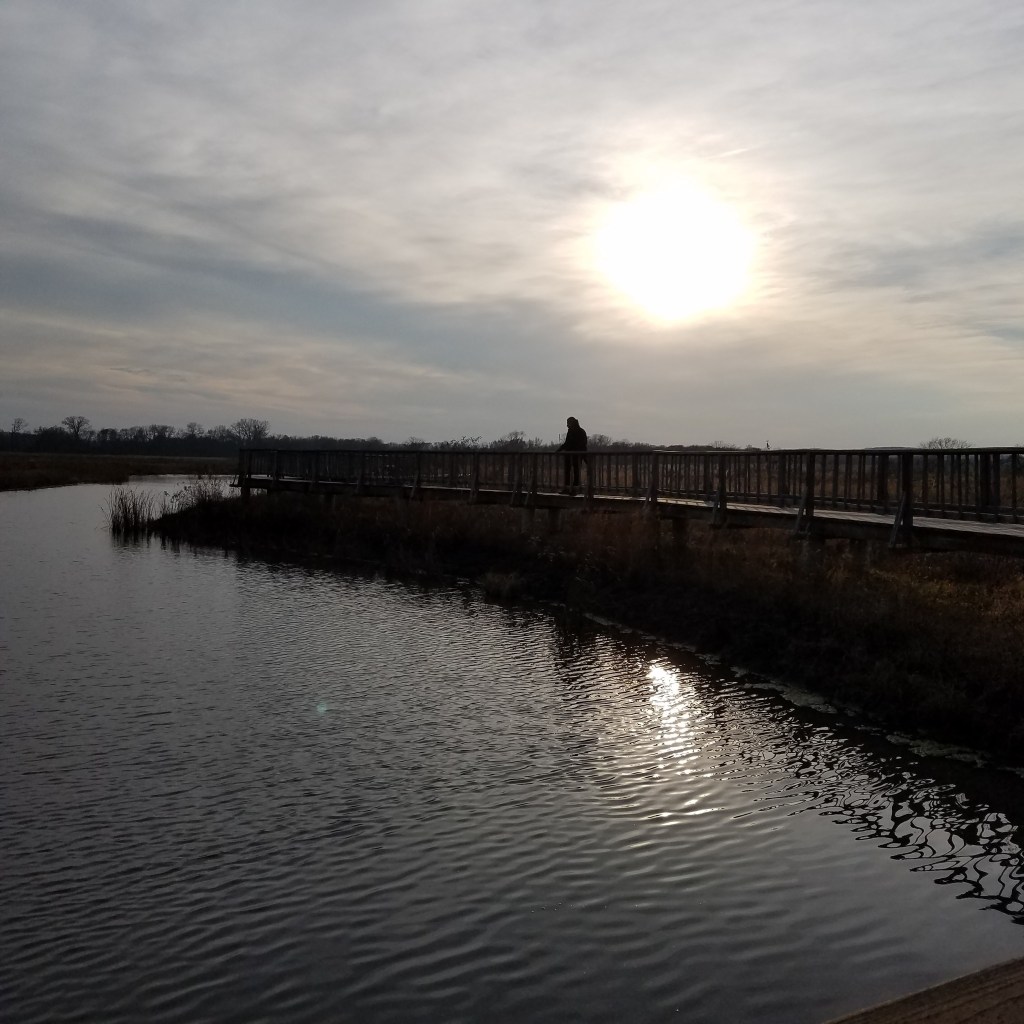
My friend Jose Faus in the distance at Baker Wetlands in Kansas, 2017. It was evening. We were alone. I saw a Wilson’s Snipe. I’d recently stopped writing poetry. Jose, a poet, ventured into birding with me so we could spend time together that way. It wasn’t half bad, being a birder and not a poet.

 and trauma (v) if trauma can verb.* I think it can. Think: She will trauma her way through life. Think: May she trauma in peace. Maybe we should spell the verb form differently to avoid confusion, like traffic and traffick. But what would trauma look like spelled any other way? Whatever form it takes, it all looks like ruin.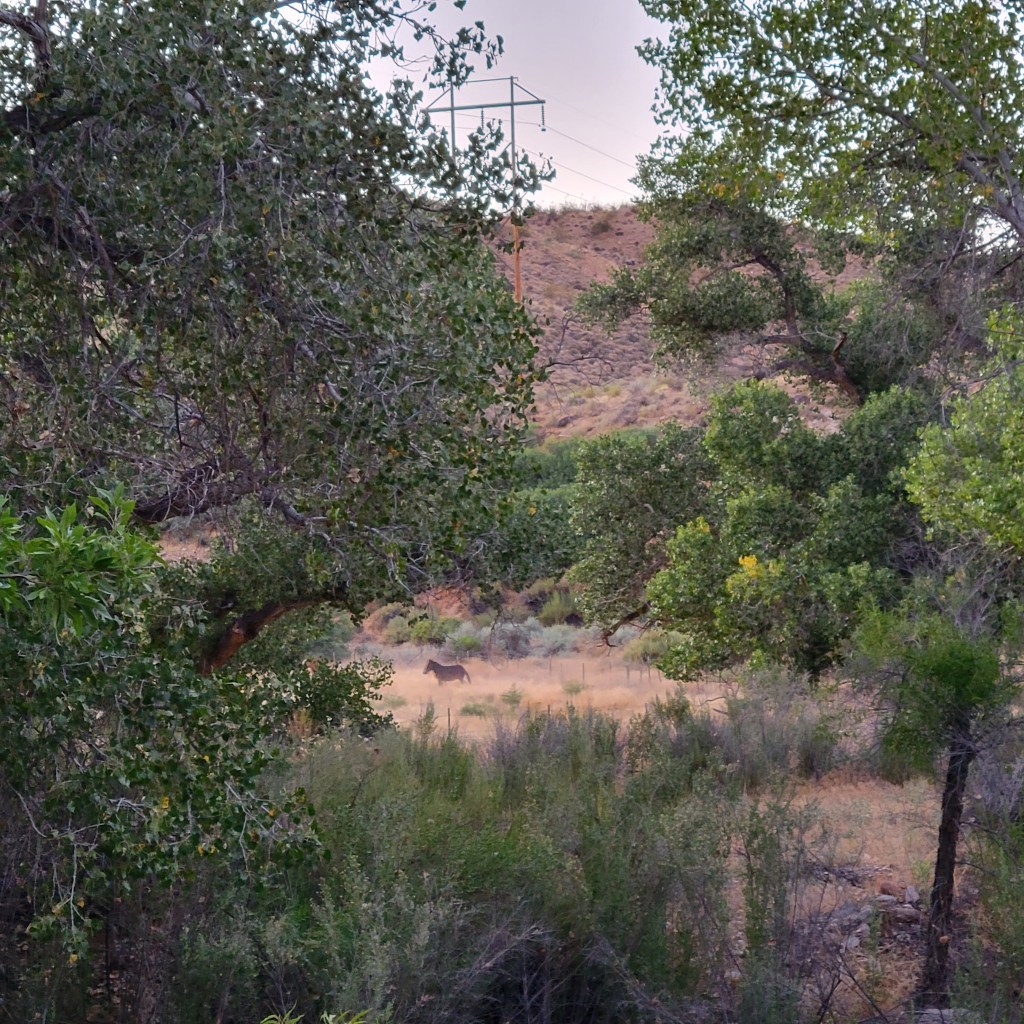
 Dana Henry Martin