Notched

I dreamed I was a crew member for a reality television show in which a group of women and female-bodied contestants were trying to overcome their trauma and abuse by getting a very old man—who was close to death and just wanted to collect sticks on the beach and fashion them into wings before he died—to love them. The goal was to get him to lay down his pile of sticks and follow one of the contestants. In this moment, both the old man and the contestant would be healed live on national television.

I realized the man was being forced into a situation he didn’t want to be in and his life was being prolonged because he couldn’t leave Earth until he completed his wings. I saw that the contestants were becoming more and more traumatized. Their flesh peeled away from their backs like old papier-mâché falling from the form it was appended to, exposing their ribs. The contestants were carving deep notches in each rib for every day they were made to participate in the show. One woman had so many exposed ribs and notches that the camera crew couldn’t figure out how to shoot the final scene. I heard two producers talking off stage.

We wanted to show trauma but not this degree of trauma, one said. Who in America wants to see someone as crazy as this?

They adjusted the scene so all the contestants’ scarred ribs were visible but not too visible. I stood in a pool of red velvet drapery at the edge of the set trying to make everything go away, even myself. We were moments from taping the final scene. The old man was oblivious to what was happening. The contestant who’d been deemed the winner was elated that she’d finally be healed. Everyone thought she’d be able to get the old man to follow her as she ran down the beach and waves teased her bare feet.

The show’s final song played in the background.

              In your flowing sea-green gown
              Tempt father death and you’ll be found
              To have a body-mind unmoored
              To be life’s bride and not its whore

The old man found his pile of sticks, which had been stashed by one of the producers. He quietly began picking them up. I helped him. I wish I could tell you that made me a hero. It didn’t. I wish I could tell you the man flew off. He didn’t. I wish I could tell you the contestants healed or the producers learned something about empathy or the audiences who watched the show learned from the old man and the contestants. They didn’t. They didn’t. They didn’t.

Frictions

“Nothing about us without us.” That’s a guiding principle in the disability-rights movement. It applies to the mental-health justice and recovery movements as well because mental-health issues are often disabilities for those of us who live with them—sometimes because they are truly disabling and sometimes because our cultures disable us, our communities disable us, and those around us disable us because they don’t understand us (or try), don’t include us (or try), discriminate against us (often because of unexamined or dismissed bias), and subject us to their versions of who we are, which happens daily through language and actions and the way real and conceptual spaces are structured.

I bought a clicker, one of those old-fashioned ones that employees at the academic library where I worked in college used to track how many people came in each day. I’m going to use it for two weeks and track how many times I encounter instances of sanism, both in real life and on social media. I started doing something similar last week by making ticks on a piece of paper. But I like the idea of using a clicker in part because it’s an object I can hear and feel as I operate it, in part because it fits in my hand, and in part because it’s a bright color. I have the kind of sensory processing that appreciates those things. The clicker also feels more formal and official, and I can use it even when I don’t have a pen and paper with me, which makes it more practical. I may include notes about each instance, including the context, date, and time.

OK, I actually bought six clickers in an array of colors because they came in a set, but that’s beside the point. You may think that’s too many clickers. I don’t. I’m mildly tachycardic right now just thinking about their arrival. There’s a black one and a green one and a pink one and a red one and a white one and a yellow one. I’m actually trying to humanize myself in this paragraph and the last one because I made some big assertions in my opening paragraph, the kind that make people (in this case me) unlikable mostly because they fall under the information you didn’t ask for that I think you should know category but also because they may apply to you or those you know rather than some far-off “they” that we can all join in both hating and distancing ourselves from together.

“Nothing about us without us.” I take this principle seriously. It’s like no taxation without representation, only it’s like no characterization, no proclamations based on misinformation, no policy decisions, no representations in the arts and the media, no casual or formal conversations, no application of diagnostic labels especially when used in a pejorative manner, and no limited or completely erroneous lay insights without our representation. That means we are centralized, not marginalized. We are present, not absent. We are heard, not talked over, not silenced, not discounted. It means if we say there’s an issue, you listen. You don’t shift in your seat or put up a wall or fail to respond or shift blame to us. 

I’m no longer entering rooms where there are frictions only I appear to see and concerns only I appear to discern, one thousand frictions that are invisible to those who are not queer or neuroatypical or living with trauma or serious mental-health issues. That doesn’t mean those frictions don’t exist. It just means they may not exist for you, and if that’s the case, I’m happy for you. I’m glad a room is just a room is just a room. But your inability to see what others see, feel, and experience in those rooms—your failure to cultivate literacy about the things those who are oppressed and marginalized have to see in order to survive every day—is part of why rooms continue to not be the same rooms for you that they are for others.

These rooms are exhausting. Click click click (click click). If in addition to instances of sanism, I count instances of trans erasure (click), ableism (click), neurotypical bias (click), discounting of women and those who are female-bodied (click), jokes about diversity (or the lack thereof) in a space (click), and more,* there will be no end to the clicking in too many rooms, even rooms full of poets.

It’s impossible to know which rooms will be full of frictions. I’m trying to figure out what clues I can look for ahead of time and to develop a matrix I can use so I know when to call any given room quits. I no longer believe I can change hearts and minds with my presence, my words, or my work. I feel like, more than ever, I’m in a box called “crazy” and that terrifies people, no matter how I live, what I accomplish, how I treat others, or how wonderful folks think I am before they learn I have a DSM diagnostic label or that I’m queer or that I’m neuroatypical in numerous ways. I’ve seen that semipermeable membrane more times than I can count: the one where inclusion becomes exclusion and being part of becomes being removed from.

I feel like my attempts to address frictions only lead to more frictions, many of them in the form of irritation, denial, resentment, and even fear and disgust. But I will do what I can until I realize I can’t do any more. Then I’ll leave before I accept my own erasure and even start erasing myself. I can’t abide that or any other form of complicity.

I’ve mainly seen this level of friction in Utah. At least in other places, my experience has been that I become more human when I talk, when I write, when I take part in things. Of course, I was largely in the closet about my bipolar until two years ago. That may be part of why people accepted me as a human being and not as an amalgam of their stereotypes, biases, and misunderstandings about bipolar. Who knows what those places are like now, in this new world that has us all doing the work of marginalizing and dehumanizing others on some level.

The rooms with poets are the ones I must approach with care above all the others because I need to believe in poets, even if that belief is misguided. I’m not ready to let go of that yet. I know better. I think I know better. I want to know better but, more than that, I want to be wrong. I want to believe in poets the way some people want to believe in God. It’s like that for me.

I also can’t help but see something else in those rooms, wherever they’re located: a kind of arts-driven traveling medicine show meets multilevel marketing network. It’s not quite either of those things, but it does feel like a system that created itself and now uses its existence as a way of validating itself, one that enriches the few and relies on the many, and one that’s unhinged from actual oversight or governance by the institutions many of these poets actually work or once worked for, which means those institutions will not act based on anything that happens, up to and including sexual assault, in or near those rooms. It’s hard not to see it like that, especially after some of my personal experiences in such rooms, which makes it even harder to find spaces that are safe and poets who are doing good work in those spaces.

* I’m just listing ones I’ve encountered recently.
Loosening Our Ties

My father had a tiger’s eye bolo that I loved. I wore it in grade school when we reenacted the Oklahoma Land Run. (Yeah, we did that. Also, there was more than one land run, but we only learned about and celebrated—for lack of a better word—the main one for simplicity’s sake.) I wanted to be a cowboy. My teachers protested. They wanted me to do whatever the girls were doing.

I’ve been looking for a bolo that’s like my father’s for a long time, but most of them are turquoise, and my father’s was shades of brown. I found one today tucked into the back corner of a gift shop. It was made of tiger’s eye. As soon as I saw it, I remembered that’s what my father’s was made of, and it’s also why tiger’s eye was my favorite gemstone as a child.

As I held the tie, I thought, “My father was more than the sum of everything terrible that happened to him and everything terrible he did, including what he did to my mother and me.” It was a surprising thought. I want to believe that—that there was an untarnished part of him tied to the traintracks inside his heart. He may have tied that part up. He may have wanted it tied up. But it still existed, whether or not he longed to free it.

I bought the tie to commemorate continuing to be in mental-health recovery after my trauma-induced mania two years ago. As I drove home, 104.1 played “Dust in the Wind” by Kansas. The sky was lapis lazuli polished and held to the light. The cliffs in and around Zion looked at once eternal and ephemeral. As much as their presence hints at forever, they are also literally dust in the wind.

I started crying. How could I not? How could anyone spend time with this land, this sky, and not untie the parts of themselves that are immobilized in their hearts?

Let the heart run. Let it rewild. Let it forget suffering. Let there be nothing to suffer from or for. Let us all loosen our ties and help others loosen theirs.

Good Dreams and Bad Wakings

I had an exciting thought about a poem at the tail end of a dream, and now I can’t go back to sleep. The fact that poems thrill me after three decades says a lot about poems. Perhaps it’s not just the Earth and sky that last forever, as the band Kansas asserts. It’s also the verse, the line.

I will never remember what happened to me two years ago today because I was overmedicated in the emergency room at Intermountain Health after being turned away when I went to the mental-health access center there for help the day before, but not before the access center kept me in a loud, brightly lit room for 24 hours with no bed, where I was left alone with two male nurses. What a terrifying thing for someone with a history of abuse at the hands of men to endure while in a state of trauma about her childhood abuse. Also, sleep deprivation and exposure to lights and noise, including music, day and night are more in keeping with prison torture tactics than with mental-health care, but sadly, the two are often one in the same. Shame on Intermountain for engaging in such practices.

To top it off, they failed to give me my thyroid-replacement medicine for hours, thereby exacerbating the state I was in by disrupting my endocrine system, which in turn negatively affected my HPA axis. That axis is key to emotional regulation. I don’t have a thyroid thanks to thyrotoxicosis and cancer, so my thyroid-replacement medication is critical. My TSH was already 11mIU/L when I got to the access center. It should have been less than 1mIU/L. The access center made my hypothyroid state even worse by not administering my medicine in a timely fashion.

The ER overmedicated me after I said Joseph Smith was delusional. What I actually said was, “Sure. It’s fine when Joseph Smith does it, but not me.” I wasn’t being hyperreligious. I was deconstructing religion, in that moment Mormonism, as well as the unwritten social rules that appear to govern when someone is seen as insane, divine, or both. Crazywise, as some call the latter. But not, largely, Southern Utahns, and certainly not ER workers at Intermountain.

That’s the last thing I remember. I blacked out for more than a day, this one: September 9, 2023. It’s a dark, rough-hewn box I can’t open, but I think Sharon Olds’ devil from her collection Satan Says might be inside it. By that, I mean my father.

Poetry Is an Act of Living

I dreamed I was in the U.S. Senate chambers, where a politician was spewing the hate of the moment as faithfully as a geyser, when a feeling started moving through my body. It began in my gut and had me on my feet before it reached my brain. I didn’t even know what I was going to say, but it ended up being this:

What’s the point of poetry?

Why does it matter when it can lead you down some unknown path, and you don’t even know how it will end?

When it gets you so lost you feel like you’ll never be found?

When everything ahead of you is a blank page, and there’s nobody there to help you fill it?

What’s the point of starting out on that journey all alone, maybe never to finish, never to come back the way so many who wander lose in the end to their wandering, boots into snow, knees into dirt, head into clouds?

The point is to go forth anyway.

To try.

To make that creative journey, which is an existential journey, because it can bring us back to ourselves and each other in the end rather than relegating us to seats where hate lives and breathes, where the air is sucked out of the room every time we open our mouths, because poetry is an act of living and an act of love, and politicians, hell all of us, need to lean into love.

Leaning the other way, into darkness, is not an option because it’s an extinguishing.

The human spirit will not be extinguished.

Living beings will not be extinguished.

The Earth will not be extinguished.

We’re here.

Poems are here to remind us why.

The whole thing was somehow caught on a live camera and played to a gaggle of teens who were visiting the capital. As I left the chambers, they all threw their arms up the way I’d thrown mine up as I spoke. In unison, they yelled “POETRY!” Poetry gave them hope that day, as it gives me hope every day.

I’ve written before about how dreams may be more our reality than waking states. I hope that’s the case and that dream logic seeps into all our waking states today, tomorrow, and as long as we’re all sharing space here in time. Happy fall equinox.

More Abuses in Poetry

I’m reflecting on how I could have stopped writing poetry at any of a number of points over the past year:

Last spring, when a poet I’d known for more than two decades went on his page and threatened me because he thought it was inappropriate for me to tell him that, as a friend, I loved him. He decided that meant we were having an affair. He attacked me privately, then went on his page to tell the entire poetry community he was going to out me as a married woman who was acting disgracefully. I had to watch women poets, including those I know, console him rather than telling him his behavior was inappropriate. That is the one and only time I’ve screenshot a Messenger conversation and shared it. I did so to put an end to the unfounded, untrue, and libelous comments he was making. He immediately blocked me. I never even said his name—though I would if something like that happened again today—and I removed the screenshots the next day rather than leaving them up as I could have.

Last winter, when a poet who’d been following my work for months and said he wanted to publish some of my poems left an obscenely hostile, sanist comment on one of my microessays lamenting the fact that people are using a bridge down the street to die by suicide. He screamed that I needed to be in therapy rather than writing and that my writing was the last thing he needed in his life, as if he hadn’t followed me and chosen to read, and laud, my work up to that point. As if he didn’t have the power to stop reading what I wrote or unfriend me or mute me or any of a suite of well-adjusted options that were available to him.

Two days ago, when a poet I’ve known for more than a year, perhaps the most successful and talented poet I know, lashed out at me for using the term sanism, indicating that I was “borrowing” the term, implying my experiences with abuse and trauma and my lived experience with bipolar aren’t valid because, unlike him, I haven’t been to war. It was not the first time he’d lashed out at me or the first time he’d engaged in disconcerting comments about and behavior toward women, namely women poets with mental-health diagnostic labels and lived experience.

That’s about one-third of what’s happened over the past year. Poets can be so toxic and vitriolic and othering and fragile and entitled and bullying—and even engage in nasty tactics like gaslighting—that it’s still hard for me to wrap my head around it. I am shocked every time it happens, though I shouldn’t be. Something similar but much worse is why I left poetry for years back in 2015.

Shame on those who engage in behaviors like this. Shame on the effect you’re having on other poets. Shame on the dynamics that underlie what you’re doing. Shame on you for doing everything seemingly in your power to remove folks like me from poetry in particular and the world in general. I mean the human world. I also mean the living world. Like everyone with a dignoastic label and lived experience with bipolar, I have a 1 in 5 chance of unaliving myself. Not trying to. Actually doing it. Anyone who nudges, pushes, or shoves another human being in that direction needs to sit with what they’re doing and why they’re doing it. Bigtime.

I had just finished my essay for Mad in America the day before the poet accused me of appropriating the term sanism. What if I’d pulled that essay? What if I’d decided not to submit my manuscript to any more contests? What if I’d decided not to write poems or essays anymore? What if my mental-health recovery had been compromised?

Folks who need my writing would have lost my voice, including my insights, perspective, and stories. And I would have lost part of myself. That could have been what happened because poets like the ones listed above make poetry too much. Too hard. Too unwelcoming. Too dehumanizing. Too rancid. Because of the sexual assault that occurred with my mentor, which took me away from poetry and—in a sense—my life for seven long and lonely years, I am always close to leaving when some new poet rears his head in a similar way, with similar impulses and similar levels of dysfunction.

But I told myself when I came back that I will not leave. I will not budge. I will not back down. I will be a 4 in 5 even if certain men in poetry have absolutely no regard for my health, well-being, or life. That’s the biggest fuck you I can give men like that.

And I will write. I will not stop writing.

And those of you who know these types of folks and do nothing? Shame on you as well.

And those of you who think folks like me should shut up about things like this, who confuse us for the problem because we speak about the problem, who tell us to just get over it or at least not talk about it publicly? Shame on you, too.

I do not have the capacity for any of you. The work I’m doing is far more important than publishing poetry, that is if I have to stay silent about abuses in order to have work accepted or dissociatively participate in the system without being able to advocate for change within the system. I will not stay in the good graces of a toxic culture. This is about human rights. All of it. My life, my work, my purpose.

Updated Immunotypical Privilege List

In 2014, I wrote a piece titled “44 Signs of Immunotypical Privilege” shortly after my diagnosis with common variable immunodeficiency. It’s a compilation of my experiences and those articulated by others living with various forms of primary immunodeficiency. The Irish Primary Immunodeficiencies Association published it on their site and had plans to make it into a brochure, though I’m not sure the brochure ever materialized.

My piece was inspired by Peggy McIntosh’s famous essay, “White Privilege: Unpacking the Invisible Knapsack,” written in 1998. I later updated my piece when “COVID” and “monkeypox” became household names. It’s now titled “46 Signs of Immunotypical Privilege.”

I plan to write a new piece titled “44 Signs of Neurotypical Privilege in the Poetry Community.” It won’t make people feel comfortable. That’s not the point. The point is that it needs to be written, and it matters, and I can’t see how to not do so after what amounts to an executive extermination order against those with mental-health issues. Ask Brian Kilmeade. He sees that order for exactly what it hopes to be and understands exactly what it allows those who hate us through and through to say, including my fellow Utahns.

46 SIGNS OF IMMUNOTYPICAL PRIVILEGE

Every day, as an immunotypical person—

  1. I can go out when COVID is circulating without being in a high-risk category that makes me much more likely to be hospitalized, die, or develop long COVID.

  2. I can go out during flu season without worrying too much about how serious contracting the flu could be.

  3. I can see the exponential rise in monkeypox cases and not worry that I might be especially vulnerable to the disease.

  4. I know my immune system will respond to flu and COVID vaccines. I might even skip vaccination altogether without serious health consequences. Attenuated, live vaccines such as the one for monkeypox are safe for me because my immune system works properly.

  5. I can read about measles resurgences without feeling alarmed. After all, the measles vaccine isn’t contraindicated for me, and I know my body has mounted an immune response to the disease.

  6. I can touch door handles and other surfaces in public without much concern.

  7. If I get a slight cough, I don’t have to worry about it turning into bronchitis or pneumonia.

  8. My health status never goes from relatively normal to life-threatening in a matter of hours.

  9. When I take antibiotics, they work quickly, and I only need one round.

  10. I haven’t been on antibiotics dozens or even hundreds of times over the course of my life.

  11. I’ve never been on prophylactic antibiotic therapy. I don’t even know what that is.

  12. I don’t have to routinely take medicines such as prednisone that weaken my bones and put me at greater risk for osteopenia and osteoporosis.

  13. I don’t have to wonder what comorbidity might be lurking just around the corner and if it will be a noninfectious condition, a malignancy, or an autoimmune disorder.

  14. I’ve never heard the phrase “immune dysregulation” and don’t have to concern myself with what that might mean.

  15. For me, boosting immunity means popping more vitamin C or Airborne. I have no idea what immunoglobulin is or why it’s essential to the human immune system.

  16. When I attempt to eat out, I don’t have to think too much about how long items are left on buffet tables or how well food is washed and prepped by food handlers.

  17. When I’m out in public, I don’t have to worry when people cough into their hands or without covering their mouths.

  18. I can be sure that, when I go to classes, movies or restaurants, I’ll find a place to sit in which I’m free from issues that exacerbate my breathing problems, such as perfumes, fragrances, and cigarette smoke.

  19. I know I won’t have to pass on social activities because they would put my health at risk.

  20. I know family gatherings won’t pose a threat to my health, even if young, potentially unvaccinated, children are present.

  21. If someone I love is in the hospital, I don’t have to think about when I can visit, how long I can stay, or other health considerations. I can fully focus on that person and their health needs.

  22. I can attend school, have a full-time job, raise a family, and engage in recreational activities without also having to manage the many conditions that would affect me if my immune system didn’t function properly.

  23. I can leave meetings, classes, and conversations and not feel excluded, fearful, attacked, isolated, outnumbered, unheard, held at a distance, stereotyped, or feared because of my immune system.

  24. If I pick up a magazine or watch television, I’ll see images that represent me and my experience of my health.

  25. I never have to speak on behalf of all those who are immunotypical. My thoughts about my immune system can be my own with no need for political alliance relative to my immune function.

  26. My actual and potential contributions to society will not be challenged because of my immune system.

  27. I can go for months without thinking about or being spoken to about my immunotypicality.
  28. I’m not identified by my immunotypicality.

  29. I won’t lose friends who can’t relate to what I’m going through, who think I’m exaggerating about my symptoms, or who just can’t deal with having a friend with my health status.

  30. I know I won’t be discriminated against by employers who neither understand my condition nor have the desire to provide a reasonable accommodation, despite the legal requirement that they do so.

  31. I don’t have to be afraid that, when I talk with others about my health, they will suggest unsolicited supplements, dietary approaches or exercise programs.

  32. I won’t be told by friends, family, and even uninformed members of the medical community that my condition is really just a psychological problem such as anxiety or depression.

  33. I know nobody looks at me and makes assumptions about why I appear to be ill (or well), or why I am too thin (or too heavy), or why I am not fit (or manage to stay fit despite my illness), or why I do (or do not) eat what I do (or do not) eat.

  34. I don’t have to explain why I have a lingering cough, why I might sometimes need to wear a mask in public, or why situations and settings that are safe for others may not be safe for me.

  35. Because I have never had to wear a mask in public, I have never been asked to leave a public place because the manager or owner of the establishment believes I am putting others at risk, when in fact the mask is to protect me from the pathogens others carry.

  36. I don’t have primary immunodeficiency, so I never encounter people who make the assumption that, despite the condition being genetic, I somehow brought it on myself through my diet or lifestyle.

  37. People aren’t embarrassed to be seen with me because of my health status.

  38. When I talk about my health, I can be certain that friends, family, co-workers, and others won’t become uncomfortable and change the subject.

  39. My partner doesn’t suffer from undue stress and hardship because they’re my primary or only caretaker.

  40. Nobody tells me I should feel lucky to have primary immunodeficiency because it means I don’t have to work or accomplish anything during my lifetime.

  41. My doctors have seen a lot of patients who are immunotypical. This means I’m not put in the position of having to educate them about my immunotypicality, since they’re already familiar with it.

  42. When I present in a health crisis at the emergency room, I’m given prompt medical treatment, not told I’m merely having a panic attack.

  43. I’ve never had the experience of being misdiagnosed over and over again throughout my life.

  44. I don’t have old misdiagnoses in my medical record that can’t be removed without a great deal of time and effort on my part.

  45. I don’t have to deal with the financial burden of expensive, ongoing medical care and therapy.

  46. I don’t have to face insurance companies that must review coverage for my life-saving therapy before that treatment is approved; that sometimes make patients go off their therapy for months in order for those patients to prove they still have the condition; and that sometimes deny therapy because they don’t feel the patient is ill enough to warrant it, despite documentation to the contrary in the patient’s file.

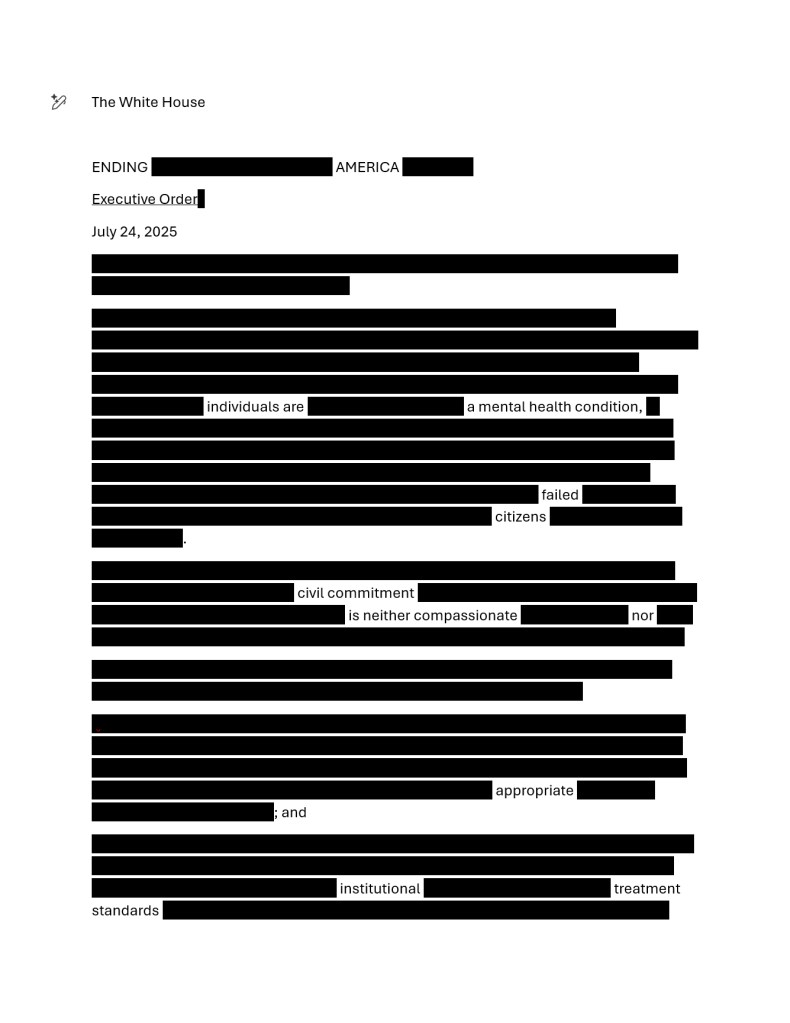
July 24 Executive Order Erasure 1

Given that Fox News host Brian Kilmeade just called for people who are unhoused or have mental-health diagnostic labels to be killed by way of involuntary lethal injection, I’m sharing two erasure poems that use the July 24 executive order as their source text. Nobody, including poets, seems to be aware of the existence of this horrific executive order. This is the second erasure.

My Kingdom for a Pencil (in the Psychiatric Ward)

Two years ago today, I came out of my medication-induced blackout at the inpatient psychiatric unit and began working on an elaborate origami project that involved making the Sydney Opera House with a theater and stage inside it. I used paper placemats and pages from a colorful book for this purpose. I was given a copy of the Book of Mormon by the staff, but I didn’t use its pages in my project. It sat in my room idle as I worked.

I wrote and performed rap songs with another patient named H— to the delight of other manic patients on the unit. Those with severe depression were not moved by our artistry. We were good at the rapping, and our antics provided a counterpoint to the aimlessness, the hall-wandering, and the five-minute interfaces with the psychiatrist each day in which he blamed us for having depression or bipolar.

I used a deck of cards to map out human networks that are responsible for abusing and trafficking others. The kings and jacks were big players in those networks, and they were also stand-ins for my father and his best friend. The networks were very organized and knew how to hide other cards, and themselves, as needed. My father’s name was Jack. He was a jack of all trades, even ones that weren’t legal.

I wrote short poems and made notes about my stay using a tiny pen that only sporadically worked. Pencils, Intermountain. Give patients on B-Ward pencils.

In my chart, the staff noted that I was well-behaved and posed no threat to anyone. I did throw paper at one point, down a long hall, overcome suddenly by how dehumanizing psychiatric care is. Nobody noted that in my chart, but one tech did scream, “If you do that again … ” without completing the threat.

I declare today, September 10, the Day of Origami and Rapping forevermore. Long live folded paper and battled song.

Folding and Unfolding

This is the two-year anniversary of my stay at the local inpatient psychiatric hospital where the psychiatrist described me as being involved in sex trafficking, as if I was trafficking others as an adult as opposed to having been trafficked as a child. The psychiatrist also said my trauma had nothing to do with my mania, told me in so many words to be a better wife when I expressed my concerns to him about my husband’s behavior, refused to help me get services from the local organization that helps people who’ve survived sexual abuse, and wrote in my chart that I had a poor prognosis because I have no insight into having bipolar.

And he was supposed to be one of the better psychiatrists at that hospital.

This is also the day I briefly saw Utah poet laureate Lisa Bickmore and thought she was some kind of healing Earth goddess, which I still think is the case. When I’m manic, I see essences. Lisa is a lot more than a healing Earth goddess, but she also has the essence of a healing Earth goddess.

These are the final days of my hegira, the one I declared over before it was over. Over the next few days, I’ll be sitting with everything that happened two years ago in a process that’s like folding now and then together the way two ingredients are combined in baking. Not that I bake. I prefer folding time to folding things like whipped eggs and melted chocolate. When I need to eat something, I just eat it. I rarely mix it with something else.