We’re Here. We’re Poets. Get Used to It.

I dreamed I was in the U.S. Senate chambers, where a politician was spewing the hate of the moment as faithfully as a geyser, when a feeling started moving through my body. It began in my gut and had me on my feet before it reached my brain. I didn’t even know what I was going to say, but it ended up being this:

What’s the point of poetry?

Why does it matter when it can lead you down some unknown path, and you don’t even know how it will end?

When it gets you so lost you feel like you’ll never be found?

When everything ahead of you is a blank page, and there’s nobody there to help you fill it?

What’s the point of starting out on that journey all alone, maybe never to finish, never to come back the way so many who wander lose in the end to their wandering, boots into snow, knees into dirt, head into clouds?

The point is to go forth anyway.

To try.

To make that creative journey, which is an existential journey, because it can bring us back to ourselves and each other in the end rather than relegating us to seats where hate lives and breathes, where the air is sucked out of the room every time we open our mouths, because poetry is an act of living and an act of love, and politicians, hell all of us, need to lean into love.

Leaning the other way, into darkness, is not an option because it’s an extinguishing.

The human spirit will not be extinguished.

Living beings will not be extinguished.

The Earth will not be extinguished.

We’re here.

Poems are here to remind us why.

The whole thing was somehow caught on a live camera and played to a gaggle of teens who were visiting the capital. As I left the chambers, they all threw their arms up the way I’d thrown mine up as I spoke. In unison, they yelled POETRY! Poetry gave them hope that day, as it gives me hope every day.

I’ve written before about how dreams may be more our reality than waking states. I hope that’s the case and that dream logic seeps into all our waking states today, tomorrow, and as long as we’re all sharing space here in time. Happy fall equinox.
More Abuses in Poetry

I’m reflecting on how I could have stopped writing poetry at any of a number of points over the past year:

Last spring, when a poet I’d known for more than two decades went on his page and threatened me because he thought it was inappropriate for me to tell him that, as a friend, I loved him. He decided that meant we were having an affair. He attacked me privately, then went on his page to tell the entire poetry community he was going to out me as a married woman who was acting disgracefully. I had to watch women poets, including those I know, console him rather than telling him his behavior was inappropriate. That is the one and only time I’ve screenshot a Messenger conversation and shared it. I did so to put an end to the unfounded, untrue, and libelous comments he was making. He immediately blocked me. I never even said his name—though I would if something like that happened again today—and I removed the screenshots the next day rather than leaving them up as I could have. (Update January 26, 2026: They’re back up on my Facebook page.)

Last winter, when a poet who’d been following my work for months and said he wanted to publish some of my poems left an obscenely hostile, sanist comment on one of my microessays lamenting the fact that people are using a bridge down the street to die by suicide. He screamed that I needed to be in therapy rather than writing and that my writing was the last thing he needed in his life, as if he hadn’t followed me and chosen to read, and laud, my work up to that point. As if he didn’t have the power to stop reading what I wrote or unfriend me or mute me or any of a suite of well-adjusted options that were available to him.

Two days ago, when a poet I’ve known for more than a year, perhaps the most successful and talented poet I know, lashed out at me for using the term sanism, indicating that I was “borrowing” the term, implying my experiences with abuse and trauma and my lived experience with bipolar aren’t valid because, unlike him, I haven’t been to war. It was not the first time he’d lashed out at me or the first time he’d engaged in disconcerting comments about and behavior toward women, namely women poets with mental-health diagnostic labels and lived experience.

That’s about one-third of what’s happened over the past year. Poets can be so toxic and vitriolic and othering and fragile and entitled and bullying—and even engage in nasty tactics like gaslighting—that it’s still hard for me to wrap my head around it. I am shocked every time it happens, though I shouldn’t be. Something similar but much worse is why I left poetry for years back in 2015.

Shame on those who engage in behaviors like this. Shame on the effect you’re having on other poets. Shame on the dynamics that underlie what you’re doing. Shame on you for doing everything seemingly in your power to remove folks like me from poetry in particular and the world in general. I mean the human world. I also mean the living world. Like everyone with a dignoastic label and lived experience with bipolar, I have a 1 in 5 chance of unaliving myself. Not trying to. Actually doing it. Anyone who nudges, pushes, or shoves another human being in that direction needs to sit with what they’re doing and why they’re doing it. Bigtime.

I had just finished my essay for Mad in America the day before the poet accused me of appropriating the term sanism. What if I’d pulled that essay? What if I’d decided not to submit my manuscript to any more contests? What if I’d decided not to write poems or essays anymore? What if my mental-health recovery had been compromised?

Folks who need my writing would have lost my voice, including my insights, perspective, and stories. And I would have lost part of myself. That could have been what happened because poets like the ones listed above make poetry too much. Too hard. Too unwelcoming. Too dehumanizing. Too rancid. Because of the sexual assault that occurred with my mentor, which took me away from poetry and—in a sense—my life for seven long and lonely years, I am always close to leaving when some new poet rears his head in a similar way, with similar impulses and similar levels of dysfunction.

But I told myself when I came back that I will not leave. I will not budge. I will not back down. I will be a 4 in 5 even if certain men in poetry have absolutely no regard for my health, well-being, or life. That’s the biggest fuck you I can give men like that.

And I will write. I will not stop writing.

And those of you who know these types of folks and do nothing? Shame on you as well.

And those of you who think folks like me should shut up about things like this, who confuse us for the problem because we speak about the problem, who tell us to just get over it or at least not talk about it publicly? Shame on you, too.

I do not have the capacity for any of you. The work I’m doing is far more important than publishing poetry, that is if I have to stay silent about abuses in order to have work accepted or dissociatively participate in the system without being able to advocate for change within the system. I will not stay in the good graces of a toxic culture. This is about human rights. All of it. My life, my work, my purpose.

My Poems in Fence

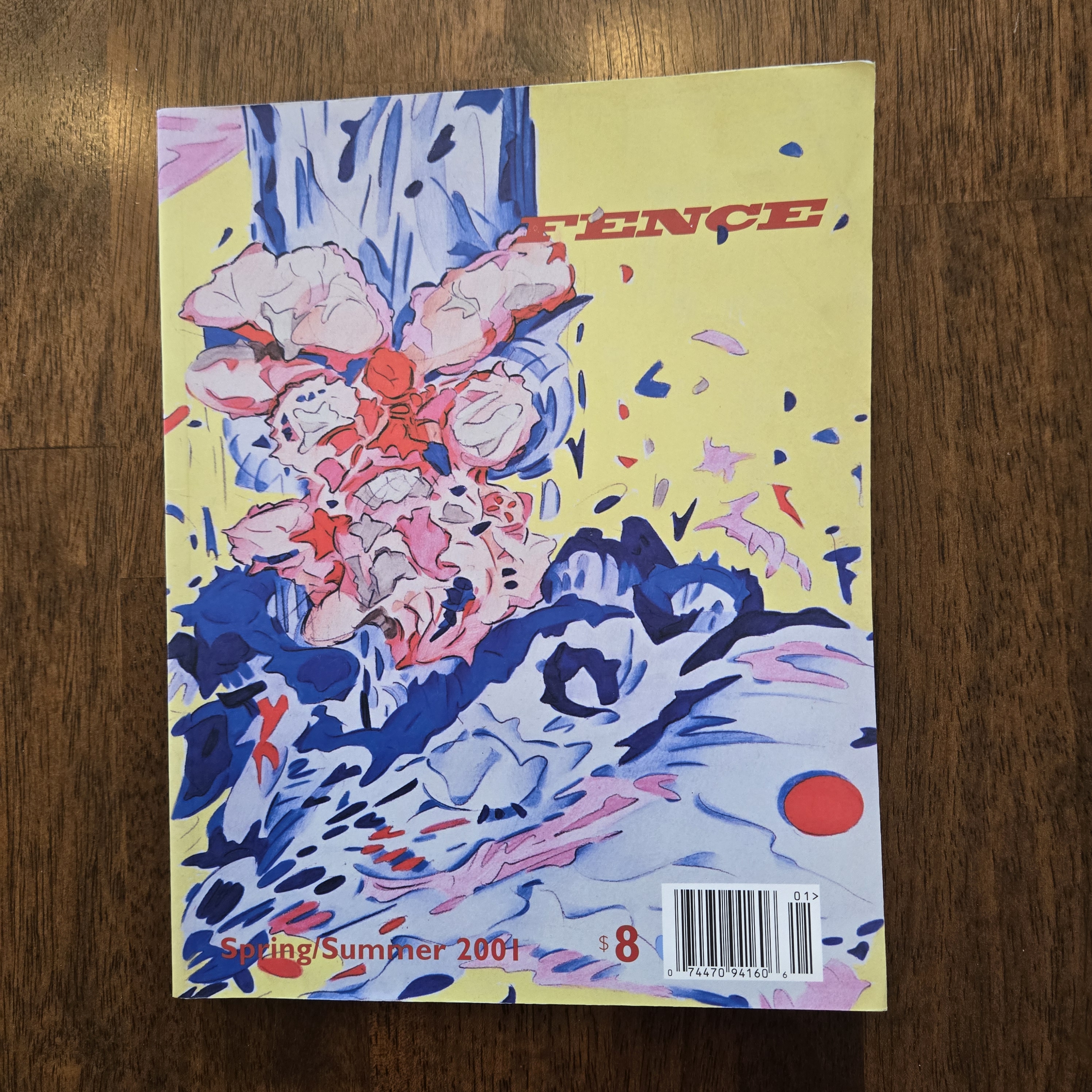
This is the issue of Fence that my work appeared in back in 2001 just after I completed my undergraduate coursework. When I showed it to my first poetry teacher, he wouldn’t even look at my poem. He just said the journal wasn’t one he read or took seriously. I felt stupid for thinking my work had merit and that Fence was a credible publication. I didn’t submit work for seven years after that interaction with my teacher. I mostly didn’t write during that period, either. Matt Jasper calls this kind of thing wing clipping. This felt more like ripping my feathers out by their calami.

The issue I was in includes work by Bruce Andrews, Jorie Graham, Cate Marvin, and Adrienne Rich, among others. It’s astounding that anyone could look at the table of contents and respond the way my teacher did. Fence is one of the best literary journals out there. My teacher should have been celebrating me, not diminishing me.

Fence is currently open for submissions. Their reading period closes October 31, 2025.

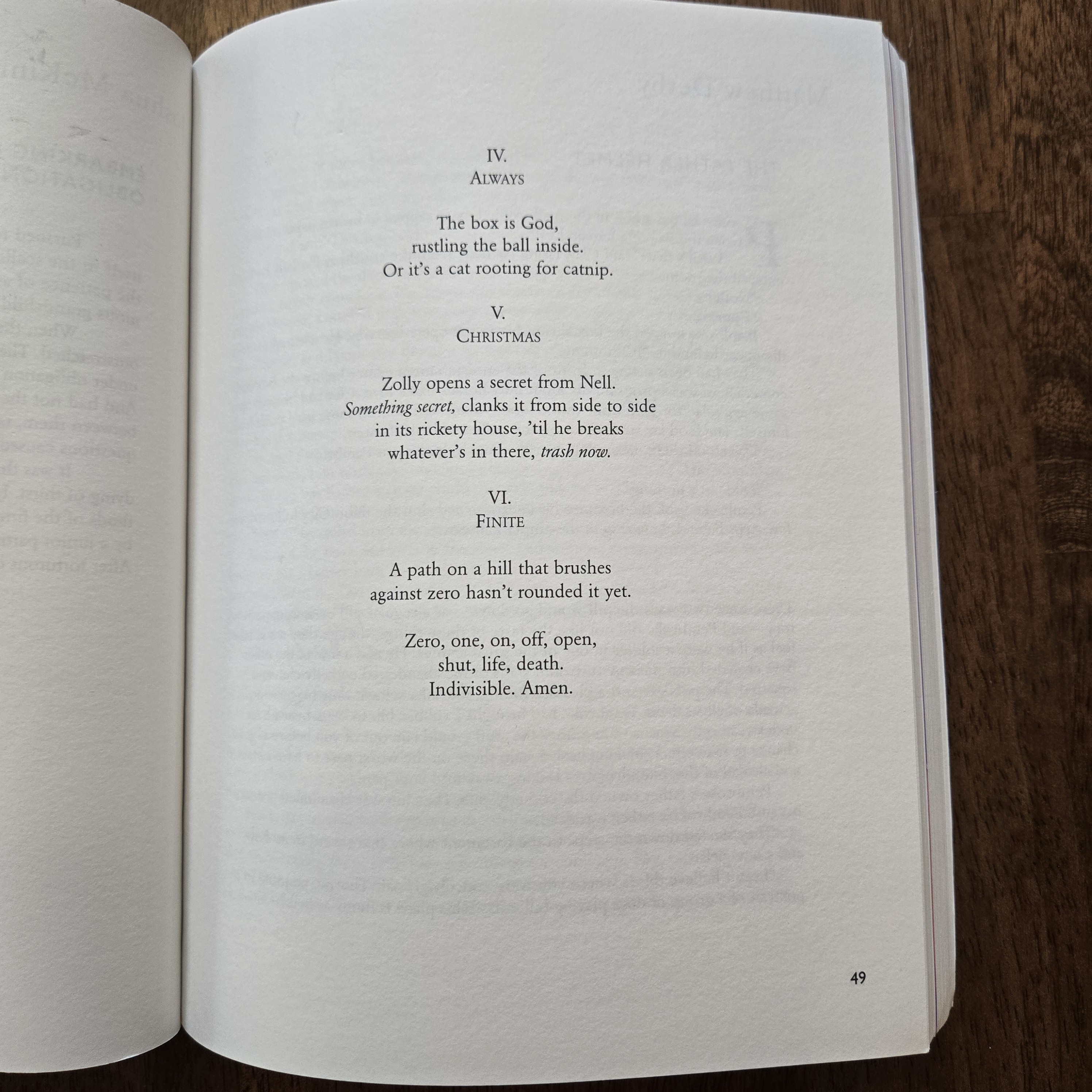
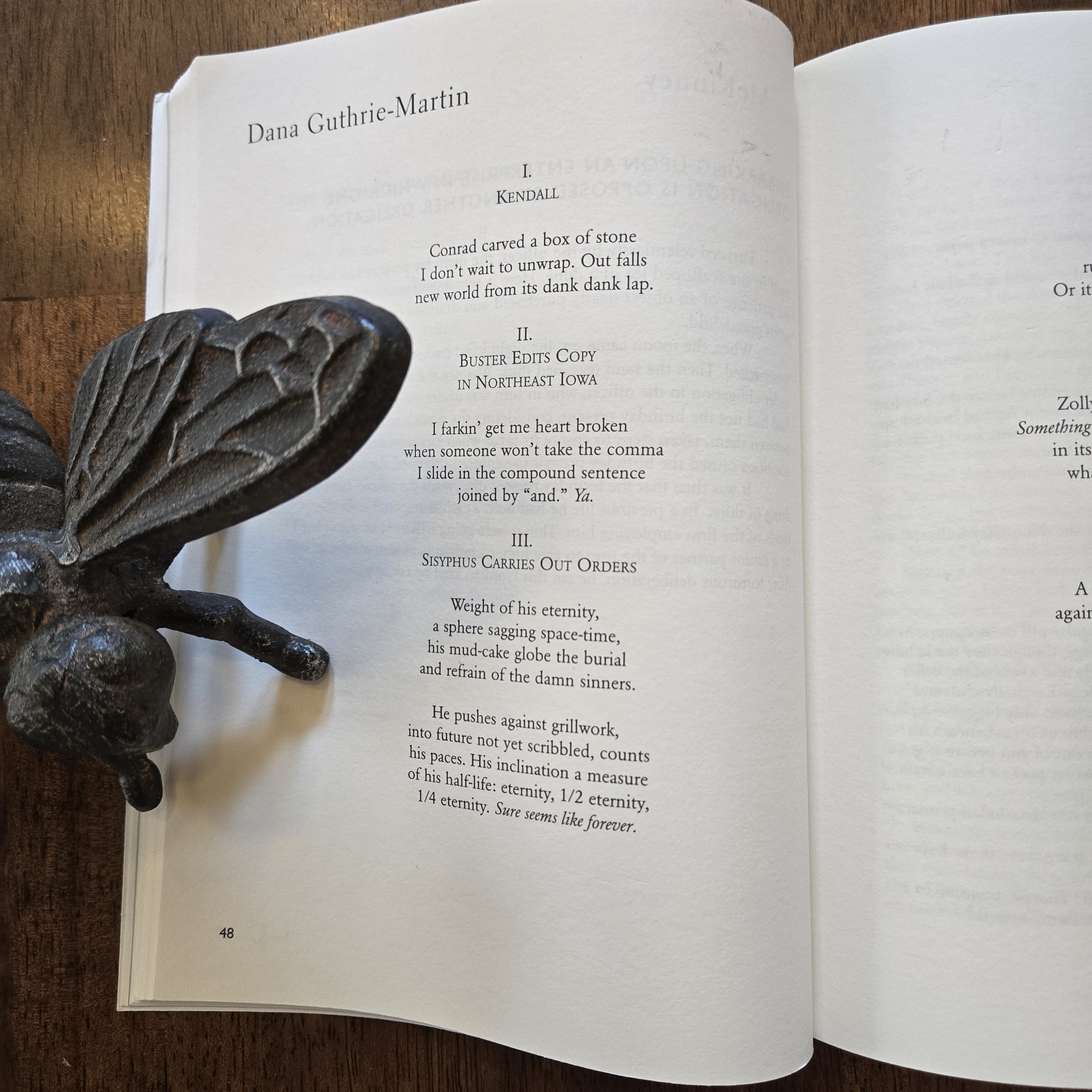
Images: 1. The front cover of Fence, Spring/Summer 2001. 2. The first page of my poem Quintet being held down by an iron bee paperweight. 3. The cseconf page of my poem.

Black Box

I had an exciting thought about a poem at the tail end of a dream, and now I can’t go back to sleep. The fact that poems thrill me after three decades says a lot about poems. Perhaps it’s not just the Earth and sky that last forever, as the band Kansas asserts. It’s also the verse, the line.

I will never remember what happened to me two years ago today because I was overmedicated in the emergency room at Intermountain Health after being turned away when I went to the mental-health access center there for help the day before, but not before the access center kept me in a loud, brightly lit room for 24 hours with no bed, where I was left alone with two male nurses. What a terrifying thing for someone with a history of abuse at the hands of men to endure while in a state of trauma about her childhood abuse. Also, sleep deprivation and exposure to lights and noise, including music, day and night are more in keeping with prison torture tactics than with mental-health care, but sadly, the two are often one in the same. Shame on Intermountain for engaging in such practices.

To top it off, they failed to give me my thyroid-replacement medicine for hours, thereby exacerbating the state I was in by disrupting my endocrine system, which in turn negatively affected my HPA axis. That axis is key to emotional regulation. I don’t have a thyroid thanks to thyrotoxicosis and cancer, so my thyroid-replacement medication is critical. My TSH was already 11mIU/L when I got to the access center. It should have been less than 1mIU/L. The access center made my hypothyroid state even worse by not administering my medicine in a timely fashion.

The ER overmedicated me after I said Joseph Smith was delusional. What I actually said was, Sure. It’s fine when Joseph Smith does it, but not me. I wasn’t being hyperreligious. I was deconstructing religion, in that moment Mormonism, as well as the unwritten social rules that appear to govern when someone is seen as insane, divine, or both. Crazywise, as some call the latter. But not, largely, Southern Utahns, and certainly not ER workers at Intermountain.

That’s the last thing I remember. I blacked out for more than a day, this one: September 9, 2023. It’s a dark, rough-hewn box I can’t open, but I think Sharon Olds’ devil from her collection Satan Says might be inside it. By that, I mean my father.

Biomimicry: Poetry As a Cell

In a world of ribosomes (poets) crowding the nucleus (poetry establishment), live reeflike as the smooth endoplasmic recticulum on the outskirts of the cell. This is where synthesis happens, and much-needed detoxification.

Shown: Image of a cell I altered so the labels apply to poets and poetry: Establishment Poetry, Barrier, Poets Girdling Establishment Poetry, Reeflike Synthesizing and Detoxifying Poets.


Breaking Molds or Just Breaking

More notes on how and why I’m at an impasse with poetry. I’m amending my previous statement about my poetry and writing not being strong enough to continue with either. I think both are strong but that my poetry in particular is not aligned with what editors and publishers are looking for and that shaping my work so it’s better aligned with what contemporary editors want will destroy something fundamental in the work, in the process, and in my healing.

I don’t want to slot my poems into this or that mold. I don’t even want to be aware of what the molds are. Poetry is as much about breaking molds as honoring those that have a history of serving poems and their readers well, even if it’s just because familiar molds create one less barrier for the reader. But new molds do something for the reader as well, and for the poet. And barriers aren’t always a bad thing. Some of the most rewarding poems require thoughtful consideration on the part of the reader. New molds are important and shouldn’t be rejected because they’re unfamiliar. Not everything new is bad. Not every outsider poet has no idea what they’re doing.

The highly endogenous nature of poetry doesn’t always serve poetry well, as folks tend to gravitate to the names they know and the styles of poetry that sound a lot like the other poems they’ve been reading. How many voices are being missed? My guess is a lot.

I think poetry has moved in some disconcerting directions in the past few years in terms of what’s allowed and what’s not allowed, which extends to which voices are included and which are excluded. I’m not down with any of that. I’m down to write—and to write from my embodied self as it relates to the world. I don’t want to see my work altered to the point of being unrecognizable so that it can get published. What use do I have for a poem that doesn’t look or feel like me anymore? I don’t want to see my work or my life or my mother’s life gutted for the sake of having an easier or more palatable or less complicated poem or understanding of the world or understadning of things like psychosis.

I also recognize that if I had more talent or if my poems were challenging in the right ways (whatever that means), there would have been some evidence of it by now. That evidence doesn’t exist. As I move into my mid-50s, I have to consider what I’ve invested in poetry over the past three decades and whether I can continue to invest in it. Workshop fees, contest fees, manuscript reviews, submission fees, and more add up, as does traveling to read my work, assuming I could even get an invitation to read anywhere. I don’t have the time, energy, or health to keep up with the financial and other demands of poetry, all while waiting years for something, anything, to happen.

Then there’s the sexual assault I’ve talked about more than some of you might like. That experience in itself was awful, but worse, perhaps, was the poetry community’s response years later when information about that poet came to light from several sources. Hundreds of poets were involved in discounting the poet’s actions and claiming he couldn’t have done what he was accused of doing. By that I mean: hundreds of poets I respected up until that collective public outburst were involved in discounting the poet’s actions and claiming he couldn’t have done what he was accused of doing.

This is what I mean when I say pathology is systemic. In this case, it wasn’t just one poet doing harm. It was many, including editors and publishers, the very people I won’t placate now with easy-to-slot work that doesn’t raise anyone’s hackles or that only raises certain hackles the right way (again, whatever that means). There are too many of these poets to avoid. They live in every part of the country, teach at numerous institutions, and have published with just about every publisher out there. I remember what they said. It’s triggering to see their names throughout the day when someone brings one of them up or quotes their work or drops their name into a group chat I’m in.

When I crept back to poetry cautiously in 2022, I thought things would be better. They aren’t. The kinds of things that happened to me are continuing to happen to other poets. Poets are still largely silent about everything that happens in poetry and protective of those who create and sustain systems that lead to inappropriate exertions of power.

Navigating all this is weighing heavily on me. I told myself in 2022 that I’d go as far as I could go in poetry and that I’d stop if it became clear I needed to. I would just stop. I said this to myself as if it would be simple, stopping. It isn’t. Continuing isn’t simple, either.

Not About You

A poet from Kansas City berated me today after I posted about needing to evaluate whether to continue writing. The post made him angry. He said he’s still upset that I disappeared from poetry in 2015 after he’d been invested in me and my work. He felt I owed him an explanation for that decision and treated my post today as an affront to him, as if my leaving poetry would cause him more pain than it would cause me. As if my leaving poetry is a situation he’s at the center of.

I don’t know this man. I certainly didn’t owe him anything, including telling him that I left poetry because I was sexually assaulted by a poet who was working with me in the role of mentor. That it had happened on the way to my MFA and that it derailed my studies. That the poetry community was sputtering and vitriolic years later about that same poet but also about anyone who said he’d harmed them. That I had just been diagnosed with a rare, life-threatening form of immunodeficiency. That I had thyrotoxicosis. That I had cancer. That my marriage was close to ending and in a scary place. That I ran. That I had nowhere to go. That I had a nervous breakdown. That leaving poetry was the only way I could save myself, so that’s what I did.

Yeah, I didn’t tell someone I’d only met in person once for a few minutes and barely knew at all any of that, just as I kept most of that information from everyone I did know as I tried to sort through the detrital state my life was in.

This is part of the problem with poets and poetry: The way people feel like they can make demands on the poets whose work they even superficially engage with. The way their parasocial relationships with poets make them feel like they know those poets, like those poets owe them something, like there’s intimacy there that doesn’t exist, like it gives them the right, even ten years on, to verbally attack a poet they’ve concocted a relationship with. The way parasocial relationships tend to be directed at female-bodied poets. The way female-bodied poets have to endure this kind of dynamic on top of trying to do the work of writing. The way social spaces become especially unsafe for female-bodied poets because of dynamics like this.

This is not about you, Kansas City poet. I hate to burst your bubble, but it’s not.

Excerpts from My Marginalia in Anne Sexton’s The Complete Poems

Written while hospitalized in KU Medical Center’s psychiatric unit in June 2015. It’s nothing super interesting, but it’s part of my life and my experience. It’s pretty cogent, all things considered. I left out all the parts where I said my father was the devil.

A psychopath is simply one who structures the world in such a way that control and containment and order and binaries and easy answers prevail. An empath is simply one who for whom prevailing universal ideas of love dominate.

Use words people understand.

Explosive and dysfunctional families are the ones in which tension and brilliance come together in such a way that empaths can be created.

Take breaks. Hydrate. Move slowly.

Names and faces are hard to remember.

Every iteration is true but distinct as a dual-state metaphor. Examples: Love is love. Is = Is = Is. People who talk in tongues are actually the ones waking up between these two states.

Empaths are everywhere. They get activated in situations by other empaths but also by psychopaths.

Use plain language during activated periods.

Knowing how to meet someone on their own level is how to keep them safe.

Are you infinite? Still, the same journey.

Take whatever you can in the process of becoming and you will get what you need. Ask for what you need and you will get something different.

Waves of empaths = people get charged up all at once while things are moving in the right direction in the world.

False prophets in poetry are not empaths.

All speech is code. The erratic voice is the always-seeking voice iterating over a larger sense.

You can be an empath and do great harm. Both the empaths who harm and the ones who are harmed are bringing about change.

Call-out / call-in culture. Bring all voices in.

True speech parts seas.

Know your empath legacy.

Strife. There will always be lots of it. Talk through it. Write through it. Trust when to stop engaging and when to reengage.

Avoid people who call themselves healer or shaman.

Poems and where they go are a test of the testimony.

You will confuse any traditional workplace.

Hate is the false avatar of love.

In other cultures, to be means to emerge.

A word is a word when a word is needed.

The difficulties, all of them, are important to the journey.

Do before thinking everything you need to do to get where you are going.

What encourages a crisis is part of the path presented.

Strong times of need require strong signals.

What words emerge from journey, crisis, sojourn?

Revelations close to death

A condition by any other name is still a condition.

Withhold

Crisis of God / of whole

We become the core crisis of our family, the tension that wants to resolve.

The book of poems is the breath.

People will say definitely do something.

Pain is necessary for our suffering parts to come into alignment.

What leads to love: hard work, dedication, and sacrifice, but also support, forgiveness, and acceptance of impermanence.

Even those who harm deserve forgiveness because we all harm each other and heal each other in the same moment. I love Jon even though he harmed me some of the time and healed me other times. I love Jon especially because he loved me through the ways I harmed him. Neither of us wanted to stand beyond good and evil, but we do. I stand at the lips of my maker and breathe and wish him the best in this life and the next. Holy. Holy. I love you, Jon.

The world is five times our size.

Every life is equal. Everyone, even your greatest enemy, is also an angel. I have already met my enemy and can call him my best friend. I thank him for showing me the beauty of the world. Sacrifices are worth it. I love everyone now equally. I would love to spend the second half of my life inside this love, with the friends I have never known as well as I know them today.

Beating Back Blackbirds

I went to Storm the Mic tonight at Art Provides in St. George, Utah. This is the energy and community I’ve been looking for here in Southern Utah. Things finally aligned in a way that allowed me to attend. I also read three of my poems. It’s the first time I’ve done so in more than eight years.

It was important for me to read tonight. If I didn’t do it, I’d never do it. And poems can’t just live on the page. They live in us, through us, and between us. We have to give them breath. They move through our bodies by way of our lungs, our throats, our mouths.

Poems are like instruments. You can’t leave an instrument in its case or just open the case and peer inside at all that bright metal or dark wood. You have to get it out and say it/play it.

I left poetry and the poetry community eight years ago after an especially traumatizing situation that made it impossible for me to continue writing. I vowed to never write another poem. And I didn’t until I had a cancer scare last summer and started talking with some friends of mine, poets who never gave up on me, who kept loving me and checking in on me year after year. One night, after talking with one of those friends, I decided to write a poem to wind down before I went to sleep.

“Boys are beating back blackbirds. Houses hoard the sunrise. / This autumn is unmetered, a dream of wind and shovels.”

Those were the first two lines. I knew I was in trouble. Poems were still there, inside me, surrounding me, eager to be transcribed. Poems waited for me, too, all those years. When I returned, they weren’t even angry. They just flowed.

“This room. This rock. This rough sand. On my shoulder. / On my stutter. On my girl skull. On my hinges.”

Oh, I was in so much trouble. But it was good trouble. This time, poetry would be nothing in my life but good trouble. I could tell. I could feel it. I was home, again, in these words that twist and dance and break and stammer all around us all the time. I could catch them and engage in deep play, deep exploration.

Love. That’s what it is. Writing poetry is an act of love, an act of care directed inward and outward: community care and self-care. It doesn’t even matter what we write about. It’s all love, ultimately. Love is—didn’t Thich Nhat Hanh say this—the act of being alive not only within but also because of uncertainty and pain. (I’ll find the quote and update this post when I do.) The upshot is: What isn’t love? It’s all love.

“Night of deep crimes. Day of mirage ceilings. / During each, an orchestra of fire between my ears.”

Darren Edwards does an incredible job hosting Storm the Mic. I’m so thankful for him, for everyone who attended and read, and for Art Provides for letting folks use their space. They are literally providing for artists, poets, and writers when all three are so desperately needed.

On Poetry and Healing

I don’t approach poems as therapy. I just come to them as myself.

Poems allow us to reclaim our stories, understand trauma and survival, realize that growth and healing are possible, lessen shame and embarrassment, and give us a sense of belonging.

The hippocampus, which situates our memories in time, doesn’t function properly under stress or during trauma. My poems are an external mechanism for placing traumatic events in time, which keeps them from feeling never-ending and ever-present. I think of it as a kind of assistive technology, like a keyboard for my dyslexia or glasses for my farsightedness.

Poets use the beauty intrinsic to poetry to shape their experiences and change the way they live in the mind and body. What’s made is more than noise. It’s a way of singing through pain or, as Orr says, allows us to order the disorder that’s in and around us, that’s intrinsic to the world we live in.

I see great value in dreams and writing about them, not only because dreams are where we do unfiltered processing of our experiences without the imposition of an artificial sense of time or an enforced rigid inner governance but also because we can more freely make leaps when talking about dreams, since that’s exactly what dreams do. Injecting a bit of the surreal into the poem can help us bring our dream wisdom into our waking lives—and therein lies not just surviving, but the ongoing work of healing.

Poetry’s concision and beauty allow me, as a writer and reader, to enter into myriad experiences—some like mine and some unlike mine—and to see common human impulses at work. A collective psyche emerges—a collective conscience and collective unconscious—as a backdrop to the individual experience. Poetry has taught me a great deal about my own psyche, my own mind, my own impulses, and my own needs. But it’s also contextualized all of that within a larger environment and larger swaths of time than a single human timespan. Poetry approaches the archetypal, the mythical, the things that lie deep in our ancestry: things we can’t, and shouldn’t, ignore if we’re going to survive on this planet and help this planet survive.

Stephan Torre says that, for him “… writing comes when it must, when it’s too hard to hold in the joy or grief without blurting it out.” I love that way of approaching poetry, but I personally don’t wait until the point of bursting. I try to do the work every day of cultivating making music out of noise, as Kim Addonizio writes in her poem “Therapy.”

Gregory Orr talks about something similar, which is that the act of writing a poem gives the poet more control than they had at the time of the traumatic event they’re writing about, which in itself is empowering and healing.

And then there’s all this beauty intrinsic to poetry, which the poet uses to shape the experience and move it into a different part of the mind and body. What’s made is more than noise. It’s a way of singing through pain or, as Orr says, allowing us to order the disorder that’s in and around us, that’s intrinsic to the world we live in.