ICE OKC

In Oklahoma, the federal government is attempting to convert a 415,981-square-foot warehouse thirty minutes from the home where I grew up into a 1,500-bed ICE detention center. City attorneys and city officials say they can’t stop it because these detention centers are explicitly exempted from local zoning regulations.

That’s been the case for a long time, with precedents that date back to 1941. What’s changed is the number of people being sent to these centers. That number jumped during Trump’s first term in office and is jumping again during his current term.

What’s also changed are the conditions within these centers and the number of human-rights violations and worse occurring within them, including the homicide of Geraldo Lunas Campos, who was in ICE custody in Montana. According to a witness, five guards held him down. One put an arm around his neck and squeezed until he was unconscious and died.

Detainees held a demonstration inside an ICE facility in Dilley, Texas, two days ago to bring attention to the inhumane conditions within the facility and to demand their freedom. Among those heard shouting during the demonstration? Children.

Five-year-old Liam Ramos, detained in Minnesota last week, is one of the children being detained at the Dilley facility. He’s there with his father.

Demons

Was I creating demons when I was at a poetry dinner party in Kansas City with Carolyn Kizer, and the entire group attempted to elide over her comments when she talked about another well-known poet attempting to rape her?

Was I creating demons when a member of my poetry class in Kansas City started stalking me, leaving flowers, torn-up copies of my poems, and letters about how bad and offensive my writing was on my windshield?

Was I creating demons when a poet and publisher in Kansas City screamed in front of a large group of poets, including my best friend, that I wanted to fuck him behind a dumpster?

Was I creating demons when a poet in Seattle who had agreed to work with me on my poetry googled (from his IP address) the words married and naked in combination with my name before we met? When he then canceled the appointment, told me I was childish for writing cut-up poems, and said I was wasting his time. When he also created a fake blog username and trolled me on my site (again, from his IP address) for months, trashing everything I wrote, including my poems.

Was I creating demons when two other Southern Utah poets said my work was pornographic and I should find another state that would accept it, while refusing to let me join their two state poetry society chapters and telling me they’d stopped meeting when they hadn’t?

Was I creating demons when a poet who’d been following my work for months and said he wanted to publish some of my poems left a hostile, sanist comment on one of my microessays in which I was lamenting the fact that people are jumping from a bridge down the street? When he screamed that my writing was the last thing he needed in his life, as if he hadn’t followed me and chosen to read, and laud, my work up to that point. As if he didn’t have the power to stop reading what I wrote or unfriend me or mute me or any of a suite of well-adjusted options that were available to him. That poet later disappeared during a mental-health crisis. When I was asked to help, I skip-traced him to his brother’s house, and he was eventually found safe. Because that’s who I am. Not someone who creates demons or treats people like demons. I’m a person who helps people when they need help, no matter how they’ve treated me.

Was I creating demons when a poet asked to read one of my manuscripts, then replied that he was sorry he’d even asked to read it? When he then rewrote part of it the way he’d like to see it, infantilized me and my work, assumed the speaker was me, treated the work not as work but as the opportunity to intervene in my personal life and my past, and talked about me in extremely sexist ways. When I responded and he continued the attack and infantilization, using my own work against me by calling me a little fist of a girl, a line from one of my poems. When he continued to move between unwanted intimacy, flirtation, and attacks in successive emails, even after I asked him to stop communicating with me. Or when my life partner had to intervene to make him observe my boundary.

Was I creating demons when a poet I’d known for more than twenty years threatened me here on Facebook, publicly in front of the entire poetry community, saying I was committing both a transgression and a manipulation when I told him I loved him, platonically, as a friend, something my context made clear? Was I creating a demon when he did similar things to other women and female-bodied poets.

Was I creating demons when a poet messaged me about a gay Arab who had gotten ahold of a photo of him in bed without his shirt on and how upsetting that was for him and who then sent me that photo through DM so I could see what he was so upset about? Or when that same poet viciously attacked a woman who was experiencing psychosis and got a group of poets to gang up on and attack her, which could have put her life in danger. Or when he refused to take his public post about her down so she could get some help without being pushed further into a dangerous or life-threatening situation. Or when he later told me I was borrowing the term CPTSD and wielding the label sanism, implying I don’t live with the former like he does as a war veteran and therefore have no right to identify and address the latter. By the way, I helped that woman, too. I reached out to her directly and got her a welfare check. If I’d been in the same part of the county as her, I would have been there for her in person. That’s a lot better than telling her she’s a terrible person and getting at least a dozen other poets to do the same.

Was I creating a demon when my poetry mentor breached my trust seventeen years ago with his words and his body and his insistence and his intrusion? When he made me talk about the ways in which my father abused me and became aroused when I did so. While he had me pinned down with his body. While he talked real nice, real childlike. While he continued despite no and stop and no and no and no. That was not a demon. That was a man. And a poet. A beloved one at that. I didn’t create that man any more than I create demons.

More recently, was I creating demons when a poet told me my comment about mentors not taking advantage of their students, which stems from my own experience, didn’t need to be said because it was already implied in the statement that students shouldn’t sleep with their mentors? That, in other words, we should all just be following the programming we’ve been given, which is to place responsibility on victims for not being or becoming victims. Look at my paragraph above. What part of that looks like a mentor trying to sleep with me? What part of that could I have avoided under the circumstances? Was I creating demons when that poet interrupted me in front of a group of poets to make his assertion? How about when he turned my gender into a joke and literally wanted to tell it as a joke on his joke podcast. How about when he asked how my life partner felt about my having sex with whoever I wanted and continuing to ask me that inappropriate bullshit question even as I kept repeating the word asexual, emphasizing the first syllable in the hope he’d understand not only his error but the violation intrinsic in his question. Is that evidence of my demon-making. (Note to everyone: Just because someone uses language for their gender and sexuality doesn’t make it your right to ask personal questions about either, especially not when first meeting them.)

Was I creating a demon when a friend of the poet in the paragraph above, one who’d been supportive of me, my work, and everything I’ve discussed about poets and poetry—up until it involved someone he personally knows—sent me a message in response to my asking not to be invalidated in which he says I am marshaling evidence, finding demons, distracting from real communication, seeing a glitch as a serious issue—thereby invalidating my concern about that issue—calling me a wrecking ball, making it clear none of the poets in the group, my former friends, like me, not even the one who appears to like me, saying this very personal issue around my story of sexual assault should have been mediated in the group and as a group—as if my experience and my trauma should be on trial and the most painful parts of my life should be made freely available to the group? Then, when in order to drive the point home about what a terrible person he thinks I am, he says, I think you’re a great writer. That opinion is somehow impersonal and won’t change. Or when he ends by saying he knows his own mind and I am welcome in it anytime I welcome that.

And that was from a friend, a dear one, who in one paragraph tried to invalidate everything I’ve ever seen or experienced and to get me to see myself as nothing, as worthless, as a monster. He reminds me of my father. He reminds me of my father’s best friend. He reminds me of Ruthie’s father and her brothers. He reminds me of Shawn Green and Greg Kullich and Jack Ladd and Matt Rawlinson and my trigonometry teacher, Steven Knight. He reminds me of my nephew. And of my old friend Jared.

The life partner says I tend to be drawn to creative people, and they tend to be drawn to me. I need more boundaries around that, clearly: who gets access to me and when and where and how. In this case, I’m at a bit of a loss. I’d been close friends with this person for years, the one who reduced me to creating demons. It feels like another example of someone being with me all the way until I talk about someone they know personally. That happened around the assault seventeen years ago as well.

Ironically, the group I created where this rift occurred was supposed to be a safe space, a place for creativity to flourish, and a place for peer support around mental-health issues. That’s something I need in my life and know others need as well. Instead, my biomarkers have been negatively affected, I feel like I was attacked when being vulnerable, I feel like my story was submerged under the weight of those who don’t want to hear it, and I feel like this last email was designed to destabilize my mood and be health- and even life-threatening. One in five is the statistic for those living with bipolar, not even bipolar coupled with trauma. Knowing my past and what I’ve survived, I can’t reconcile how this poet, this friend, would choose to do the maximum amount of harm possible, including attacking my sanity, my motives, my perceptions, and my worth as a human being.

I’m at a loss. With regard to my relationships. With regard to poetry. With regard to this country. All I can do is honor my commitment to speak out and keep speaking out about issues and injustices at all levels. I am not on this Earth to remain silent. The moment I let someone silence me is the moment I stop living.
Gaslit

I was just on the receiving end of the most surprising gaslighting I’ve experienced in my life. In part because of what I wrote yesterday, I was accused of turning everyone into demons, and the concerns I’ve articulated about various experiences I’ve had in poetry were described as my finding new demons every month.

That’s a particularly painful accusation because it not only discounts my experiences in poetry, up to and including sexual assault, it’s also sanist in that the implication is that I don’t have clear seeing or clear perceiving. That I am not sane.

When I was delusional in 2023, I literally thought I was evil or even the devil, something I’ve written about here and in numerous poems. The poet making his accusation today knows about that delusion and how terrifying it was. To call up the word demon the way he did, to resort to making me afraid I can’t trust my own perceptions—well, it doesn’t surprise me. I thought someone would have that reaction to my writing. I just didn’t think it would be this person, this poet, who I considered a dear friend.

I am as unsettled as I’ve been in a long time. I am so tired of folks doing the greatest amount of harm possible when they disagree with someone else. It happens all the time on social media, but this is different because it’s not an interaction with a stranger on a comment thread. The call came from inside the house. And it wasn’t a calling in or a clarifying. It was needless, pinpointed weaponization of communication to do the most harm possible.

This is a story I’ve known since childhood. Long before I had lived experience with mental health, I was called crazy anytime I talked about what I saw and what I experienced. Abuse. Assault. Bullying. CSA. Trafficking. The R word.

I don’t see demons. I don’t have to. I see humans under their gloss, their resumes, their titles, their connections, their reputations. I’m going to keep talking about what matters because it matters and because I learned decades ago that silence never helps me or anyone else. Not ever.

Not Being One

A few months ago, I attended a writing conference in Arizona. I experienced instantaneous healing after a speech by the keynote speaker. During her speech, she told students not to sleep with their mentors. As someone who was assaulted by a poet acting in the role of mentor, I immediately saw the imbalance in that comment. It’s akin to telling people not to get raped rather than teaching people not to rape or saying boys will be boys (and by extension men will be men) rather than teaching all children (and adults) how to be respectful, kind, and compassionate. In each case, the responsibility is shifted to the person who has little to no power, who has been targeted, and who doesn’t hold the keys to or actually wield institutional, professional, or social power.

When the conversation was opened up for questions, I stood and spoke. I asked if anyone in the room was a mentor. Then I said, Mentors, please don’t take advantage of your students. It was well-received. People clapped. The speaker expanded on my comment. Some of the attendees came up to me afterward and thanked me for what I added to the conversation.

There was no awkward silence, no feeling alone, no sense of isolation. None of what I’d lived with for seventeen years, which is how long ago the assault happened. I wrote this shortly after the conference:

Those of you who know me and my history will recognize why that was such a meaningful moment. I was able to leave part of my past and part of my pain behind as I spoke those words. I said them because they needed to be said, but I want them to mean something. I hope they make a difference for others. I want things to change, and to continue changing, for the better in poetry and for all poets.

When I say instantaneous healing, I both do and do not mean that. I’ve been healing for years from what happened, first outside of poetry and more recently as a poet and within poetry circles that I feel are safe and inclusive. But there was also a culmination of that work that I never thought I’d experience. It happened the moment those words left my mouth, in that room with those poets, where I was suddenly aware of how understanding the world can be and how I can be understood within it. I mean the larger world and also the world of poetry, which felt cordoned off from me after what happened seventeen years ago.

When I got back from the conference, I met with a few poets online. One of them asked me to talk about my experience in Arizona. I began to recount the story above. Partway through, before I could describe how healing the experience was and why it was transformative, another poet interrupted me to say that I didn’t need to make the comment I made. It was unnecessary. His reasoning was that men (his word, not mine) already know they shouldn’t be doing what they’re doing with their students. It doesn’t help to make a comment like that.

This poet knows about my assault. He’s one of the few people I’ve entrusted with that story. He knew why that moment at the conference was meaningful for me, but he chose to cut me off and derail the conversation in favor of his imposed read on my experience and my decision to speak when and how I did. There’s no better illustration of gender-laden explaining, negation, and erasure than that one, at least not in my book.

I tried to point out how we do this in our culture: assign responsibility in innumerable situations to those who don’t have the power and control, as opposed to those who do. It was as if he’d never heard such arguments before, as if nobody on the call had heard of such a thing. I was baffled, confounded, and hurt. I want to say my healing at the conference was undone in that moment, but I won’t let that be taken away from me, not by anyone, and certainly not by a poet whose aim was to discount what I was saying and smother my voice with his own.

I’d had other experiences with this poet that were suboptimal before this interaction, but I was still trying to give him the benefit of the doubt and get to know him better. I should have seen the red flags for what they were. Issues included stereotyping people with mental-health issues, minimizing the harms being done in this country to folks who are queer and trans, and allowing people to make infantilizing and sexist statements to guests in a series he runs. He also tried to turn a story about my being nonbinary into a joke. And, when I had an emotional conversation with him about being assaulted by the poet who was acting as my mentor, he wasn’t listening, at least not fully. I thought he was asking questions because he was engaged in the conversation, but he was trying to get keywords from me so he could find the name of the poet who assaulted me online. That felt like a violation, much like his comment about my experience at the conference felt like a violation.

After that call, the poet reached out to me. I told him how I felt about his transgressions in a private message. He replied that he didn’t feel safe because my perception of him might affect his writing career. He then went to the other poets who were on the call and tried to send my private communication to them, which felt like another violation. He purportedly told at least one of them that it was a difficult time to be a white male poet. I’m sharing my message below, since he’s already shared it or threatened to share it with others:

It feels like you miss the mark in terms of connecting meaningfully and emotionally at important moments, then you interrupt and turn to playing devil’s advocate or, worse, imposing your own framework on someone else’s life and experience. You’ve done this several times in [our] meetings and when you and I have interacted one on one.

You also did it during [ ]’s first meeting with us. It feels like a dilute, deflect, and dismiss approach. In my case, it involved dismissing my concerns about those who often have no choice or power or control being yoked with the burden of preventing what those with power and control are doing. There are myriad analyses of this kind of shifting of responsibility to the exploited. Women, including presenters at the conference, didn’t approach me after the session to thank me because what I said was already known and didn’t need to be said. [The speaker] didn’t thank me in front of everyone and expand on what I said because it was implied, and that was enough.

You are daft about this issue and come across as extremely insensitive and entitled. You did the same thing when [ ] and I were discussing the specific ways those who are queer are under attack. You tried to claim everyone is behaving like that now. You diluted what we were saying, and it took an inordinate amount of emotional energy to talk you through why and how you were doing that. I don’t have that energy. You embody a lot of what I’m working against in poetry. I don’t see you as emotionally safe.

You also revealed private health information about your [co-worker’s] mental-health issues in one of our meetings. [In your professional line of work], you should know better than to do that. Why would you not do the same to me or any of the [group] members? You aren’t modeling best practices around mental-health support.

Why am I writing about this now, months after it happened? Because it happened. It’s still affecting me and my relationships with poets I once trusted and considered dear friends, one of whom is calling into question the validity of my concerns. Things like this happen far more often than they should, and not just to me: both these types of experiences and the ways in which they’re minimized, denied, and justified with language like, We don’t always have clear seeing or There’s often more to a person than we realize. As if people in these situations don’t understand the first thing about perception and memory. As if we level other human beings the way kids smash LEGO figures, reducing them to one aspect of who they are or to a single moment.

Neither of those things is true. What is true for me personally is that I know harm when I see it, when I feel it, when I hear it, when I taste it in the air. I know harm, and I know when someone is doing harm. Humans don’t need to be omniscient to know that, to call it what it is, and to stop giving it yet another pass.

Oh, and for anyone who thinks it’s hard being a white male poet these days? Try not being one.

Split

I dreamed I told my brother what our father did to me. He threw me out of the house. The moment the words left my mouth, our father died. My brother blamed me.

Later, my brother split in two: one who believed me and one who didn’t. The one who believed was locked in a room crying and wailing, not just about what happened to me but about what happened to him. The one who didn’t believe was standing over the one who did. He was pointing and screaming. He started to beat up the one who believed but instead fell to his knees, bawling.

I was all alone in another room. I thought they’d come for me once they realized what had happened to them and to me. They never came. They were lost in a world in which they could only console each other. It was like I’d never existed. But I did, and I do. I believe they exist, too, in one body: half believing, half trapped in disbelief. One brother cordoned off behind a velvet rope in a bewildering cage our father made for him that’s now his own.

Howard Dully

Here’s what could get you lobotomized at the age of 12 in 1960 here in the United States: not reacting to love or punishment, objecting to going to bed but sleeping well, daydreaming and not discussing the content of the daydreams, and turning the lights on in a room when it’s sunny outside.

These are the “symptoms” that led to Howard Dully being institutionalized from the age of four and undergoing a trans-orbital lobotomy in which an orbitoclast was inserted into his brain through each of his eye sockets.

Please don’t make jokes about lobotomies or about mental-health issues and treatments in general. And please realize that we’re headed backwards in this country where mental healthcare is concerned. Lobotomies may not be in our future, but barbaric treatments and human-rights abuses are. I pray I won’t live long enough to see them or to be on the receiving end of them.

I Am Them

For me, the pronoun they works on many levels. One complaint about using they in the singular is that it’s grammatically incorrect. But is it? The mind is plural and decentralized. We may be one, but “I” may not even be a thing other than an understanding between us, a kind of “you there, me here” shorthand, a fiction that appears to simplify living. They is a better pronoun for me than he or she any day. It does more than help me escape the waist trainer of gender essentialism. It helps me remember that my mind is not one and never was and never will be.

FI-YUR

Just as I was falling asleep again after the recurring nightmare about the house with thirty basements that are actually a portal to hell, the fire alarms went off in our house, making it, too, a portal to hell, an existential one that can only be reached by way of six interconnected wireless fire alarms blaring and yelling FI-YUR FI-YUR FI-YUR all at once.

This is the third time this has happened in less than a year with these fancy alarms the life partner installed, the ones that should last ten years with no issues. Maybe time’s moving faster than I think. Maybe years are decades and decades are eternities. Maybe I’ve been here forever and so have you.

The alarms are terrifying our dog, wrecking our sleep, and allowing my body to rehearse going into flight mode, which isn’t what it needs to be doing. My intestines got so upset, I think they consumed themselves and left a ball of iron in their place. I guess I’ll have to learn to live on air and remember to avoid MRI machines.

I’d rather die in a house fire than ever hear another fire alarm go off. I said what I said.

Neuro-

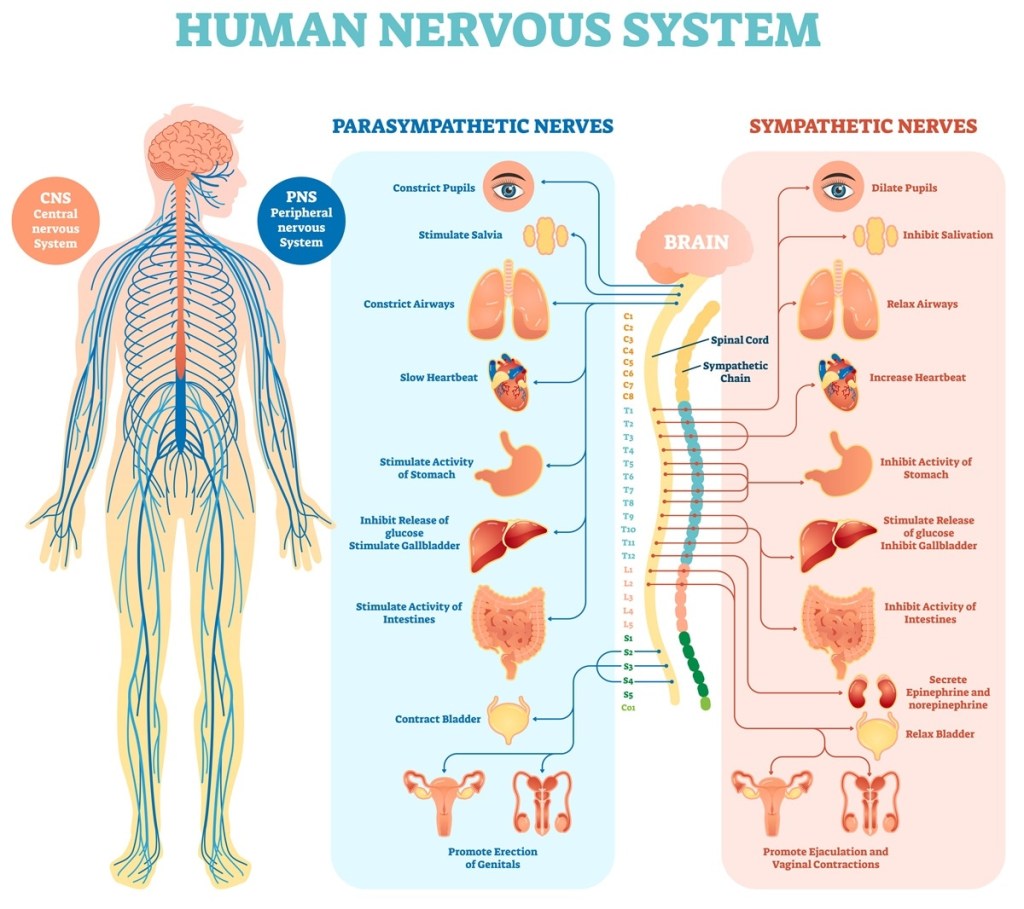
Neuro- is a combining form that means nerve, nerves, and nervous system. It does not mean brain, though the nervous system includes the brain. So when I talk about neurodiversity, I am not reducing folks and their experiences, identities, or labels to their brains, and I am not situated inside any kind of bioessentialism or biomedical framework. We are biological organisms. Everything that happens to us is biological. Our biological experiences are largely informed by our nervous systems. Our nervous systems are—both acutely and chronically, and both idiopathically and collectively—affected by everything around us, including our experiences, our abuses and traumas, the ways in which we are marginalized and oppressed, and more. Saying something is neuro-, including using terms like neurodiverse within the framework of neurodiversity, is not saying this, that, or the other thing starts and ends in the body. It is not the equivalent of denying or discounting the larger systems, functional and otherwise, in which we as biological beings exist or the forces those systems exert on our lives.

Image: A graphic depicting the human nervous system, including the parasympathetic nerves and the sympathetic nerves. The functions of the former include constricting pupils, stimulating saliva, constricting airways, slowing heart rate, stimulating stomach activity, inhibiting the release of glucose, stimulating the gallbladder, stimulating the intestines, contracting the bladder, and promoting the erection of genitals. The functions of the latter include dilating pupils, inhibiting salivation, relaxing airways, increasing heart rate, inhibiting stomach activity, stimulating the release of glucose, inhibiting the gallbladder, secreting epinephrine and norepinephrine, relaxing the bladder, and promoting ejaculation and vaginal contractions.

Image source: News Medical.

Maria Gugging Psychiatric Clinic

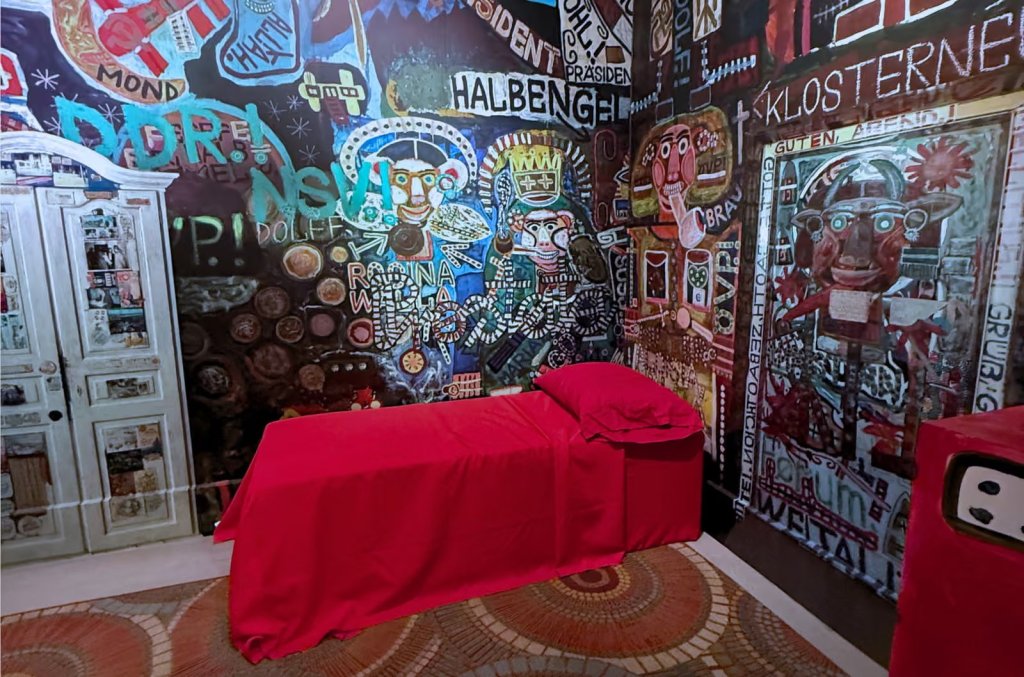
In September 1994, [David] Bowie and Brian Eno—who had reunited to develop new music—accepted an invitation from the Austrian artist André Heller to visit the Maria Gugging psychiatric clinic. The site’s Haus der Künstler, established in 1981 as a communal home and studio, is known internationally as a centre for Art Brut—or Outsider Art—produced by residents, many living with schizophrenia and other psychiatric disorders.

The acclaimed Austrian photographer Christine de Grancy documented the visit, capturing Bowie engaging with these so-called outsider artists—a term often criticised for framing artists through illness or marginality rather than authorship. For the first time, these intimate portraits will be shown in Australia, when A Day with David opens at Joondalup festival in Western Australia in March, in collaboration with Santa Monica Art Museum.

And, of note: Gugging itself carries a darker weight. Founded in the 19th century, the clinic was later absorbed into the Nazi’s Aktion T4 program, which targeted those with mental and physical disabilities, and resulted in the mass murder of an estimated 250,000 people. At Gugging alone, hundreds of patients were murdered or sent to extermination facilities.

Source: The Guardian.